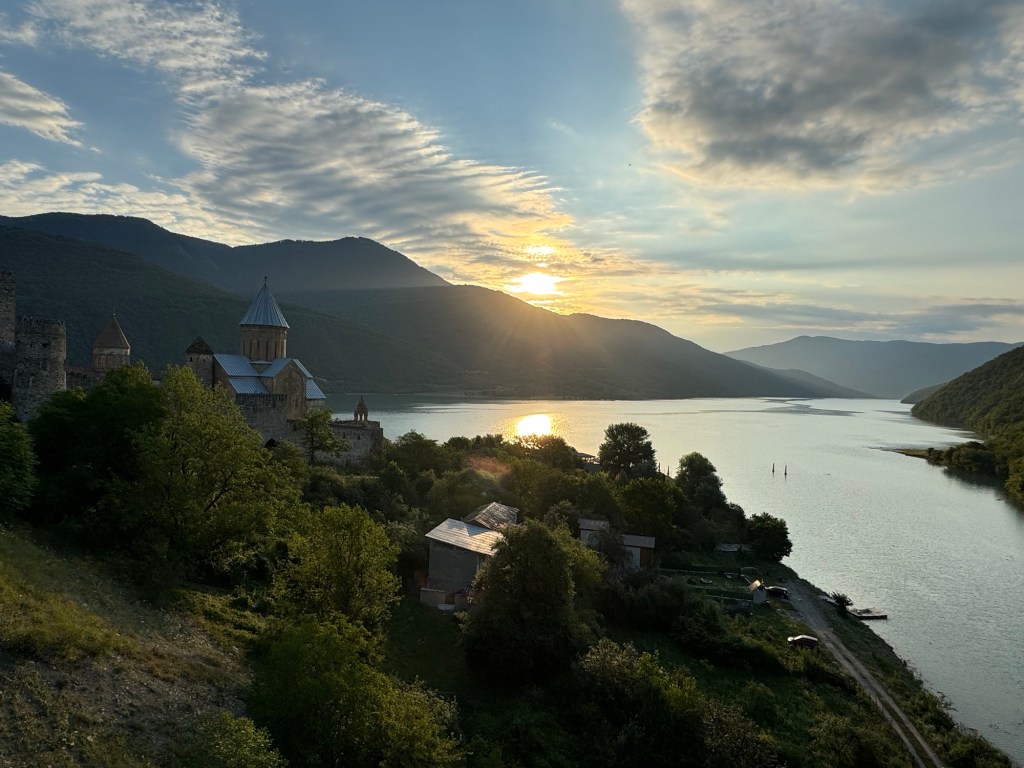
Driving along the Georgian Military Highway, leaving behind me the world heritage site of the castle of Ananuri,
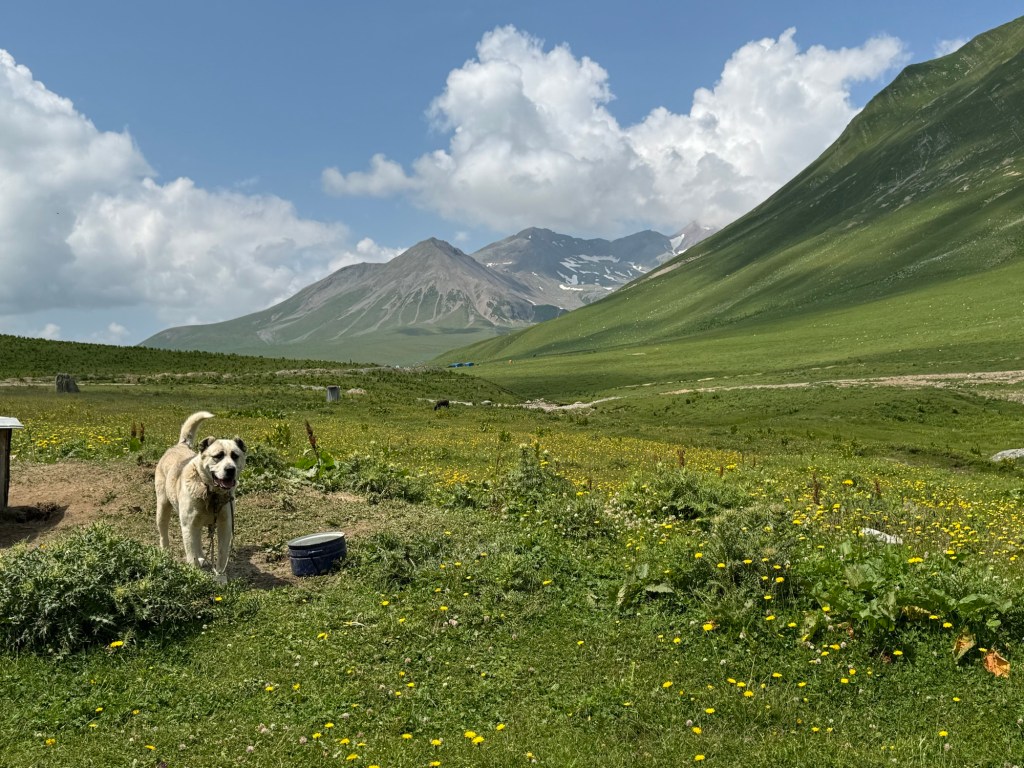
and heading North towards the town of Stepantsminda, I had to cross the over 2000m high Jvari Pass, where the green meadows of an Alpine plateau offers an ideal pasture for large herds of sheep.

Crossing the highest point of the pass, it was impossible to ignore the numerous wood fires places and the corresponding “Halal” signs at the side of the road.
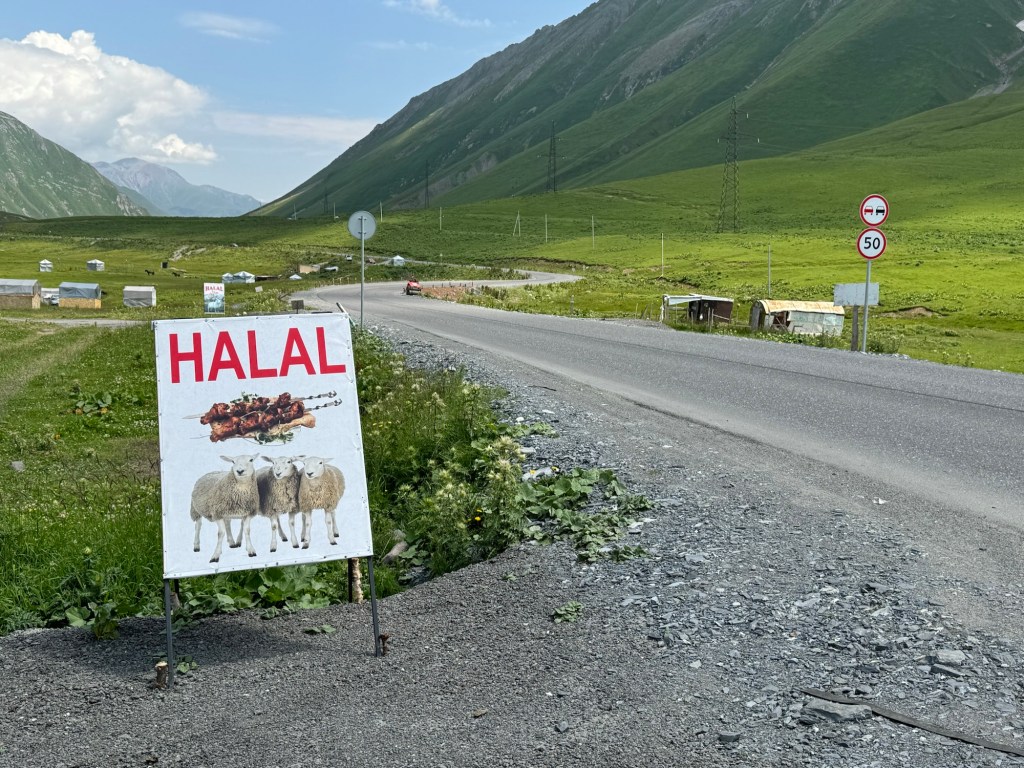
Here the local shepherds were offering their fare to hungry travellers.
I personally found the signs, which were indicating that here the sheep were exsanguinated without prior stunning, somewhat off putting, but I appreciated that this was the traditional way of slaughter, that had been practiced in these mountains for hundreds if not for thousands of years and that, if done correctly, the suffering for the animal would be fairly brief (and yet still too long if you looked at it through the eyes of a vegetarian…..). Furthermore, taking a more holistic view, I thought that these animals had probably a far better life, than their cousins in our world of industrialised farming. Rather than being kept in narrow enclosures to grow and being, at the end of their lives, transported over long distances to a slaughterhouse, these sheep were born on these mountains, free to roam under an open sky for most or for all of their lives and then finally killed in a (hopefully) fast and efficient way in familiar surroundings.
When stopping my car and walking up to one of the fireplaces, I realised that I had arrived too early for lunch. A freshly slaughtered carcass was hanging on a hook,
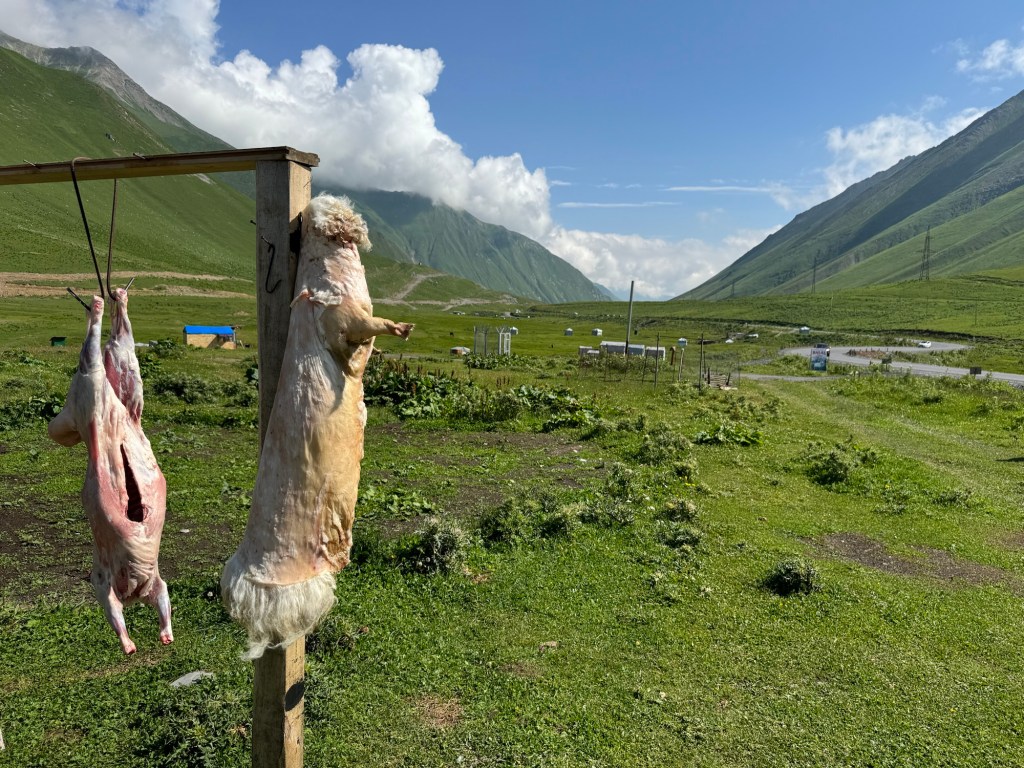
but the fire hadn’t been lid yet.
“Dicid minut ! Ten minutes!” the shepherd shouted in my direction, being uncertain if I was Russian or someone from further afield.
Taking him by his word, it left me with enough time to have a closer look at his dogs….
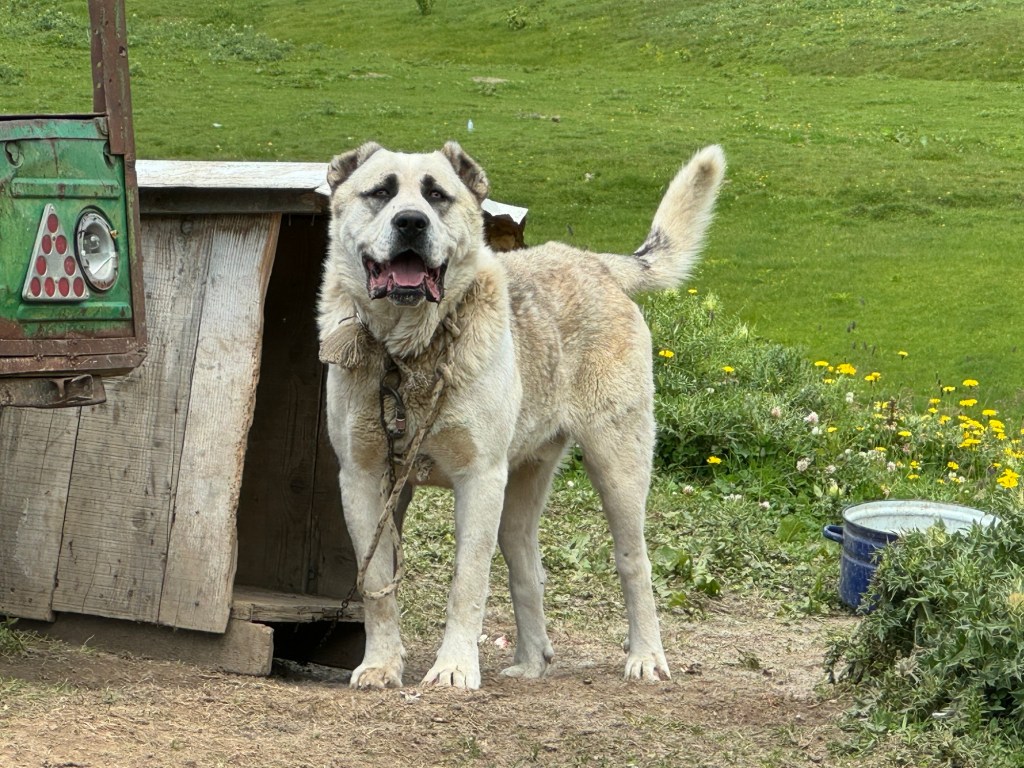
Not far from the fire place, there was a huge Caucasian Shepherd, which dwarfed the Rottweiler that kept him company.
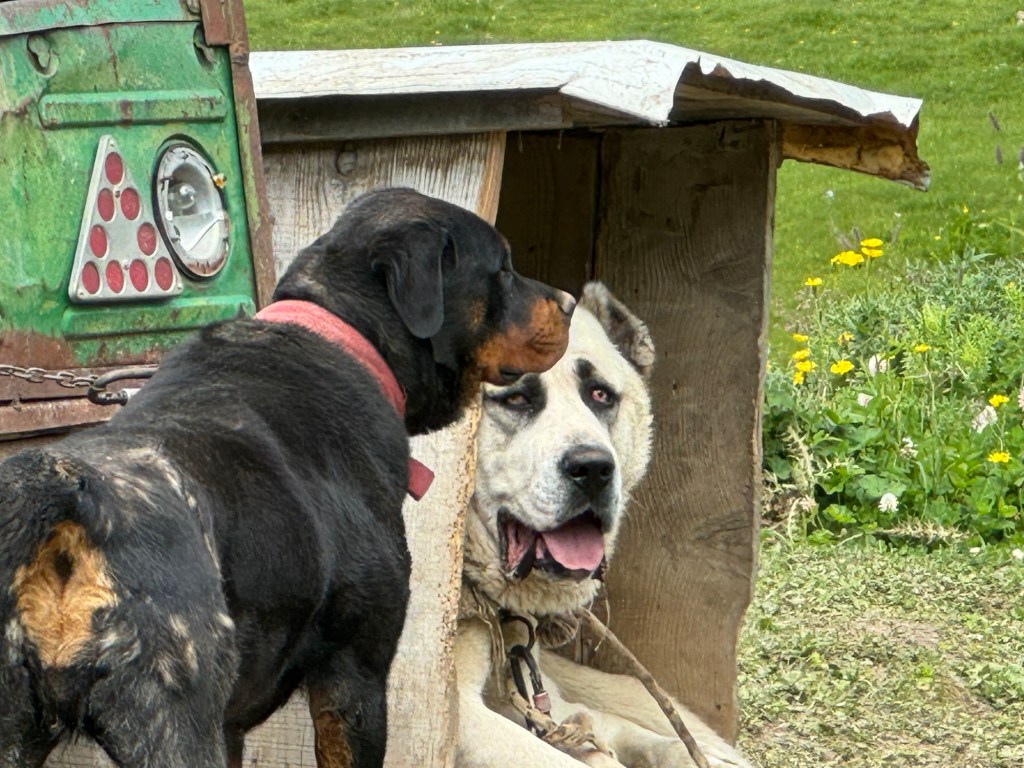
Both dogs remained relaxed and not overly interested in my presence, but I have to admit that I was relieved that they were kept on a chain and I remained at a safe distance.
The purpose of these dogs, which grow up together with sheep, is to guard, rather than to herd the flock. In this part of the world (and now also in many parts of western Europe), these dog have to stand up to, and to fend off predators like wolfs and bears, for which a domestic sheep or lamb would be an easy catch.
When hiking in the mountains – even worse if you bring along your own dog – you certainly don’t want to come across one of these canine giants near a herd of livestock….
You rather meet a wolf or a bear!….
I didn’t envy my Georgian colleagues, who occasionally have to treat these huge animals.
“ The Rottweiler is useless and the Caucasian is small for his breed.”, the shepherd said in broken English, standing suddenly next to me. It appeared that he had figured out that my Russian wouldn’t get us very far…..
“The meat is ready!” he added, before walking back to the barbeque.
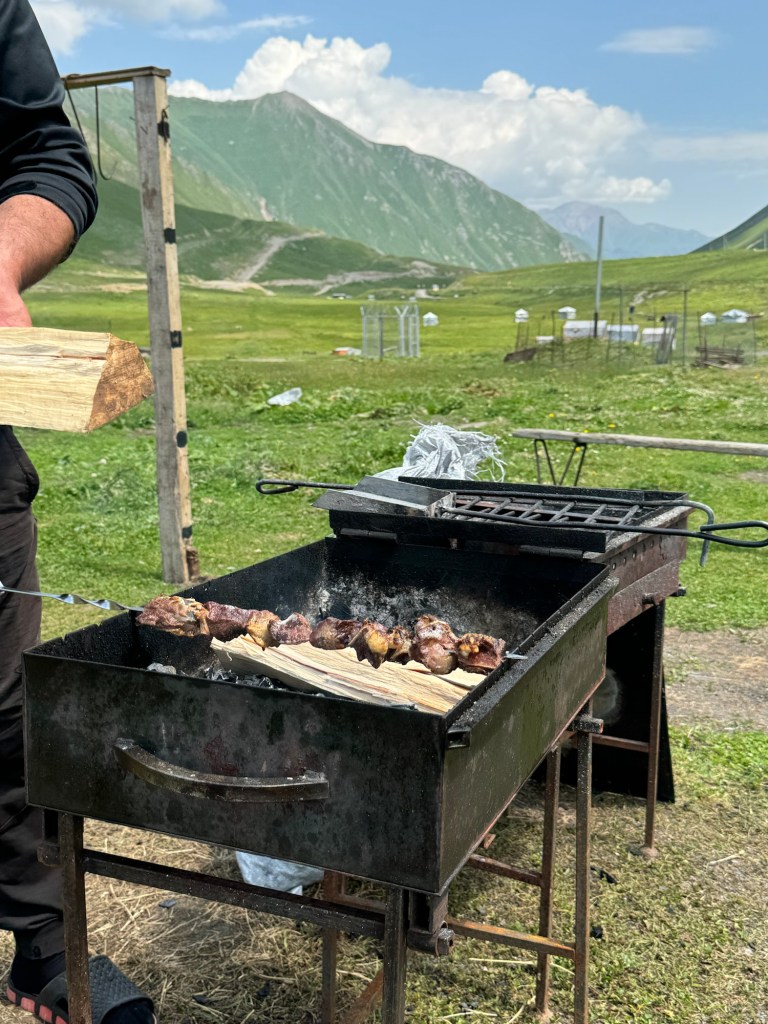
Not even eight minutes had passed and sure enough, a large skewer with big chunks of coarsely cut meat was waiting for me.
A pinch of rock salt was the only seasoning and a large piece of plain breed the only accompaniment.

And yet – it was delicious !
The meat was firm but not chewy, it had a distinct ovine taste, somewhat amplified by the salt, but not adulterated by additional herbs or by a sauce. Eating it with a hunting knife and bare fingers as the only cutlery, under a blue sky, surrounded by Caucasian mountains, certainly enhanced the experience and I couldn’t think of a more fitting dish, when travelling in this part of the world.
 The Blue Vet Diary