
Returning from the truly remarkable setting of the small church of Agios Ioannis, which is precariously placed on top of a large rock at the weatherbeaten Northern shore of the Sporadic Island of Skopelos,

I was sitting over a beautiful traditional Greek dish of octopus with herbs in olive oil and vinegar,
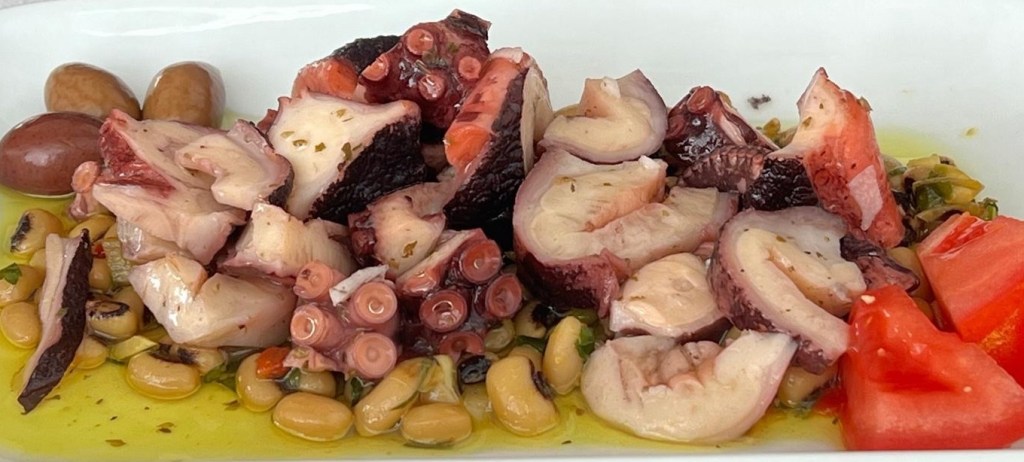
when my thoughts trailed off to a memorable event many years ago in Central America….
It was at the end of my course at Hanover Vet School, when I decided to spend a few months in Guatemala and Honduras, to learn Spanish and to travel through this exciting and colourful part of the Globe.
Felling very lucky that I had just survived the short flight from the Honduran mainland to the small Caribbean island of Utila, where I had found myself, due to a shortage of remaining seats, in the vacant co-pilot seat, I had decided to make use of the remaining hours of daylight and to go snorkelling.
Near the sandy outcrop on the island’s Southern shore, which functioned at that time as a landing strip for planes, I had planed to investigate the fuselages of a couple of small aircraft I had seen during the descend, which had not been so lucky and had ended in the shallow water among the corals……
The water was warm and clear and tropical fish could be found in abundance. A large green moray eel was passing a few meters below me from one hide out to another.
I soon reached the remains of one of the small aircraft and while I was inspecting the surprisingly intact structure, I spotted nearby, underneath a small rock a sizeable octopus. With no firm dinner plans that day, I grabbed the struggling mollusc and with a swift cut of my diving knife, severed most of its donut shaped brain from its satellites in the eight tentacles that had entangled my left arm.
Back on land, I tenderised my catch in the traditional Mediterranean way by slamming it multiple times again a rock, before walking back into the village.
Crossing the small bridge that connected the airport with the harbour, I was happy, that a few of my hunter-gatherer genes had survived six years of academic work and I prepared myself for the respectful looks and comments of the locals, which I had much appreciated when hunting these animals in the Cyclades.
But how much more wrong could I have been ? ….
When I was spotted by the first villagers, their eyes widened, their pupils dilated and there were suppressed mutterings of utmost revulsion.
In no time, a group of people of all ages had gathered, with some of them pointing at the deceased cephalopod I was carrying.
Eventually, a young girl approached me, to find out, why I had caught the octopus.
When I replied that this was supposed to be my dinner, utter pandemonium ensued and the islanders had found a story, that would keep them entertained for weeks.
“Nobody eats such a thing here!” one women was shouting.
Another was adding: “That is disgusting! We call it the “cat of the Sea”!”
The final humiliation came from my landlady, who was equally displeased, when I approached her house:
“Your are not coming near my kitchen with this thing !”
I don’t think, that her instructions could have been any clearer…..
Thankfully, as a student travelling on a shoestring budget, I had my own cooking utensils with me and with the help of some tomatoes, onions, a few herbs and some lemon juice and – of course – some Honduran beers, I didn’t have to go to bed hungry that day.
Returning to my octopus in the small restaurant on Skopelos, which was a true delicacy, I appreciated how different the perception of the same thing can be in different cultures.
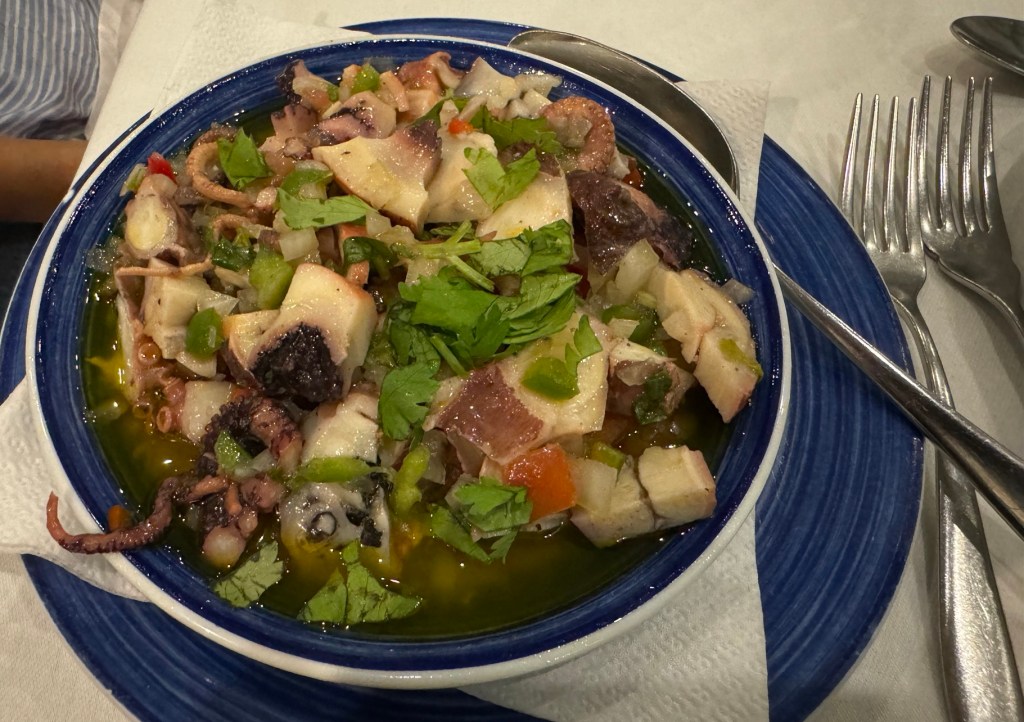
Octopuses, as recent studies have shown, are highly intelligent, sentient beings.
As a veterinarian, I have no misgivings about my conduct at that time, but as much as I am enjoying these creatures in most of their culinary varieties, I am somewhat pleased, that I don’t need to hunt them any longer myself and I hope that these clever animals will continue to be caught from the bottom of the Sea and not as a mass farmed animal from a tank.
 The Blue Vet Diary