
It was the piano music that I noticed first, while strolling down Terazije, one of the central boulevards in Belgrade, in October.
Finding myself somewhat drained from another vet congress, where I had updated myself on how to remove gall bladders in dogs, how to endoscopically neuter chickens and how to dampen the blow to confidence in the “Valley of Despair” of the Dunning-Kruger effect, I had decided that it was time to take a break from the lecturing halls and to explore one of the historic places of this great city.
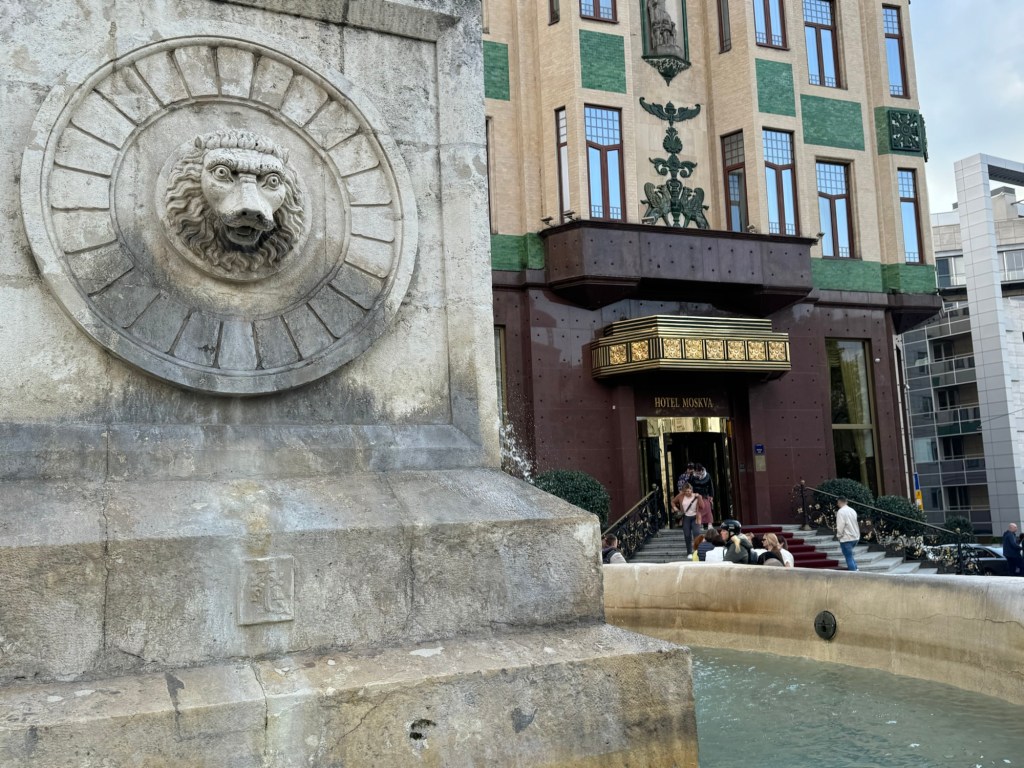
Hotel Moskva, a very prominent building in the centre of Belgrade had been pointed out to me, as one of the best places to drink coffee and to enjoy the local pastries.
This turn of the century monument, covered in beige and green tiles, was the result of a cooperation of Serbian and Russian architects and the hotel was initially just part of a multifunctional palace, that also housed a Russian insurance company and luxury apartments. As one of Belgrade’s tallest buildings at the time, overlooking the Sava river to the West and the Danube to the North, it stood like a bulwark of Imperial Russian influence against the Habsburg empire on the other side of the Danube.
Due to its dominance in the city centre and because of considerable challenges during the construction caused by the soft soil and a number of subterranean springs and streams, it became known as “ the most expensive and the most beautiful Russian house in the Balkans”.
More than 100 years later, I got the impression that still many visitors to the city agreed and walking through the polished brass framed, glass entrance door, I found myself in the impressive reception hall.
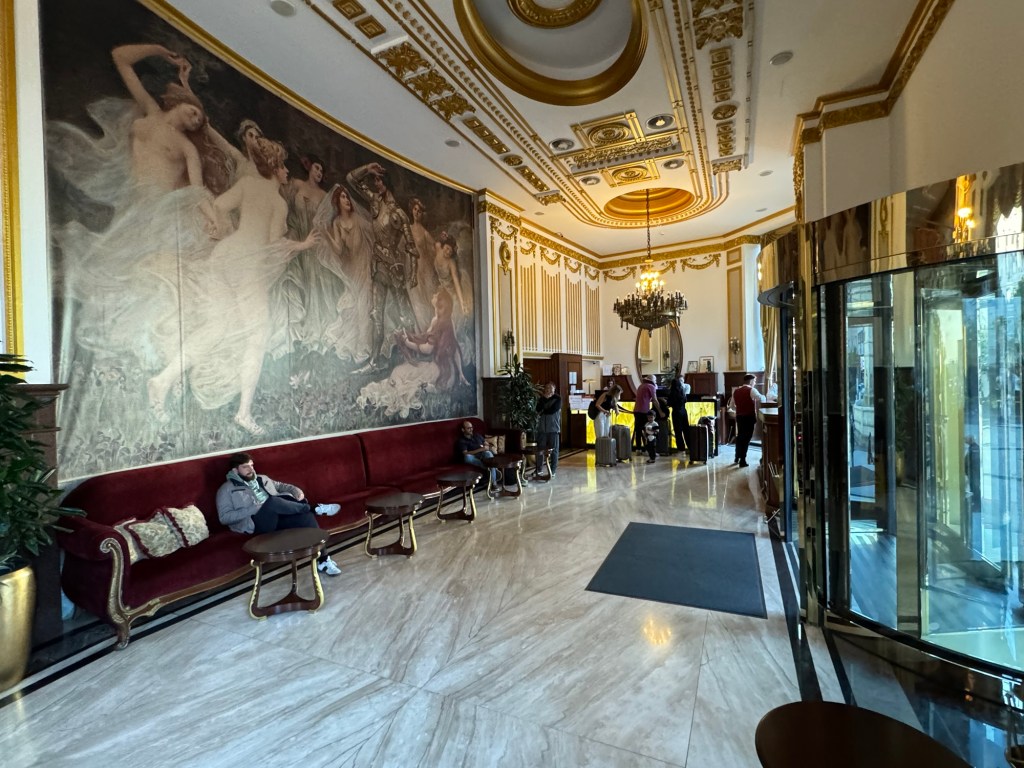
On the other side of the room, you couldn’t miss a mural depiction of Parsifal, surrounded by lightly clad maidens, covering nearly the entire wall above a long red velvet sofa. Two large chandeliers were suspended from an immaculate golden stucco ceiling. Proceeding along a grey marble floor, I entered into a busy early 20th century viennese coffee house environment, with a very cosmopolitan clientele, where Serbian seemed to be one of the least commonly spoken languages.
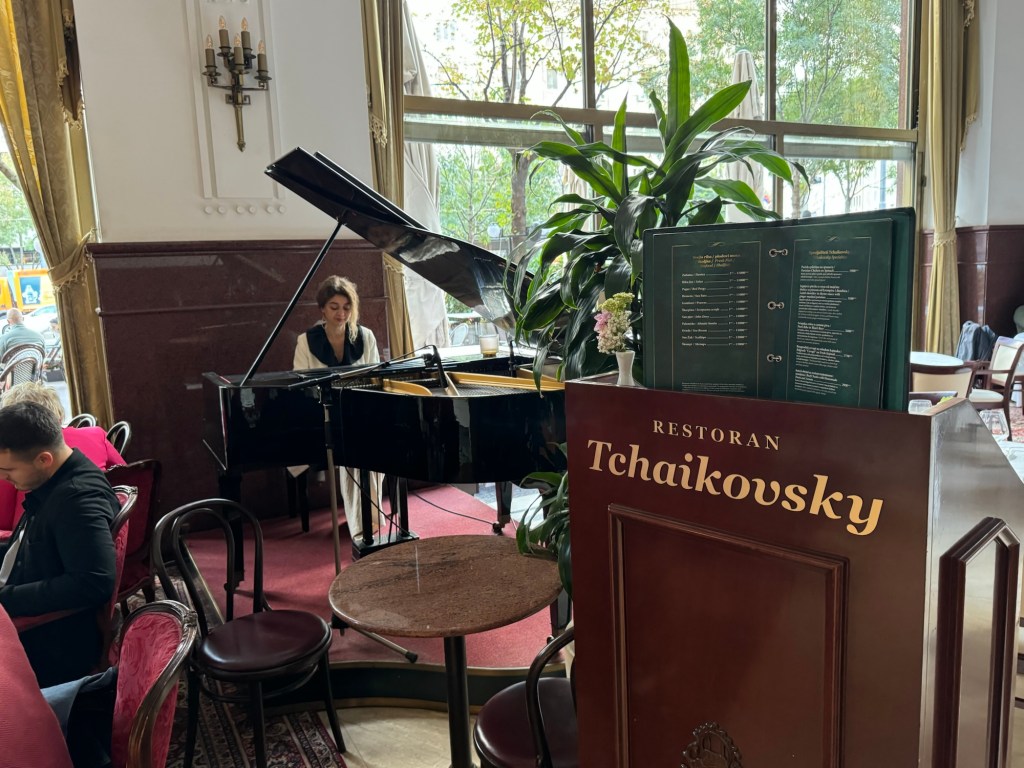
Adding to the cacophony of conversations and the rattle of kitchen utensils, was the light music that originated from a black Blüthner grand piano at the end of the room, which was located next to the terrace door.
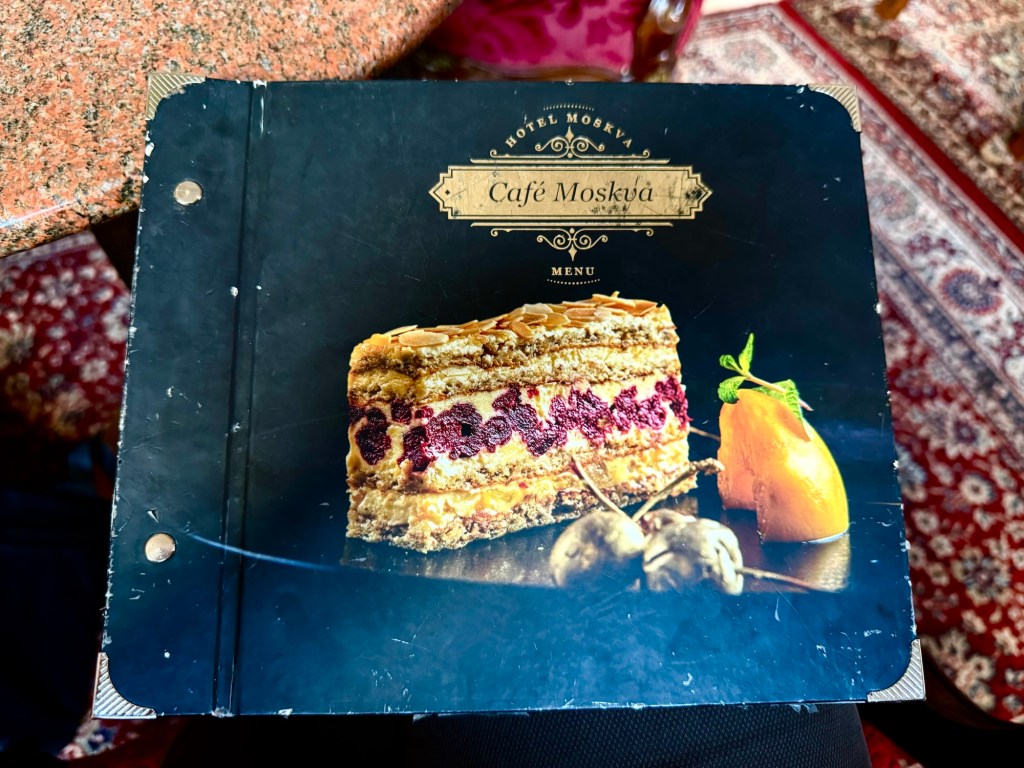
Eventually I found a spare seat at a just vacated table and while the stressed looking waiter issued me with a somewhat tired looking menu, he pointed out that I would have to be patient, as “he might be some time….”.
My heart sank and I prepared myself for a similar wait, as when this quote was made famous by Captain Lawrence Oates before leaving Scott’s tent in Antarctica…
At least this allowed me the time to study the menu in detail.
Now I learned, that Albert Einstein and Luciano Pavarotti (among many other famous and some infamous guests like Mikhail Kalashnikov and – during the war – the Gestapo) had frequented this place. It also became clear, that the pastry to eat here, was the “Moskva Snit”, a slice of cake made with French Buttercream, sour cherries, pineapple, peaches and covered with sliced roasted almonds.
Luckily and probably due to the slightly more amenable temperatures in Belgrade, the waiter eventually reappeared and after another wait that was much shorter than expected, I was presented with the signature dish of the house, accompanied by a traditional Serbian coffee.

We will probably never know if Einstein had more groundbreaking ideas or if Pavarotti became a better tenor after visiting Hotel Moskva; for me however, it very nicely concluded another day of knowledge gain in one of Europe’s most underrated capitals, in a city that never ceases to surprise.

 The Blue Vet Diary