After a week on the road, it was time to get some of my limited supply of clothes washed.
As it turned out, there was no laundry near Lučki Most and a half an hour walk, covering the length of the city was required to get to a laundry that was open on a Saturday.
A good opportunity to see more of the place I thought and so I set off….
Crossing the bridge and passing the Emina Café, where local men were enjoying the warm spring sun and some strong Bosnian coffee, I came across a crack in the pavement, that had been repaired masterfully with a colourful pattern of small tiles. The damage of the road surface had become the canvas for the artist. A mosaic of bright red, golden, lilac and light blue ceramic shards appeared from underneath the tarmac, as if a superficial layer had been peeled away, revealing a far more interesting multi-coloured world underneath it.


What a great, yet unobtrusive way to make the world a bit more colourful.
Following the Neretva in a northerly direction, I had to cross the river again and just after passing another building that was still carrying the scars of war, I came across a second, slightly larger installation.
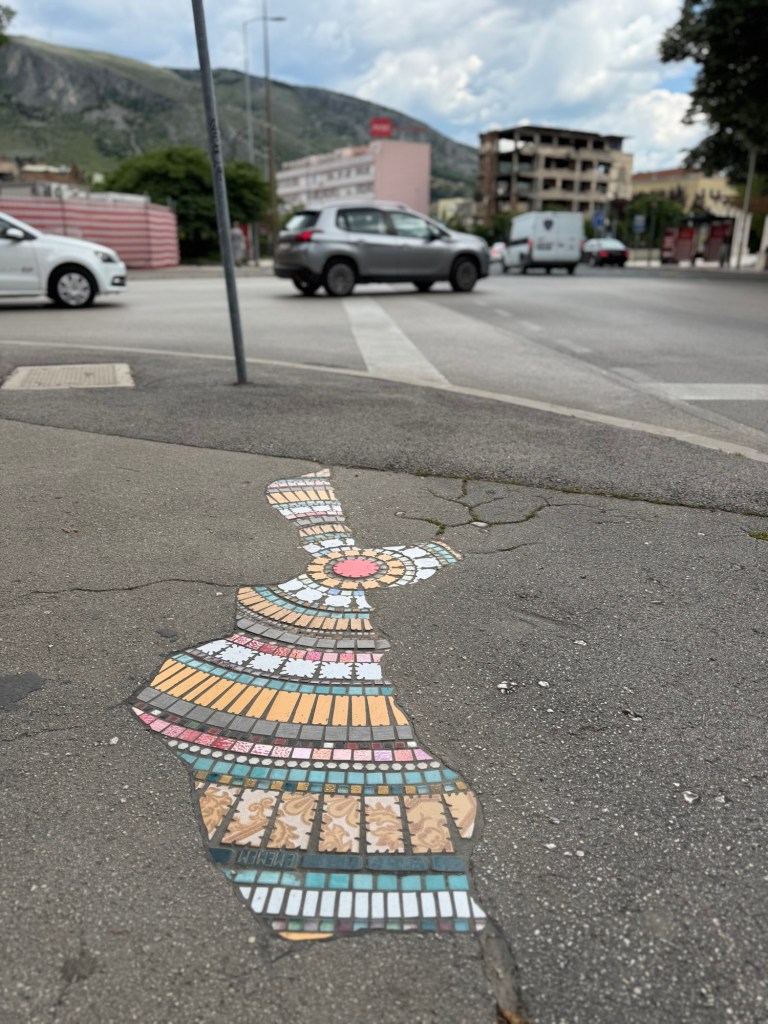
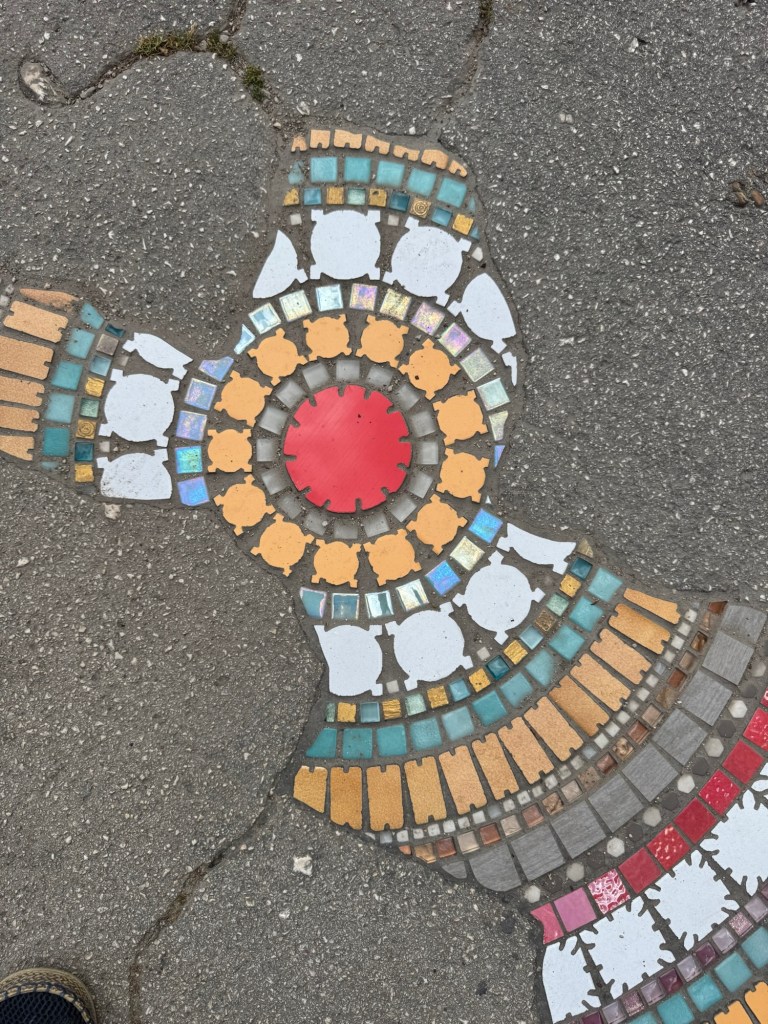
Starting with a circular red tile in its centre, rows of yellow, blue, grey and slightly textured red tiles were radiating across the whole defect, like a piece of a torn colourful table cloth that had been spread across the tarmac.
It then didn’t take me long to find a third, more complex pattern of ceramic pieces and another outstanding example of “flacking”:

Here the damage caused by a grenade, had been used as the outline for an elaborate graft of golden tiles to cover the circular crater. The scars in the pavement around it were left unchanged, to not excuse or to hide what had happened here. The work done at this place served both as a means for remembrance, as well as a statement that sometimes a repair can be even better than the original condition.


Finally I had reached the laundry and while my dirty linen were getting washed and dried, I had some time to investigate a bit further, what had now sparked my interest.
It turned out that all of these installations had – unsurprisingly – been the work of the same French artist and that he had applied his craft not only on the streets of Mostar.

Ememem, started his work in 2011 in Lyon, but by now his beautiful mosaics can be found in several countries in Europe and as far away as in Melbourne and in the US.
As a self proclaimed “surgeon of the sidewalk”, his work has to be understood as that of a Banksy working on horizontal and on three dimensional surfaces, who tends to perform his magic during the cover of night and who prefers to remain anonymous. His art reminded me of some colourful mosaics I had seen in Morocco, possibly paired with the playfulness of a Hundertwasser construction.
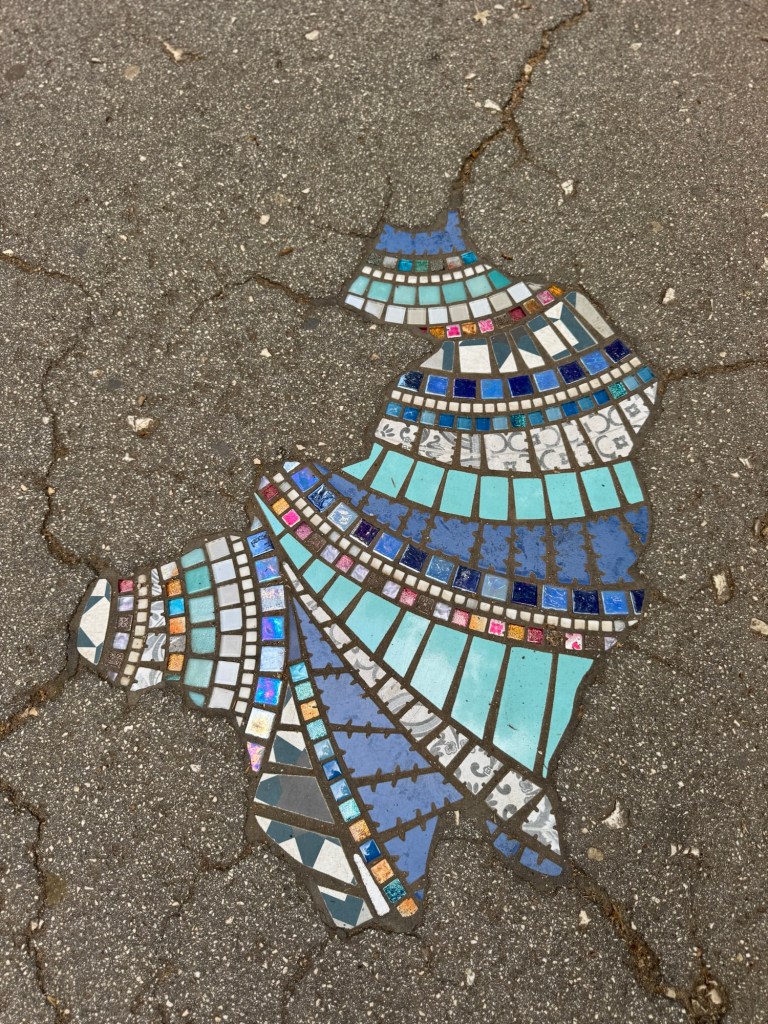
I also found out that Mostar was the home of not three, but four of his installations, with the final one a bit more difficult to find, but proving to be equally charming.
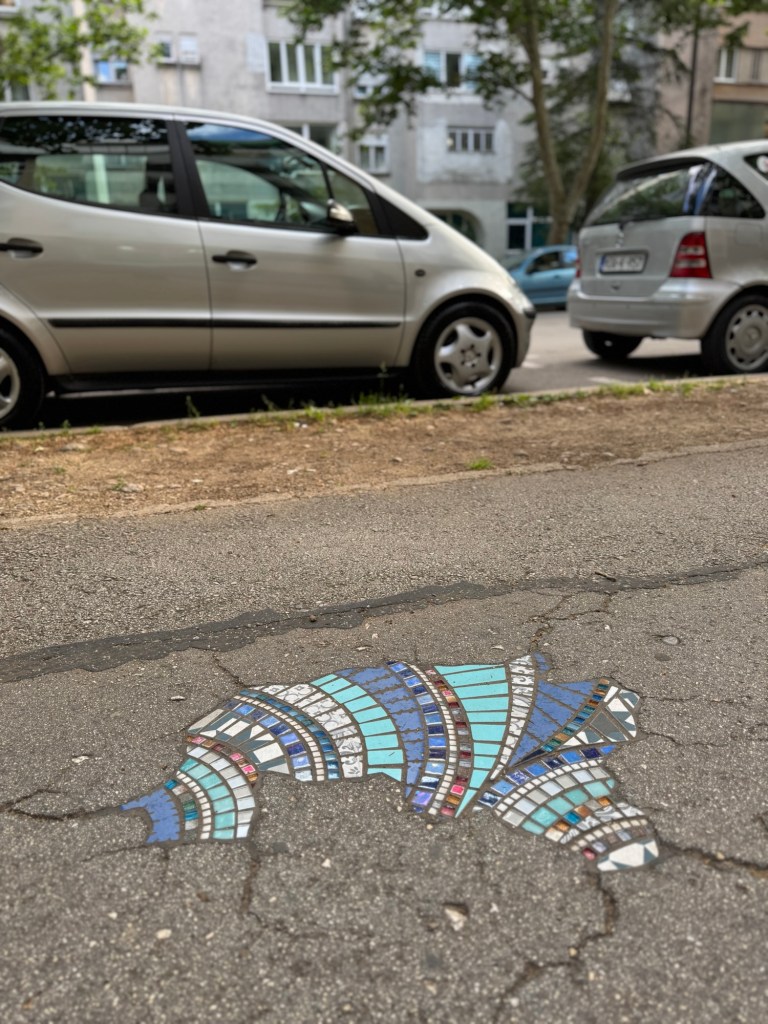
For this crack, a blue and turquoise colour scheme had been chosen, resembling – with a bit of imagination – a crooked version of an island in the North Atlantic…
Only when my washings were done, and I started to return to my temporary home just South of the Old Bridge, being satisfied that I had been successful in finding all four pavement installations of this city, did my eyes begin to focus on the vertical surfaces around me…..
Creativity had been feeding off creativity !
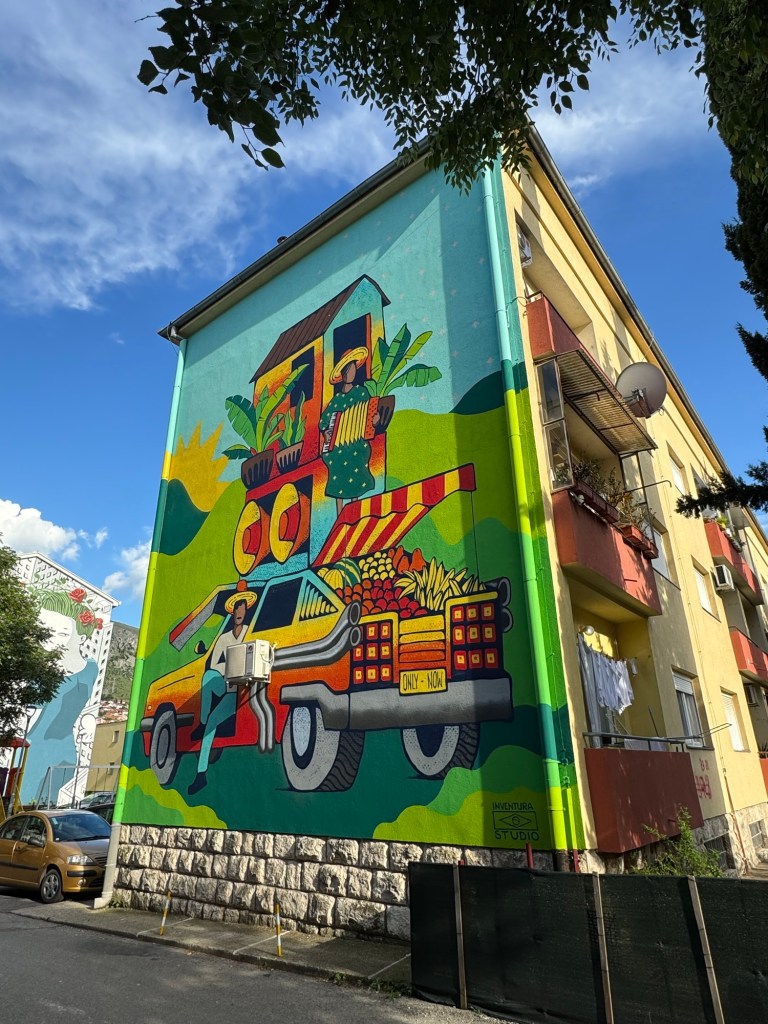
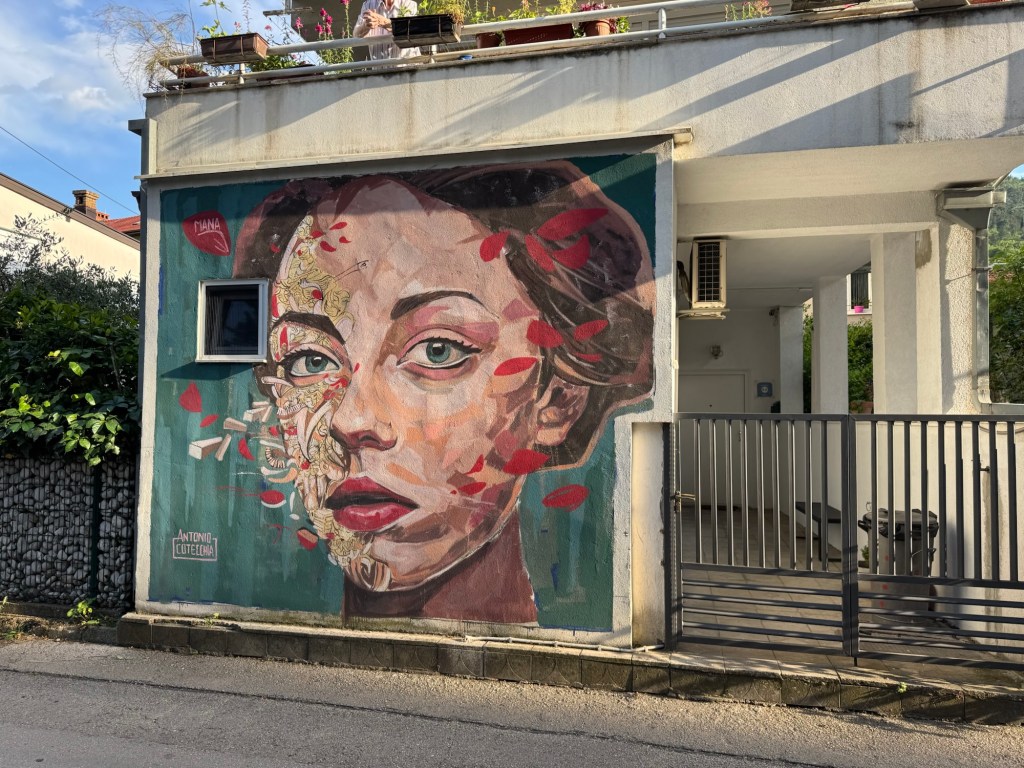
Just now did I notice the colourful mural works of art that could be found everywhere on buildings, garages, perimeter walls and even on half finished building structures.
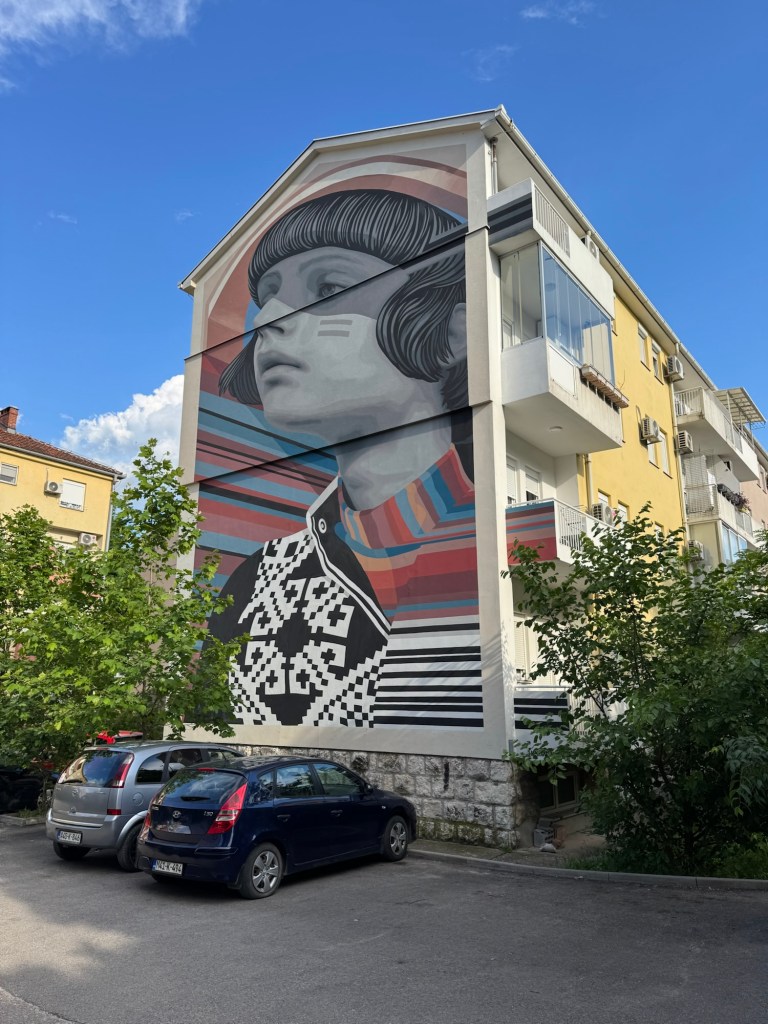
Plain multi-storey house walls had become the canvas for giant portraits, for tropical market scenes, for Pop-Art statements or for colourful cartoon characters.

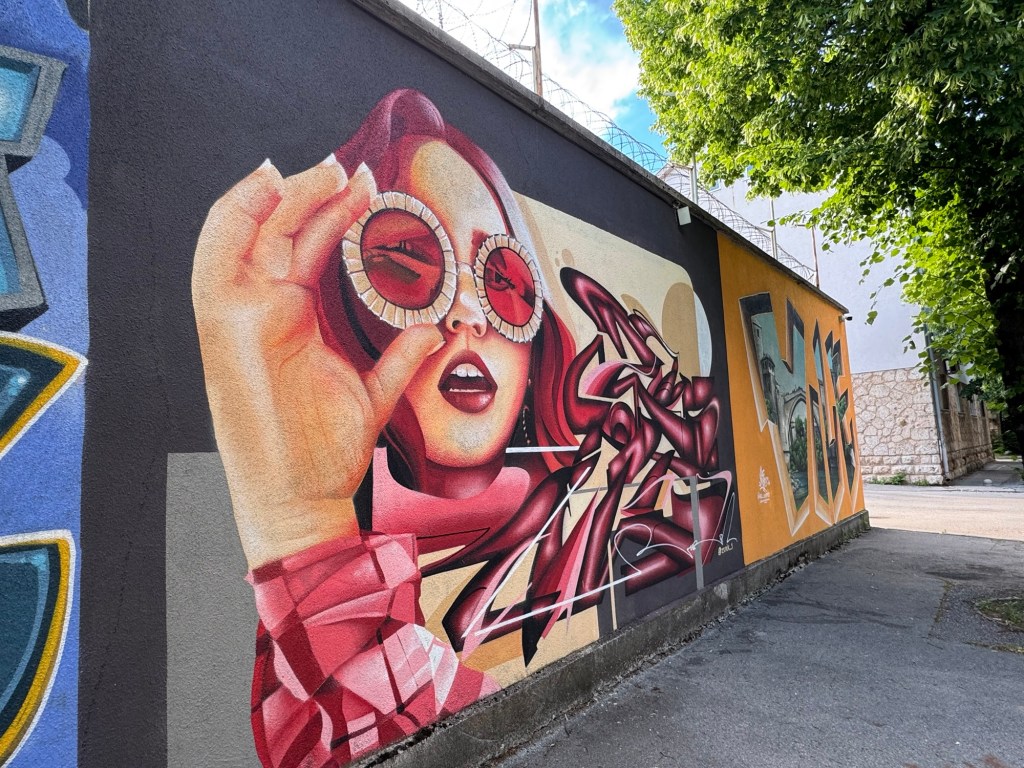
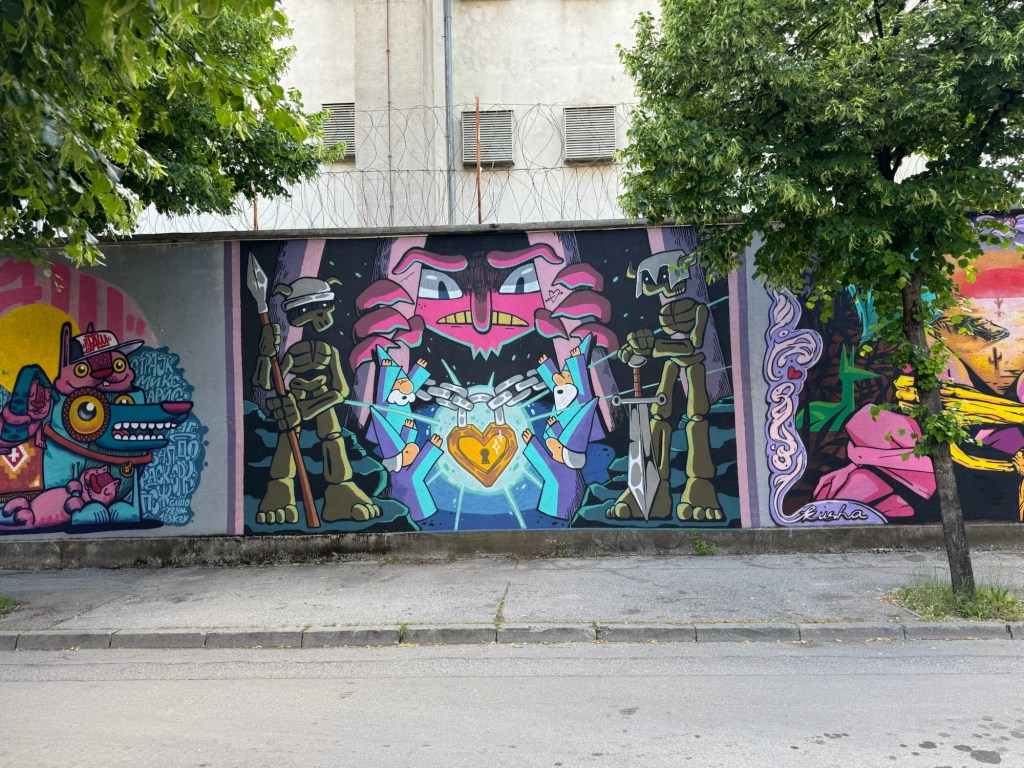
Where walls still featured unrepaired bullet holes, these had been integrated and in fact appreciated as helpful assets to give a painting a third dimension.
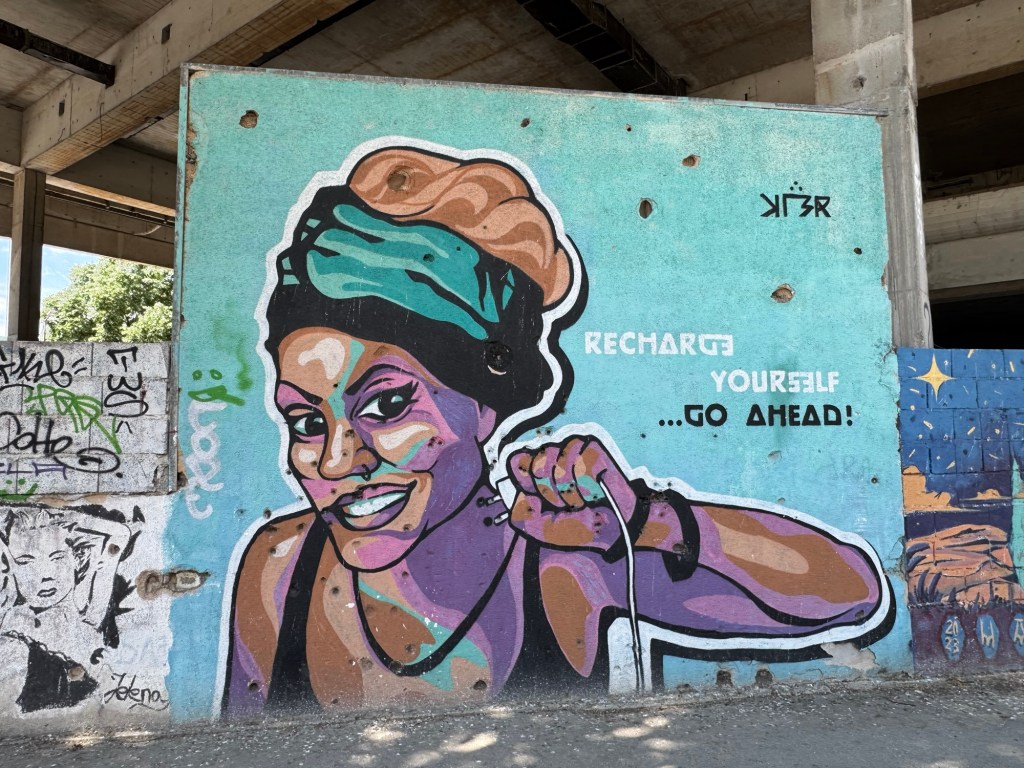
And then it struck me – not for the first time – that art and colour might be the best form of response to transform and to heal deprived and dilapidated houses, streets or even whole cities.
It probably is also the best remedy for the scars of war, both on the buildings as well as on the people who have to live in these places, once the fighting has stopped. A force which only finds its equal in music, in nature and in the human-animal bond.
 The Blue Vet Diary