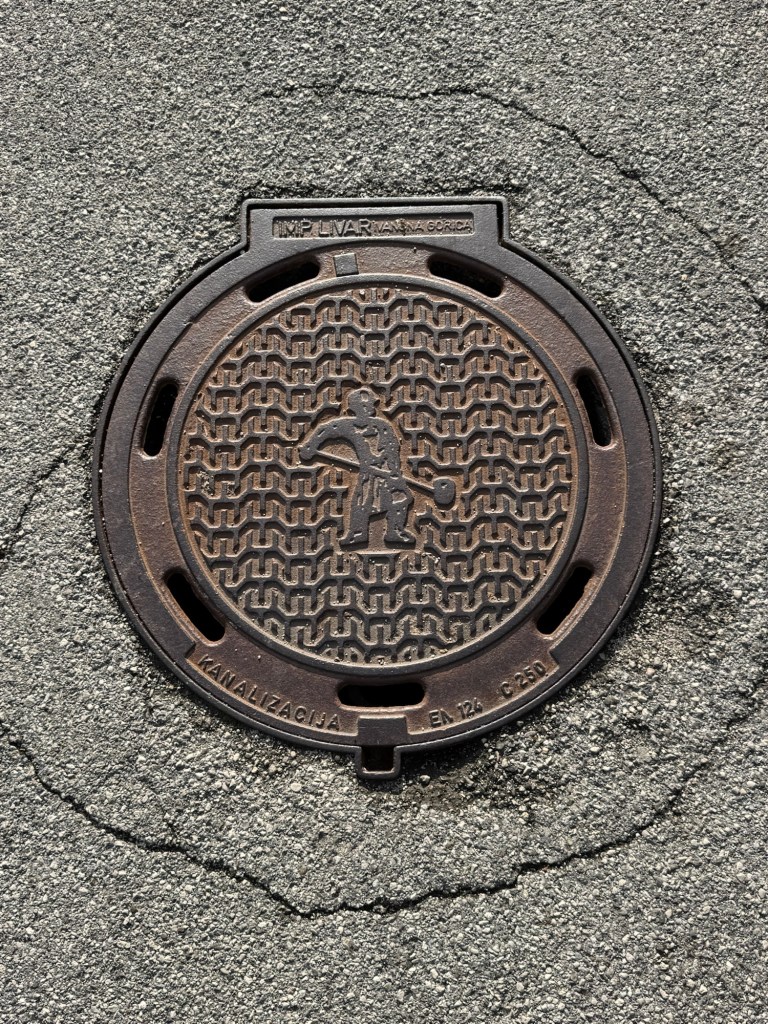
Ana wasn’t on time – she was five minutes early ….
This usually is fine by me, but not after a party with one of Belgrade’s finest rock music bands and a subsequent tour with the die-hards through Ljubljana’s limited, but still surprisingly wild nightclubs, resulting in hardly more than a couple of hours comatose sleep.
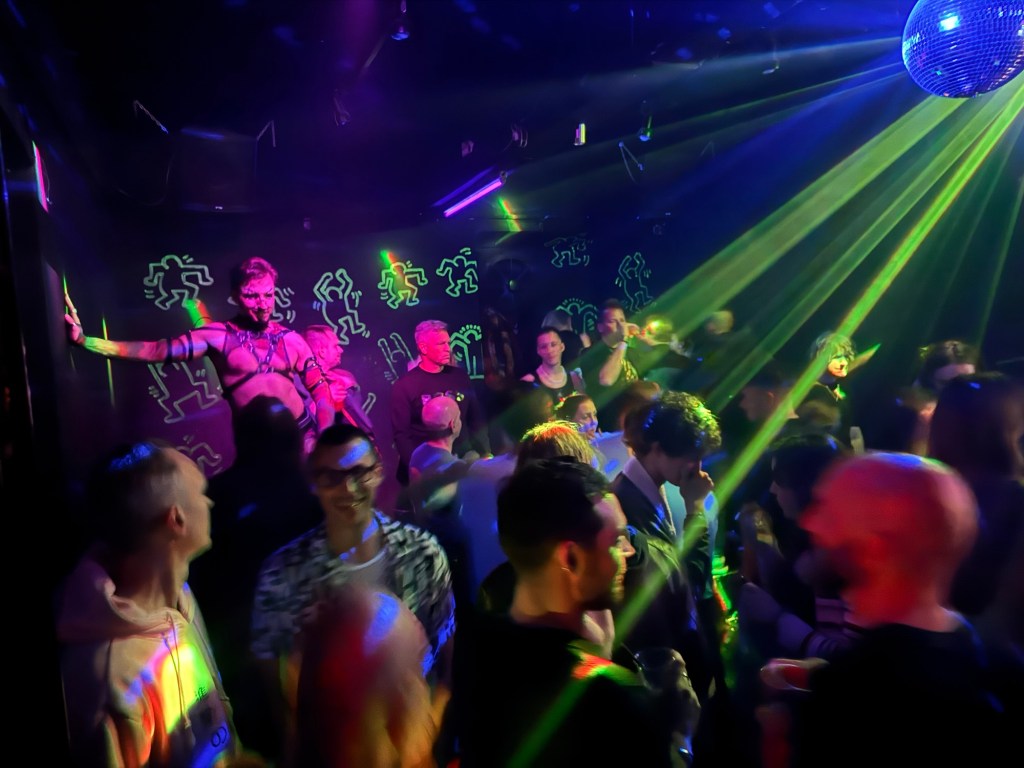
With a constant ringing from the traumatised tympanic membranes in both ears, I dragged myself down the stairs and in front of the hotel where her car was already waiting.
I knew that it hadn’t been wise to schedule our trip on the last day of the conference I was attending, but this one was special and I had been looking forward to it for as long time.
Ana Nemec, no ordinary colleague, but one of Europe’s finest veterinary dentists, was in addition to this also an ambassador of the great outdoors of her native Slovenia. If her posts did not feature the oral cavities of smaller or larger domestic carnivores, Ana was taking her large number of devoted followers to the most scenic and pristine and unspoiled locations of her Alpine home, either on her mountain bike or while hiking, usually in the company of her black Labrador.
With other words – I couldn’t have asked for a better mountain guide, and I wouldn’t let a hang over get in the way of joining her for a day.
Thankfully Ana was driving, so that I could just lay back and enjoy the scenery, while we were heading West towards the border of neighbouring Italy.
“We are driving to a slightly unusual location” said my guide “It’s a mercury mine. I have never been there, but I think that you will like it….”
“Lovely” I said and raised an eyebrow while Ana was watching the traffic ahead of us.
‘Had I misheard or had I done something wrong ?’ I thought. ‘Is she serious ?’
Mercury – one of the most lethal environmental toxins. The stuff of nightmares – stories about chronic renal failure, mad hatters, birth defects…immediately crossed my still dazed mind.
‘Where is she taking me ?…..’ I thought, and my expectation of seeing a pristine alpine autumn landscape was replaced by a sense of foreboding that we would spend the day hiking through an industrial wasteland. Had Ana, the nature lover, gone to the dark side and developed a secret passion for post apocalyptic factory ruins?
And just then it was that I noticed that her Labrador was missing too…..
After half an hour we exited the motorway and the roads became noticeably smaller as the landscape around us became more mountainous. We drove through villages that had the characteristic mix of Austrian, Italian and Yugoslav features, that is to typical for this part of Europe and that told the story of periods of variable occupations.
Eventually, we arrived in a narrow valley, in a small town that was dominated by a white church and a calvary of fourteen stations on a steep hill. The surrounding mountain sides were a beautiful patchwork of green fields and dense forest covered in yellow, amber, red and brown leaves. From time to time the cloud cover broke and rays of the still warm October sun enhanced the display of colours and patterns.
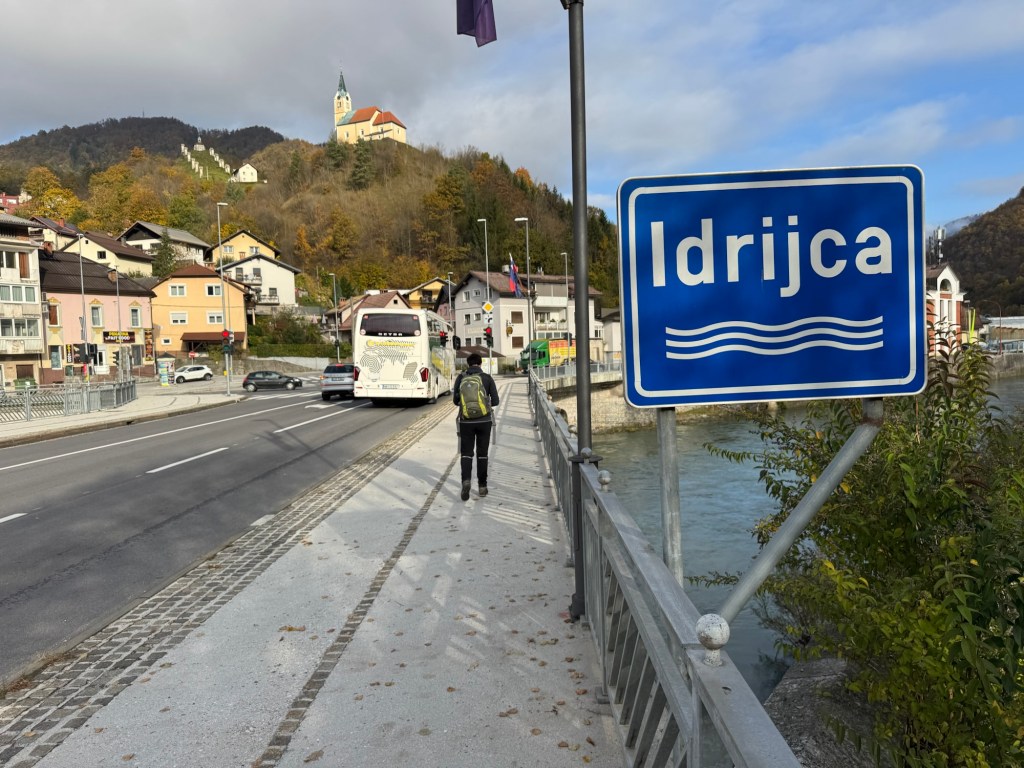
“Here we are !” said Ana while parking the car near a bridge.
“This is Idrija, where we will start our hike!”
And sure enough, after walking just a few hundred meters, passing pedestrian crossings that were decorated with white lace ornamentations, we were standing in-front of an old factory building that once housed the World’s second largest mercury mine. This harmless looking 19th century structure produced up to a ton of the liquid metal every year, feeding the world wide demand of gold prospectors in the Americas, thermometer manufacturers in the Rhine Valley, hat makers in Saville Row and even that of 19th century confectioners in Europe’s capitals.
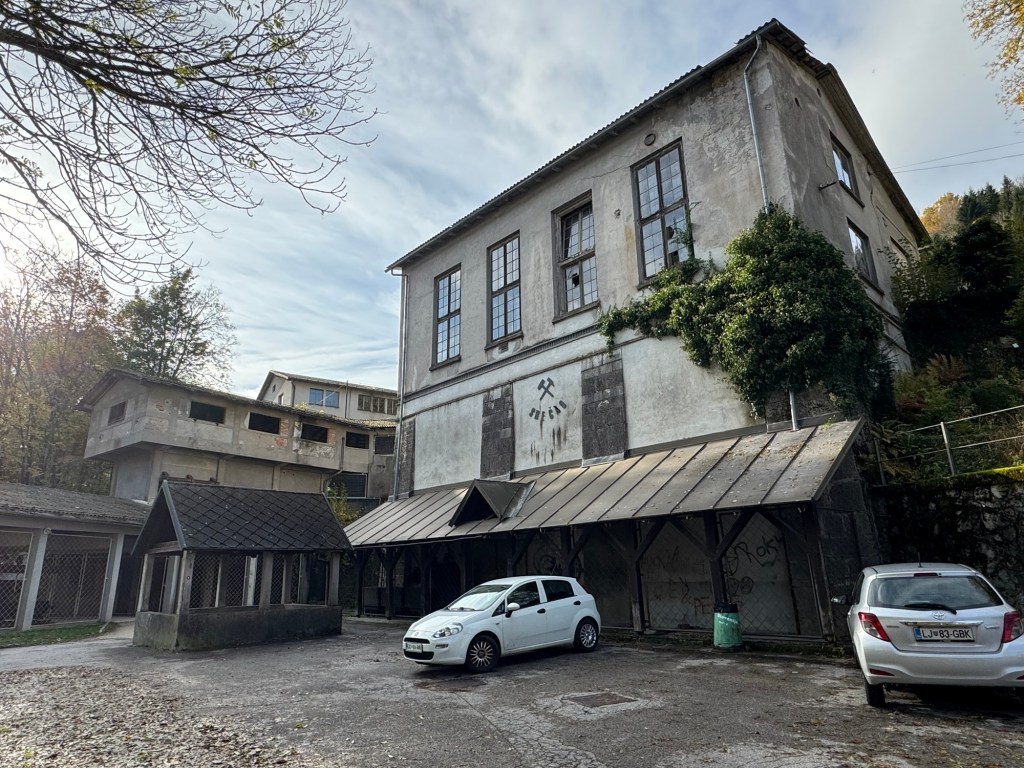
While mercury’s unique ability to contract and expand considerably depending on its ambient temperature, had helped to advance science and in particular medicine, it had left its trail of chronic illness and death not only in the work shops and the gold mines all over the world, but also in the local community of Idrija, who’s inhabitants still had some of the lowest life expectancies in Slovenia and who were still discouraged from growing vegetable in their own gardens.
A yet, once mining had stopped, nature had reclaimed the valley and the surrounding mountains and the slopes on both sides of the local Idrijca river provided some of the most striking hiking opportunities in the country.
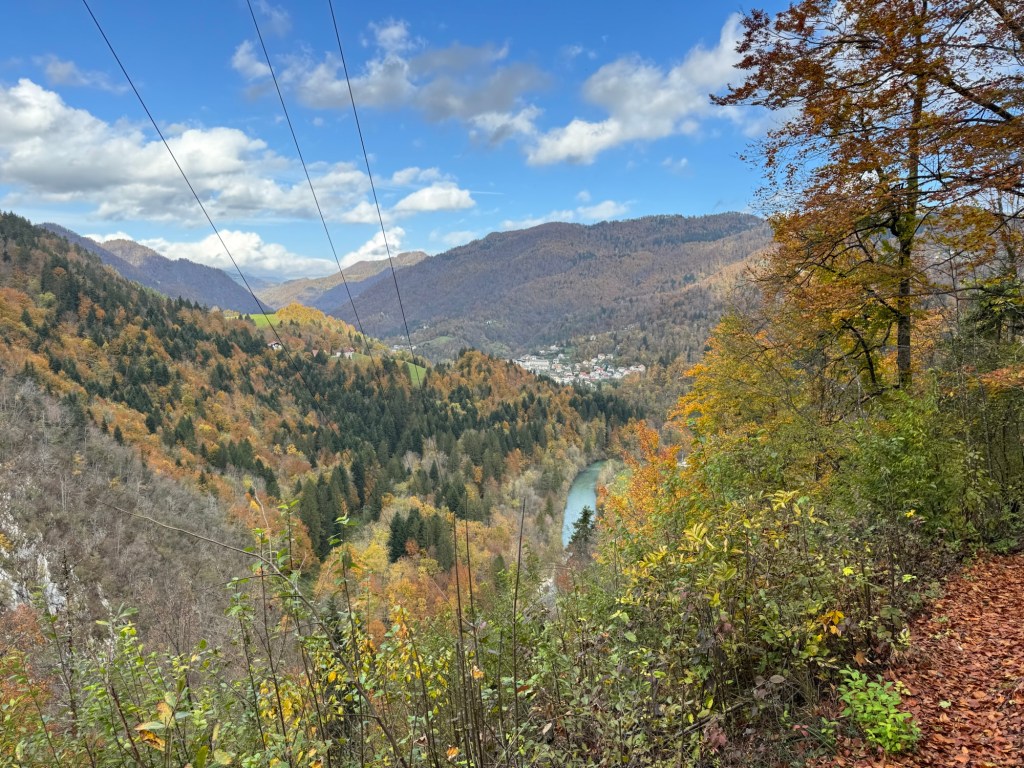
With winter having made an early appearance with very low temperatures and snowfall on the mountain tops, Ana had wisely decided to go easy on her charge by sticking to the valley.
Setting off alongside the Rake Water Channel, a four-hundred year old aqueduct that once supplied water to the sawmills, pumps and crushing devices of the mining company and that now drove a small hydroelectric power plant, we were walking right into the rays of the low lying morning sun. This was easy hiking and with only very small packs to carry, it was no effort to have a conversation at the same time.

After a few kilometers, a suspension bridge leading to the other side of the Idrijca, had to be crossed. While walking high above the alpine stream, I became progressively concerned about the severely deteriorated state of quite a few planks and I started to take great care to only step on the points that had an additional steel support directly underneath them, so that I couldn’t break right through one of the planks. While Ana had walked ahead of me, it was of little reassurance, as she was so much lighter than me.
Reaching the end of the bridge, the final three planks were missing so that a large step was required to reach the concrete abutment. Just then we noticed a flimsy line of tape and a warning sign that was informing us, that under no circumstances one should try to use the bridge, as it was extremely dangerous….for some strange reason, a similar warning and barrier had been missing on the other side.

Hiking with Ana continued to be an adventure…..

Joining a small road for a short while and then climbing up the hillside next to the road, we reached the ‘Feldban’, a comfortable, wide hiking trail that been cut out of the rock to support a narrow gauge railway line to transport vital supplies to the nearby frontline during the 1st World War. While the rails and the sleepers had been removed a long time ago, a small tunnel had remained to add character to this hiking route.

Our next opportunity to get killed or at least severely injured, was a ten meter steel ladder that without any additional safety features went up a straight, but at least not overhanging concrete wall.
Before now returning to the trailhead, it was time for a picnic while taking in the peaceful autumn scenery around us. Needless to say that my mountain guide had prepared for this in form of bread rolls and Kiwi slices.

From here, the trail went mostly downhill right next to a small, meandering mountain road and then alongside the river, back to Idrija with its lace patterned pedestrian crossings.

What better way to finish then off our hike with a plate of ‘Idrija žlikrofi’, the traditional small dumplings that as Ana told me were so typical for this place as the lace making and the mercury mining.
I am already looking forward to the next hike with Ana – that time hopefully together with her black Labrador, which with hindsight for this hike of many surprises, ,wisely had stayed at home.
 The Blue Vet Diary