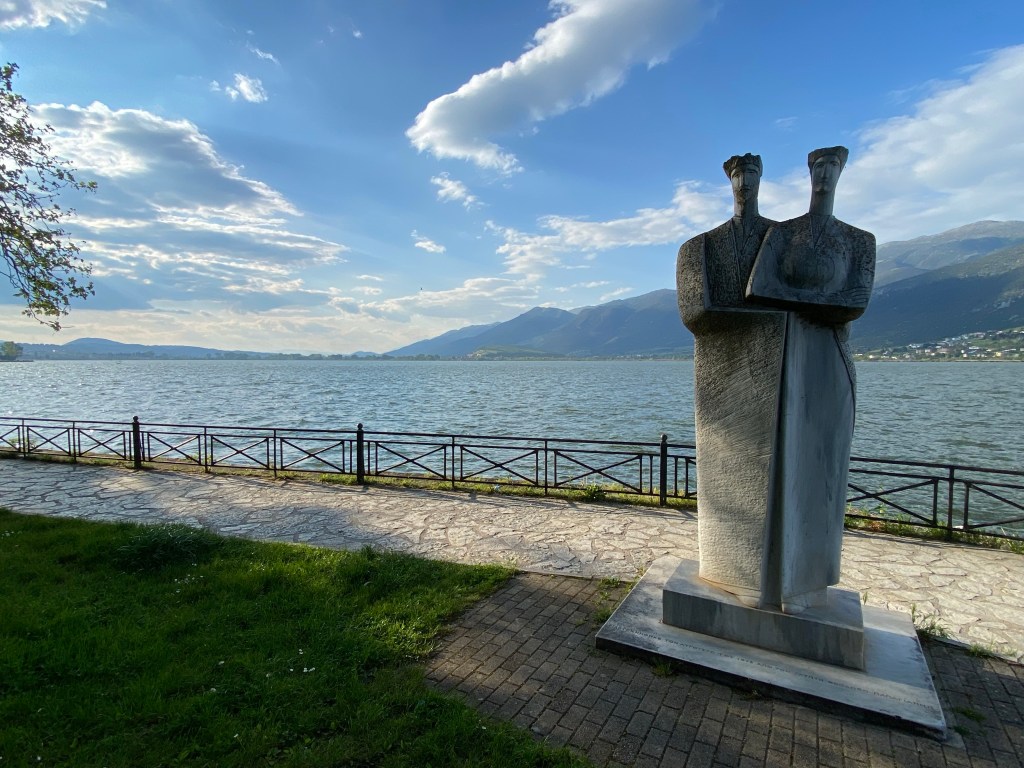
While strolling along the promenade in Ioannina, just below the Aslan Pasha Mosque, I am coming across the beautiful sculpture of a couple, which – I find – is in perfect juxtaposition to the lake and to the mountains behind it.
The elegant simplicity of the figures, reminds me a bit of the “Couple on Seat” by Lynn Chadwick in the center of Canary Wharf (and in other locations).
While standing infront of the sculpture, I am noticing the sound of some beautiful piano music nearby, which is so in tune with the whole surrounding.
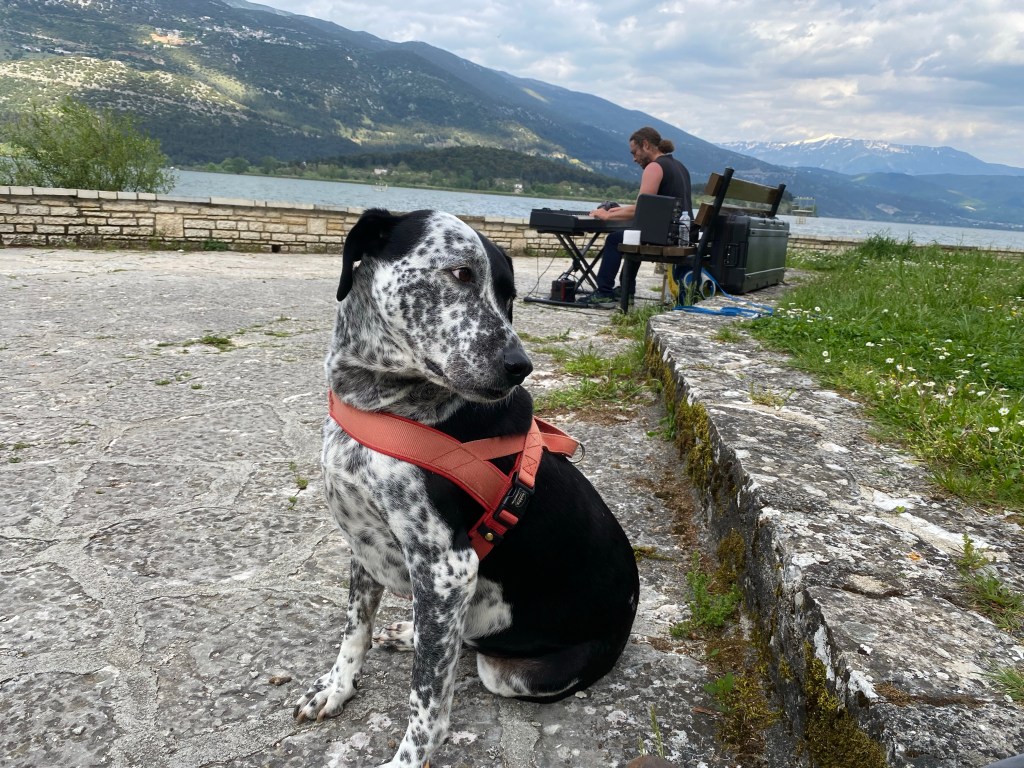
The piano is being played by Costas, who – as I find out later – is travelling and playing the piano in company of his canine friend Michalis, who is a beautiful 8 year old cross breed, who appears to have taken a liking to this combination of stunning sites, fine classical music and of a lot of attention (and treats ?) from the passers by.
Both this spot and one on an Aegean island at sunset are Costas’ favourite places and entirely appreciating the wisdom of his choice, I am sitting down just listening and enjoying life, helped further by Michalis rolling himself up right next to me…..
Once again I find that the best things in life are actually free and that you notice sheer perfection when you see it.
Witnessing this perfect example of the human-animal bond, the simplicity of life of this modern day Diogenes, the beauty of the lake, of the still snow capped mountains and of the sculpture of the couple, and listening at the same time to these timeless tunes, is making me happy for the rest of the day….
Before you wonder though……of course I left a decent tip in Costas’ box before I left and let’s agree that the best things in life are ….nearly…. free….
It was 3 o’clock in the morning just North of Skopje, when the door to the compartment was pulled open and my girlfriend and I, together with an American couple, were told to step outside immediately.
Still half asleep we looked at each other when one of the police officers jumped onto the seats of the railway carriage and produced a long screwdriver. Within minutes the ceiling of the compartment was disembled and realising what was happening, I wispered to my partner, that we would be in for the Grandmother of all troubles if someone had planted anything there….
A few minutes later and after thankfully nothing had been found, we were again allowed to return to our seats and without a word of apology the officials left, heading for their next unsuspecting victims….
Hard to believe that this is now nearly 40 (!) years ago and at that time I had just finished my first year at vet school. Together with my Norwegian girlfriend I had hitchhiked from Hanover to Salzburg, where we boarded a train, that was carrying us over the following 36 hours from the North of Austria through Yugoslavia to Athens. The train ride was all but comfortable and the rudeness of the Yugoslav police and border guards was not only a nuisance, but the knowledge that we would also have to return that way, hung then like a dark cloud over our heads while we were spending our holidays in the sun on the beaches of Paros and Antiparos.
Once again I am standing in the center of Belgrade – not only my university course, but also a few decades of work are behind me, my then girl friend is now a respected lecturer in animal welfare at the vet school of her native Oslo, the state of Yugoslavia has ceased to exist and has been replaced by a handful of smaller, independent nations and somewhat disappointingly, there is no longer a train allowing this form of travelling….
There is apparently a night train that connects Belgrade with Thessaloniki, but if at all, it only operates during the summer months and as it is just the first day of May, I have come too early.
The views from the train journey have remained with me though and my plan is, over the following weeks, to learn more about the people of the Balkan, to walk across their mountains, to eat their food, to drink coffee, wine and raki, to listen and to talk.
I want to visit my friends and colleagues here and – hopefully – make a few new ones.
If all is going well, my route will take me from Belgrade to Thessaloniki in Macedonia, to Ioannina and the Pindos mountains, then through the whole of Albania and pass Tirana to the mountains in the North. From there I hope to cross into Montenegro, visit Dubrovnik on the Southern tip of Croatia, before heading North into Bosnia Herzegovina to travel pass Mostar and Sarajevo back to Belgrade.
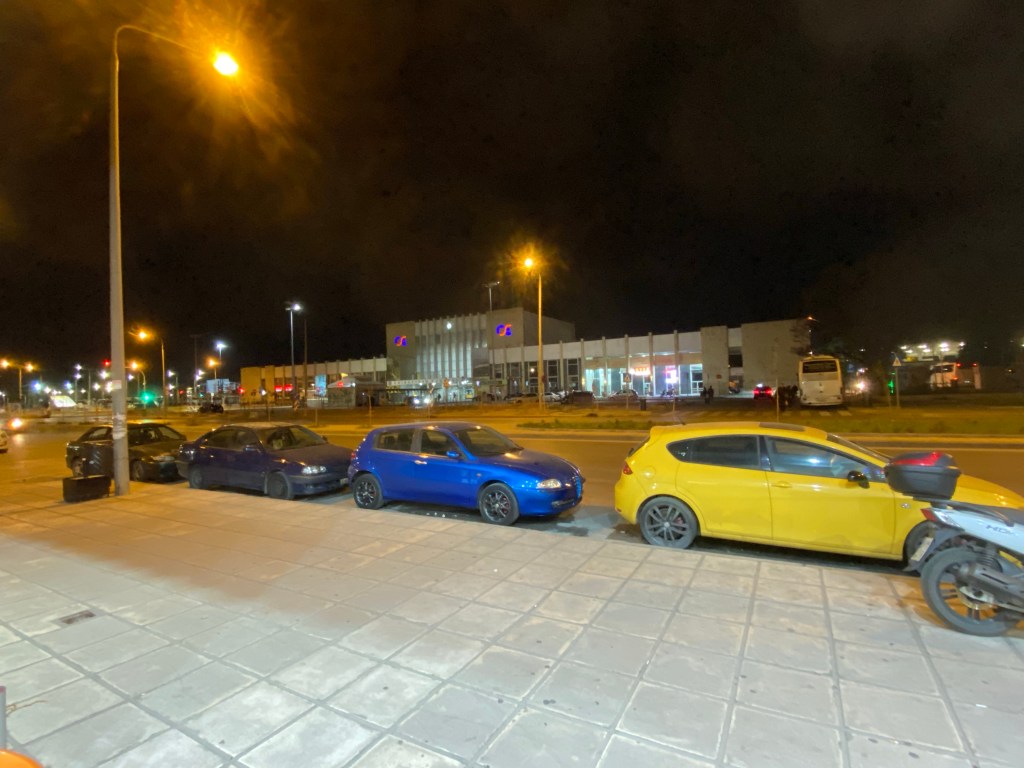
Without access to a train, but being determined to cover the distance by land, the even more uncomfortable alternative of an overnight bus journey is the second best option…..
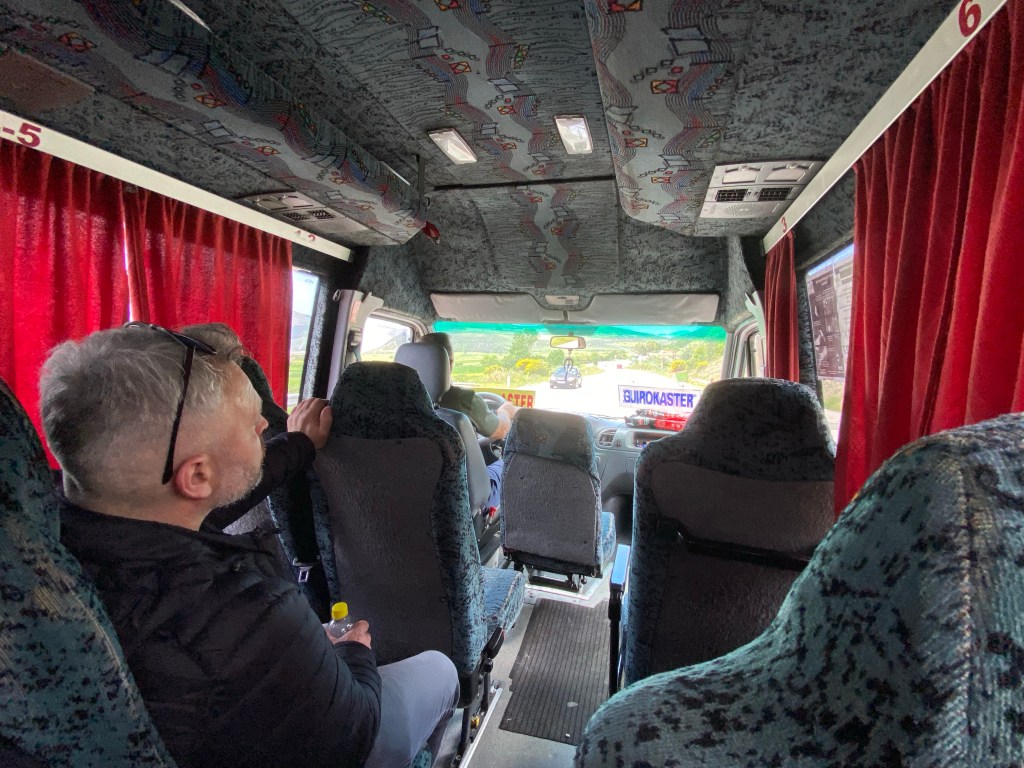
Having reduced my necessary belongings for the next month to whatever fits into a backpack, that can be carried with not too much effort over mountains, I am finding myself in the not very inviting surroundings of Belgrade’s central bus terminal and after an involuntary tour of pretty much the whole site, I arrive just in time at platform 5 where my international carrier turns out to be a somewhat worn mini bus that looks as if it had a former life as a busy airport shuttle. Slowly I am starting to understand the puzzlement in the faces of my Serbian friends, when I told them what I was planning to do and their subsequent question why I wasn’t flying….
Well, now it is too late anyway to turn and I enter the nightbus to Thessaloniki….
What follows is certainly not the most comfortable night I had in my life, but despite us covering over 600 kilometers and two border crossings in just under 11 hours, it doesn’t involve unfriendly border guards and thankfully no screwdrivers or any other household tools get involved.
At just before 6 am the next morning I am sitting down in a small cafeneon in Thessaloniki and order my first Greek coffee on this new adventure……
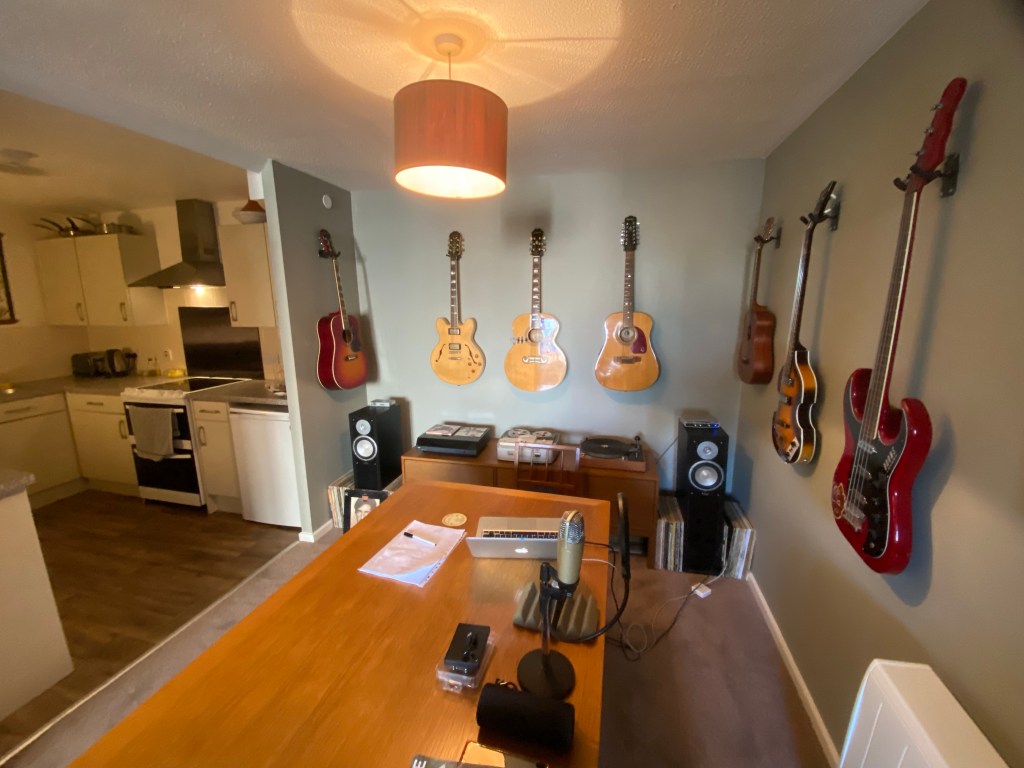
There are seven guitars hanging off the wall in Alistair’s living room and a couple of microphones are lying on the breakfast table – signs of a monastic life dedicated to music and lyrics…..
Born and bred just around the corner and living here ever since, Alistair is my perfect host in Manchester, this archetypal English city in the North, which – after so many years on the island – I am now visiting for the first time.
With its city center, where the wrought iron fenced facades tell of previous riches and of its now uncomfortable colonial history, where modern coffee chains mingle with addresses like Canada or India House. A place which features large deprived areas and yet not one but even two of the World’s most famous (and expensive) football clubs with the eternal rival – Liverpool – just a stone throw away towards the East.
Having for a few days updated myself on the newest ideas in veterinary care at the grand location of the converted Victorian Central Railway Station, my focus is now on checking out the local music club scene and for this I decided Alistair couldn’t be better suited.
Staying for another night and following his advice I am setting out late on Saturday evening, strolling through the densely populated city center towards a small Jazz club in the Northern Quarter.
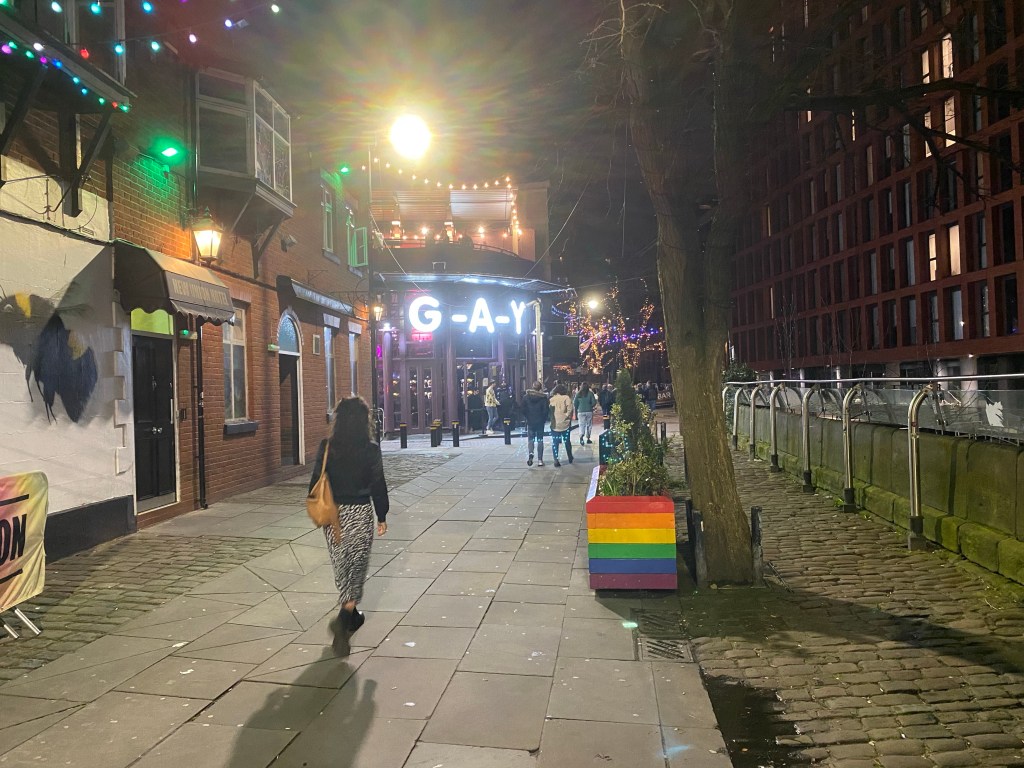
Walking along the old canal, passing Gay Village, I am approached by the towering figure of a guy in drag with a faux fur coat and on 14 inch stiletto heels, trying to usher me into one of the local bars. I have to smile and decline politely, but while carrying on with my walk, I can’t help feeling like a fly that just had a close encounter with a praying mantis…..
A few minutes later I am entering the already packed Matt & Phredd’s Jazz Club and after finding myself somewhat lost in the crowd, nursing my first Cuba Libre of a few that night, I notice that a chair just next to the stage appears to be still vacant.
Utilizing my German genes, I am seizing it (even without having a towel….) and luckily only a couple of hours later I become aware of a “Reserved” sign on which I have been sitting the whole evening…..
At that point however it didn’t matter anymore…
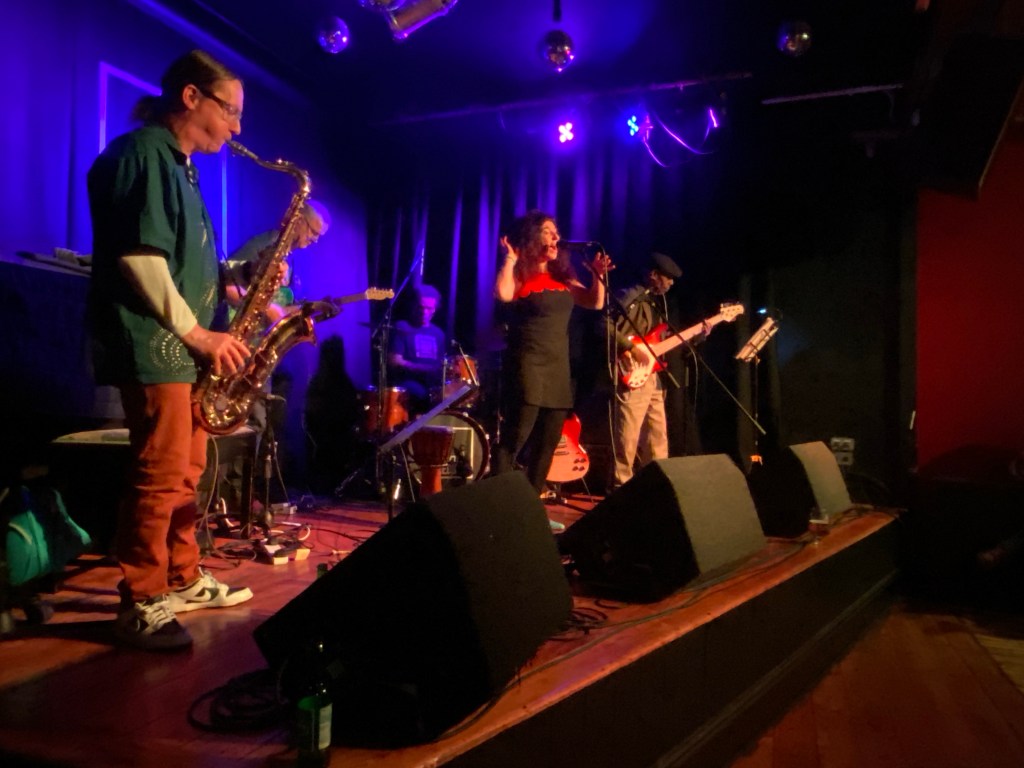
Shortly after my arrival, Terri Shaltiel and her band are entering the stage and the audience is being treated to a great fusion of soul, blues and R n B. A bit of Amy Winehouse, a bit of Aretha Franklin and of Gladys Knight with some impressive instrumental solos adding to the mix.
In the breaks, while sharing drinks with Bolee, the bass guitarist, I am once again reminded how small the world is, when it turns out that he had served in the British Army in both Hanover and Paderborn, exactly at the same time when I was studying there veterinary medicine and when I started with my first job mainly treating farming animals.
Time for another drink and for more “Sweet Things” by Terri Shaltiel….
There are these irritating first five minutes that are hurting when going for a run in the morning. The whole body has to follow the mind, accepting that from a state of total rest and immobility all systems have to be activated to reach three times the previous heart rate, to adapt the body to the cold and to move in a fast and balanced way.
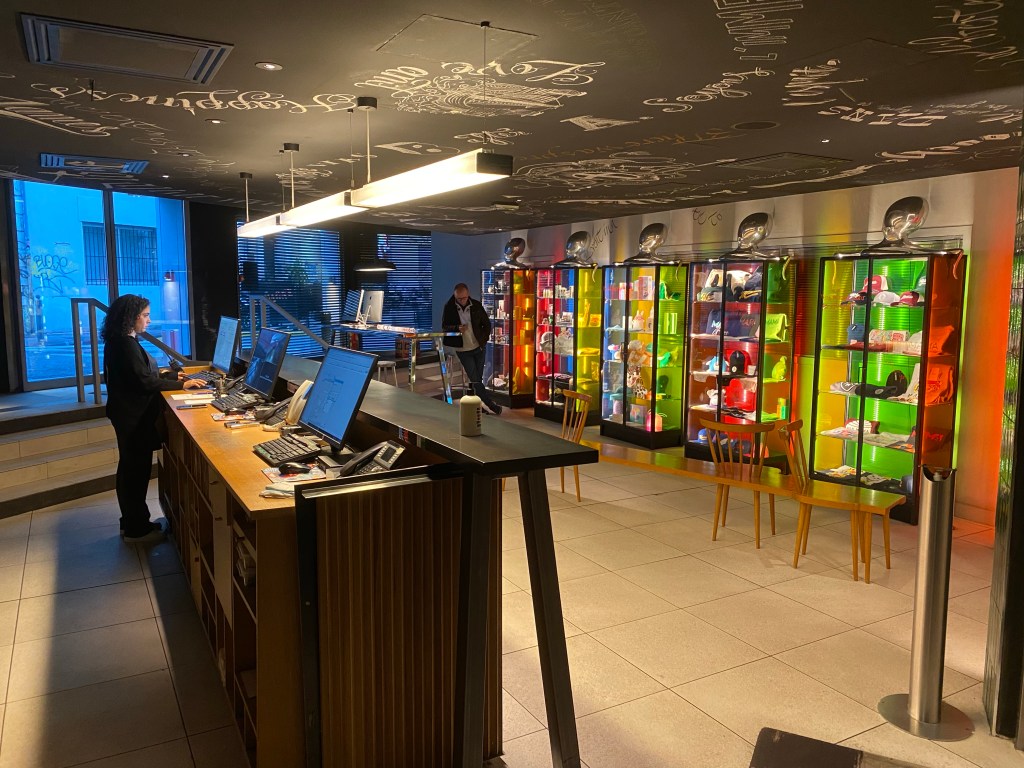
It is 6.00 am at the beginning of December and while stepping out of the quirky surroundings of Mama Shelter, my home in France for a few days, I am reminding myself that I am not really an early morning runner, but if you want to experience a still sleeping city this way, you need to bite the bullet…..
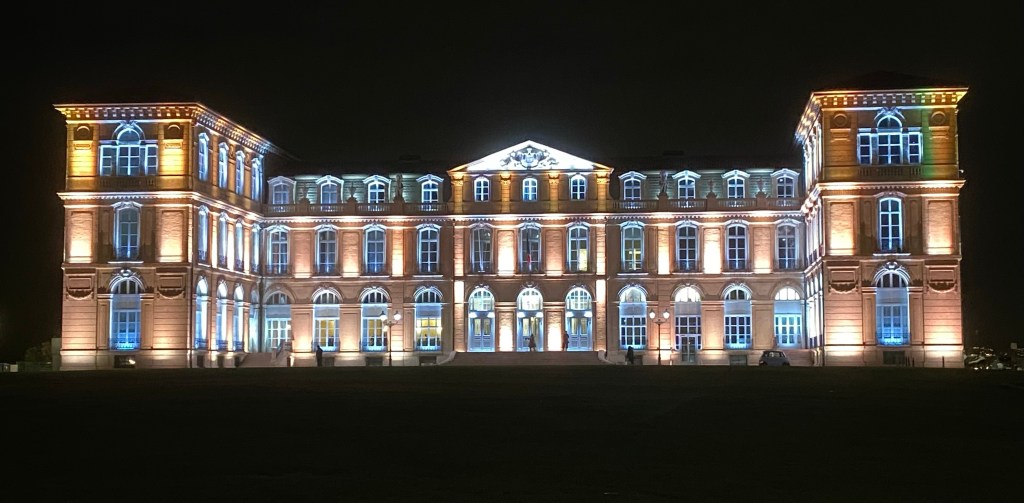
Following a brief uphill section towards Notre Dame Du Mont, the road descends towards the habour where the sea food venders are busy setting up their stalls. At this time of the day there are hardly any cars on the roads and I am able to run along the waterfront of Quai de Rive Neuve towards Parc Emile Duclaux where I was fortunate enough to enjoy a reception together with my French colleagues in the glamorous Palais du Pharo the previous night.
Built by Napoleon III in the middle of the 19th century and towering over the entrance of the habour, it gives this rough Mediterranean seafarer city a more respectable front.
Turning South here, with my body now fully awake, I am faced with the main challenge for this run: finding a route uphill to the Basilica of Notre Dame de la Garde before sunrise.
Despite it is overtowering the whole city and the surrounding countryside, I am finding it surprisingly difficult to see this landmark among the narrow streets of the 7th arrondissement. Several times I am stranded in some dead end roads adding to the mileage of my morning run.
Eventually my system of moving in roughly the right direction and using all roads leading uphill, pays off and I find a small pass heading directly to this beautiful church.
There are just a few minutes to spare before the sun is rising behind the mountains in the East, covering the whole city into a warm orange glow.
This spectacle only lasts a few minutes, which is perfect as my body is now cooling fast and I am starting to head downhill through the streets and staircases of the 6th arrondissement
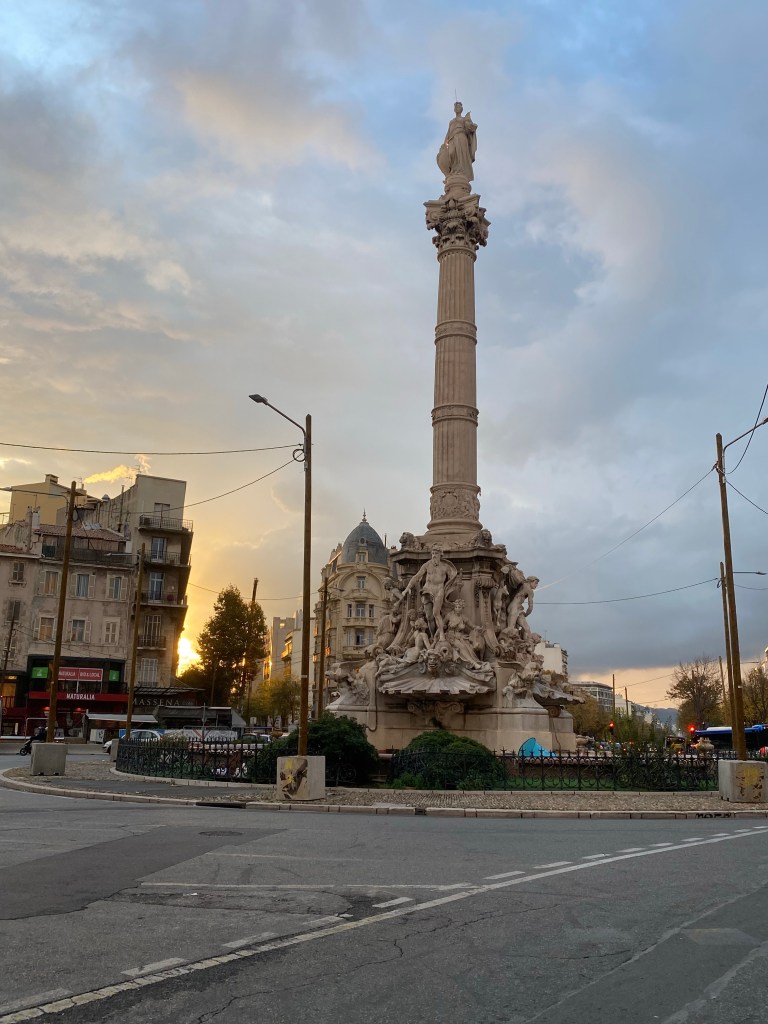
towards the column of Place Castellane, which featured in Conrad’s now over a hundred year old and so fittingly named novel “The Arrow of Gold”.
No time though for me to sit down and read, but instead to give it a final push uphill for a warm shower and a hard earned breakfast at Mama Shelter.
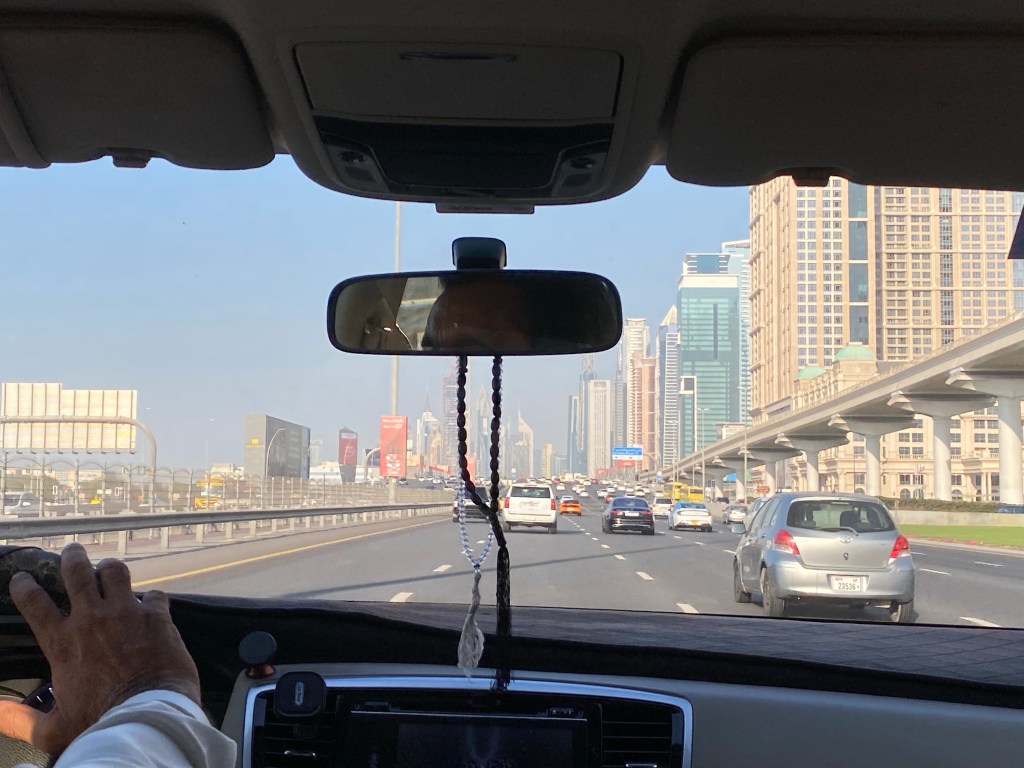
Rashid’s Lexus had just left Dubai’s alley of skyscrapers and while the silently running air conditioning was keeping an ambient temperature inside the car, we were driving through the desert with the blue water of the Persian Gulf on our right side.
About 100 km South of us in Abu Dhabi I was planning to visit someone I had secretly followed for many years and we had finally arranged to meet….
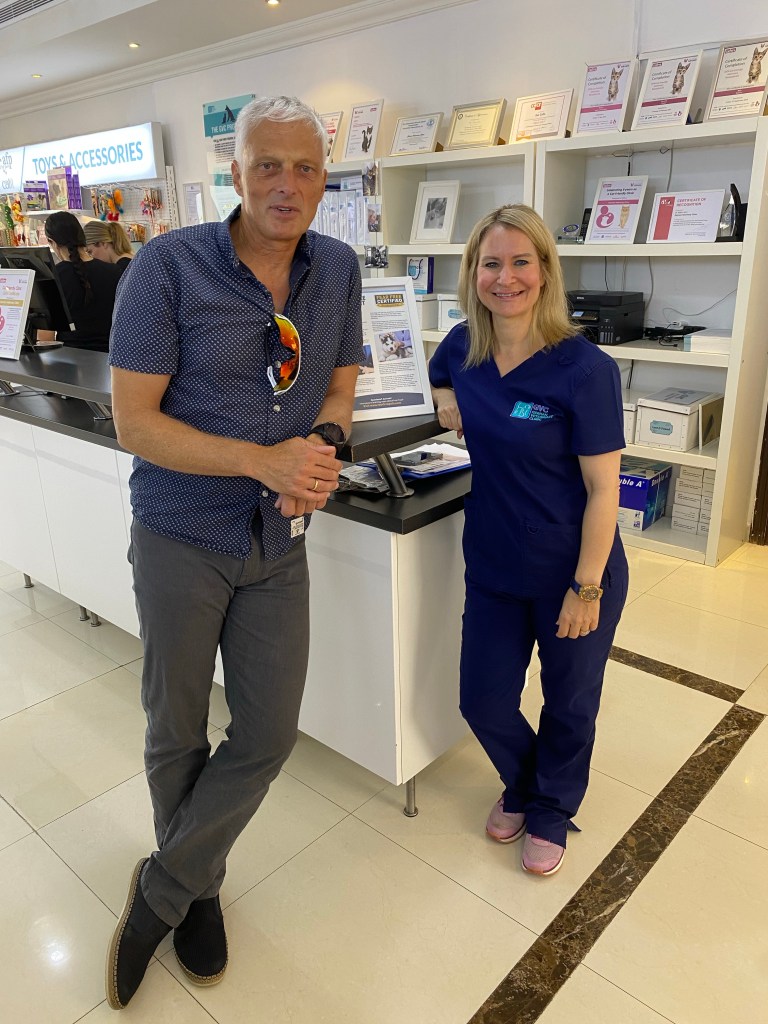
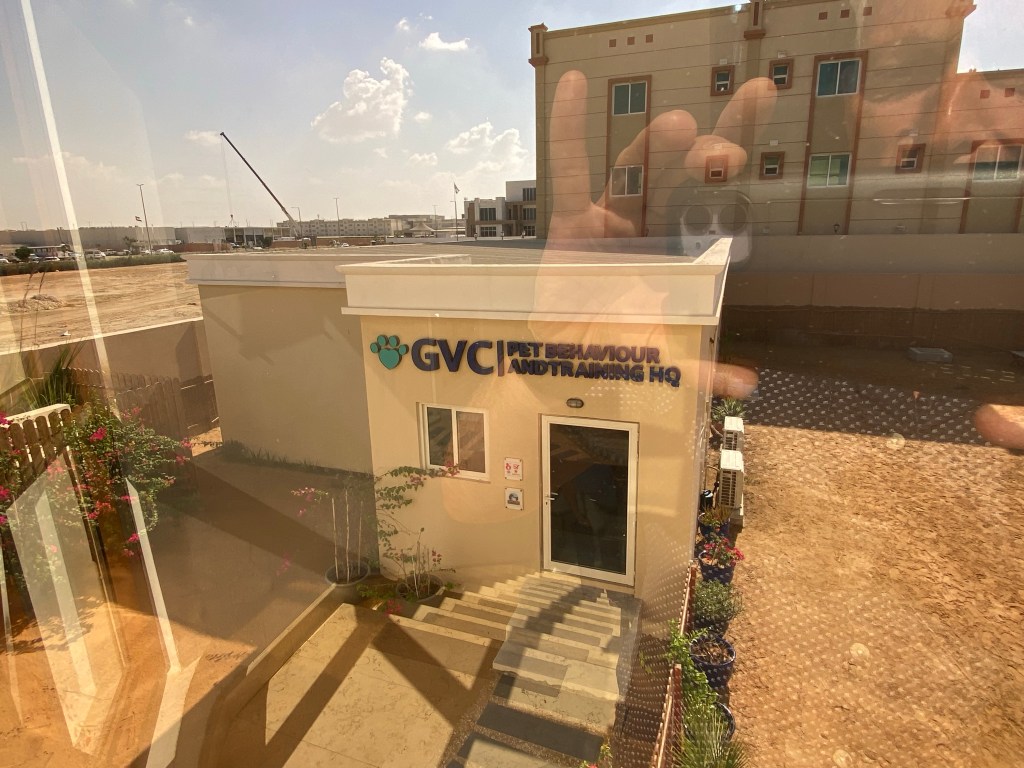
After about an hours drive the car was coming to a hold infront of a sizable building in the suburb of Khalifa City and from the stifling heat outside, I am stepping into the airconditioned waiting room of the German Veterinary Clinic both established and managed by Katrin Jahn.
About 15 years ago this petite blond women, who like me had a mixed British/German professional background, had turned her back on Europe and after a short period of working as an assistant in the region, had decided to open her own clinic in the outskirts of this desert city.
I remembered reading an article about Katrin and her clinic in a veterinary journal some years ago and I immediately thought that one day I would have to visiting this adventurous colleague and her team. The conference in Dubai finally gave me the opportunity….
While I was stitching up injured pads on a rainy afternoon in Virginia Water, Katrin was neutering cats in sunny Abu Dhabi. While I was concerned about the heating of my clinic in the winter, Katrin was concerned about her airconditioning. While I was advising families which were moving to the Middle East about the dangers of heat stroke and dehydration, Katrin was advising families that were moving to the UK about import requirements and the importance of pet insurance cover.
At the entrance door of the clinic I had noticed an “Investor in People” plaque, a “Cat Friendly Gold Standard” Award and a “Fear Free Practitioner” sign and this is immediately backed up by the welcoming and at the same time very clean and professional looking interior that indicates a strong commitment to customer care and a dedicated and organised team.
Despite being very busy, Katrin – with an inviting smile – takes herself a lot of time showing her foreign (for her actually not so foreign…) visitor around:
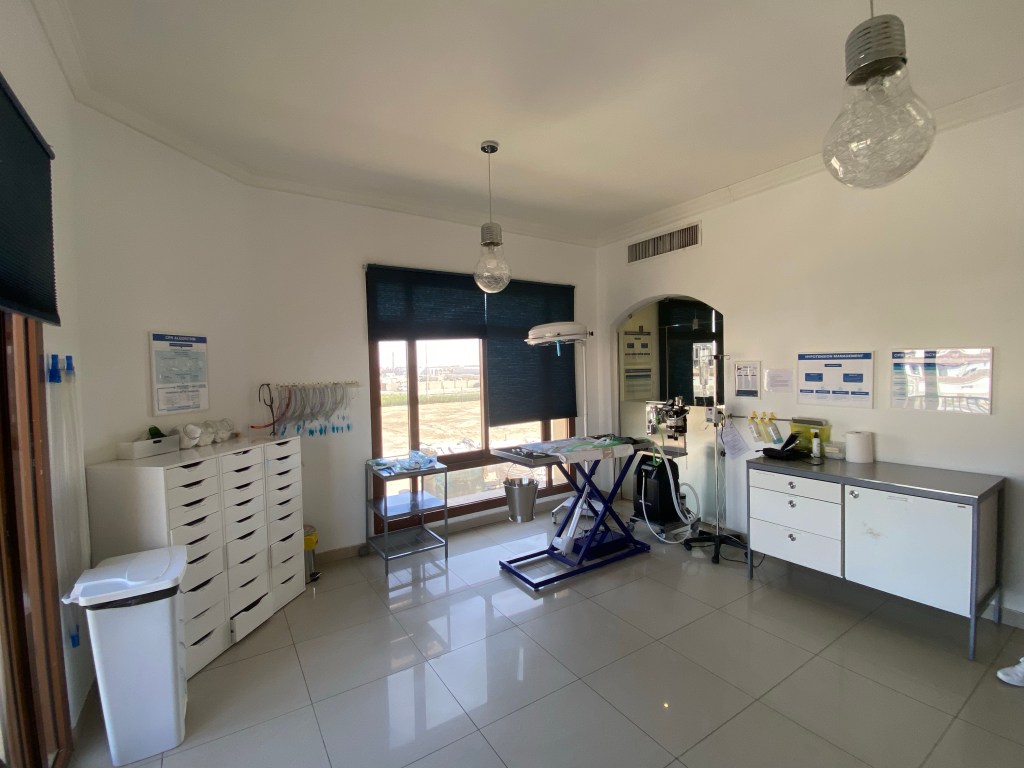
The clinic has well lit but functional consulting rooms. A comfortable mat on the floor indicates that a lot of examinations and treatments are performed on the ground to reduce patients’ anxiety. Treats are readily available in all rooms to make the visit to the clinic especially for stressed dogs as enjoyable as possible.
For cats there is a dedicated waiting area and the cat boarding room has been fitted with self designed, noise reducing cages with both climbing and hiding opportunities.
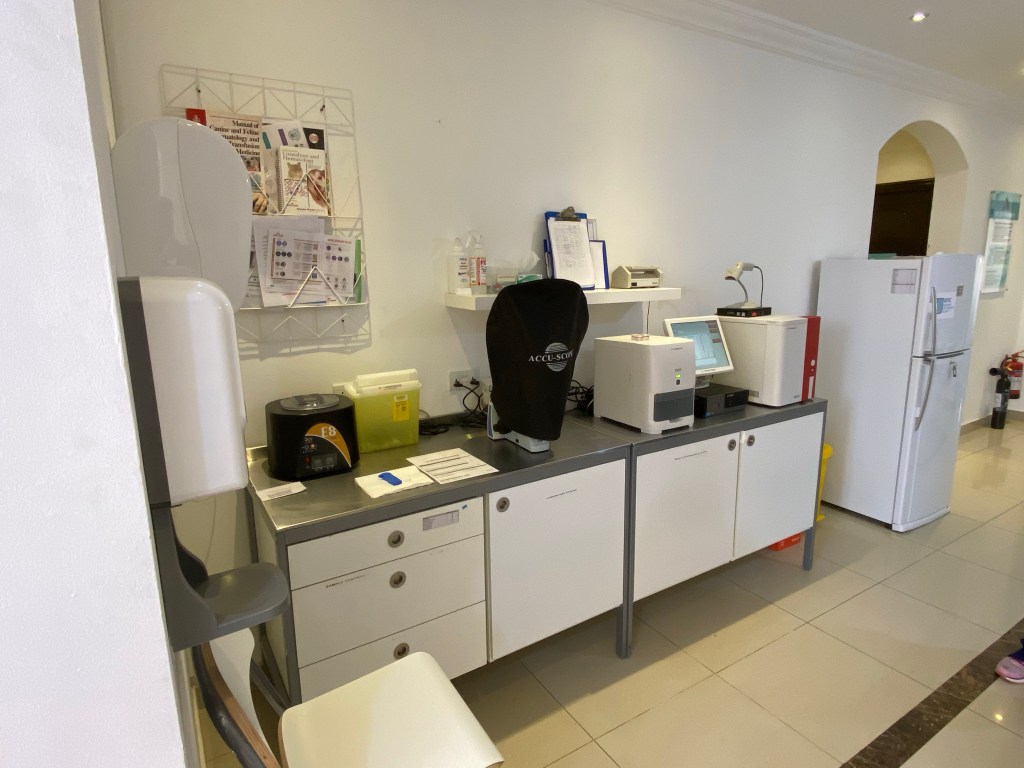
The clinic has its own laboratory and to the rear a dedicated animal behaviour and training unit.
The whole setup including the shining, beautifully tiled flooring gives the impression as if standing in an elegant German small animal clinic somewhere in Munich or Stuttgart on a nice summer’s day.
Despite being a foreigner, Katrin has managed to established and to grow her business from scratch. Unsurprisingly the clinic has proven to be very popular especially with Abu Dhabi’s expat community and not less than 60% of the patients are cats. Consultations are frequently performed – with the support of the whole team – in multiple languages.
Like her own personal history, Katrin’s team has a very international background and it is not difficult to appreciate that working here certainly has a strong appeal.
To stay up to date with recent professional developments and with new treatment ideas, Katrin is a frequent visitor of international veterinary conferences and of online courses.
Being very impressed with that what I have seen, I leave Katrin with her patients and we are heading back to Dubai.
While looking through the car window, leaving the well attended houses of Khalifa City behind us, I summarized that despite the geographical distance and the cultural differences of the places where we worked, there were so many similarities between Katrin’s clinic in Abu Dhabi and my small place in Surrey, with just one difference: whatever I had done in Virginia Water, Katrin had done just one level better in the Middle East….
(or when the fine line between architecture and jewellery becomes blured……..)
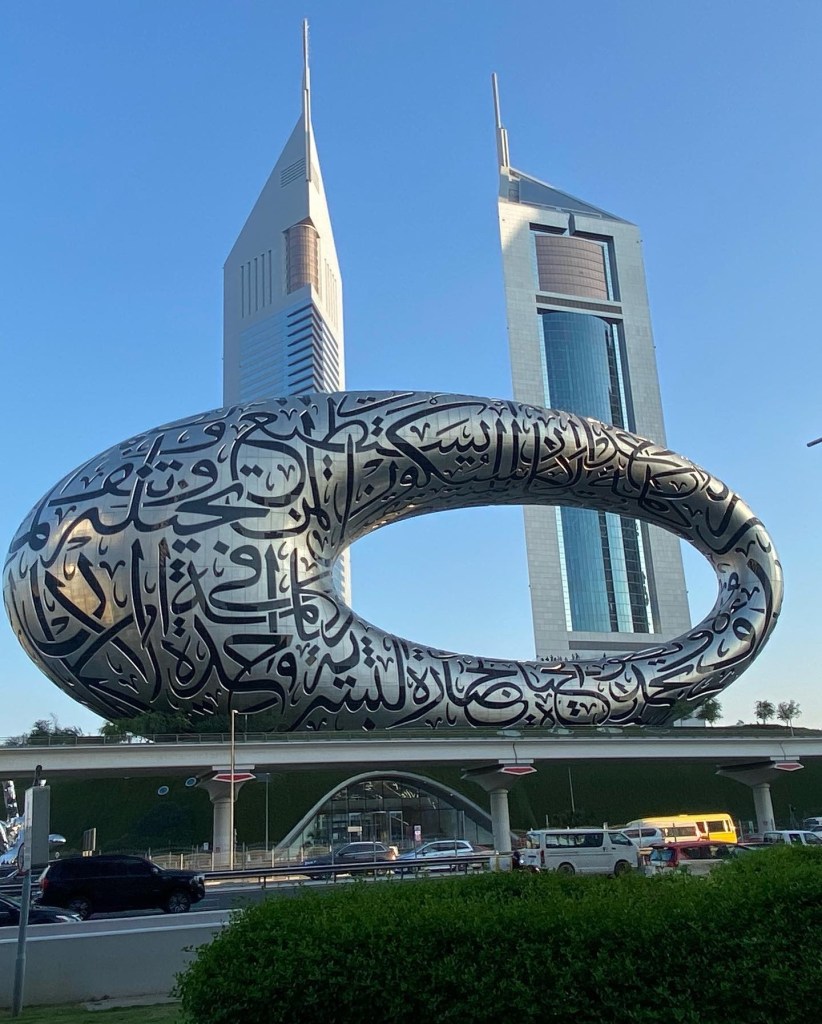
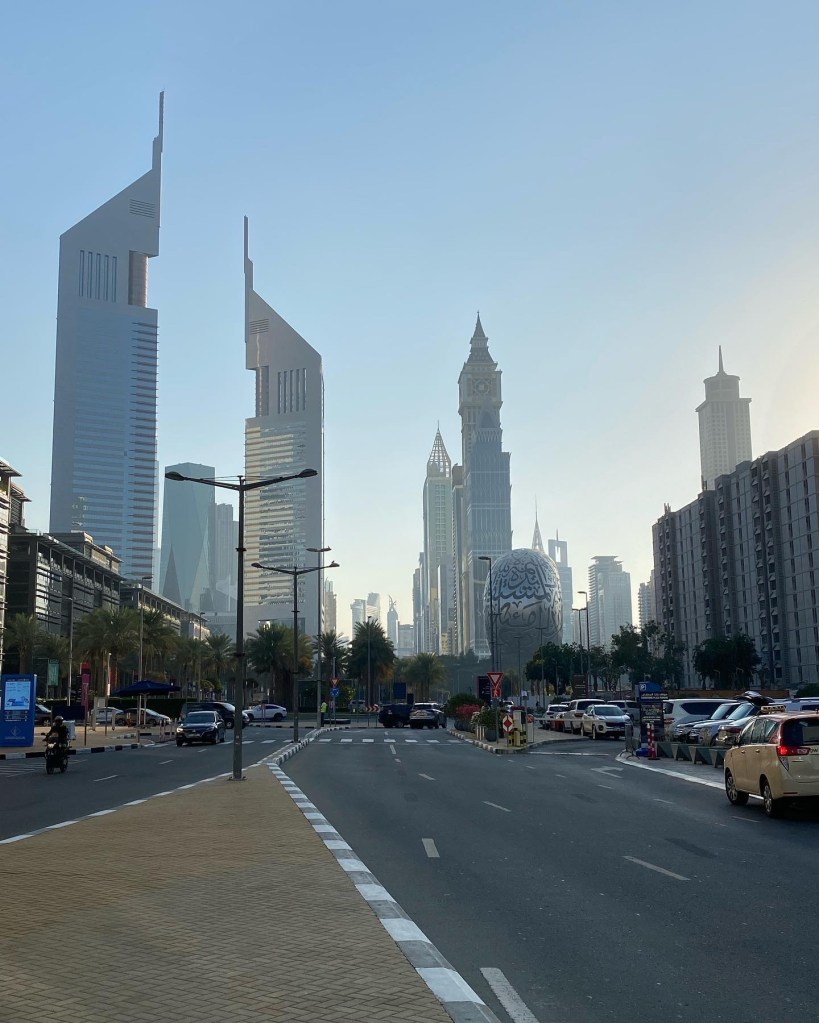
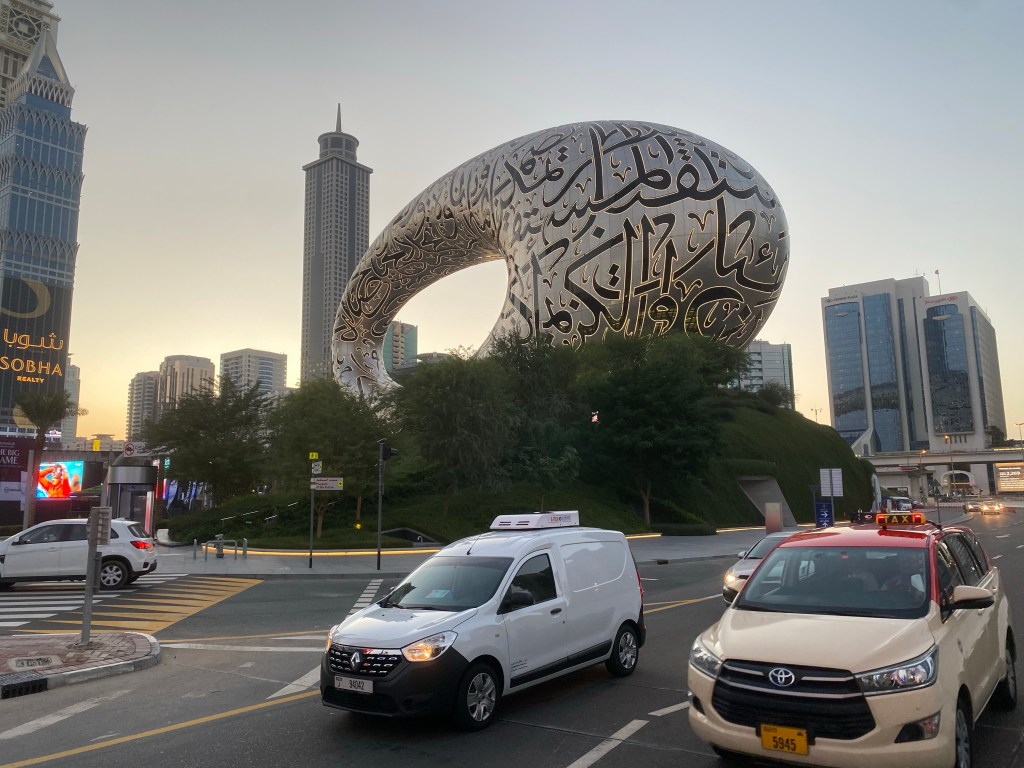
Entering the center of Dubai coming from the international airport, you can’t fail to notice a structure that appears to originate from out of this world and that resembles more an alien spaceship or an oversized piece of beautifully crafted jewellery, rather than a building.
I am a great lover of the outdoors and I feel more at home in the mountains or in a small cottage at the seaside than in an urban environment. I am also of the firm belief that nothing man-made can rival the beauty of nature. However, having seen the cathedral of Mont Saint-Michelle in Normandy or the Messner Mountain Museum at the Plan de Corones in Northern Italy, I appreciate that the margins can be very slim…..
I – admittedly – had not prepared myself for Dubai and I only learned while standing infront of this object that I was looking at one of the Emirate’s newest attractions : The Museum of the Future !
While still admiring the beautifully crafted, rounded outside of this ring shaped structure that was covered in long lines of arabic calligraphy two thoughts crossed my mind:
The first was that thanks to Vassiliki’s generosity an entrance ticket for this attraction was actually in my luggage as part of my speaker’s pack.
The other had to do with another innovative and disruptive woman who I deeply admire and who I always imagine to have been the ultimate nightmare for builders and for structural engineers around the world: Zaha Hadid.
This stellar figure of global architecture was a great champion of organic forms in all her designs and to realise her ideas she constantly put computer programs and new construction materials to their absolute limits. Ikonic buildings like the London Olympic Aquatics Centre, the Guggenheim Museum in Vilnius, the Bergisel Ski Jump Tower in Innsbruck or the above mentioned mountain museum in the Dolomites were the results.
The unique design of this beautiful structure is however credited to Shaun Killa, but without being an expert on these matters I wouldn’t be surprised if Zaha Hadid – who passed away far too early – had at some point an influence on Shaun and his team.
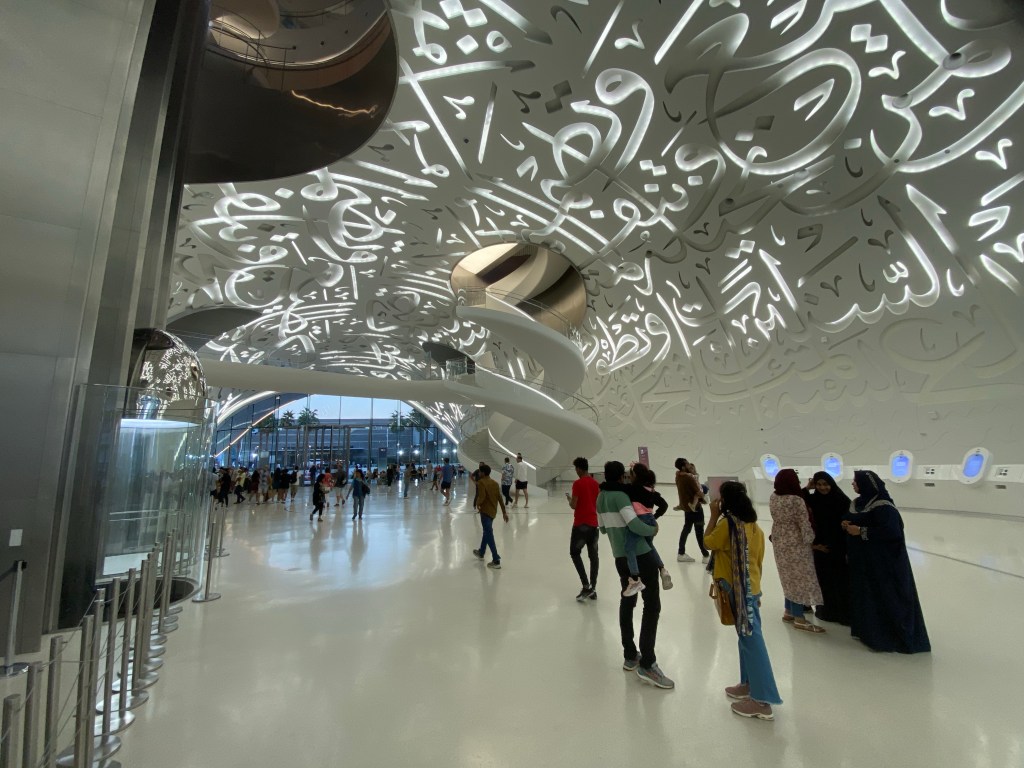
Stepping into the building a couple of days later, I was immediatedly struck by the brightness of the light that was entering the huge hall from all sides through the beautifully crafted letters of a poem by Dubai’s ruler Sheik Mohammed.
The eyes are struggling to find any straight lines here with the walls, the staircases and even the elevator shafts resembling natural curves.
Bullet shaped capsules are transporting visitors to the different floors and a couple of huge helium filled silver dolphines are effortlessly floating through the hall and the individual corridores.
The organised tour through the complex, which is starting with a simulated journey into space is – I find – then struggling to match the uniqueness of the building itself, but possibly with one exception: the genetic bank.
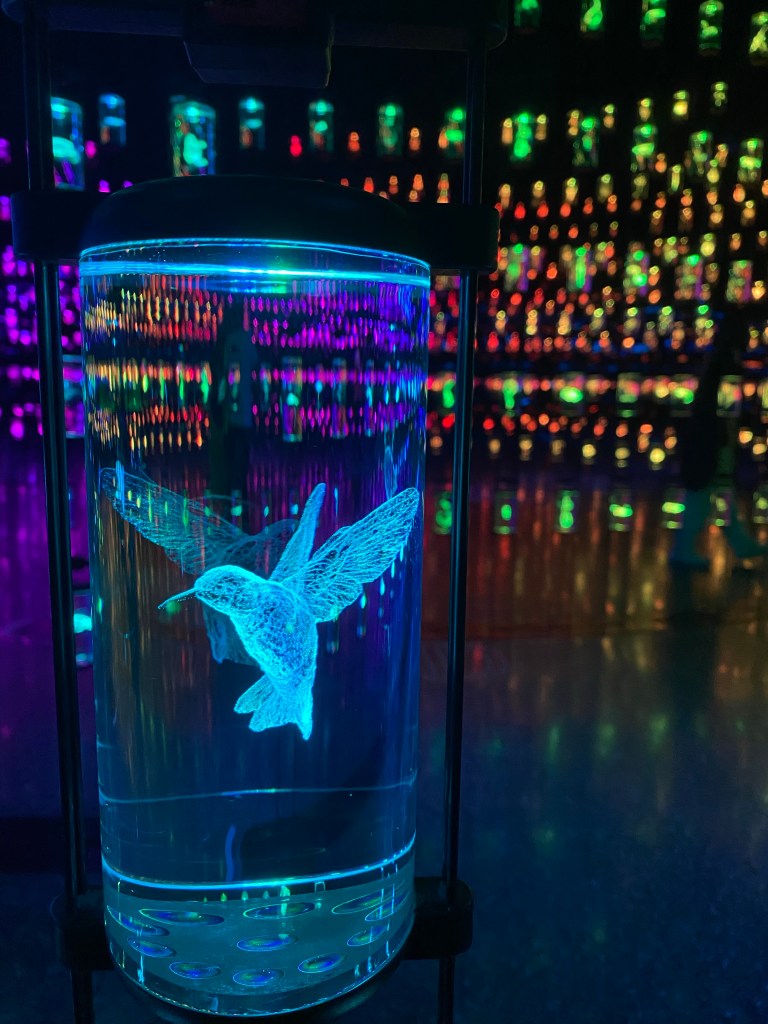
As in a vision from a Stanislav Lem novel one enters a darkened room where small glass vials with colourful hollograms of all living and extinct creatures are suspended from an invisible ceiling and the seemingly infinite columns of floating spots of light in this room leaves you with both an idea of the complexity of the biodiversity on our planet and at the same time with a feeling of dread that genetic storage facilities like these might indeed become a necessity in the not so far future.
Sitting at a table at the historic fortress of Vysehrad overlooking Prague last June and looking into the dark eyes of Vassiliki Stathopoulou, one of Europe’s foremost veterinary gastro-enterologists and daughter of a Greek business man, I realised that resistance was futile……
Six months later, just 36 hours after my return from Latin America, I was standing on the tarmac of Dubai International Airport at the Persian Golf – a place that had so completely not been on my personal list of places to visit and yet, here I was enjoying comfortable dry 25C at 7 o’clock in the morning at the end of November.
Vassiliki truly was a women on a mission and this one was no trivial undertaking: bringing the first International Companion Animal and – of course – Equine Veterinary Conference to the Middle East.
Copyright MEAVC
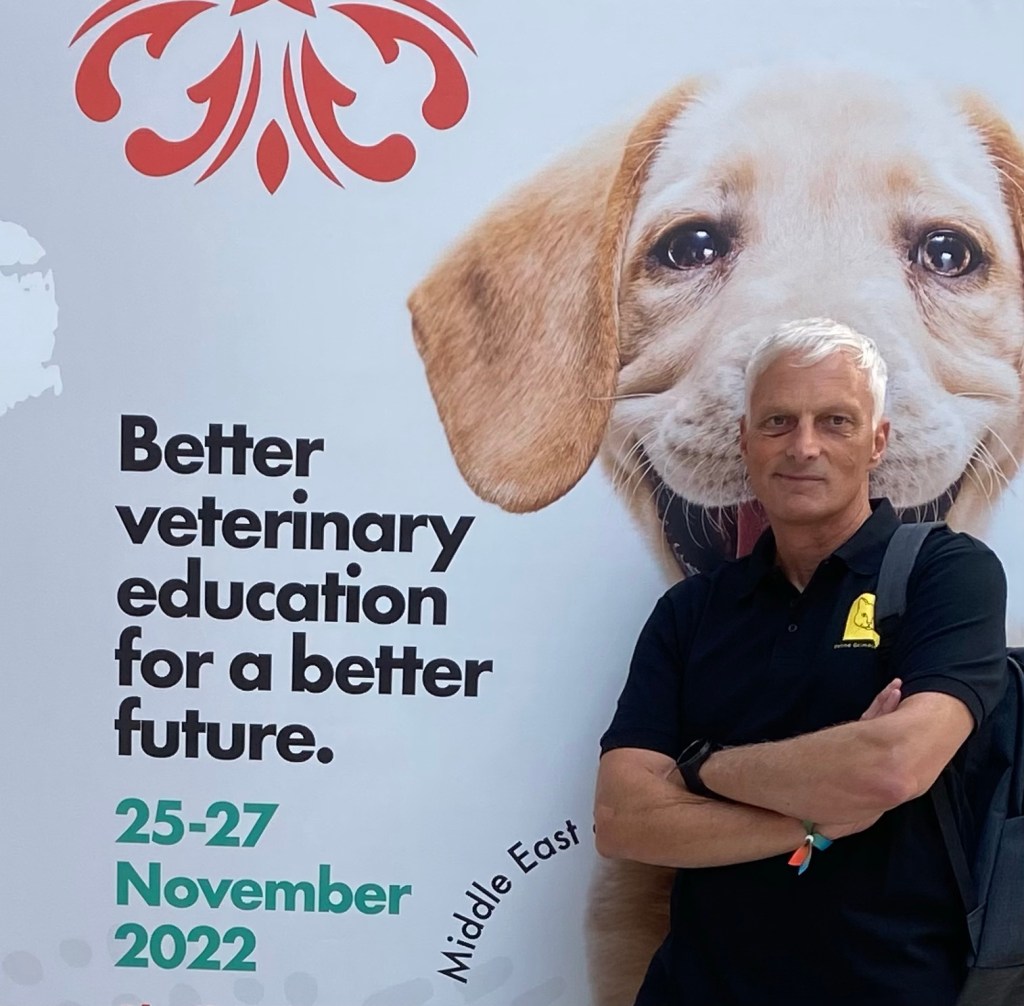
Achieving this as a foreigner and as a women was even more impressive and I was very happy lending my support as a speaker at this inaugural event, especially as I had been asked to give a presentation on one of my favourite subjects: Professional Collegiality and the Global Veterinary Family.
This wasn’t too difficult as my mind was still full of so many fond memories of the times I had spent with many – for me – previously unknown collegues in South America over the past few weeks. In many cases their trust and their hospitality had been very humbling.
As it turned out, Dubai and the 1st Middle Eastern and African Veterinary Conference would not be any different.
Once adjusting to the futuristic skyline and to the splendour of some of the buildings,
I found myself again in the company of colleagues from all over the world meeting one another regardless of their religion, their nationality or their political orientation, unified just by the desire to learn and to become better in the work we are doing. The only difference here was that the delegates from Lima which mainly came from the Americas were now replaced by a genuine mixture of Europeans, Africans, Asians and by colleagues from the Middle East.
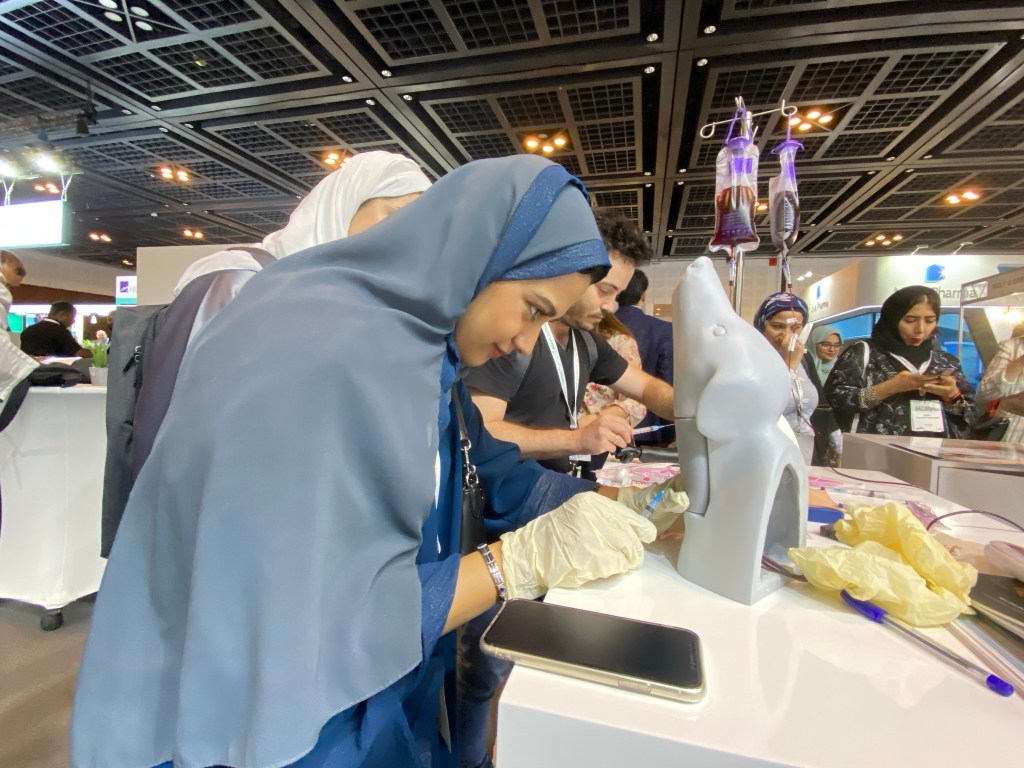
The people might have been different but the engagement with new technology like artifical patients to practice venipuncture procedures at the exhibition or their interaction with the speakers was not only the same but possible even more intense, considering that it was the first time that something like this had found its way to the Middle East.
The Emirates are certainly not short of funds (especially at the moment with sky high global oil prices), but good resources do not necessarily translate into good skills and certainly not into ethics.
As much as I admire the fast progress this part of the world has made in so many fields over the last two decades, one can not overlook that the human factor and the enjoyment of life with an element of reasonable restraint mighty at times appear forgotten. Excusions into the desert these days are no longer done on camel back but in Paris-Dakar style with highly powered, tyre pressure reduced SUVs…..
Even more encouraging than, that issues like responsible breeding, lifelong learning and collegiality were here addressed as part of the scientific programme right from the start.
As with all new ideas, it is not important that the first step is big, but it has to go into the right direction.
Sitting one evening during my stay in the desert at night and sharing a traditional meal with new friends from yet another corner of the world, I felt very grateful for having been part of this new project and I hope that Vassiliki’s vision will see many happy returns…..
It doesn’t happen very often in these days of conveyor belt serving multinational coffee chains that people are happy to queue in front of a cafe and wait for the best part of an hour before claiming their seat.
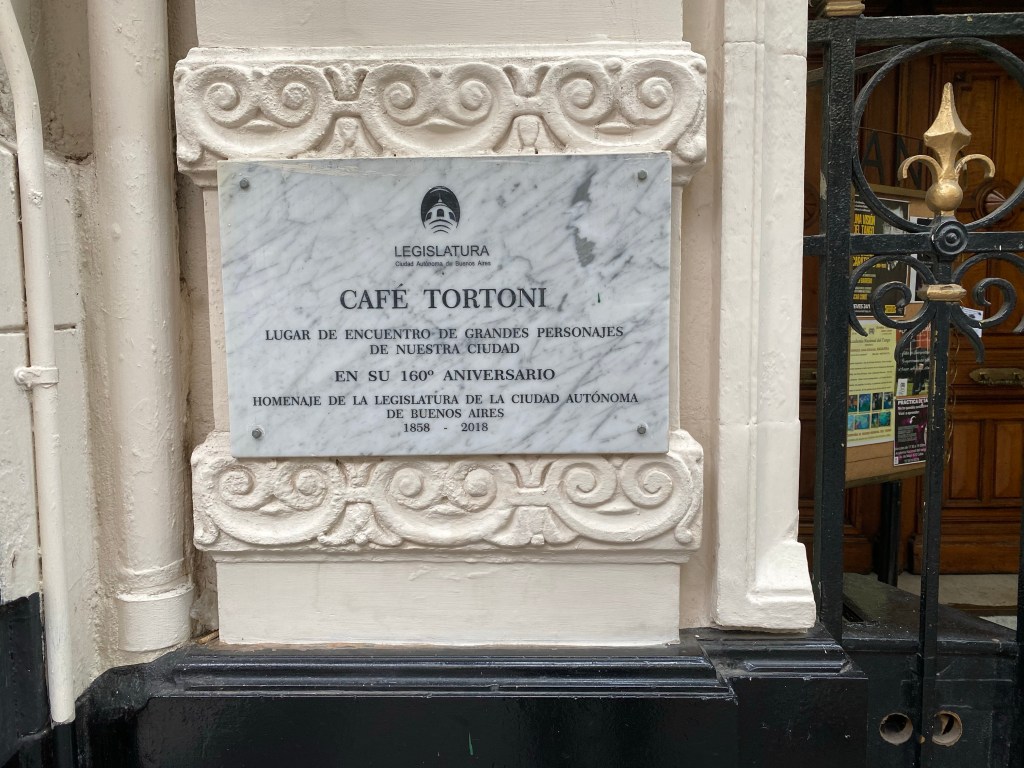
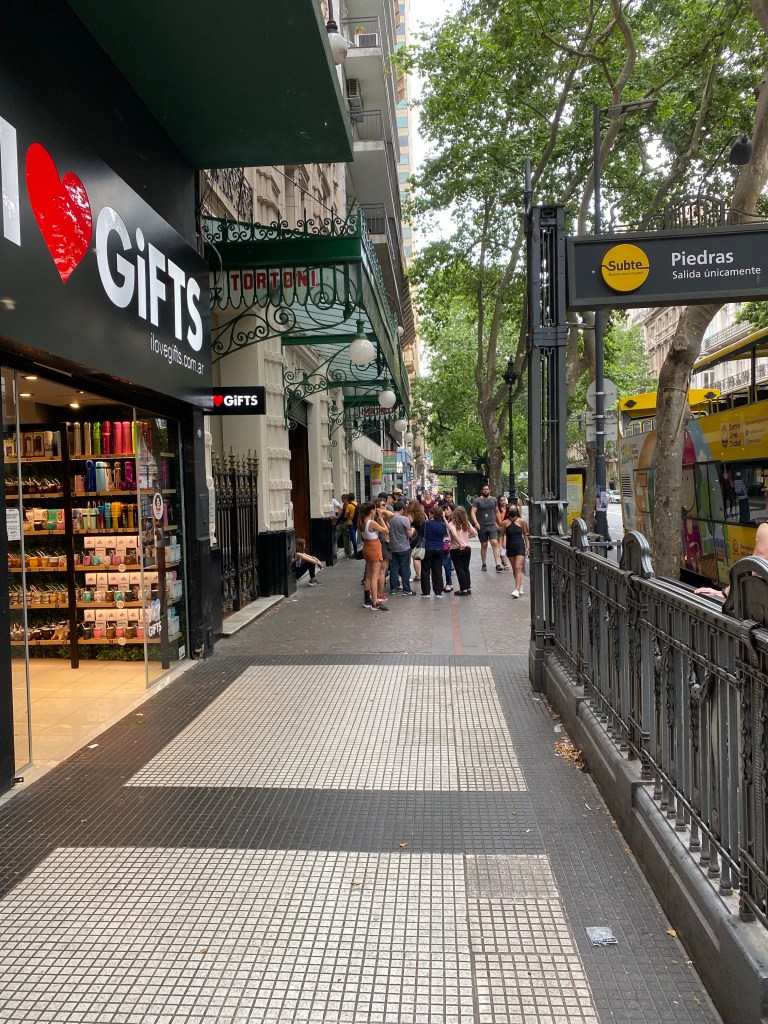
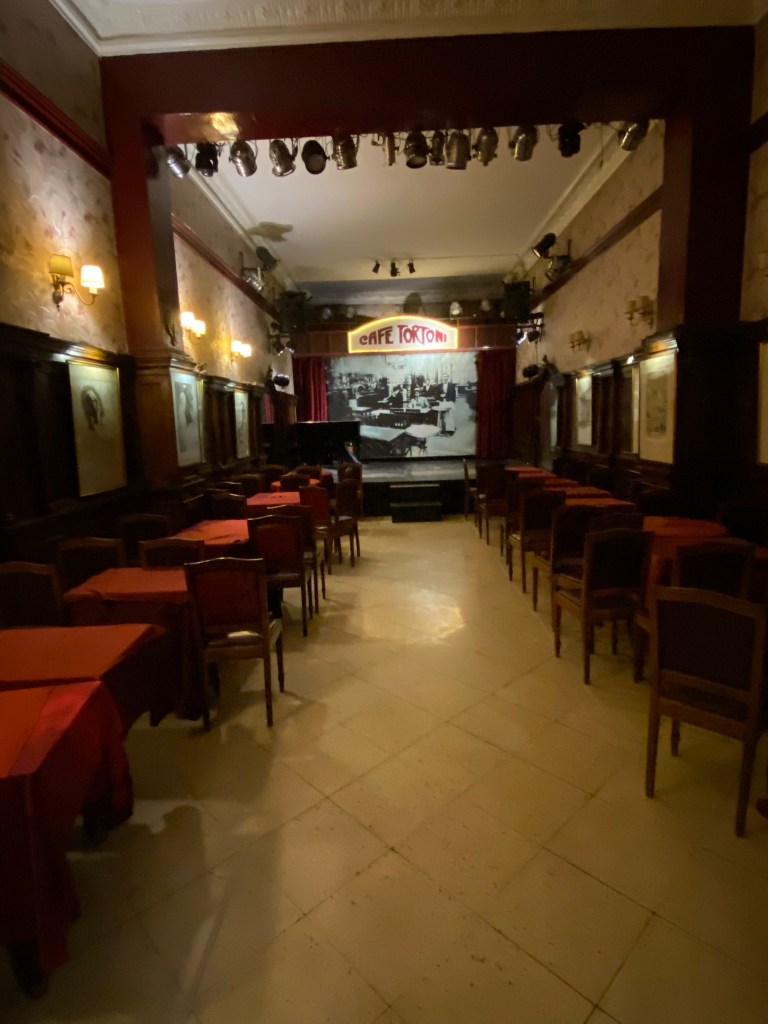
This however is not an uncommon sight at 825 Avenida de Mayo in Buenos Aires where coffee (and art and literature) lovers from all over the world want to walk in the foot steps of Albert Einstein and Frederico Garcia Lorca to enjoy the hospitality at Cafe Tortoni.
This Argentinian cultural institution is a manifestation of the close link the city has to Paris and to Mediterranian Europe. Established by a French immigrant in the middle of the 19th century, inspired by a similar cafe on the Boulevard des Italiens in Paris, the establishment became fast a magnet for writers, artists and tango dancers in the Argentinian capital.
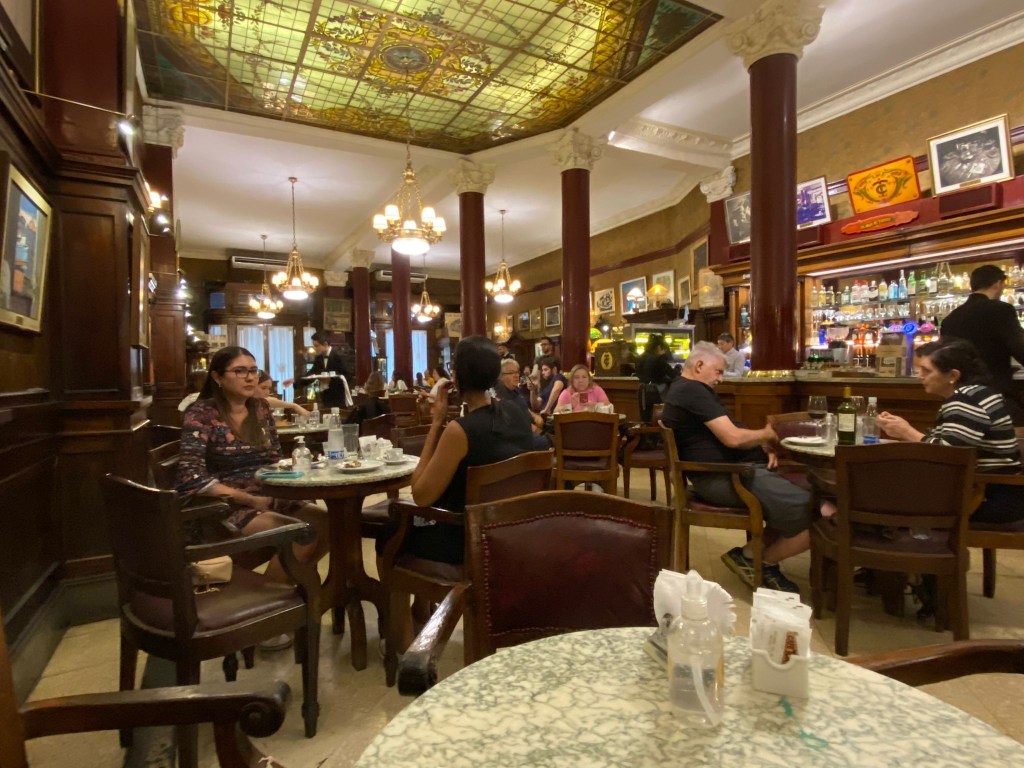
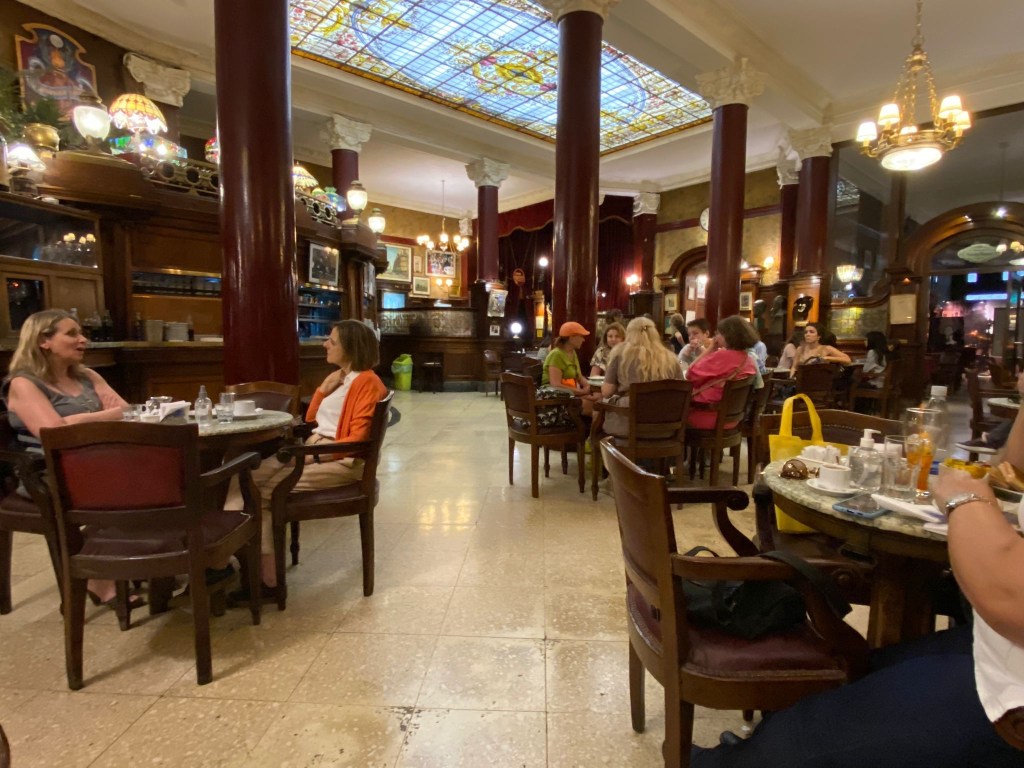
Following a entertaining chat with two British travellers in the queue who – as it turned out – lived not more than 10 miles away from my house in Surrey, I was finally guided to my table in this timeless temple of Art Noveau, of busy waiters, of continental pastries and artisan coffee.
Just a few days ago I had finished reading Paul Theroux’s “Old Patagonian Express” and the account of his time in Buenos Aires when he was enjoying the cafes and restaurants of the city with Jorge Luis Borges as his tour guide.
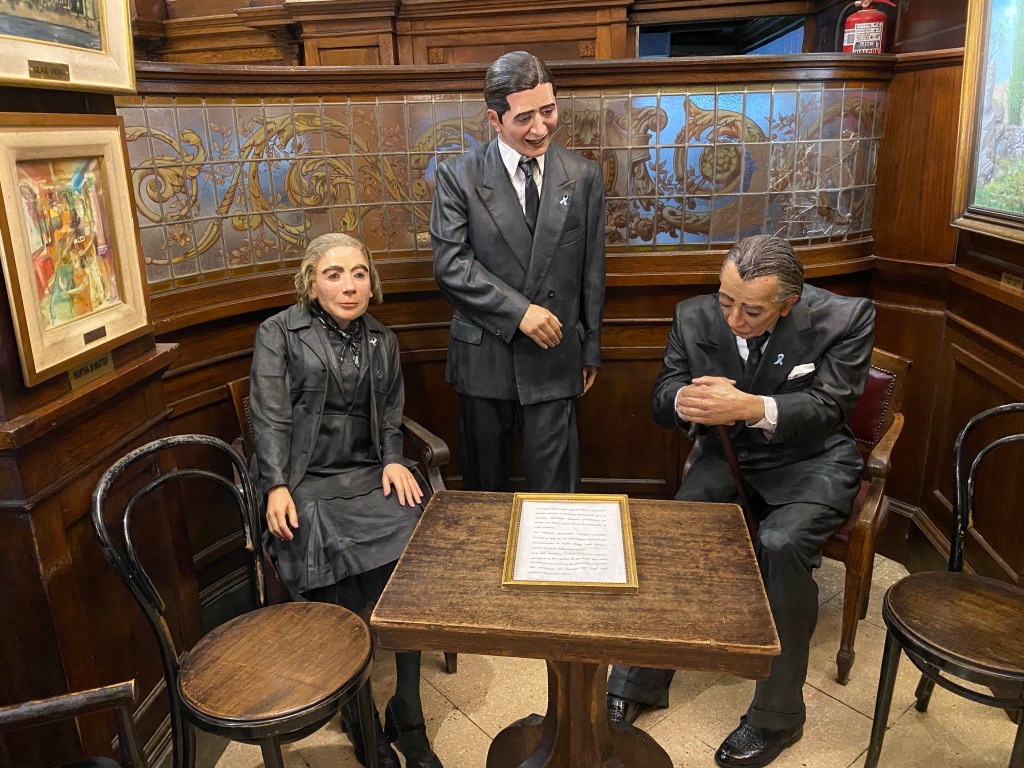
As Borges was apparently a very frequent visitor here – as indicated by a wax model (of not quite Madame Tussauds’ standard) in a corner of the cafe – I was wondering if they might have ended up at one of these tables as well ?…..
If so, they must have made an odd couple with the blind spiritual leader of a whole nation guiding one of the world’s most famous – yet surprisingly negative – travelwriter through the best restaurants in town while jousting constantly with their extensive knowledge of but differing opinions on central figures of world literature.
While the main hall of Cafe Tortoni was exclusively frequented by foreign tourists (like myself….), the side rooms and the basement continue to be the setting for readings, intellectual gatherings and both jazz and tango events.
No such things today though, so that I am left just with my imaginations while enjoying the grande surroundings, one of my final coffees in Argentina and a somewhat average Tiramisu which I recall to be much better on the other side of the big pond…..
In front of me, on a blue table top, I am looking at a syringe, three vials of local anaesthetic and the skull of a dog……
Sucking gently through a silver bombilla on his maté, Juan Jose Krauss, the man who introduced veterinary dentistry to Argentina and in fact to many other countries in Latin America as well, is giving me a private lesson on facial nerve blocks.
The final stop of my journey through South America had brought me to Buenos Aires, where I had to grasp the opportunity to pay the great man a visit at his small and intimate clinic which he shares with Guille Manigot – another big name in Latin American veterinary medicine – who sees dermatology referral cases in the room next door. Both Guille and Juan Jose have shared their knowledge with countless veterinary students and colleagues for decades and they have contributed to global treatment guidelines which have transformed the way companion animal care is provided today around the world.
The day had started with me getting lost on my morning run through the large nature reserve which is separating the centre of Argentina’s capital and the Rio Plata. Not only was the park more sizeable than I thought, I was also distracted by several encounters with a creature that I had seen a few times in my own practice – the Argentinian Tegu.
These more than half a meter long lizzards live happily in their burrows in close proximity to the busy town centre and they considered me a real nuisance disrupting their sun bathing sessions which are usually held in the middle of the jungle path.
The subtropical park, the wildlife, the huge city just a stone throw away and this all near a busy shipping lane – it all reminded me of the nature reserve near the Marina Sands Complex in Singapore where the Rio Plata was replaced by the Strait of Malacca.
Just in time and with burning muscles I had arrived back at my hotel near the Peace Palace which very fittingly was located next to the National Museum of Arms.
Juan Jose had very kindly collected me from there and following a brief sight seeing journey through the center of Buenos Aires, we had ended up in his clinic, discussing injection techniques and the benefits of different local anaesthetics while my host was enjoying his herbal infusion.
In commercial terms veterinary medicine in Argentinia continues to be very poorly funded with – according to Juan Jose – a consultation at the local vet costing not more that 10 $ even in the capital.
Both Juan Jose and Guille have managed though to find their niche, living reasonably comfortable just from their knowledge and their person skills with a decent work – life balance, without the need for a lot of staff or equipment, leaving in the surgery fridge enough space for a few bottles of excellent Argentinian Cava to be able to celebrate from time to time a treatment success in style.
With a lot of thought given these days to complex ideas on how to reduce stress and anxiety levels in a progressively corporate working environment, we might overlook how with much simpler means this can be achieved as well.
It was easy to see that the little clinic of my friends in Buenos Aires is a business with a soul where local pets will find excellent treatment and care, but I wondered if anyone in this beautiful city would be able to carry on with Guille and Juan Jose’s work in the same way.
When saying goodbye I considered myself again lucky for having had a further opportunity to visit a magical veterinary location at the other end of the world……
Oh the wind, the relentless wind of El Chalten!…..
If I talk about wind, then I mean the sort of wind like you haven’t witnessed it before: constant, gusting, merciless, unforgiving wind that knocks you off your feet, wind that after a while becomes irritating. Wind that can make a fairly undemanding hike in the Andes a dangerous undertaking.
El Chalten is a small village in the Southern Andes, circa 200 miles North from Puerto Natales.
To get there I first had to cross the border into Argentina where – I have to admit – the very public and frequent reminders that “The Malvinas are Argentinian!” made me for the first time slightly uncomfortable travelling with a British passport.
About 100 miles behind the border I reached the regional center of El Calafate, which is located on the shores of the huge Lago Argentino which is supplied year round by the ice and melt waters of the Parque Nacional Los Glaciares in the West.
Changing buses here, I took the epic “Ruta 40” further North, towards the equally large and cold Lago Viedma, before turning West towards the mountains. For this journey I was lucky to get a front seat on the upper level of a double decker coach, which was providing me with a perfect panoramic view.
In this arid landscape virtualy devoid of any but the hardiest vegetation , with hardly any human settlements and just the cadavers of some unfortunate guanacos in the fence alongside the straight, endless road telling a tale of an most unpleasant death, my heart went out to the first brave people who tried to cross this land on foot or on horse back.
Sitting on my front row lounge seat sheltered from the elements like the pilot of a low flying plane, I felt a bit like a fraud enjoying the unforgiving countryside around we with the snowcapped mountains on the horizon.
It was just before sunset when I arrived in El Chalten and I had to fight my way against the wind along the highstreet towards my next residence – an individually designed and lovingly constructed tiny house which was condensing a living room, a kitchen, a bathroom and a double bed – all of comfortable size – on not more than 8 sqm. Possibly a bit tight for a family but perfect for me. Despite its lightweight construction I was also pleasantly surprised how little it appeared to be affected by the constant storm outside…..
Why is ElChalten such a windy place?
If you take a look at the map, you appreciate that the whole of Patagonia is wedged between the cold current on the Pacific side and the warmer current on the Atlantic side. The further South you go, the more likely it is that these temperature differences will result in strong wind and in storms. Cap Horn has been and still is feared because of this by seafarers from around the world.
To add to this El Chalten is located right next to a giant freezer – the Glacier National Park – which features one of the largest continental areas covered by a thick layer of ice outside Antarctica. Just imagine a slightly opened fridge door in the heat of the summer and the draft the temperature difference will create.
Further more El Chalten is located at the end of a long valley with a nearly perfect North-South orientation with any wind been funneled through the small gap between the mountains towards Lago Viedma in the South.
With this exposed position, El Chalten is not only one of the windiest places but also one of the coldest places in Argentina. While during my stay the temperatures hardly reached double figures, Buenos Aires was enjoying more enjoyable 25 C…..
So why then travelling to this cold and windy place ?……
The answer was given the next day when I set out after breakfast hiking West towards the mountains to another unforgettable sight in the Patagonian Andes: the Laguna Torres – an icy lake littered with floats and small ice bergs from the decaying edge of the vast ice field at the other end of the lake.
I don’t know what it is, but the sight of millenia old lumps of glacial ice in the water never ceases to fascinate me and as it appeared also several dozens of fellow hikers……
This trip was followed the next day with a long hike to the main highlight of the region – the Argentinian answer to the Torres del Paine : the towering peaks of Mt Fitzroy.
Named after the captain of HMS Beagle who had travelled up the Santa Cruz River in 1834, the sheer beauty of this mountain is attracting every year thousands of hikers from all corners of the world.
I was extremely lucky that once again the weather was outstanding (which is not very often the case…..) allowing a perfect view of the whole mountain, which is the gate keeper of the huge glaciers towards the Pacific side of South America.
As beautiful as the view was at the foothills of this giant, as brutal was the wind up here, forcing every visitor behind even the smallest rock for shelter and making any extended stay all but impossible. Standing here (or trying to…..) I was not surprised to learn at it took until 1952 (just a year before the climbing of Mt Everest) before a fearless team of French climbers had manage to summit this iconic mountain.
At sun set, exhausted, but with another wonderful memory in my luggage I stumbled back into my tiny house, now satisfied and ready to continue with my journey further North.