Bread and Rosewater


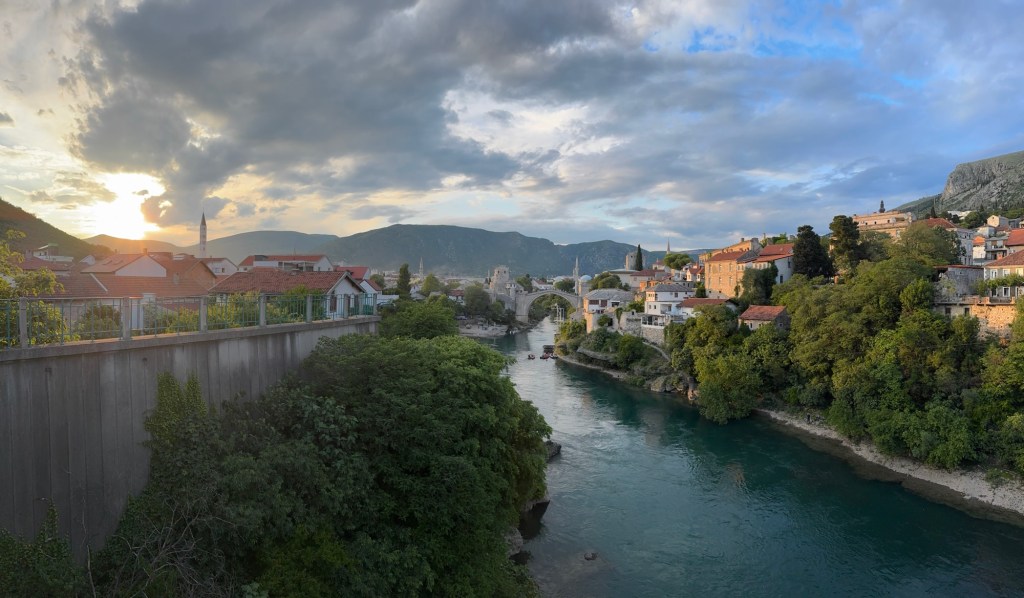
Once again I was back in Mostar, once again I was lucky to stay at Brajlovic’s white house with its beautiful garden near Lucki Most and once again I was torn between two mistresses….

Let me explain.

“Brajla” is the undisputed champion of breakfast in Bosnia.

In his garden right in the centre of the city, just a few meters away from the famous “Old Bridge”, he grows his own herbs and vegetables, you can pick figs and berries off trees and shrubs and here you are immersed in the scent of numerous rose bushes.

At a place like this, breakfast is a celebration and sure enough, well before the agreed time, I could hear that my host was getting busy in his kitchen where culinary delights were created with the acoustic background of motorbike racing commentary from around the world.

A kilo of rose buds had been harvested already a couple of days earlier and immersed in slightly sugared water and lemon juice and kept in a cool and dark spot in the basement.

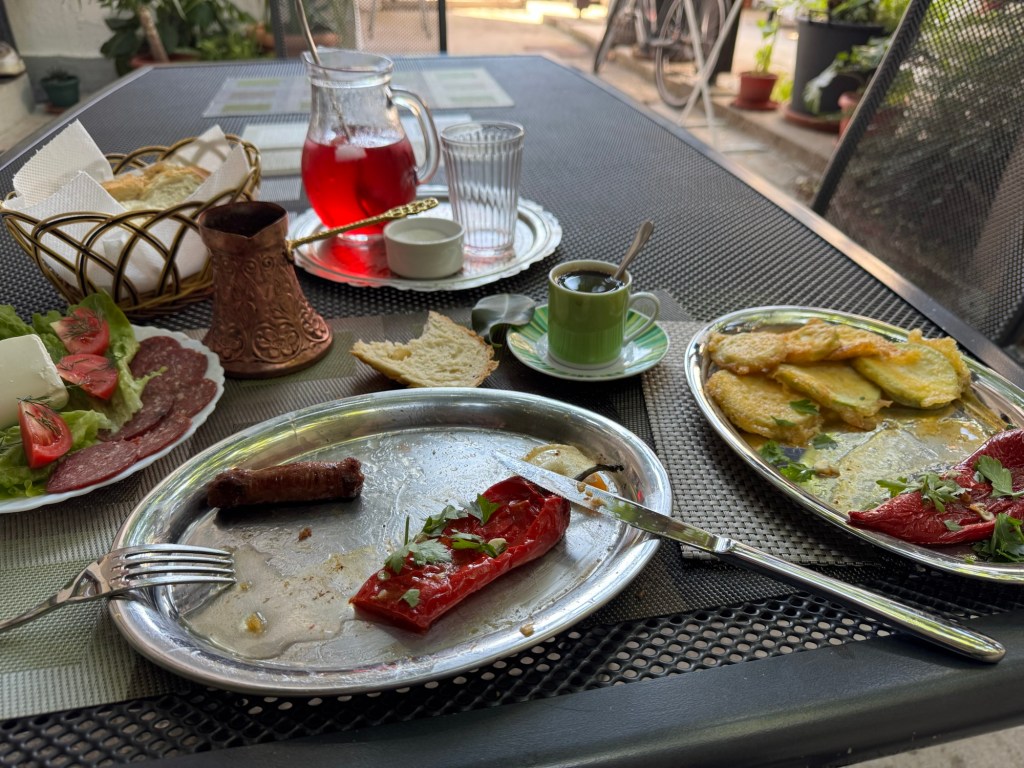
When I sat down for breakfast, the smell of freshly made Bosnian coffee blended with the fragrance of the rosewater, which Brajla had placed in a pre- cooled glass jug on the middle of the table. Small water droplets were running off the outside of the glass jug, creating a small pool of icy water on the silver plate below the vessel.  

Then the food arrived…. and kept coming….

Not less than three fried eggs, accompanied by Cevapis, the undisputed staple of Bosnian cuisine at any time of the day, together with fried fresh vegetables. There was smoked salami, fresh tomatoes and goat cheese, fried aubergine slices and freshly made, still warm bread. And just when you wondered when and who should eat all of this, the pan cakes arrived….

Food and coffee just kept coming and thankfully I had no plans for this morning, so that I could make time for this feast.

And yet, once I stepped out of the house, there it was again, the other temptation….

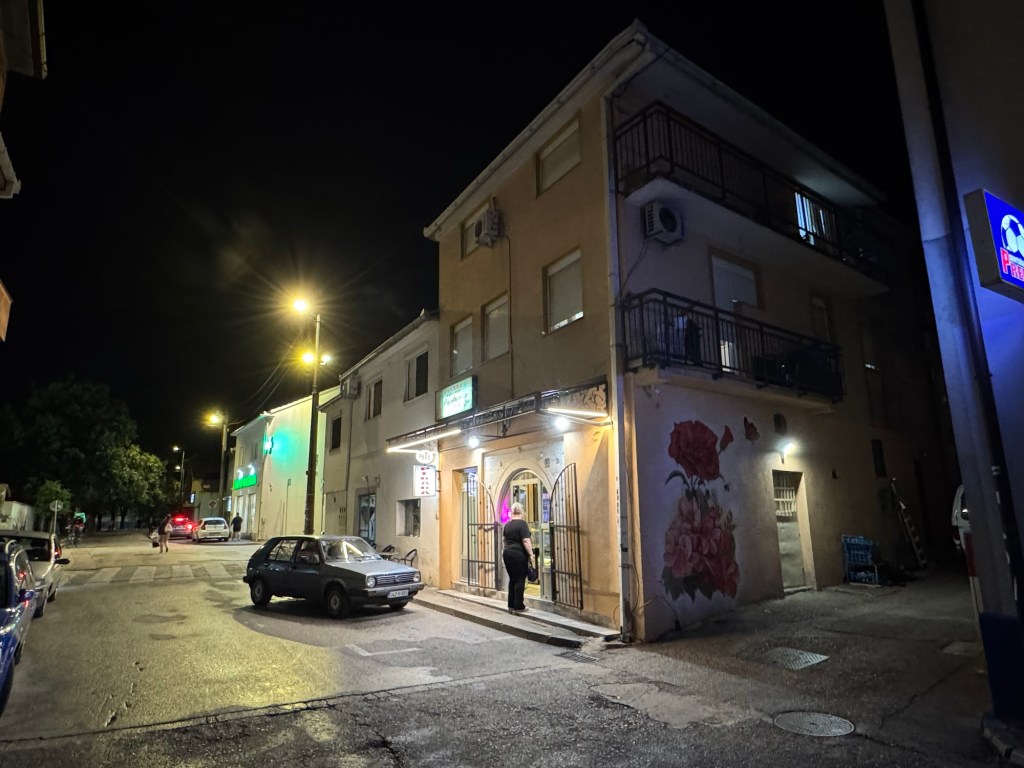
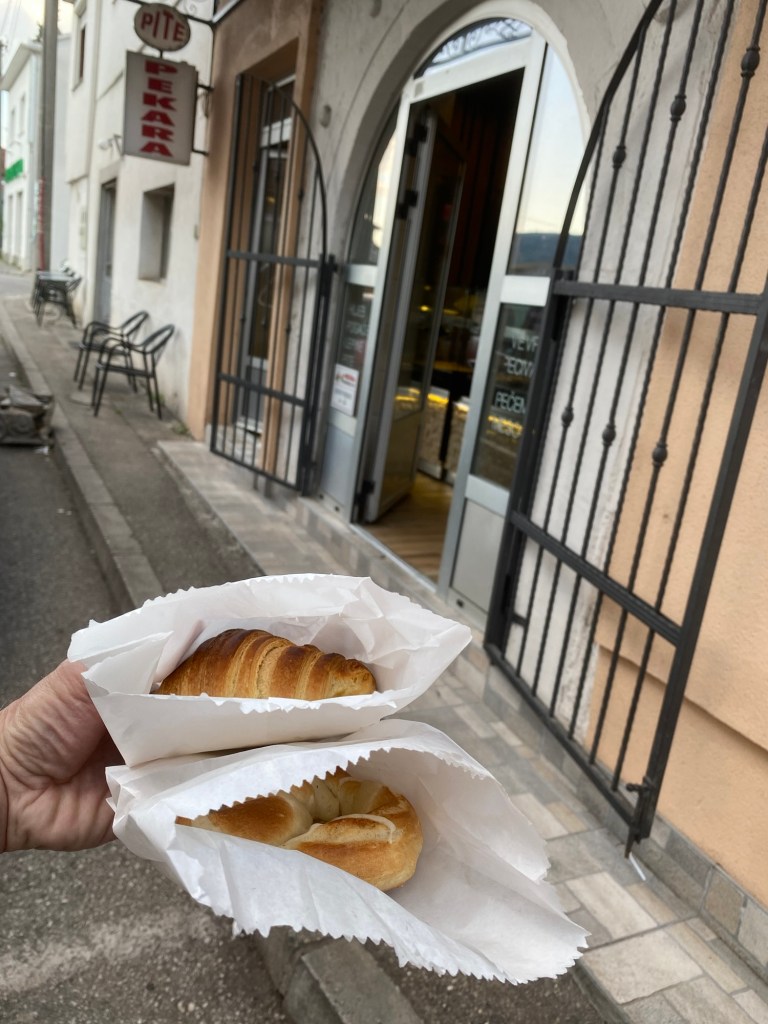
You just couldn’t avoid noticing it – the smell of freshly baked bread that came from the small bakery, located just at the end of the street.

This real hub of the local community produced and sold their fare at virtually any time of the day  and even at night.

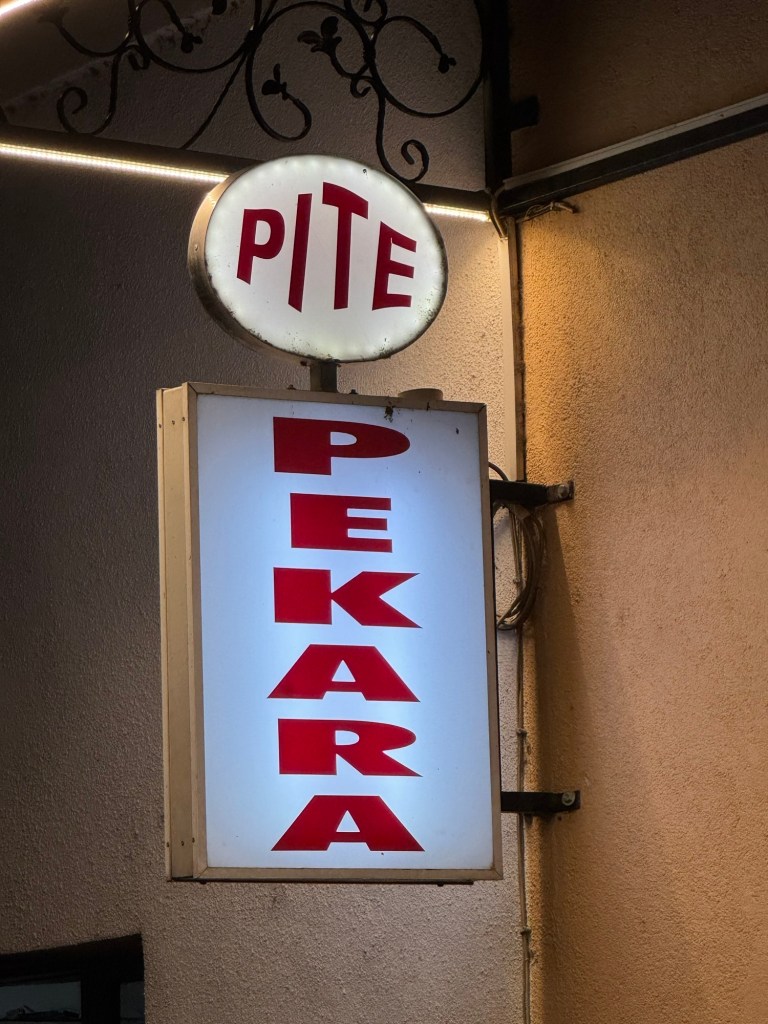
Brajla didn’t approve of the bread at “Pekara O grada”, but the queues of customers forming outside in front of the shop, showed that not everyone agreed with my host.

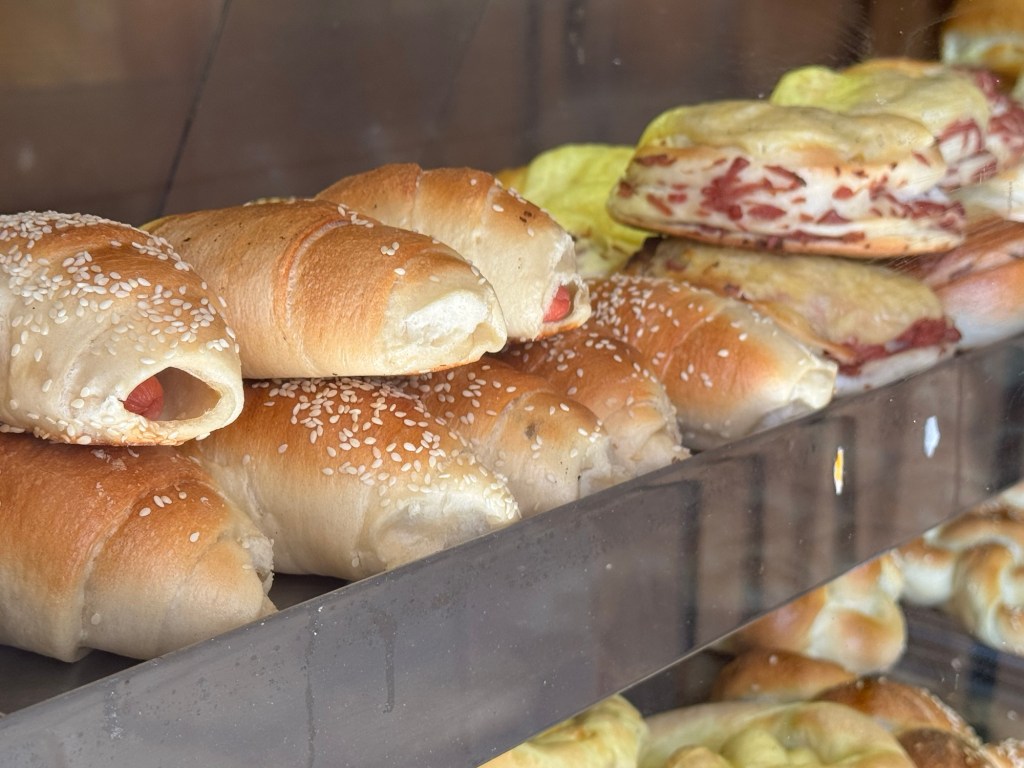
Just too tempting were their chocolate croissants, their pastries filled with sausages, with cheese or with jam  or just their plain bread.

There was hardly any decoration in the shop itself, mainly because of a lack of space, but also because there was just no need for it – the smell and the display of the produce spoke for itself.

And sure enough, despite one of the most outstanding breakfasts I have had in a long time, I found myself walking away with a couple of delicious croissants, that had been too irresistible to ignore.

They surely would have their time later that morning, helped by another Bosnian coffee.

Just don’t tell Brajla….

The Bridge over the Drina


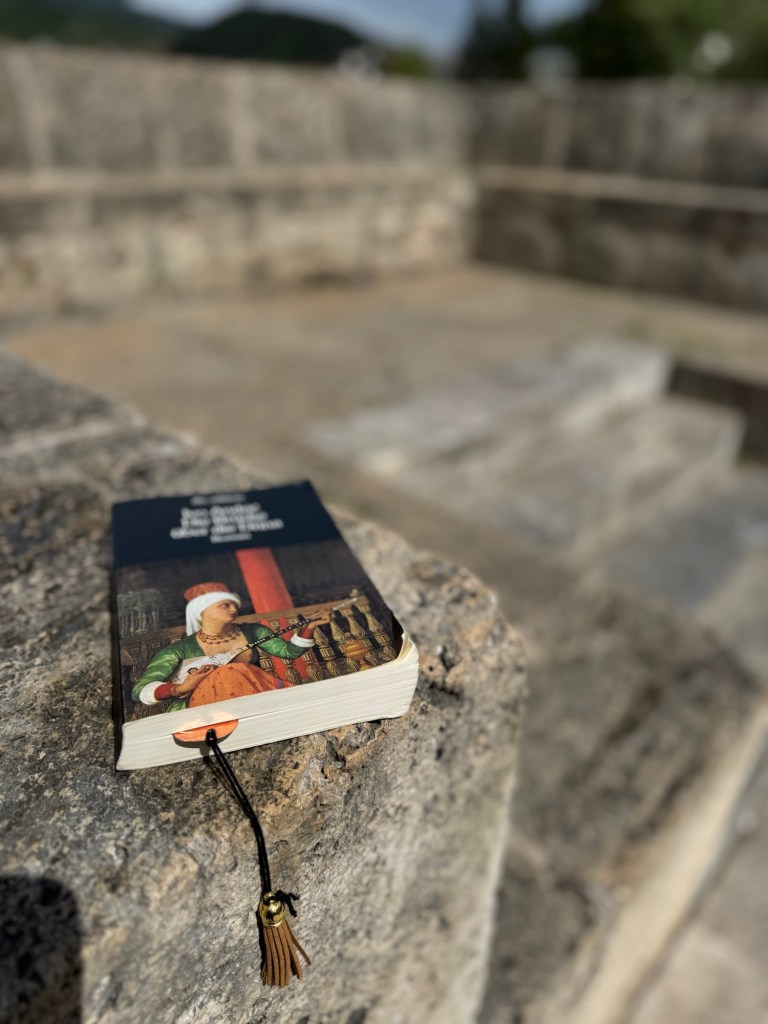
It is not so common that a building, even more so a bridge, is the main protagonist of a novel.

Before embarking on a second trip to Bosnia, I thought it a good idea to familiarise myself with the writing from this part of the world and what better way then to start with the most acclaimed work of it’s Nobel laureate Ivo Andric ?

Written during the second world war while under house arrest in Belgrade, this chronicle of the bridge at Višegrad, is certainly not a page turner and the detailed descriptions of acts of violence and mutilation as well as of personal tragedies can make it a difficult read.

However, the book gives you a great insight into the uneasy history of this part of Europe and of the communities that shared an often difficult coexistence over a period of nearly 400 years leading up to the beginning of the 1st World War.

Leaving cosmopolitan Sarajevo in a small German car, which appeared to be the most popular form of transport in Bosnia, it took me only a few kilometers of driving to notice that the Bosnian blue and yellow flags had been replaced by the Serbian tri-color, that  Cyrillic letters featured more prominently on advertisements and way signs and that political posters and graffiti were now more frequently on display.

 It also didn’t take long until I ran into a police patrol. However, as predicted by my landlady in Sarajevo, as soon as it turned out that I was not speaking the local language and that only German or English were on offer, the police man rolled his eyes and didn’t even give me a chance to produce my documents, before sending me again on my way.

Leaving the treeless mountains around the capital behind me, the landscape soon changed to green plains and areas of dense woodland.

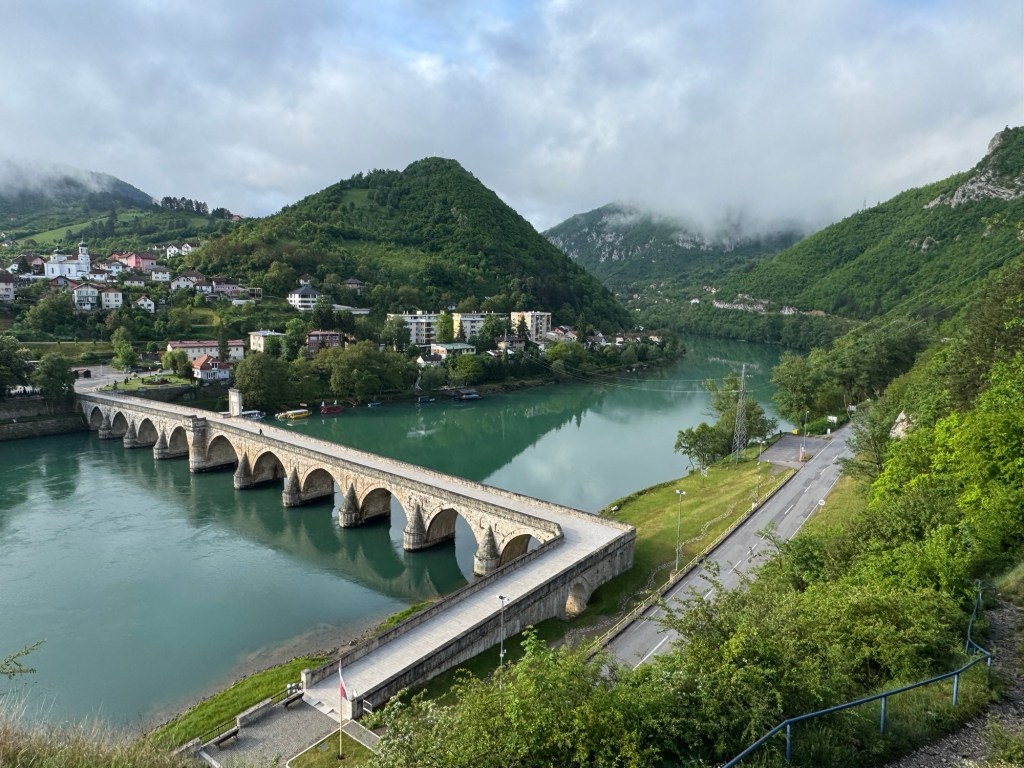
Just when the patronising software of my vehicle started to suggest for me to take a break, I found myself already driving alongside the dark green water of the Drina, a feature that Andric had described already a century ago.

It now didn’t take long until the ten limestone pillars of the bridge came into sight, that had withstood the force of the river, wars and the crossing of men, beast and machines for over 400 years.

The bridge had both been an example of the finest Ottoman architecture, as it was a demonstration of the might and the technological superiority of the 16th century rulers in Istanbul, the dominant power in this part of the world at that time.

Mehmed Paša Sokolović , who had commissioned the bridge to be build and after whom it had been named, was born not far from Višegrad. As so vividly described by Andric, he was sent as a child as “blood tax” to the Sultan’s court, where after converting to Islam and excelling as a soldier, he eventually became Grand Vizier.

With Mimar Sinan, widely seen as the father of classic Ottoman architecture, he had tasked the most outstanding architect of the time with the construction of the bridge. And yet is the bridge at Višegrad these days only regarded as the second most famous water crossing in Bosnia Hercegovina, being outshone by the international popularity of the single humpbacked arch of the bridge in Mostar, which was constructed by Sinan’s pupil, Mimar Hajruddin.

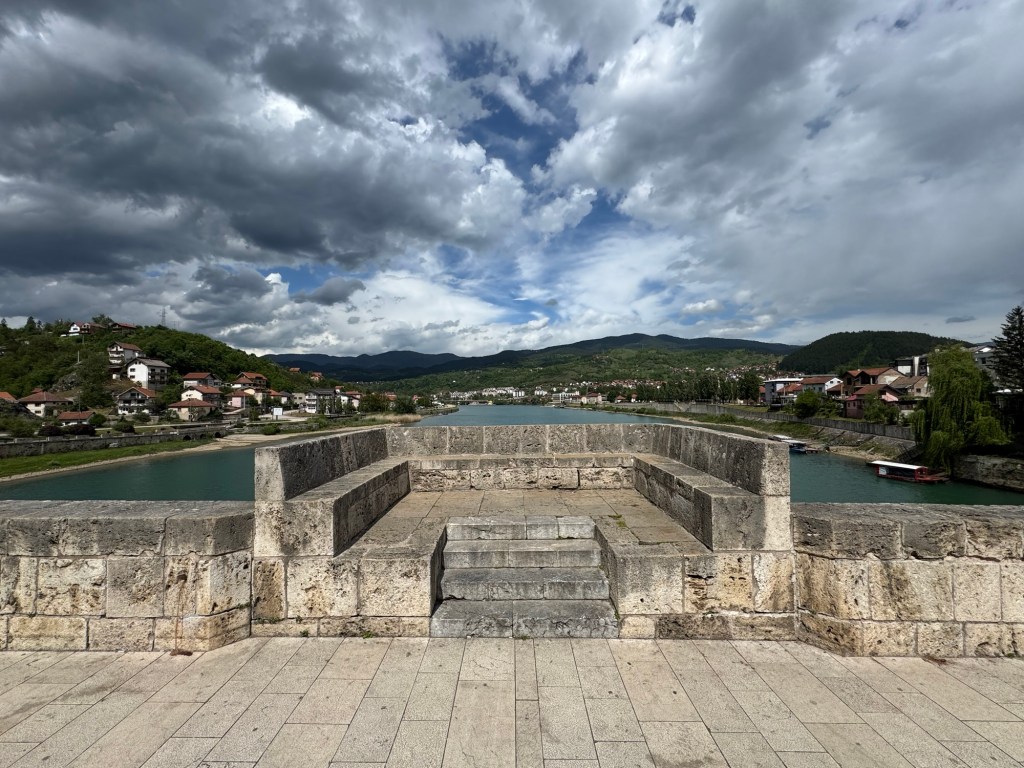
An important feature of the bridge in Višegrad is its 6th pillar, where the bridge widens to allow space for a large column with a couple of memorial plaques on one side and for the “Kapija”, a spacious limestone sofa, that used to be covered with carpets und pillows, on the other side.

This place understandably developed into a popular meeting place where the village elders where watching the comings and goings in and out of town. Thrifty merchants used this spot to relieve farmers of their produce which they were bringing to the market, to sell it themselves there later for an inflated price. While enjoying their place and the conversation on the Kapija, this group tended to maintain itself through a regular supply with tea and sweets from a number of vendors that had made the bridge their shop front.

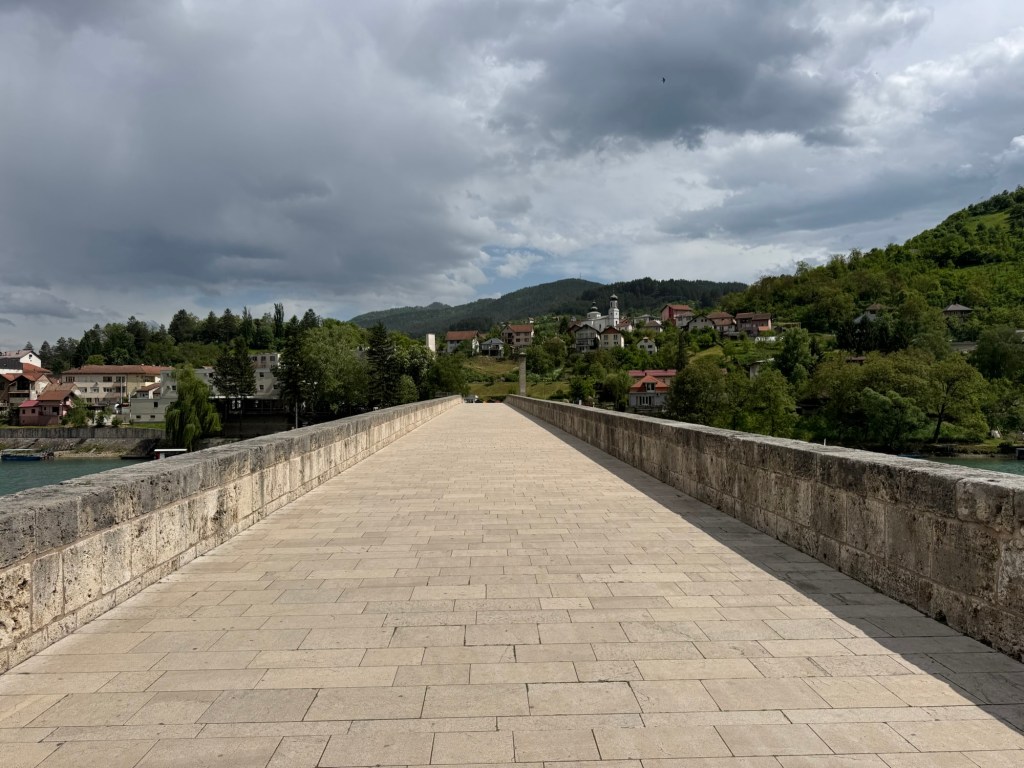
Sadly there were no such ongoings on the bridge any more these days, with most of the locals using the bridge just for its main intended purpose – to get on the other side of the river.

However, while sitting for a little while in the middle of the bridge, one can still imagine the young soldier Gregor Fedun, who was so cruelly deceived while standing here guard. It is not difficult to see Nikola the priest, deep in conversation with Mullah Ibrahim while waiting for the arrival of the first Austrian soldiers in the town.

While standing on the bridge at night, just a few meters downstream, you might still see the light coming from a single window in the otherwise dark town, where Lottika, the hard working innkeeper, is sitting over her books or writing letters of support and advice for her extended family elsewhere on the continent.

Or you might see Alihodscha, the shop keeper, one of the central characters of the chronicle, struggling, heavy breathing up the nearby hill and turning his back on the bridge that had played such an important part in his life.

Salt is the sea that could not return to the sky


The left kidney looked huge…

In fact it measured just over three times the length of the second lumbar vertebra and my mind was made up : this dog had a problem…..

Pete Mantis, the embodiment of the Greek enjoyment of life, a character that might just have jumped out of a Nikos Kazantzakis novel, a man build like a boulder, but undoubtedly gifted with one of the finest brains in diagnostic imaging, had made this the final question of one of his excellent presentations at the veterinary conference in Portoroz in Slovenia, which I was attending:

“Is this kidney enlarged or not ?….”

In line with the other 150 colleagues in the room, I had to press the right or wrong button and…..I had failed….again…..

Following a 90 minute Tour de Force through numerous normal and pathological radiographs and CT images, Pete’s closing statement was that the physiological boundary of a dog’s kidney lies between 2.5 and 3.5 times of the length of the vertebra. Good news for the dog, but for me this once again confirmed that there still was so much to learn….

Ok, thankfully not all of my previous answers had been equally wrong, but now mentally drained, I decided that it was high time for some physical exercise.

While it had been a cold and wet beginning of April north of the Alps, the small Slovenian Mediterranean coastline was basking in bright sunlight and the thermometer was nearly hitting 20C.

The destination for this run was a unique place which I had visited only once before, a few years ago: the Salina of Seča, located right at the border to neighbouring Croatia.

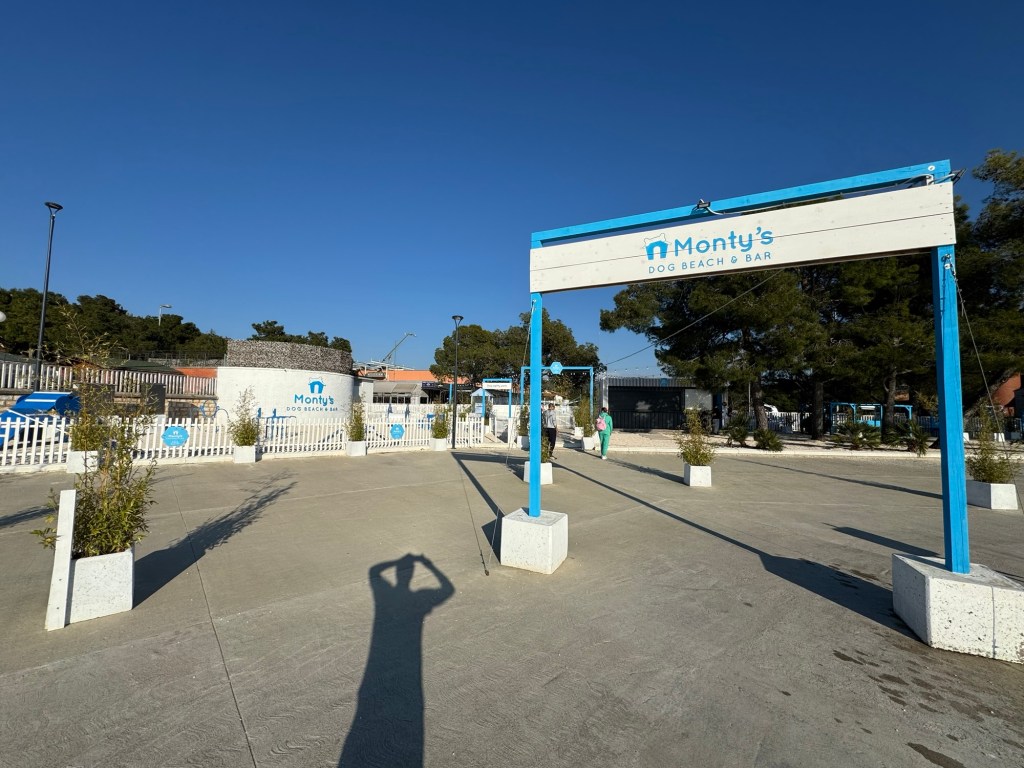
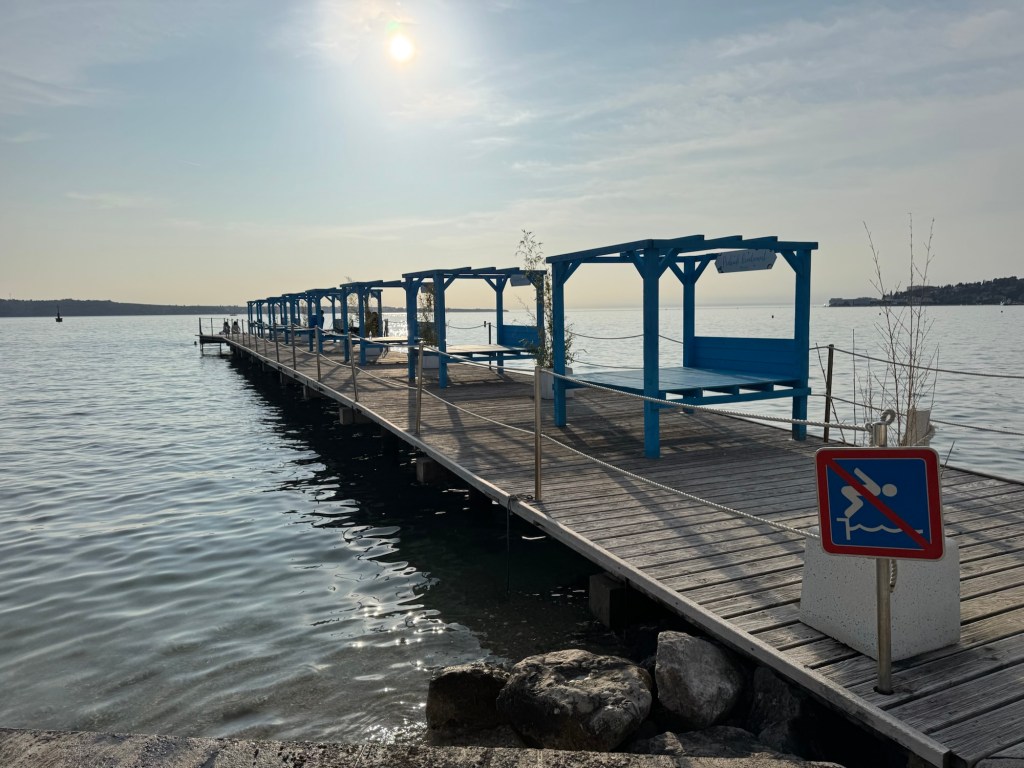
Turning left on the still fairly empty promenade in-front of the hotel, it didn’t take me long to reach the first point of interest, that demanded a brief stop and some further investigation: at probably the coolest place on the shore, a beach bar wholly dedicated to dog owners and their canine companions. What in most beach side locations suffers a poor existence – the dog beach – had apparently taken centre stage here.

If you don’t come along with a dog – tough luck, you are not part of the club!….

Pressing on, I passed the marina, where boats of all sizes where made ready for the forthcoming sailing season.

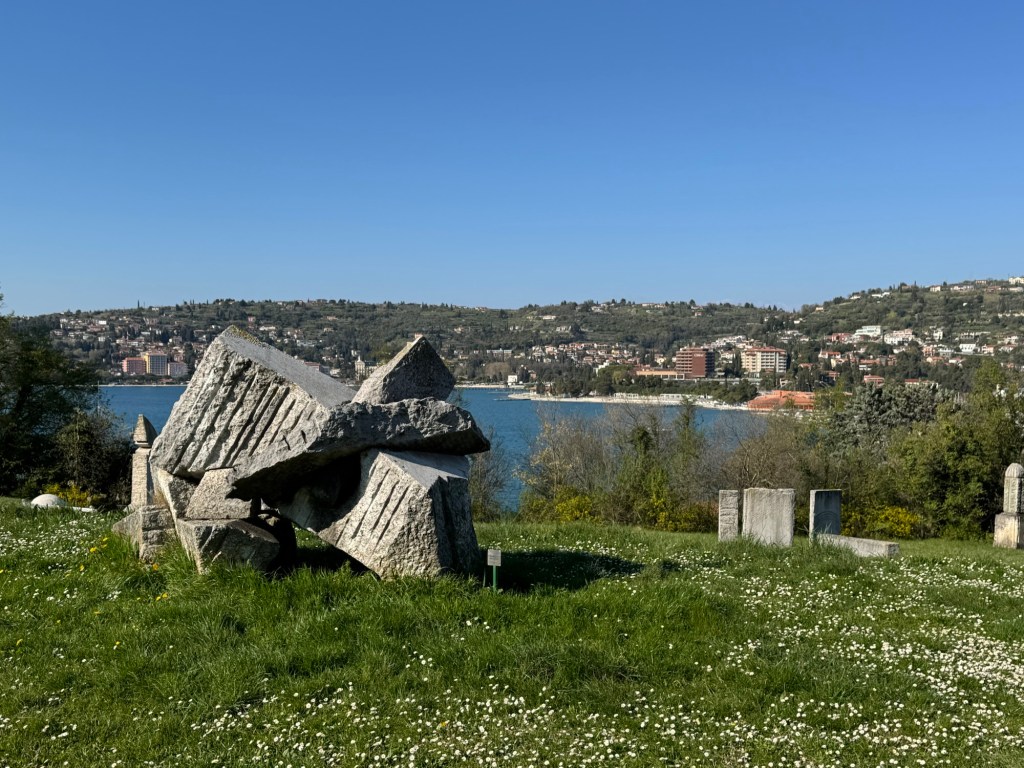
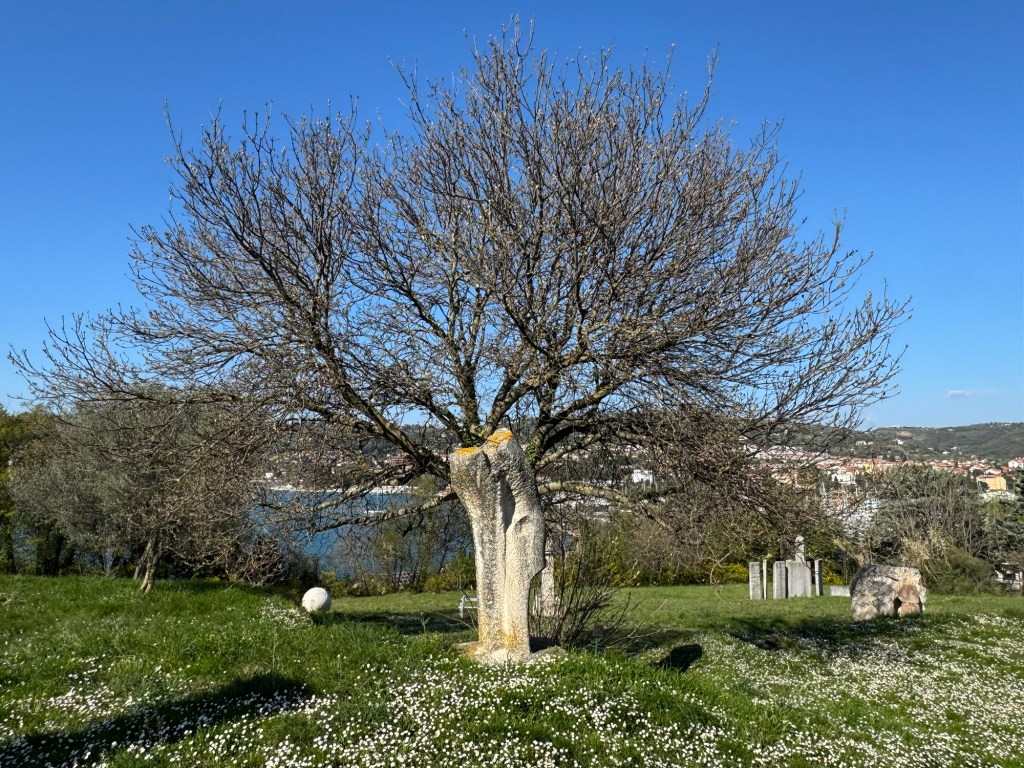
Taking then a shortcut across the small peninsula of Seča, I had to run uphill for a while and eventually found myself surrounded by olive trees which were interspersed with numerous sculptures.

This made a nice contrast to the flat and somewhat barren appearance of the salt pan, which was to follow.

Here time seemed to stand still.

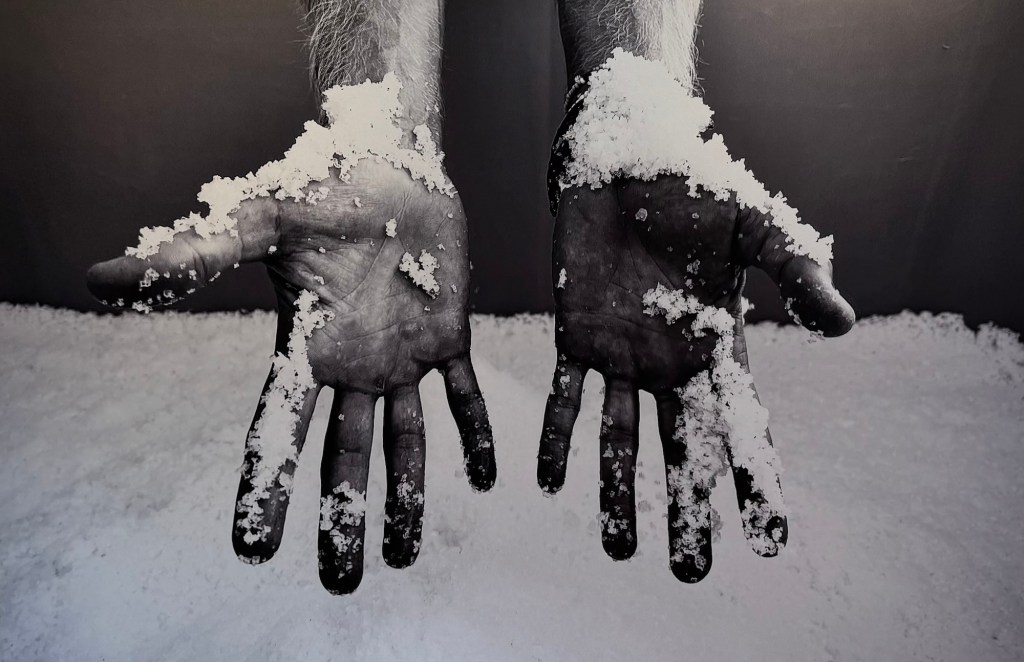
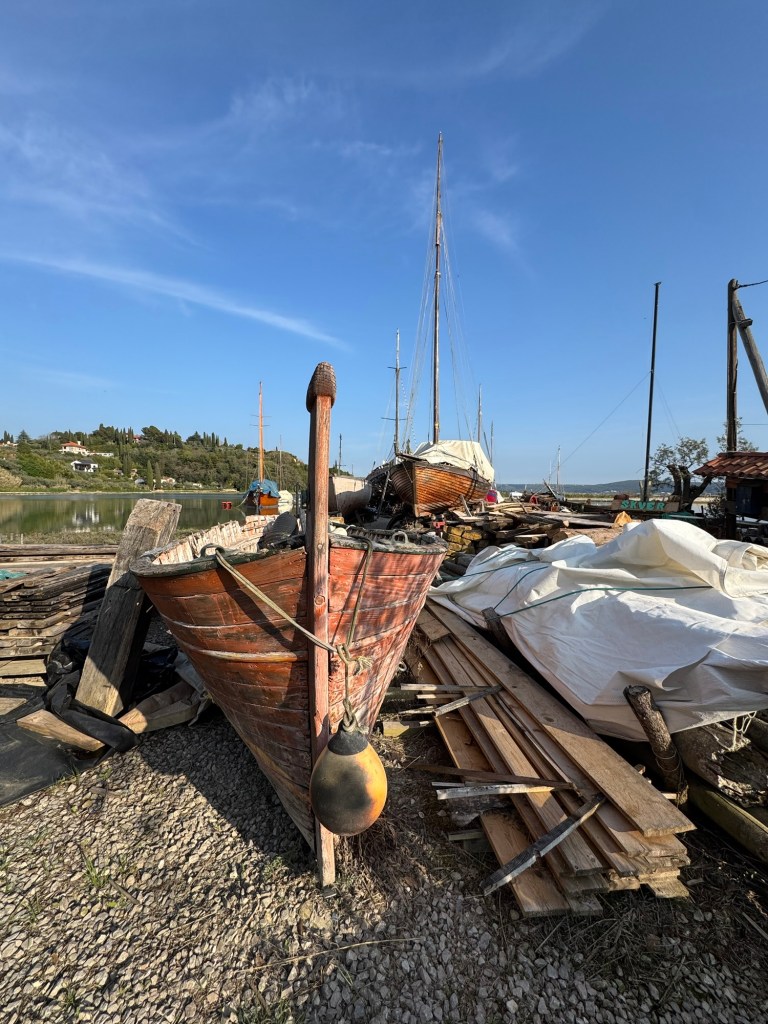
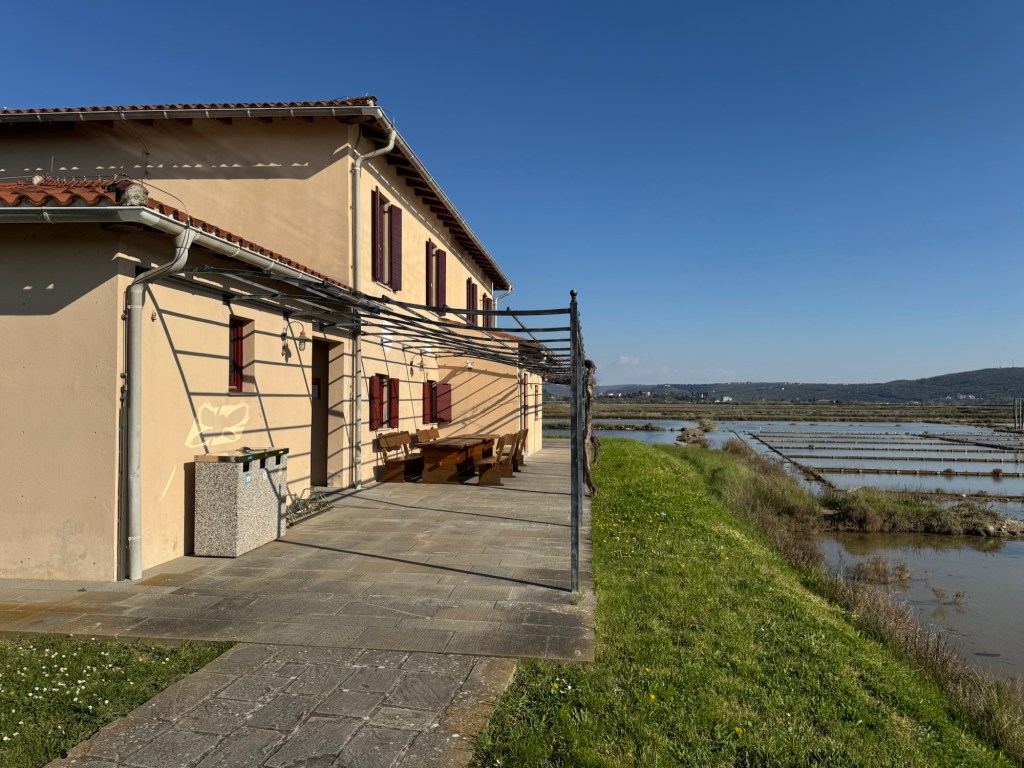
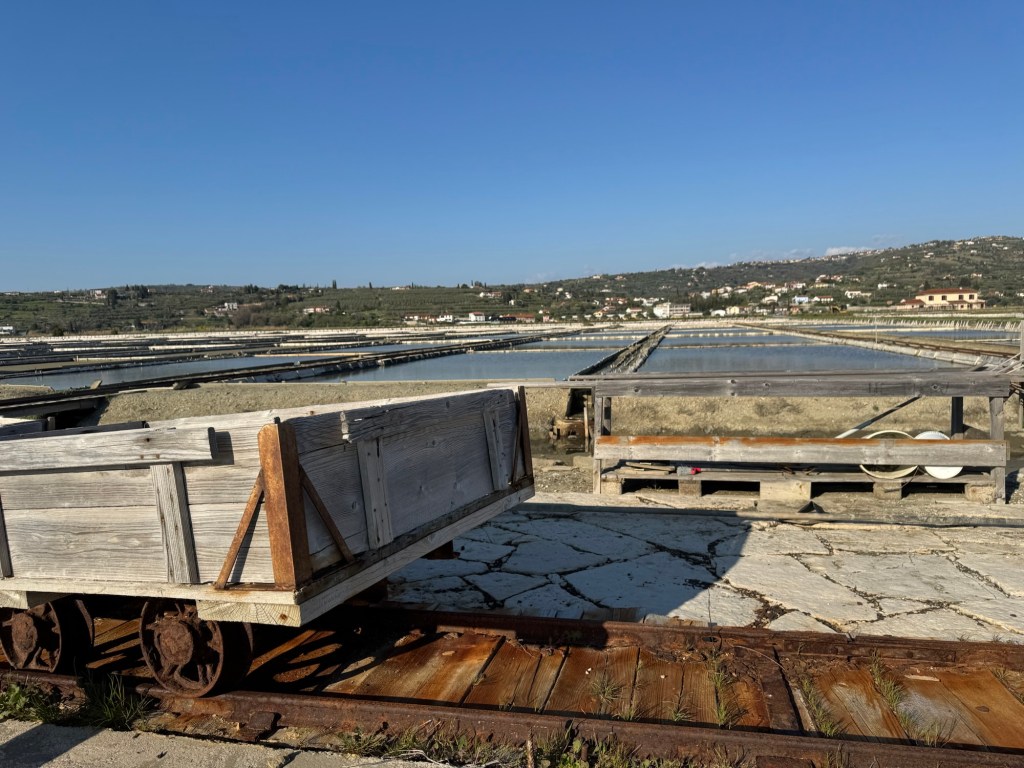
Some old sailing boats were moored at a small ship yard. Small man-made canals with hyper saline water were crossing the totally flat land, providing a haven to sea birds and to the maritime wildlife, that had adapted to this environment. The completely flat surface of the pan made for some fine running, with the occasional stop at the historic factory and storage buildings that had endured the expose to the salt and to the relentless sun for many decade.

It clearly is an industry where nothing is rushed. Harvesting the salt from the sea is a process that is taking time. There is no need to innovate or to speed up the process. For hundred of years just using the sea and the force of the sun in the right way has provided the local community with a commodity that was sought after all over the continent both as a vital ingredient for food as well as a preservative, especially at the time before the event of refrigeration.

The timeless character of the buildings, the simple tools and the geometric outline of this unusual place, had not only a calming effect, it also provided a great contrast to the world of digital innovation, the relentless advancements of technology and the constant demand for change and speed.

Great places like these are often closer than you might think, you only need to open your eyes and put on your running shoes (or hiking boots…) to find and to appreciate them…. 

Pet Insurance


I had noticed it for a couple of days, but had tried to ignore it.

When passing her bed, there was a sour odour in the part of the entrance hall, where she was sleeping. That her food was left untouched wasn’t anything unusual – she had always been a reluctant eater, but now there was also this distinct smell of gastric acid and now the evidence of some dried phlegm on her bedding….

Time to take some action….

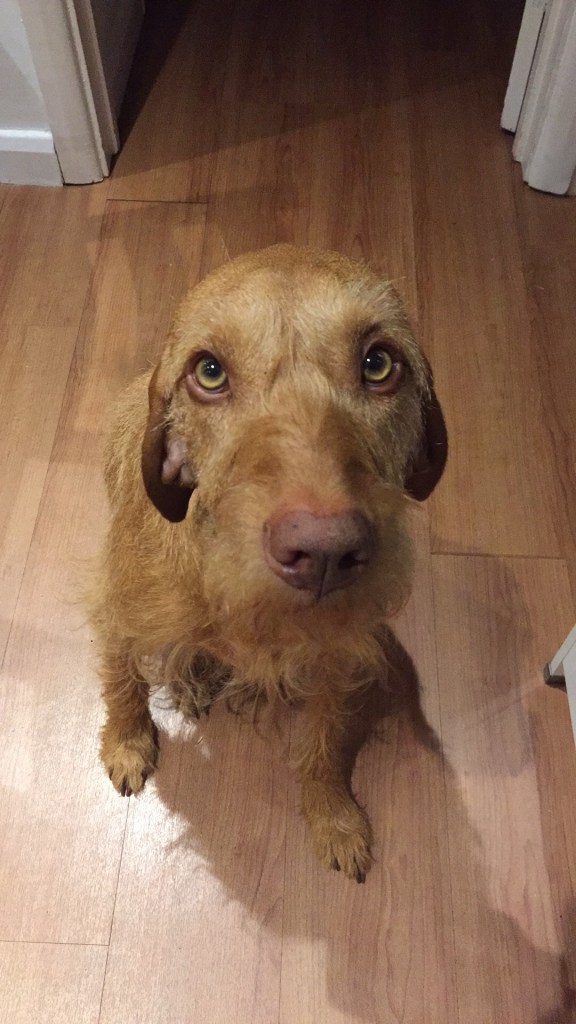
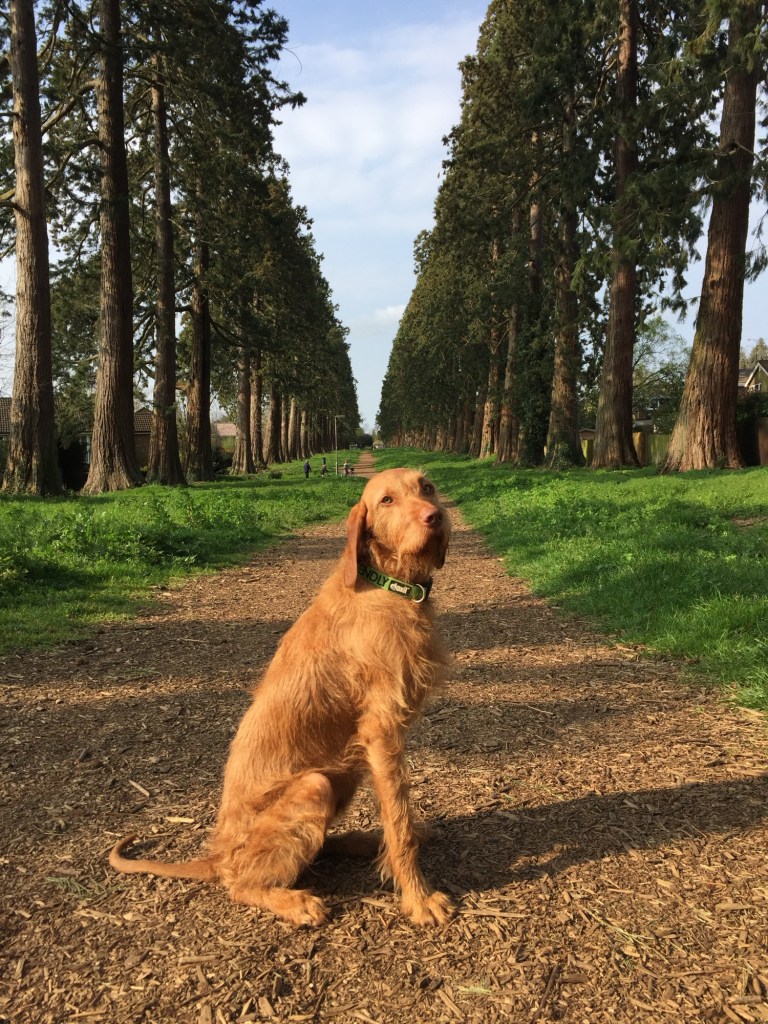
Without my own clinic now, I had to take Mia – our Hungarian Vizsla and a frequent travel companion on my journeys – to the local veterinary practices like any other pet owner in the UK and while I was allowed to stay involved with her blood tests, with the anaesthesia and a gastroscopy, which thankfully didn’t confirm my worst fears, I was still left with a bill that was just short of £ 3000.

Luckily Mia was and is still insured and while the insurer paid a fair part of the bill, I became concerned about what will happen once she gets older and is no longer insurable?….


As a young vet, there had been many reasons for me to move to England: the element of an adventure to start with, but then also the opportunity to work with international groups of colleagues, the better teamwork and the unrivalled dedication for the care of pets by most pet owners as well as by the veterinary professionals in this country.

What had been planned as a stay for a year or two had lasted well over thirty years and it is still ongoing.

Something that had come as an unexpected plus was the possibility of caring for a fair amount of insured pets.

While pet insurance had been known in my native Germany at that time as well, the few policies on the market offered only very expensive products that provided very limited cover. Insurance fraud committed by pet owners and frequently supported by members of the profession also inhibited the establishment of a diverse and widely supported industry at that time.

In the UK this had been different, mostly due to the efforts of Patsy Bloom and David Simpson, who as far back as in 1976 established PetPlan – for many years not only the trail blazer, but the market leader and the gold standard for pet insurance in Europe.

Both the uptake as well as the honest use of this kind of insurance worked here so much better and the economic success saw in a very short time the emergence of a very competitive market with a considerable number of providers who were able to offer good policies for reasonable fees.

It clearly was a game changer – both for the standard of care that could be provided to British dogs and cats, as well as for the complexity of work veterinary professionals could now offer and – of course – charge for.

With a considerable number of my patients being covered by health insurance, I could focus far more on the case itself and on tests and treatment a patient needed and I no longer had to justify to every client why an investigation was worth the fee we were charging. This took a lot of stress out of an already stressful job….

Many of my continental European colleagues envied me to work in such an environment.

As a result of  decent insurance cover being available at affordable prices, inevitably more advanced treatment could not only be offered, but was often expected by pet owners. The emergence of a number of popular vet programmes, often featuring the work performed at referral hospitals, added to this. As a result of this vet bills increased considerably and so did the price of the policies.

Seeing how high bills could now become, even I as a vet with my own clinic started to insure my own pets and as news got around of some extreme vet bills, this further made it clear to the pet owning public how vital pet insurance was, unless you wanted to face financial ruin.

The situation wasn’t much different in the Nordic countries and I recall a number of  appointments I had with continental pet owners who had taken their dogs on a Scandinavian holiday, but who saw their travel funds depleted once their canine companion required veterinary care. There vet bills could be a multiple of that what dog owners were used to on the other side of the Baltic Sea.

In most Nordic countries it is now unthinkable of owning a dog or a cat without health insurance – it’s the same as driving a car without insurance. But what happens if even that isn’t good enough?  What happens when  your pet is healthy, but becomes too old to be insured or what can you do if the treatment cost exceed the limits of your policy ?

I am still haunted by the case of a three-year old Jämthund, the dog of a forest worker with a very basic income, which I saw some years ago in Sweden.

The dog had got into a fight with a moose and had sustained a fractured jaw, a couple of cracked ribs and a punctured lung. While this case had its dramatic elements, the dog was pretty stabile and these injuries could certainly be fixed.

The owner was insured, but the cover was limited to 6000 Euro and the bill was estimated to be in the region of 8000 Euro for the necessary operations and the expected hospital care.

While the owner, an honest, hard working man, explained that he just didn’t have the means to cover the difference, the clinic management remained firm on the price they would have to charge. As a result, this otherwise athletic and healthy dog was put to sleep…..

Seemingly not an uncommon occurrence, also going by some of the cases presented at veterinary conferences, where following high end state of the art veterinary care patients eventually have to be put to sleep or were lost to follow up tests, because the owners finally had run out of funds.  

What might be the solution?

While the advancements of modern veterinary medicine is coming at a price, I am getting progressively concerned that we might be loosing sight of the solid middle ground.

Too often is there only the option between very basic and often inferior care or the high end solution with eye watering final bills. Solid but yet not specialist care needs to remain affordable and accessible, without veterinarians running the risk of being liable for malpractice if the state of the art route had not been taken. As in most cases, good communication with the pet owner has to be the key.

When it comes to the care of elderly  and no longer insurable pets, I think that both sides – pet owners and members of the profession – need to limit their expectations and at least find an acceptable solution to better the (remaining) life of the patient.

Where did this leave Mia ?….

Thankfully she recovered remarkably well from an inflamed oesophagus and a secondary aspiration pneumonia and while she remains insured – albeit with a limited cover – I have started to put money aside to be prepared for the next unpleasant surprise.  I keep her as fit and well protected as possible, but I am starting to worry that I will no longer be able to take her with me travelling to some countries once her insurance cover finally ceases to exist.

Sadly not every pet owner will have the discipline or the means to do the same with their pet….

Too late to ski, too soon to run….


It had been a quiet day at the clinic – just a couple of spays and no consults this morning. A recent publication on Anthrax in beast and man, which I had read to while away the time, had been less than stimulating – just a nasty bugger of a disease you would hope never to come across, neither as a vet nor as a human doctor.

Eventually it was noon and the crisp -5 C of the night had been transformed into comfortable + 15 C in the sun, with a blue sky and not the slightest bit of a breeze.

A high pressure system had stabilised itself over Switzerland and the Alps and with that, the finest spring weather you could imagine.

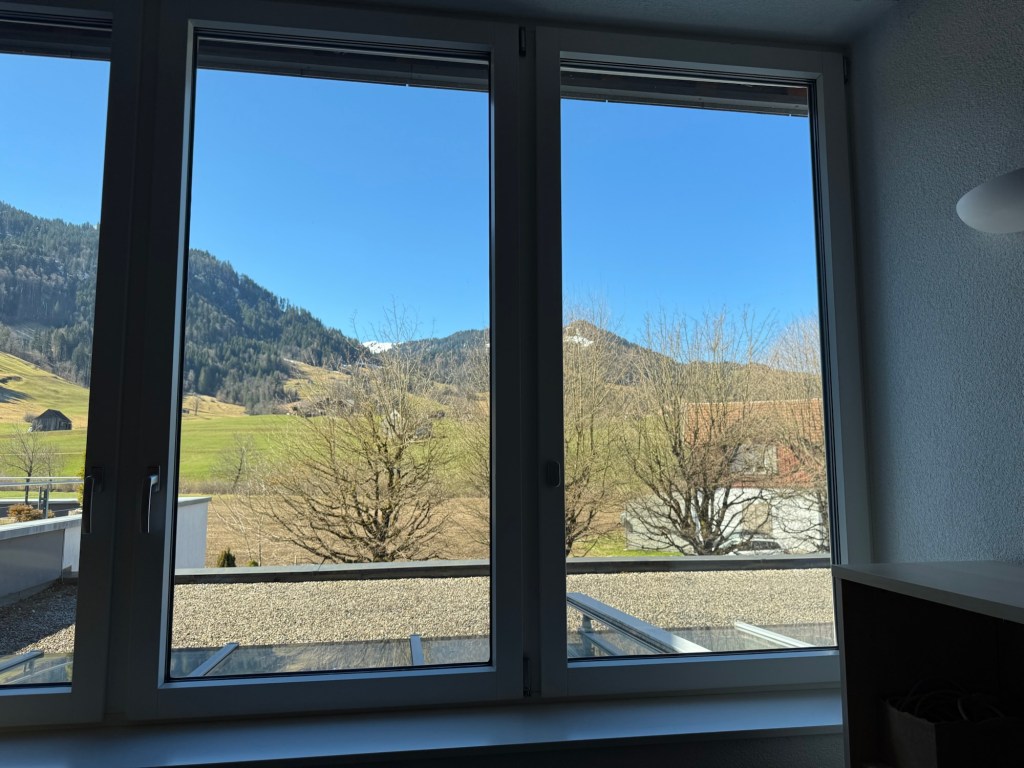
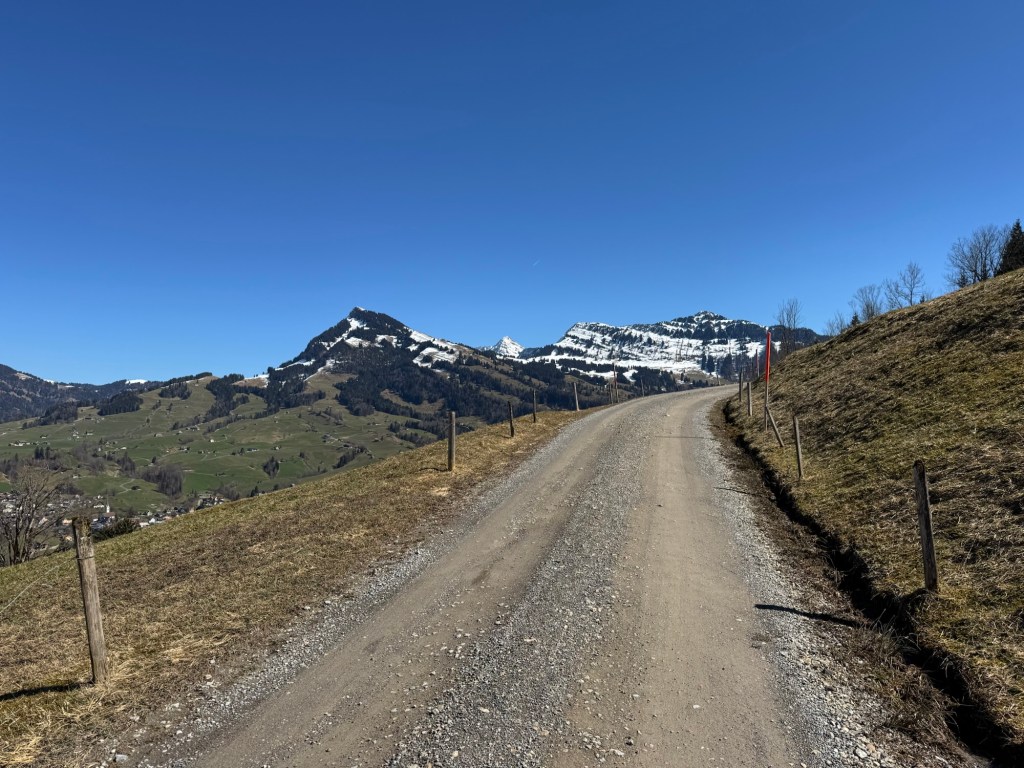
Right behind the clinic, albeit a 4 kilometre steady climb on a gravel road away, lay an Alpine plateau which struck me as the perfect destination for some lunchtime exercise.

The emergency phone left with my Dutch colleague (I had it yesterday), I set out along green fields that had just emerged from months of snow cover. The grass wasn’t showing enough growth to stain any livestock and no spring flowers were yet sprouting.

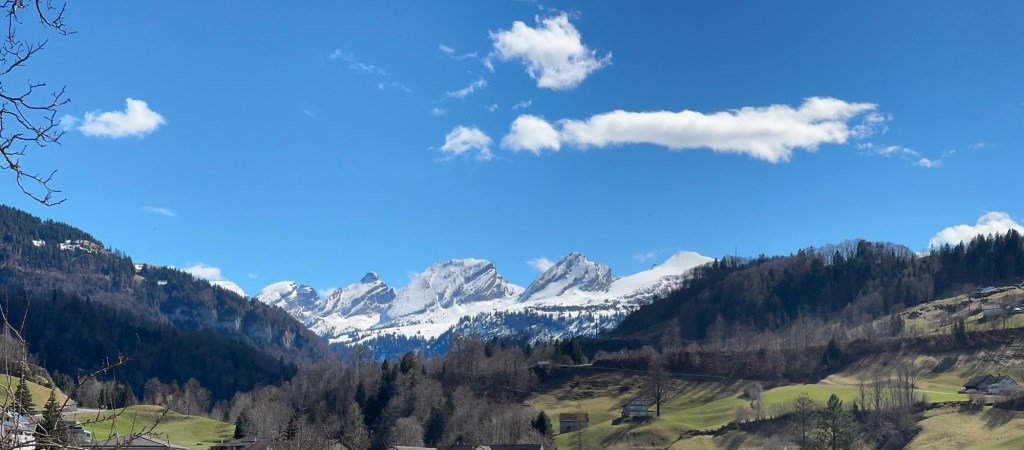
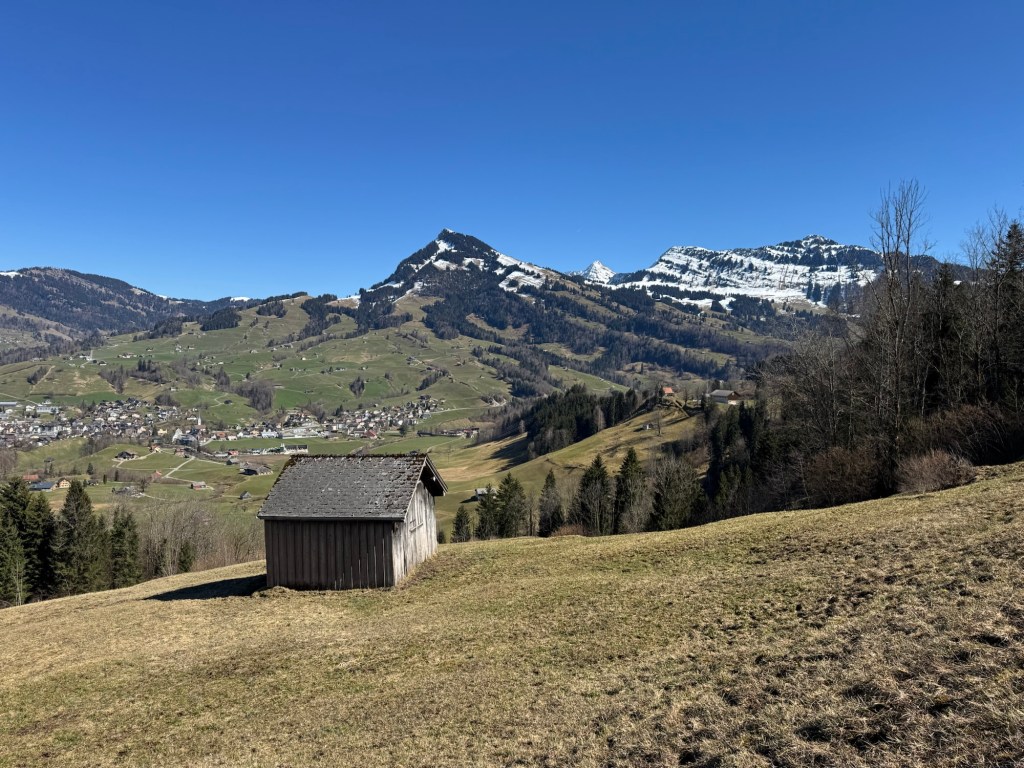
Not speed, but endurance and a steady pace was required to truly enjoy this part of the run. The higher the path ascended, the better was the view, with the still snow covered mountain tops providing a striking contrast to the fields and forest below and to the azure blue, cloudless sky above.

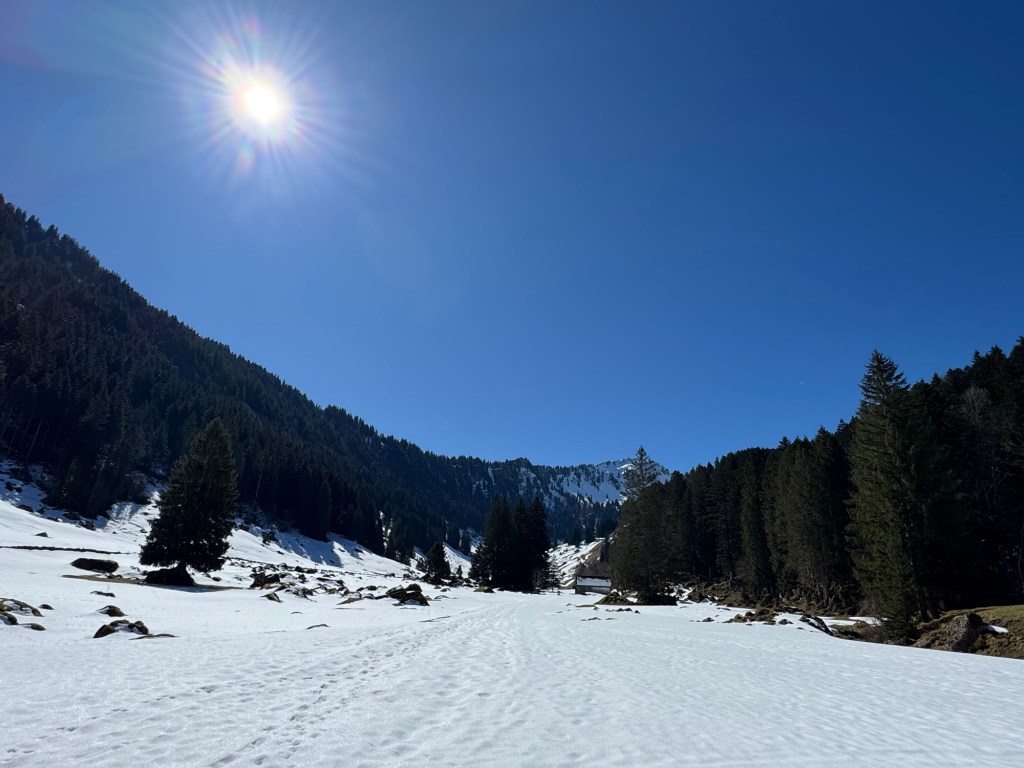
Once I had reached the shaded parts of the track, I found them still covered with the  remains of harsh winter snow and with the ice of once again frozen meltwater. With my feet struggling to find enough purchase, I realised that this would certainly not result in my fastest time for this run, but with a scenery like this, it didn’t really matter.

Reaching the plateau, I nearly stepped on a sizeable frog that had just woken up from hibernation  and I noticed that the nearby reservoir was now devoid of any surface ice.

Reaching the way sign that marked the turning point of my run, I allowed myself a pause for a few photos and to enjoy the view of the still snow covered valley ahead of me.

The journey downhill was equally delightful with more stunning views, which I would normally only expect to find at alpine holiday destinations and on cringeworthy postcards from these places. Still hard to belief, that this came along with the job.

After just under an hour I had returned to the clinic, with ample time left to take a shower, have lunch and to take a rest before the afternoon consults were due to start.

Not the worst locum placement one could say…..     

Hamburg


The conversation with Ebeling wasn’t planned, nor was the encounter with the Baroque  interior inside a Lutheran church or finding a set of concert halls inside a Tsunami….but in Hamburg these things just seem to happen….

I met Ebeling outside Carl Feddersen’s Sea Shop, enjoying the rest of his cigarette.

“Just go in, I am coming in a minute. Otherwise just leave the money by the till…”

I hadn’t really planned to visit a maritime outfitter on my trip to Hamburg, but having recently seen a documentary about an (in)famous German actress, who used to working this shop (she was in fact the daughter of the founder), I had to take a look.

A bit of a time warp I thought…..

This place must have looked just the same some 30 or even some 50 years ago, may be with the exception of the credit card terminal.

And yet – what was on the hangers and on the shelves wasn’t outdated, it was just timeless.

The designs of some oilskins and waxed woollen jackets or of the Bretonic marinieres might even have been a century old, but they still looked stylish today.

“Just put something on and I will tell you, if it’s the right size and if it looks good or crab on you.” said Ebeling, who was now standing right behind me.

As it turned out, this statement of competence had some justification : after having worked as a model some decades ago, Ebeling had not only taken over the shop from his brother in law (the actress’ brother), quite a few of the items had also been designed by him and had been produced in small quantities  in hand selected workshops in the Netherlands, in London (!), in France and in Ireland, but certainly not in a sweatshop in the Far East.

However, I soon found out that the real attraction wasn’t the clothes, it was the man behind the counter.

An international competition sailor when not busy on the shop floor, Ebeling clearly was a man who liked straight talking and had clear opinions, with a lot of black and white and very few shades of grey. Add to this a lot of life experience, the avoidance of adjectives and the razor sharp German pronunciation that is so typical for people in the North.

“So, you live in the UK?  Well, here in Hamburg, we like the British. They lived from the sea – just like us! But I don’t like the Spanish….they are just talking too much!…By the way looks rubbish on you and it also isn’t the right size. Try something else…..”

I just had to laugh….but he was right – at least about the size…..

From just wanting to look around, I spent easily the best part of 20 minutes in this small shop, just talking or listening to the conversations Ebeling had with other customers, most of whom turned out to be re-offenders, having visited the shop some time many years ago.

What you bought here really seemed to last or at least the visit must have left a lasting impression.    

With some reluctance, I eventually managed to leave the shop and headed for my second impromptu point of call : the tower of the church of St.Michaelis, the “Michel” as locals are calling it. For hundreds of years it was the symbol of the city, watching over the harbour and welcoming home sailors, traders and travellers who had crossed the continents and the seven seas.

How surprised was I though, when I stepped into this historic building:

Expecting the plain, understated interior of a Nordic Lutheran House of God, I found myself surrounded by elaborate wood carvings, gold platted Corinthian columns, cushioned pews made of teak and an altar and a pulpit build with thick blocks of marble.

Baroque architecture like this I would have more expected in a place of worship in a Bavarian market town than in a city that was dominated by warehouses made of red bricks and a harbour featuring cranes and vessels made of timber and more recently of steel. Surely a testimony not only to the age of the building, but also to the commercial success of the Hanseatic trading tradition.

However, the centre of attention has now moved away from the “Michel” to a building of a very different kind, which is situated just a few hundred meters away, right next to the water and which every visitor to the city, regardless if arriving on land or on a ship, is obliged to see.

After been pulled into the bowels of an enormous wave with the help of one of Europe’s longest escalators, I find myself in the “Elphi”, the city’s truly spectacular new home of its philharmonic orchestra.

Not much teak or marble is found in this cathedral dedicated to the religion of sound . This structure made of steel, glass and concrete emanates its very unique elegance and style, that so easily has made it the new icon of the city.

Eventually I find myself standing, well protected from a northerly breeze by a new, smart looking and well fitting Irish wool jumper, on the balcony, enjoying the view of the harbour, of the tower of the “Michel” and of the city that embodies like no other in Germany the idea of travelling.  

Two remarkable men


Over the last few weeks, I have made the acquaintance of two remarkable men.

Unfortunately both are no longer with us, but they left a deep impact on me.

Let me tell you more about them…..


It was just before Christmas and as I was not signed up for a shift at the emergency clinic that night,  I was strolling through Mayfair and Soho, enjoying  – like thousands of other visitors to London – the festive illumination of the roads and buildings along Carnaby, Bond and Regents Street.

Forgotten seemed the concerns about possible fuel shortages and lighting artists commissioned by the darlings of seasonal shoppers with infinite budgets were outbidding each other with their extravagant installations, very much to the delight of the mere mortals, who had to limit their own purchase to a mulled wine in a thin paper cup for the best part of ten pound.

Eventually I had progressed to Piccadilly and after admiring the unmistakable façade of Fortnum & Mason, which resembled a giant advent calendar, I decided to take a closer look at Hatchards, one of London’s most famous book shops, which was located right next door.

Describing the history and the dimensions of this institution, which is solely dedicated to the written word, could easily provide enough material on its own to fill a chapter of this diary.

May be another time….

Progressing up the wooden staircase through this world of paperbacks, signed hardcovers, rare 1st editions, heavy coffee table books and of new releases, which still emitted the smell of fresh ink, I came across my first protagonist:

“The man who loved Siberia”

Based on his travels to the Far East of czarist Russia, the book is taking you along on several  journeys in the second half of the 19th century together with a man called Fritz Dörries, from Hamburg to Vladivostok and to the unspoiled wilderness of Siberia.

Inspired as a child by the drawing of a colourful butterfly, unknown in Europe at that time and encouraged  by the travel accounts of famous naturalists like Alfred Brehm and Alexander von Humboldt, Dörries immersed himself into a pristine and diverse wilderness, that had been witnessed by very few human beings before him.

Here his sole focus was to collect and to preserve as many yet new and unclassified species as possible, for the fast growing collections of European universities and natural history museums that were trying to meet the demand for knowledge and entertainment of the colonial societies of that time.

His shipments from the Far East included not only rare butterflies, but all kinds of insects, plants, species of smaller and even larger reptiles, birds and mammals and also large quantities of day to day house hold and hunting utensils of the native communities he encountered. For months he disappeared, with only one or two companions, into a world, where confrontations with bears and Amur tigers were common, where groups of marauding bandits where a regular threat and where he had to live off a land that had one of the most extreme climates on the planet.

Naturally this was a time without satellite navigation, without mobile phones, without something called “travel insurance” and without even basic forms medical support.

But Dörries was prepared: having grown up in a large, science and nature obsessed household, with his father working at one of Europe’s first public zoos, he had a deep understanding of the plants and the animals he encountered, of their interaction and of the usefulness or the threat they posed.

Having fought in the German-French war, a few years before his departure, he knew how to handle a rifle and how to stay calm when coming under fire.

As natives of a maritime city like Hamburg, his whole family had an unconventional attitude when it came to long haul travelling:

At one of his occasional return journeys from the wilderness to Vladivostok, to resupply himself with basic necessities and to ship off the specimens he had collected, he just by chance runs into his 16 year old brother, who had managed to convinced his parents, that for him as well it was time to leave for the Fare East and to take up an apprenticeship as a merchant at Kunst and Albers, a famous German department store on the Russian Pacific coast….  

Dörries’ diary read like a window into a long gone and forgotten world and as unbelievable as some of his accounts were, as unusual was the journey of this book itself:

Based on a long forgotten German manuscript written in Sütterlin, the diary resurfaced, was edited and first published in Norway, before finding its way to British book shelves. A German translation is still not available.


While I was still immersed in the vivid accounts of tiger hunts, bear attacks and winter journeys along frozen Siberian rivers, my path crossed that of another remarkable man:

his name was Eddie Jaku…

“The happiest man on earth” is at least at first sight one of the most misleading book titles you can imagine…

Eddie Jaku was a Holocaust survivor, a prisoner of the concentration camps of Buchenwald and Auschwitz.

His book is an account of his childhood just after the end of the first world war in Leipzig, of the experiences of his family during the Third Reich and of his life after his rescue, now 80 years ago.

This is not an easy read…

Very much like Fritz Dörries, Eddie Jaku is taking you by the hand on a journey through his life. A life that is starting as normal and as trivial as that of many children of a well educated, middle class family in the 1920th. But it is a life, that gradually descends into a perpetual nightmare, which makes living in the Siberian winter surrounded by hungry predators sound reasonably comfortable.  

At a very early stage, Eddie’s family is acutely aware of the threat they are facing and they are resourceful and well connected.
It includes that when Eddie is no longer allowed to attend his school, they change his identity and send him to Tuttlingen, a town hundreds of kilometres away from Leipzig. Here Eddie starts an apprenticeship as a tool maker.

Even today, Tuttlingen in the Southwest of Germany is regarded as a center for medical engineering and instrument making. I visited the place several times to attend ultrasound courses or to collect equipment for my own clinic.

Eddie, despite being only 13 years old, understands that under no circumstances can he reveal his real identity. He is not allowed to return home and only in very rare occasions, he can make a phone call to his parents from a public phone box.  

The plan is working and he is finishing his apprenticeship as the best of his class, but eventually events are catching up with him and with his whole family….

What sustains Eddie through the ordeal that then unfolds are three things :

  • The skillset and knowledge he had acquired over the preceding years, which at numerous occasions save his life.
  • The few, but important friendships he forms with fellow prisoners.
  • An unbreakable will to live, even when faced with the most despicable acts of cruelty and not accepting “No” for an answer

Against all odds Eddie not only survives, but despite having seen what men can do to their fellow human beings, he not only rebuilds his life, but he uses the evil he has witnessed, to appreciate even more every small and seemingly trivial thing that a family, friendship and the life in a free and equal society can offer.


What a humbling experience to be able to benefit from wisdom of these two remarkable men….

Emergencies


At the end of a year, filled with travelling, with meeting so many inspiring new people, with working once again in new places and with new teams, something I couldn’t have imagined when setting out on this journey five years ago, it was time for me to return to the UK and to open a new professional chapter.

I had become concerned that when locuming in first opinion practice, a fair share of the workload involves “routine” procedures, which – after a while – might feel repetitive and as there is no structured continuing education, which you can follow up with some degree of certainty in your own clinic, that the gradual loss of manual skills might become an issue.

Diversification of my current line of work was the answer and once again I had to get out of my comfort zone :

An area of clinical practice where there is no such a thing as a “normal shift”, is the work in an emergency and critical care (ECC) environment.

Here  “not routine” is the norm…..

You will not be asked to vaccinate any patient, nor will you advise on prophylactic parasite treatment or on the benefits of neutering procedures. Chronic skin or joint problems are no longer your concern, unless there is an acute flare up which requires a short term solution that doesn’t interfere too much with any long term treatment plans. Dental procedures are reduced to the pain and infection management of damaged teeth and to the wiring of fractured jaws.

You work more in the “now” than in the future. In the majority of cases, your concern are only the next 24-48 hours and the immediate alleviation of pain or suffering.

Your are more likely to suture wounds, unblock obstructed bladders, deal with obstructed or twisted intestines, deliver kittens and puppies and – unfortunately – you have to be prepared to euthanise more severely ill patients.

Work in ECC has more peaks and troughs – from a period or relative calm with little or no patients to look after, you might suddenly be confronted with a number of several emergencies at the same time, where you will need all your clinical skills and a good hand for a practical triage, to still provide the best treatment for all parties involved.  

Because you are walking more often the fine line between life and death and because you are more frequently the bearer of bad news, tempers might naturally run high at times and on balance the emotional impact of this line of work might be much higher than in general practice.

This might reflect in the personality of some fellow professionals who frequently work in this field. A certain “battle field” mentality might ensue.
1st opinion small animal practitioners have by far not the same level of personal contact and regular interaction with their clients as farm animal vets.

Emergency vets will see pet owners (hopefully) even less frequently and usually under more extreme circumstances, when the pet, the client or often both will be in a state of physical or mental distress.

In this situation it is not always easy to make friends…..

While you might be faced with a larger amount of upsetting cases, there are also more situations where you – sometimes very fast – can make a difference. This can be extremely satisfying.

Another difference of emergency medicine are the working hours: when most clinics are closing their doors, the emergency workers are starting their shifts. This naturally means working at night, on weekends and on holidays.

This is (within limits) fine by me. I can function well with only a few hours of sleep and I have always loved irregular working patterns. No longer depending on school holidays is another advantage. For me it doesn’t make much of a difference, if I am now working on a Wednesday or on a Saturday.


The provision of out of hour care used to be (and still is for a lot of my continental colleagues) one of my biggest problems:

When opening my own clinic, I had to provide my own emergency service around the clock for several years and it was extremely difficult to find colleagues, who were willing to take my phone if I wanted to go out or if the family wanted to go away for a weekend.

This all changed, when I heard about Richard Dixon, a colleague from Scotland who later became not only the President of the British Small Animal Veterinary Association, but more importantly, he changed the whole system of the provision of emergency and critical care for companion animals in the whole country.

His concept was as simple as it was ingenious:

By renting the clinical facilities of the PDSA and other charities only over night or on the weekend, when they were not in use for routine work, he was able to provide a service that was exclusively performing out of hour work, without becoming a competitor for the day to day care the already established clinics were providing.

While the loss of the work at unsocial hours meant a slight reduction of veterinary income for these clinics, the loss was more than compensated for by the more regular work pattern for the day team and by the reduction of the salaries that had to be paid for out of hour work. In addition to this, it made it easier to recruit new team members by offering veterinary work without the unpopular requirement for night and weekend work.

While several veterinary groups tried to copy Richard’s scheme, no one managed to role it out to develop into a national network of emergency clinics.

In my very own case it meant, that because of Richard, I had reclaimed my evenings and more importantly the weekends, which from then on were frequently spent with outdoor activities with the family. 

For this, Richard will always be entitled to a free drink if we ever happen to be in the same room again….


Returning to Surrey, it didn’t take long for me to sign up with the local emergency clinics. For this not only my years of clinical experience helped, but a further advantage was, that this was an area and a clientele that was so familiar to me.

The next step was to sit down and to study again….

While some of the lectures I had attended in Athens and in Belgrade had given me a lot of up to date information about emergency and critical care procedures, I had to read up on aspects of clinical care, that are not so common in day to day practice.

A typical scenario was the treatment of intensive care patients, which at my clinic  – if they were just too ill and needed long term hospitalisation – we usually had to refer.


As winter was making the days shorter and a near constant cover with heavy rain clouds claimed most of the remaining light, my first locum shift arrived and once again I was enchanted by a truly British quality which – especially as a native German – will never cease to impress me: team work rather than hierarchy.

While being just a casual worker, confronted with a team of strangers and having not a clue where to locate necessary medication and equipment, I found myself among fellow professionals who where comfortable to accommodate my initial disorientation and my lack of local knowledge of the clinic and within a very short time I had adjusted to the unfamiliar computer system and the first emergency patients could be seen….


Säntis


It had only been a short walk from the clinic to the station and the yellow post bus  left right on time.

Of course it did…..this, after all was Switzerland !

I had been on emergency duty for the last 24 hours and had a day rest before starting another 24 hour shift.  Thankfully it had been reasonably quiet with only some straight forward consults and no need to use the operating theatre.

With the phone now switched over to the neighbouring clinic, I had a whole day of hiking ahead of me and despite it being the beginning of November, the weather forecast had been excellent.

It was too good an opportunity not to miss climbing  Säntis, which with an altitude of just over 2500 m above sea level  is the highest mountain of the Alpstein massif. It is located South of Lake Constance in the North-East of Switzerland.

The short bus journey brought me up to the Schwägalp plateau, where the ground was already frozen and most of the farmers and their livestock had already deserted their seasonal dwellings and the summer pasture. There was hardly any wind and with a couple of hours steady climbing ahead of me, it wasn’t necessary to wrap up in several layers of clothing. Even the light jacket I had on me, soon became too warm.

Not a lot of other hikers had been up so early and most of the day time visitors to the mountain preferred to reach the summit the easy way, with the cable car.

After just over an hour the Tierwis cabin, precariously clinging to a rugged mountain ridge, was reached, but not expecting so favourable weather conditions this late in the year, the place had already closed on the previous weekend for this season.

Passing the ridge, I now was at least rewarded with rays of bright sunlight, so that there was no longer a need for a hat or gloves and the remaining ascent could be done comfortably in shorts and just a shirt.

The Säntis summit, looking like the clone of a mosque with a minaret mixed and a Bond villain hide out, came into view.  It was towering above a small Bergschrund, the sad left over of a once sizeable glacier. Here the first few snowfields of the fast approaching winter had started to settle.

A fair amount of scrambling was now required and while hanging off a steel wire,  exposed above a sheer drop of not less than forty meters, I started to wonder if using the cable car that had just passed above my head, wouldn’t have been the better option after all…..

More steel cables and weathered iron holds followed and finally a small tunnel, which had been cut into the top of the mountain like a hole into an Appenzeller cheese, before the summit was reached.

From here the view was spectacular, covering most of the North Western Alps, but the peaceful enjoyment of the scenery was gone, due to the presence of hundreds of day trippers who must have had the same idea and who by now had caught up with me.

The cable car had certainly been busy that day…..

Having stocked up with local cheese, bread and sausages in the village on the previous day, there was no need for me to fight for a vacant table and I decided instead to make the most of the fine weather and rather then to descend directly, to take a different route further East along the narrow Lisengrat  to the Rotsteinpass.

Here the refuge had closed as well for the season, but the front of the building was at this time bathing in the evening sunlight, providing enough warmth for a well deserved rest.

Always walking towards the sun following my short break, the well maintained path started to drop far more gently towards the Thur valley ahead of me and finding myself now in a more sheltered location, the first farm buildings and some taller trees re-appeared.

Once the sun had vanished behind the mountains, Säntis and the neighbouring Schafberg, which with its summit of contorted ancient layers of sediment looked like thinly sliced Pastrami stuffed into a bagel at a New York Deli, started to glow in a warm red, creating a stark contrast to the darkness and the cold that was now enveloping the valley.

Summer truly had finished and winter was ready to reclaim the mountains.

Hotel Moskva


It was the piano music that I noticed first, while strolling down Terazije, one of the central boulevards in Belgrade, in October.

Finding myself somewhat drained from another vet congress, where I had updated myself on how to remove gall bladders in dogs, how to endoscopically neuter chickens and how to dampen the blow to confidence in the  “Valley of Despair” of the Dunning-Kruger effect, I had decided that it was time to take a break from the lecturing halls and to explore one of the historic places of this great city.


Hotel Moskva, a very prominent building in the centre of Belgrade had been pointed out to me, as one of the best places to drink coffee and to enjoy the local pastries.

This turn of the century monument, covered in beige and green tiles, was the result of a cooperation of Serbian and Russian architects and the hotel was initially just part of a multifunctional palace, that also housed a Russian insurance company and luxury apartments. As one of Belgrade’s tallest buildings at the time, overlooking the Sava river to the West and the Danube to the North, it stood like a bulwark of Imperial Russian influence against the Habsburg empire on the other side of the Danube.   

Due to its dominance in the city centre and because of considerable challenges during the construction caused by the soft soil and a number of subterranean springs and streams, it became known as “ the most expensive and the most beautiful Russian house in the Balkans”.

More than 100 years later, I got the impression that still many visitors to the city agreed and walking through the polished brass framed, glass entrance door, I found myself in the impressive reception hall.

On the other side of the room, you couldn’t miss a mural depiction of Parsifal, surrounded by lightly clad maidens, covering nearly the entire wall above a long red velvet sofa. Two large chandeliers were suspended from an immaculate golden stucco ceiling. Proceeding along a grey marble floor, I entered into a busy early 20th century viennese coffee house environment, with a very cosmopolitan clientele, where Serbian seemed to be one of the least commonly spoken languages.

Adding to the cacophony of conversations and the rattle of kitchen utensils,  was the light music that originated from a black Blüthner grand piano at the end of the room, which was located next to the terrace door.

Eventually I found a spare seat at a just vacated table and while the stressed looking waiter issued me with a somewhat tired looking menu, he pointed out that I would have to be patient, as “he might be some time….”.

My heart sank and I prepared myself for a similar wait, as when this quote was made famous by Captain Lawrence Oates before leaving  Scott’s tent in Antarctica…

At least this allowed me the time to study the menu in detail.

Now I learned, that Albert Einstein and Luciano Pavarotti (among many other famous and some infamous guests like Mikhail Kalashnikov and – during the war – the Gestapo)  had frequented this place. It also became clear, that the pastry to eat here, was the “Moskva Snit”, a slice of cake made with French Buttercream, sour cherries, pineapple, peaches and covered with sliced roasted almonds.

Luckily and probably due to the slightly more amenable temperatures in Belgrade,  the waiter  eventually reappeared and after another wait that was much shorter than expected, I was presented with the signature dish of the house, accompanied by a traditional Serbian coffee.

We will probably never know if Einstein had more groundbreaking ideas or if Pavarotti became a better tenor after visiting Hotel Moskva; for me however,  it very nicely concluded another day of knowledge gain in one of Europe’s most underrated capitals, in a city that never ceases to surprise.