After a busy day at the faculty, I could have chosen a worse places to wind down, than the historic setting of A Brasileira do Chiado, one of Lisbon’s oldest coffee houses.
Adraino Telles do Valle, a Portuguese merchant, who had married into a Brazilian coffee planter dynasty at the end of the 19th century, had established this place to both introduce this until then unknown and unappreciated drink to the city’s society, as well as to provide a place to meet and to mingle for academics, philosophers, students, artists, writers and especially for journalists, which he admired.
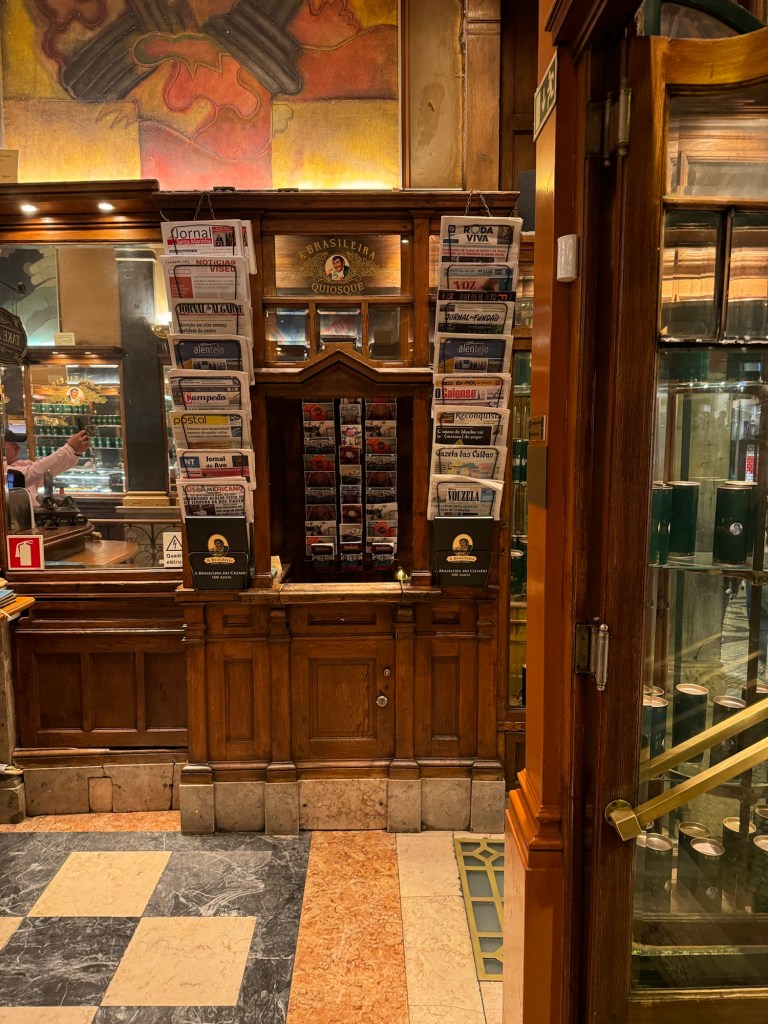
Passing through the richly decorated front door at Rua Garrett 120/122, the first thing I noticed on my right, was a newspaper stand displaying a number of Portuguese magazines – a rare sight these days, but always a good indicator for a café where you can enjoy a cup of coffee and a read without feeling rushed.
My view then travelled along a counter of dark wood with functional brass fittings, displaying a nice selection of pastries. From the high ceiling, three chandeliers were suspended, which together with the indirect lighting along the walls, illuminated a number of large paintings that were on subtle display above the eye level of the spectator.
As it was already late, I had no problem finding a small table near one of the display cabinets at the rear end of the room.
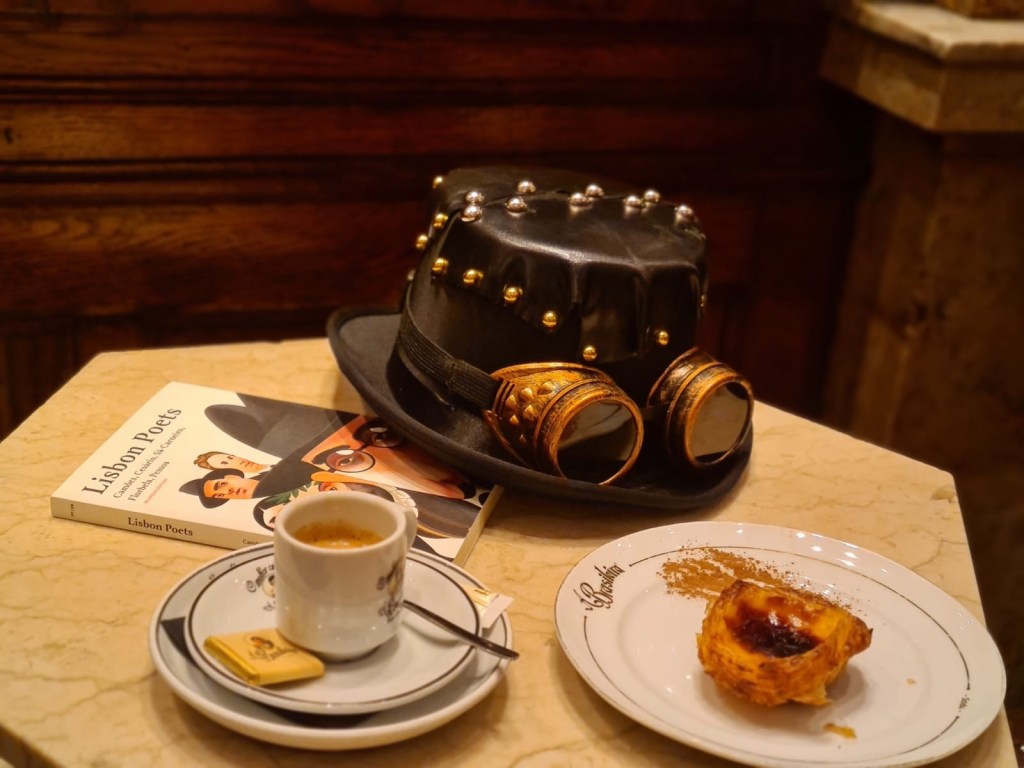
After ordering the obligatory combination of a Pastel de Nata and a Bica – an espresso, which I preferred to drink the traditional way: with a bit of sugar – I turned to a volume of Portuguese poetry, which provided a fitting counterpoint to the scores of tables and bland scientific data that had occupied me throughout the day.
Immersing myself into a few lines by Fernando Pessoa, who himself had been a regular visitor of this place, it read:
Uns, com os olhos postos no passado,
Vêem o que não vêem; outros, fitos
Os mesmos olhos no futuro, vêem
O que não pode ver-se.
With one eye on the past,
some see what they cannot see,
whilst others, with one in the future see
what can not be seen.
I ordered another Bica….
Pessoa had written these words under the pseudonym of Ricardo Reis, one of his over seventy (!) heteronyms or alter egos.
It carried on with:
Porque tão longe ir pôr o que está perto –
O dia real que vemos? No mesmo hausto
Em que vivemos, morreremos. Colhe
O dia, quoque és ele.
Why go so far for what is so near –
The actual day that we can see? In a single breath
We live and die. So seize the day,
for the day is what you are.
How true I thought …..
All too soon the café was closing and when leaving the place, I was passing a statue of the great man, who was sitting among the outside tables in quiet contemplation – like his poems – for us to enjoy into eternity.
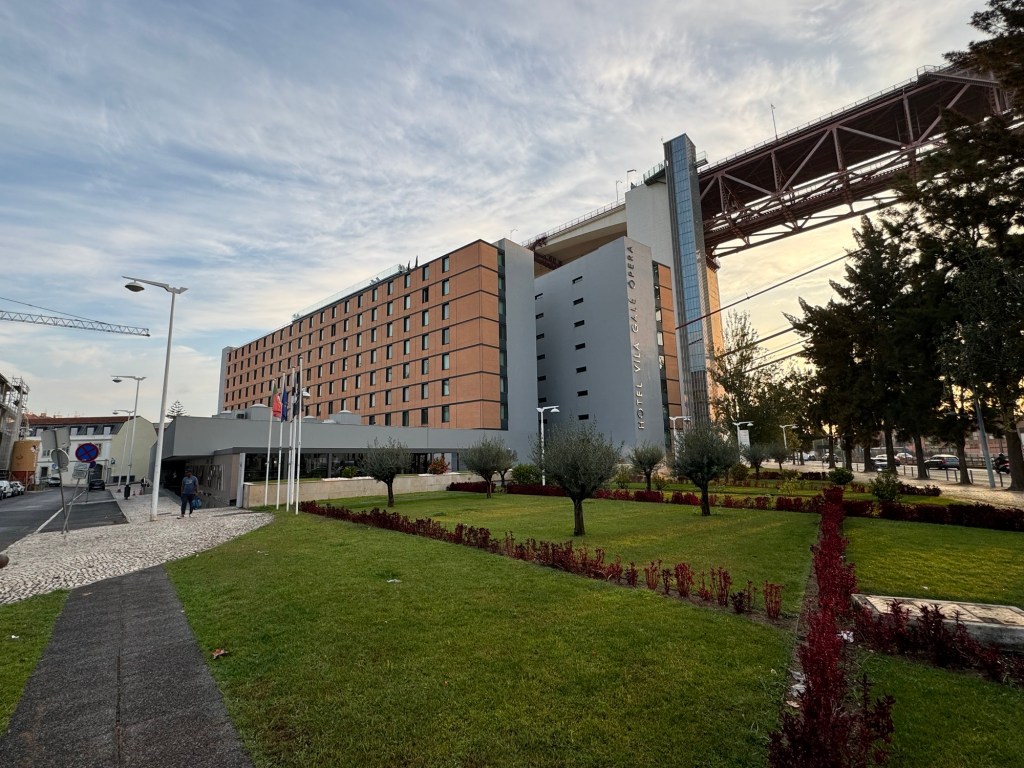
Despite my late arrival the previous day, I was awake well before sun rise the next morning, due to the constant noise of 7000 cars passing every hour 50 meters above the window of my room. In addition to this, there was a regular interlude caused by one of the nearly 200 trains that over the course of the day took the same route.
I was back in Lisbon and this time, I was living below a bridge, albeit a rather impressive one.
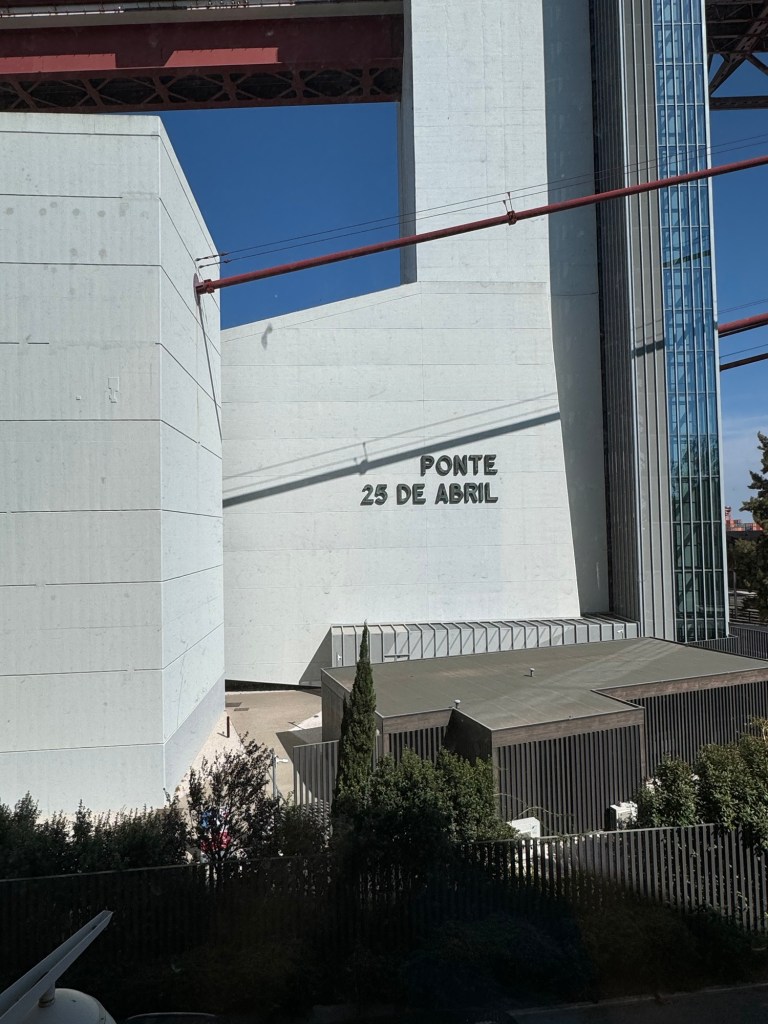
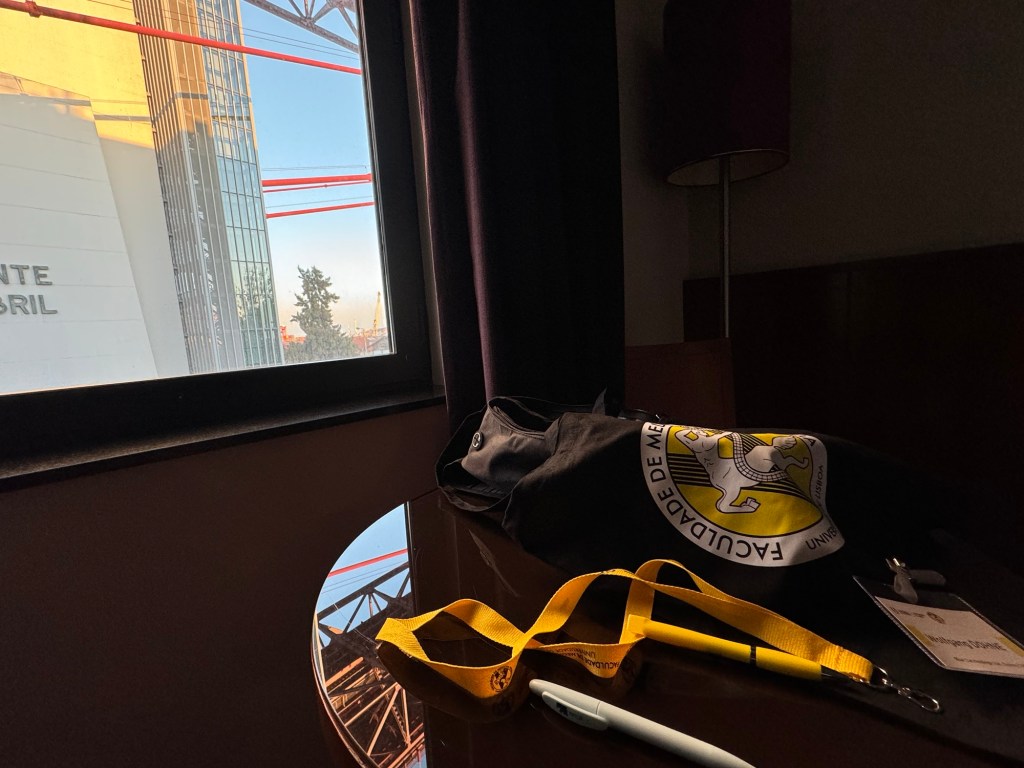
Opening the double layered curtains of my tripled glassed window, which had tried, but failed to keep the traffic noise out of my hotel room, I was staring directly on to the name of the mega structure, which was displayed in bold letters on one of the steel and concrete pillars of the bridge.
The “25th of April Bridge”, which used to be the world’s fifth largest suspension bridge when it was built in 1966, spans the Tagus River and by this, connects Lisbon with the South of the country, without the need to circumnavigate the estuary of the river. The equally impressive and even longer Vasco da Gama Bridge, which is crossing the whole estuary, was added over 30 years later.
Stabilised by enormous amounts of American steel, the bridge was constructed by the same company that also built San Francisco’s Golden Gate Bridge.
Initially called the “Salazar Bridge”, its name was changed immediately following the Carnation Revolution in April 1974. When visiting Lisbon, it is hardly possible not to notice this giant structure.
Somewhat unimpressed by so much technology and history, I found myself an hour later at the hotel reception, asking for a room at the other side of the building. I was in Lisbon as part of an international delegation to visit the local veterinary faculty and as the whole week was packed with work, I knew that a few hours of decent sleep in between would be vital to keep me going.
Needless to say that the hotel was fully booked and the promise of the management to find another room for me on one of the following days never materialised ….
This meant, that I had to accommodate my noisy neighbour and, like the people in this part of Lisbon, I had to adjust to life below the bridge.
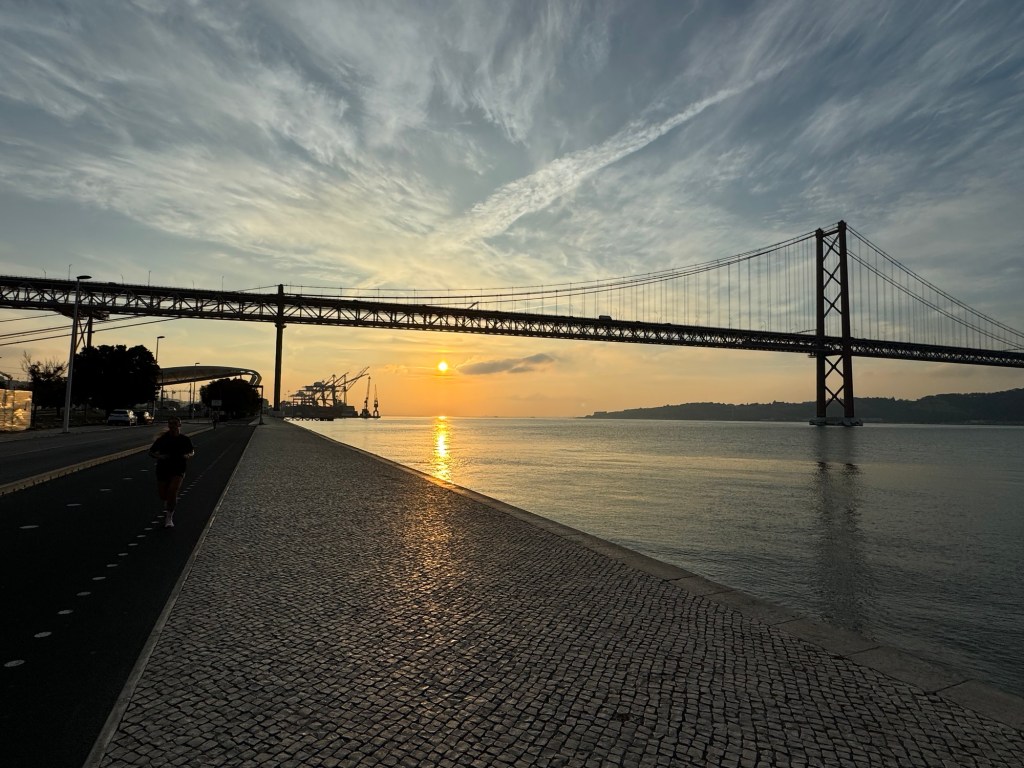
When running along the river in the morning towards the Monument of the Discoveries,
the bridge became the starting as well as the end point of my exercise – a point of reference that was visible all the time.
The lights of the bridge and of the cars on the upper platform were reflecting in the water of the river at night and by this they enhanced the image of the monument of Christ the King, located on a hill at the Southern shore and illuminated in a maritime blue light.
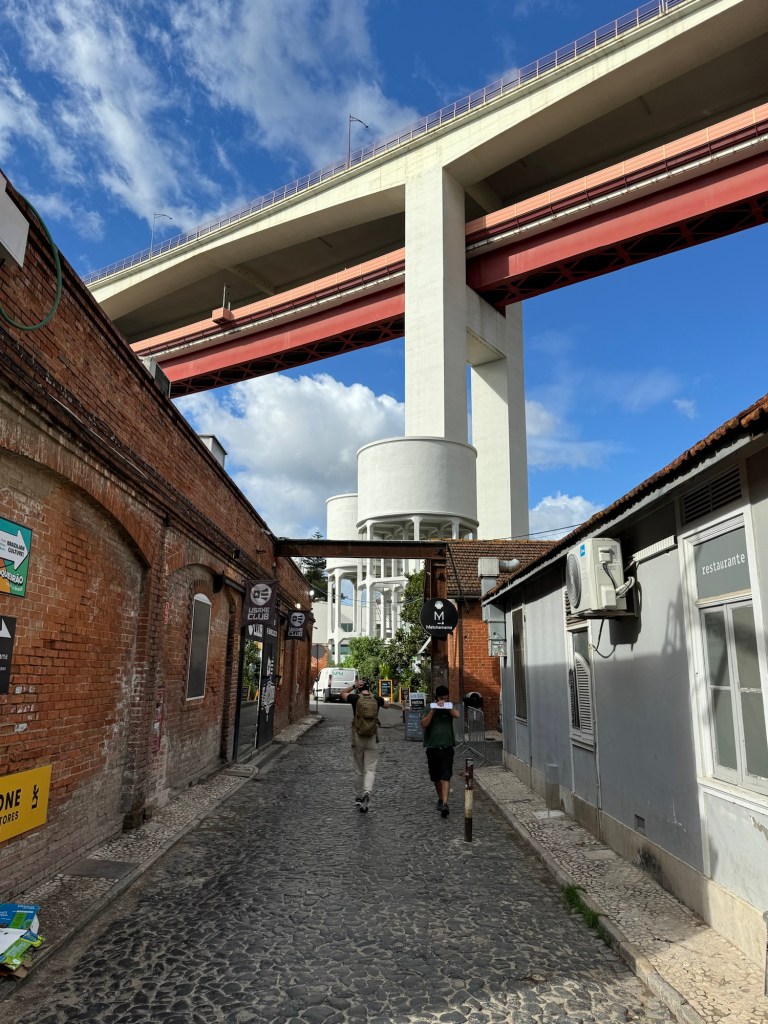
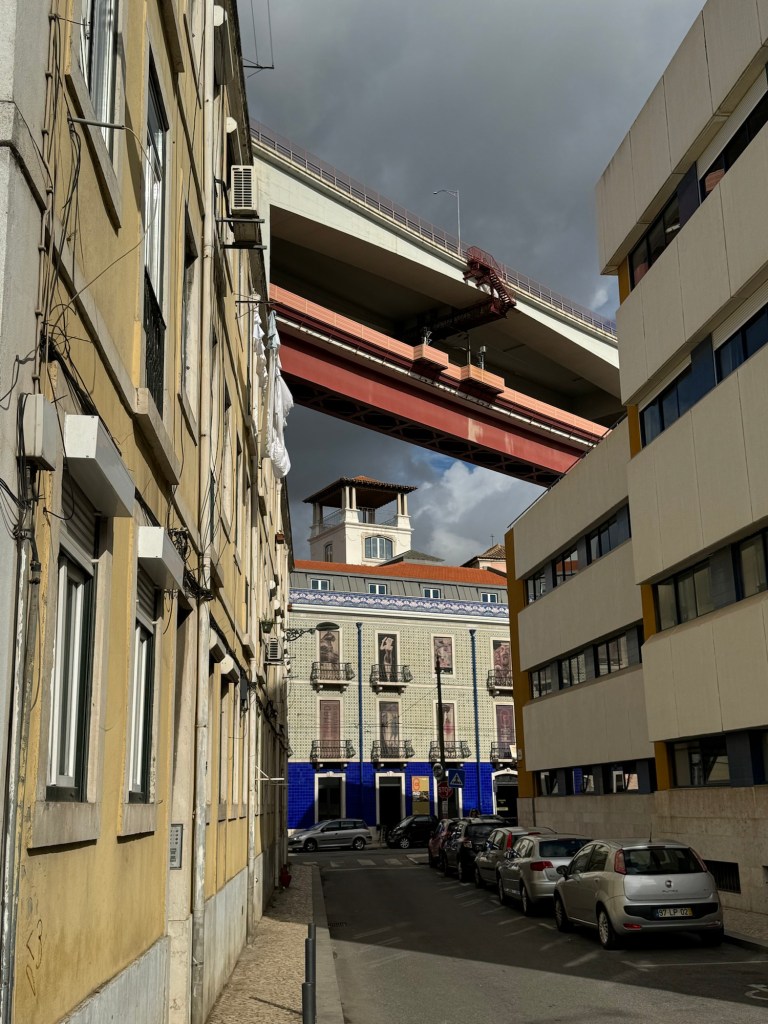
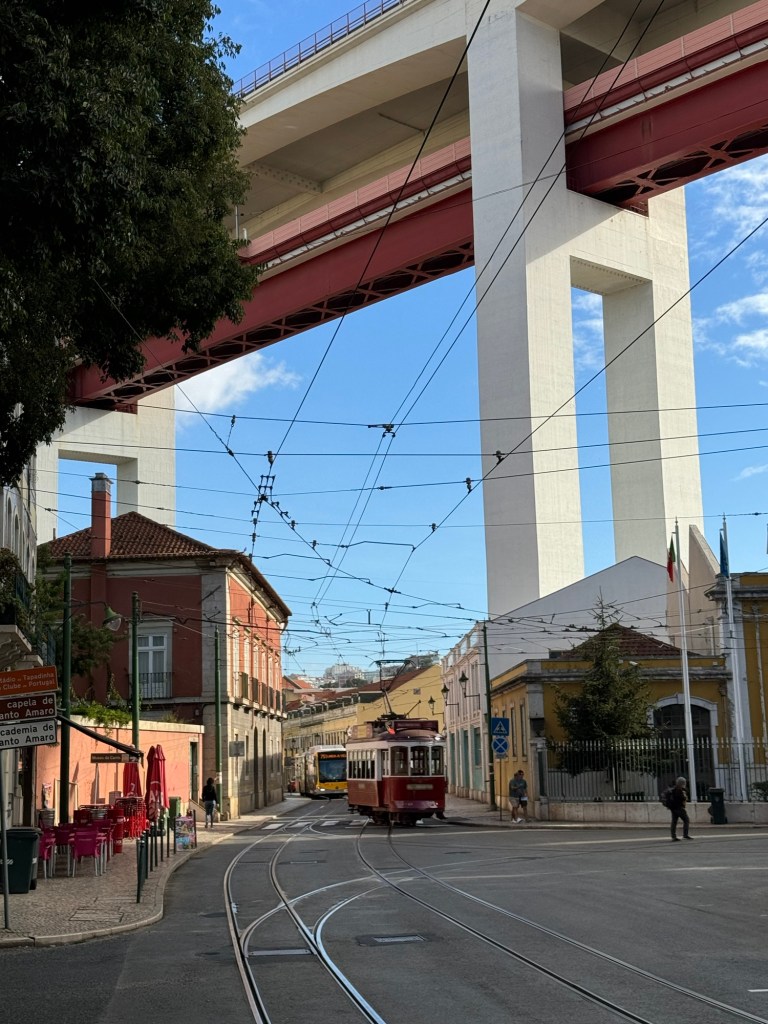
The Brutalistic architecture of this giant structure with its huge concrete pillars had – like a spaceship from another world – forced itself into a 19th century Portuguese working class neighbourhood and yet life below the bridge continued to carry on and was possibly even enhanced by the stark contrast of these two building styles.
Lisbon’s signature trams had maintained their depot below the bridge and its colourful carriages continued their sedate journeys while hundreds of cars crossed at the same time its pass at much higher speed 50 m higher up.
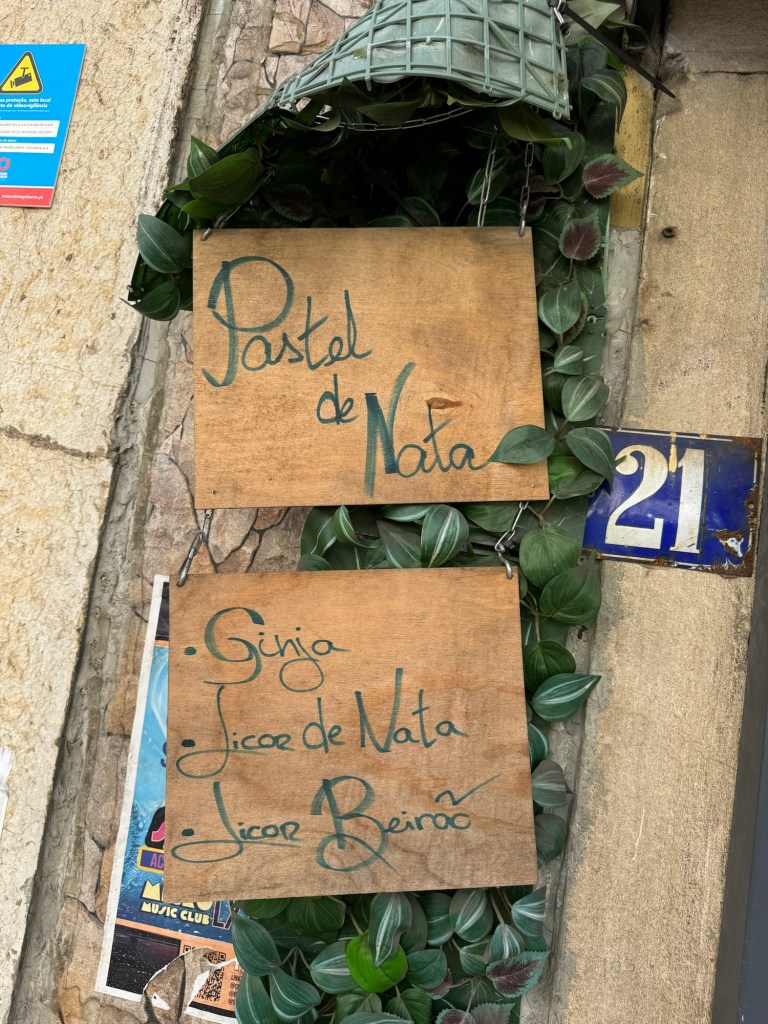
Alongside small cafes, selling the quintessential Portuguese pastry “Pastel de Nata”, a whole community of artists and dressmakers had found a new home in the abandoned buildings of the LX Factory.
Here a huge wasp was clinging to the wall of a hostel,
Jaqueline de Montaigne murals were decorating the once grey outside of factory buildings and in regular intervals, portraits on painted tiles by Bastien Tomasini were engaging with the visitor.
One of the concrete pillars of the bridge had been used as canvass for a modern still life, contradicting the static nature of the structure with various items that were precariously balanced or even caught in mid air.
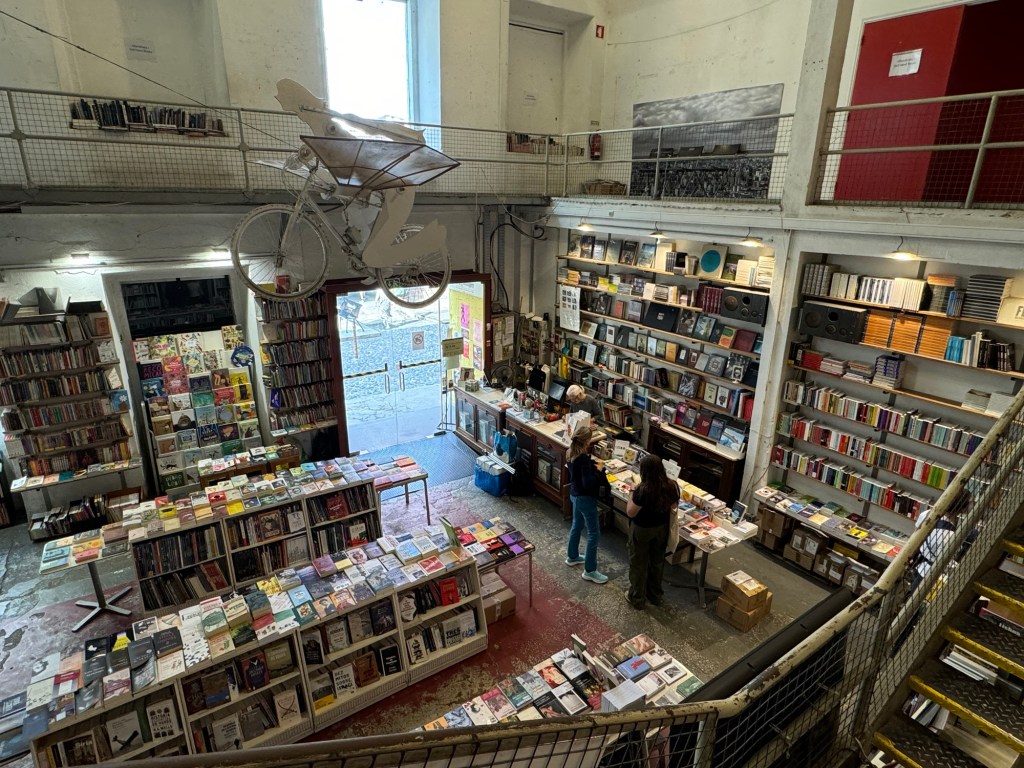
Based in the centre of the factory was the huge book store “Le Devagar”. Featuring a large printing press in the middle of the shop and book titles were staged up to 10 meters high against the wall. This place clearly required book sellers with a head for heights.
Named by the New York Times as one of the best and quirkiest book shops in the world, you could get lost here in rare as well as timeless classic titles from Portugal, from the Portuguese diaspora and from the rest of the world.
The next morning I woke up to the ringing of the alarm clock following a good night sleep and I realised that I as well had started to adjust to the life below the bridge.
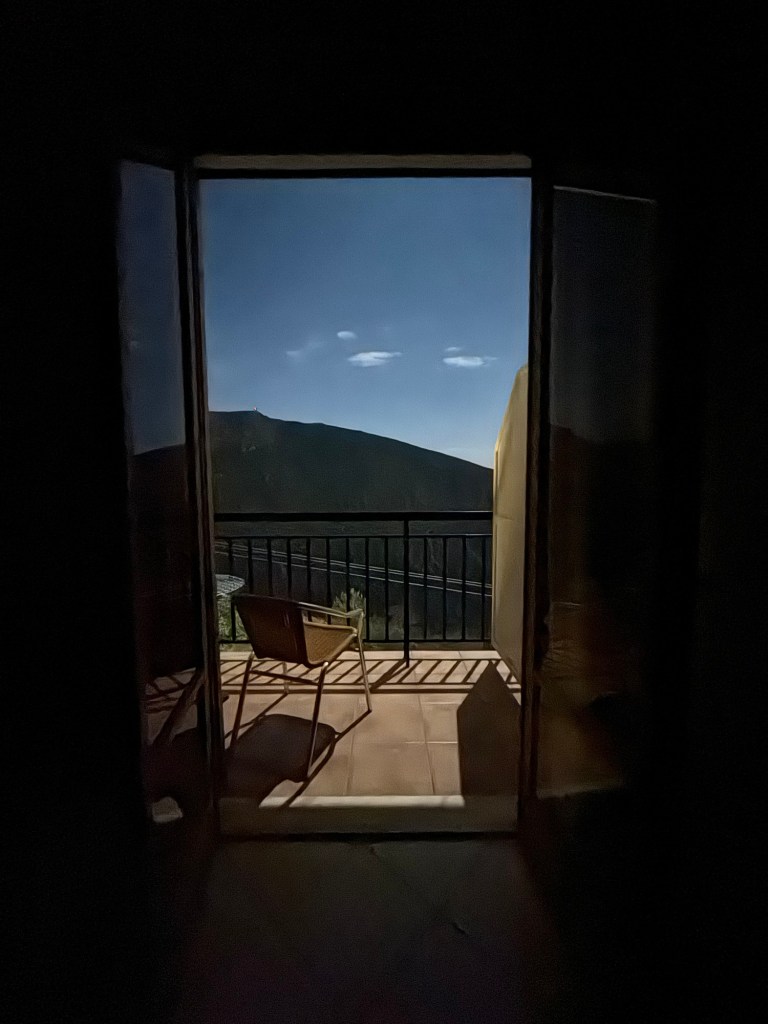
The door to the small balcony was left open and the light of the full moon came flooding into the room. A few fair weather clouds featured on the otherwise blue sky, the shadows of the bannister and the chair produced pitch-black lines on the floor, so that the whole scenery would have given a perfect background for a Magritte painting.
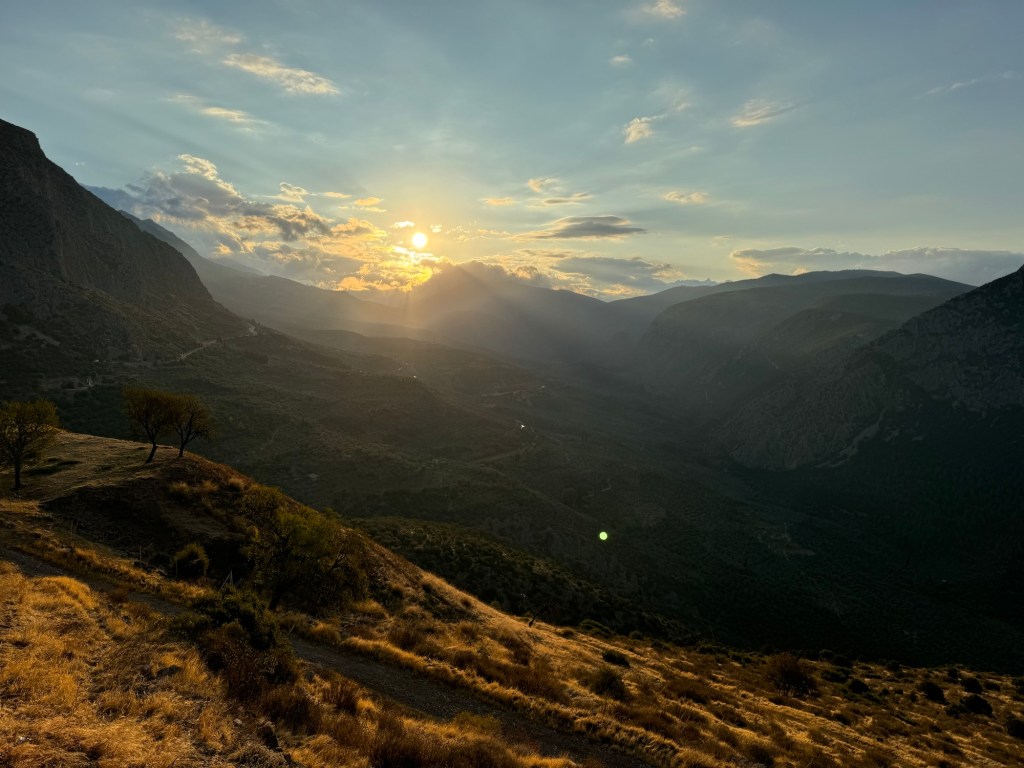
Right below the balcony, there was a sheer drop of several hundred meters into a gorge, which was lined by a Sea of olive trees. A small stream at the bottom of it led all the way South towards the brightly illuminated harbour of Itea and to the Gulf of Corinth.
Driving through the night, along narrow unlit roads, across the mountains, I had arrived late at the hotel and yet, I was up again early to witness a spectacle that had drawn people to this place for thousands of years: seeing the first rays of the sun illuminating the temple of Apollo, the home of the Oracle of Delphi.
What makes this place so special, are not only the ruins of some of the world’s once most spectacular buildings (especially if seen with the eyes of a shepherd or a sailor over two thousand years ago….), but also its location and its orientation towards the celestial bodies of the Northern hemisphere.
The whole religious complex is South-East facing and once the sun has risen above the saddle of Arachova in the East, the temple is flooded with light, while the land below remains in darkness. No wonder that the ancient Greeks considered this place to be the centre of the world I thought and it reminded me of the similar effect at the equally spectacular site of the monastery of the Black Madonna of Montserrat in Catalonia.
What a great way to start the day !
Sadly the restricted area with the temples didn’t open before 8 am, but that was still early enough to beat the crowds and to meet today’s inhabitants of the site, who appeared to be completely ignorant about the importance of this place for human civilisation.
Unfortunately as well, there was no opportunity to consult the oracle on the future journeys of the Blue Vet, so that it remains a matter of ‘wait and see’ if you want to find out…….
Returning from the truly remarkable setting of the small church of Agios Ioannis, which is precariously placed on top of a large rock at the weatherbeaten Northern shore of the Sporadic Island of Skopelos,
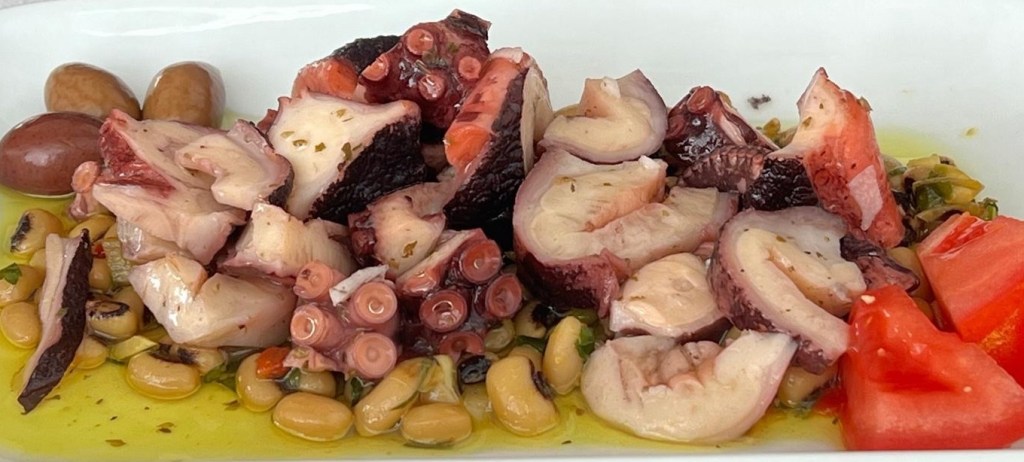
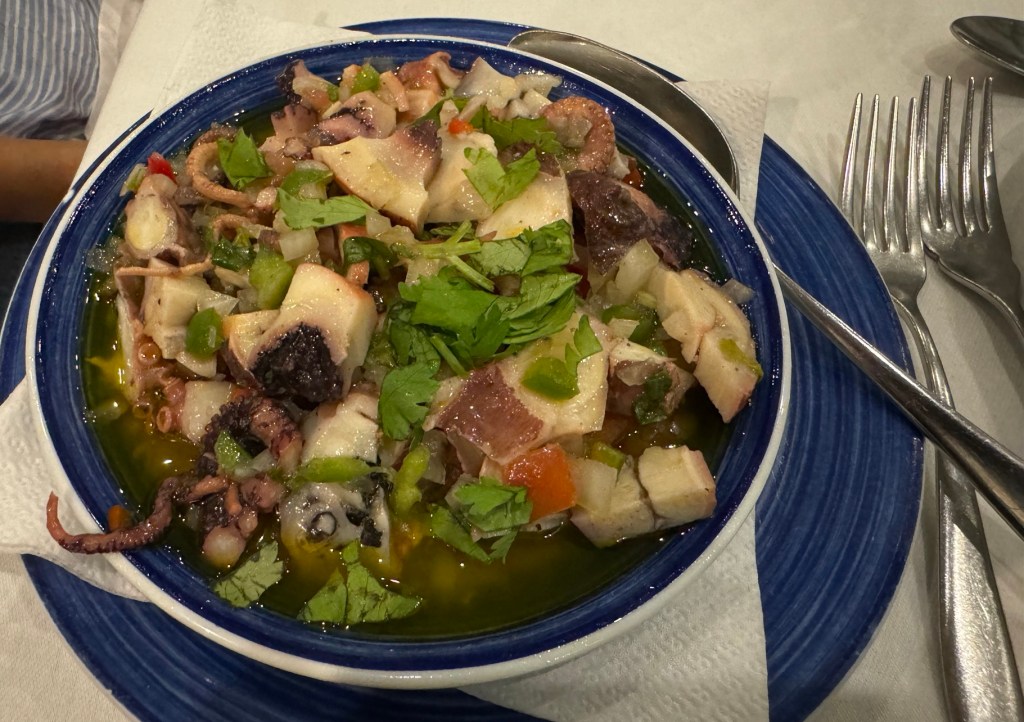
I was sitting over a beautiful traditional Greek dish of octopus with herbs in olive oil and vinegar,
when my thoughts trailed off to a memorable event many years ago in Central America….
It was at the end of my course at Hanover Vet School, when I decided to spend a few months in Guatemala and Honduras, to learn Spanish and to travel through this exciting and colourful part of the Globe.
Felling very lucky that I had just survived the short flight from the Honduran mainland to the small Caribbean island of Utila, where I had found myself, due to a shortage of remaining seats, in the vacant co-pilot seat, I had decided to make use of the remaining hours of daylight and to go snorkelling.
Near the sandy outcrop on the island’s Southern shore, which functioned at that time as a landing strip for planes, I had planed to investigate the fuselages of a couple of small aircraft I had seen during the descend, which had not been so lucky and had ended in the shallow water among the corals……
The water was warm and clear and tropical fish could be found in abundance. A large green moray eel was passing a few meters below me from one hide out to another.
I soon reached the remains of one of the small aircraft and while I was inspecting the surprisingly intact structure, I spotted nearby, underneath a small rock a sizeable octopus. With no firm dinner plans that day, I grabbed the struggling mollusc and with a swift cut of my diving knife, severed most of its donut shaped brain from its satellites in the eight tentacles that had entangled my left arm.
Back on land, I tenderised my catch in the traditional Mediterranean way by slamming it multiple times again a rock, before walking back into the village.
Crossing the small bridge that connected the airport with the harbour, I was happy, that a few of my hunter-gatherer genes had survived six years of academic work and I prepared myself for the respectful looks and comments of the locals, which I had much appreciated when hunting these animals in the Cyclades.
But how much more wrong could I have been ? ….
When I was spotted by the first villagers, their eyes widened, their pupils dilated and there were suppressed mutterings of utmost revulsion.
In no time, a group of people of all ages had gathered, with some of them pointing at the deceased cephalopod I was carrying.
Eventually, a young girl approached me, to find out, why I had caught the octopus.
When I replied that this was supposed to be my dinner, utter pandemonium ensued and the islanders had found a story, that would keep them entertained for weeks.
“Nobody eats such a thing here!” one women was shouting.
Another was adding: “That is disgusting! We call it the “cat of the Sea”!”
The final humiliation came from my landlady, who was equally displeased, when I approached her house:
“Your are not coming near my kitchen with this thing !”
I don’t think, that her instructions could have been any clearer…..
Thankfully, as a student travelling on a shoestring budget, I had my own cooking utensils with me and with the help of some tomatoes, onions, a few herbs and some lemon juice and – of course – some Honduran beers, I didn’t have to go to bed hungry that day.
Returning to my octopus in the small restaurant on Skopelos, which was a true delicacy, I appreciated how different the perception of the same thing can be in different cultures.
Octopuses, as recent studies have shown, are highly intelligent, sentient beings.
As a veterinarian, I have no misgivings about my conduct at that time, but as much as I am enjoying these creatures in most of their culinary varieties, I am somewhat pleased, that I don’t need to hunt them any longer myself and I hope that these clever animals will continue to be caught from the bottom of the Sea and not as a mass farmed animal from a tank.
And this time for a change one that will include a case of potential espionage and a visit of the American Embassy….
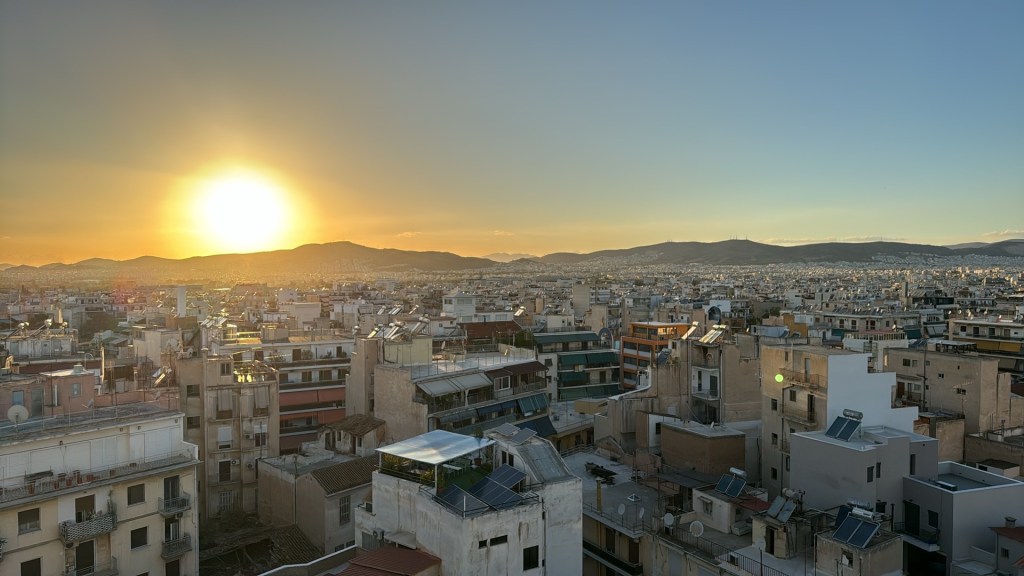
I am in Athens, in the middle of September. It’s by far not the first time I am here and I just love this city:
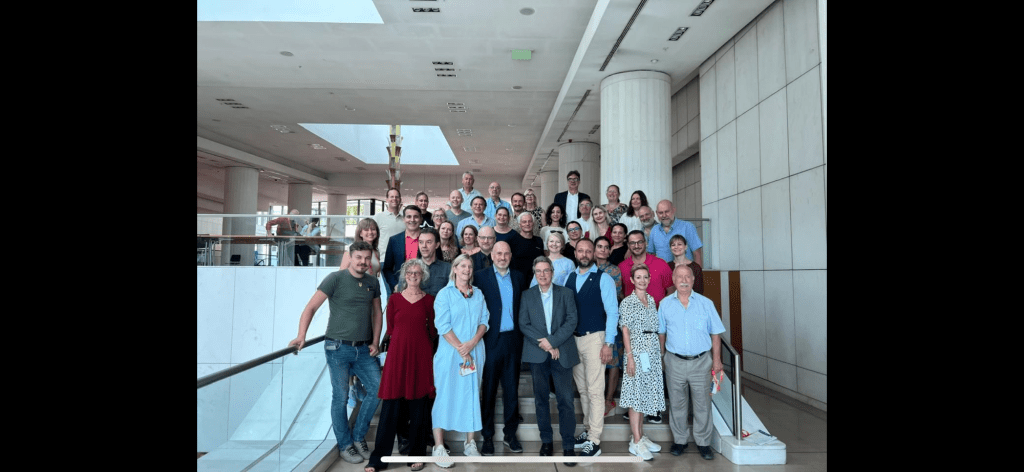
I had just attended the annual FECAVA Congress at the local Concert Hall. Here, I had once again the opportunity to see a lot of my international friends and colleagues, to attend a number of lectures to improve and to refresh my veterinary knowledge and – in the evenings – to catch up on the lives, the news and the plans and ideas of my friends, over plates of Tzatziki, Moussaka and Souvlaki, all washed down with decent quantities of Greek wine and Ouzo.
But after every night, there comes a next morning and this one was glorious – as so many mornings in Europe’s oldest Capital city.
Starting my run just before 7 am in the Metaxourgeio area in the centre of the city, I estimated that the broad shoulders of Mount Hymettus in the East might give me about thirty more minutes of shelter from the scorching rays of the late summer sun in this part of the world.
Working my way slightly uphill in a Southerly direction towards Syntagma square and the Monument of the Unknown Soldier, I was surprised by the number of people on the streets at such an early time on a Sunday morning and equally about the numerous homeless people, who seemed to have used any crevasse of the urban architecture as some form of shelter to get a precious few hours of safe and undisturbed sleep.
Taking just a brief look at the elite soldiers at the Hellenic Parliament, in their traditional uniforms which included the probably most impractical foot wear that was ever issued to a military unit, I took the first opportunity to leave the sounds and smells of the early morning traffic behind me and entered the now open gates to the National Garden to my left.
It was easy getting lost here in the labyrinth of sandy trails, that were so much kinder to my feet than the uneven pavements of Monasteraki. The air was now filled with the sounds of small flocks of parakeets and the view was that of a combination of Mediterranean and sub-tropical plants, interspersed from time to time with the busts of long deceased famous members of Hellenic society.
Exiting the garden at the other end, it was just a short distance to the Panathenaic Stadium, the site of the first modern Olympic Games in 1896. Once again, my (and that of a few other morning runners) hope, to add a round on its famous track to my urban excursion was dashed, due to urgent repair work that had started just a couple of days earlier.
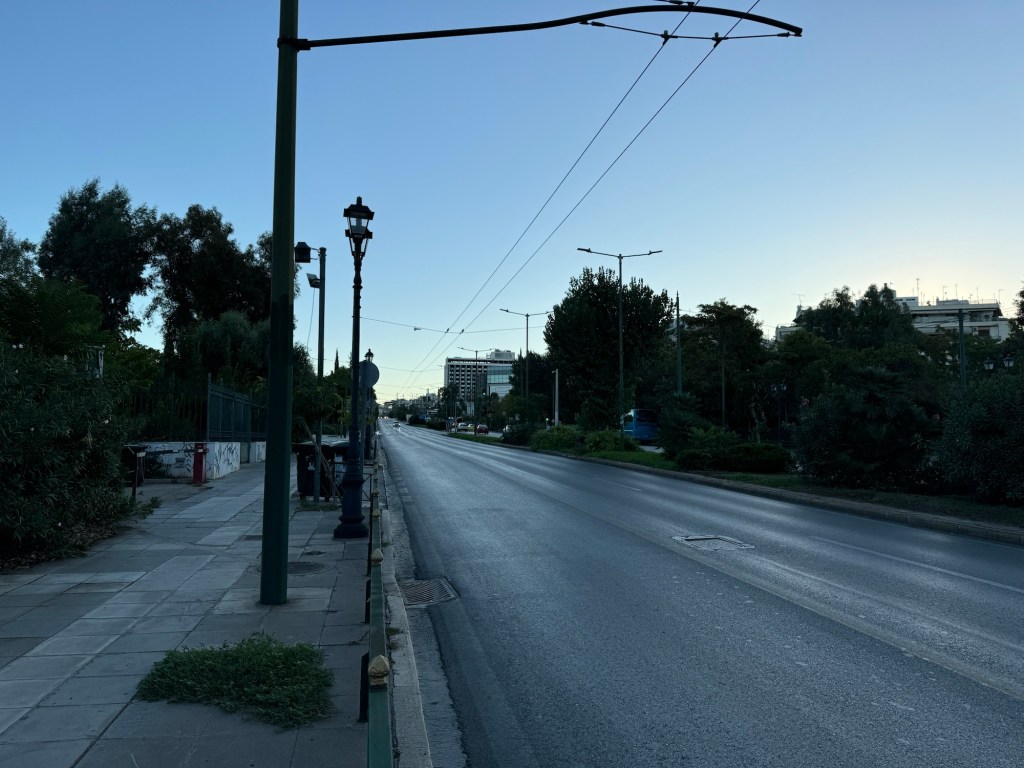
So, not point to linger, but to press on along the still empty dual carriage way of Vasileos Konstantinou Ave, towards the main aim of my excursion.
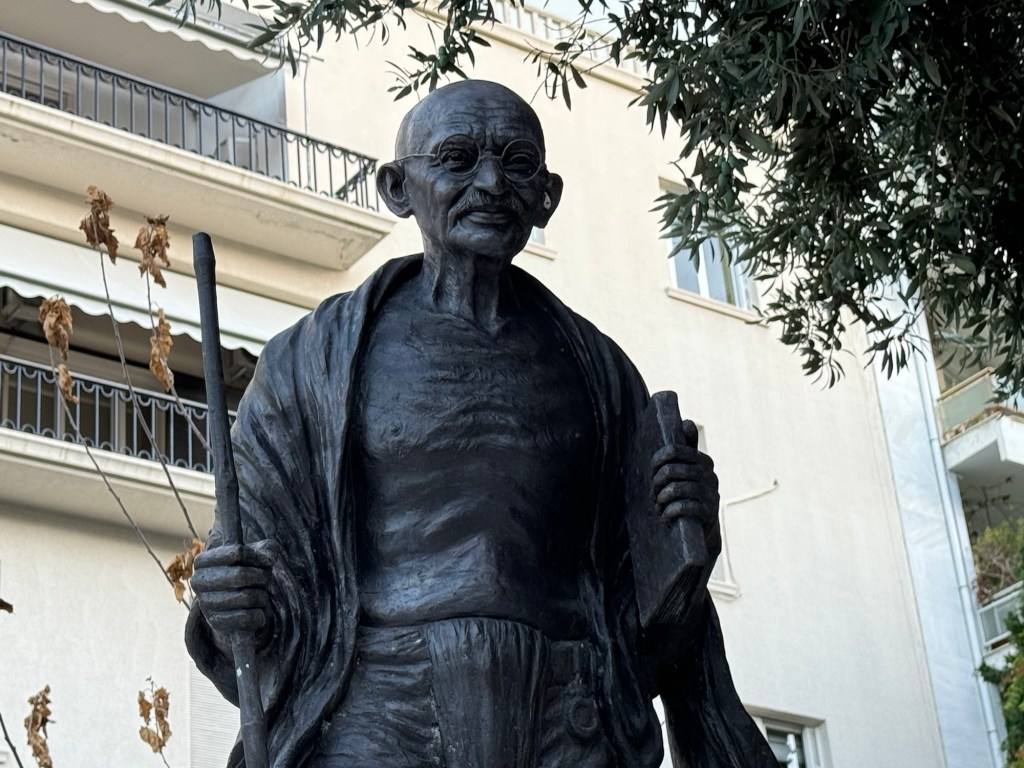
Just as I was falling into a steady stride, I had to make a further stop due to the unexpected encounter with a rather famous fellow pedestrian, who was emerging from underneath the branches of an ancient olive tree.
While the length of my run was not in the least comparable to that of the Salt March in 1930, I now felt invigorated to cover the remaining distance along the road, before the sun had reached the saddle of Mt Hymettus.
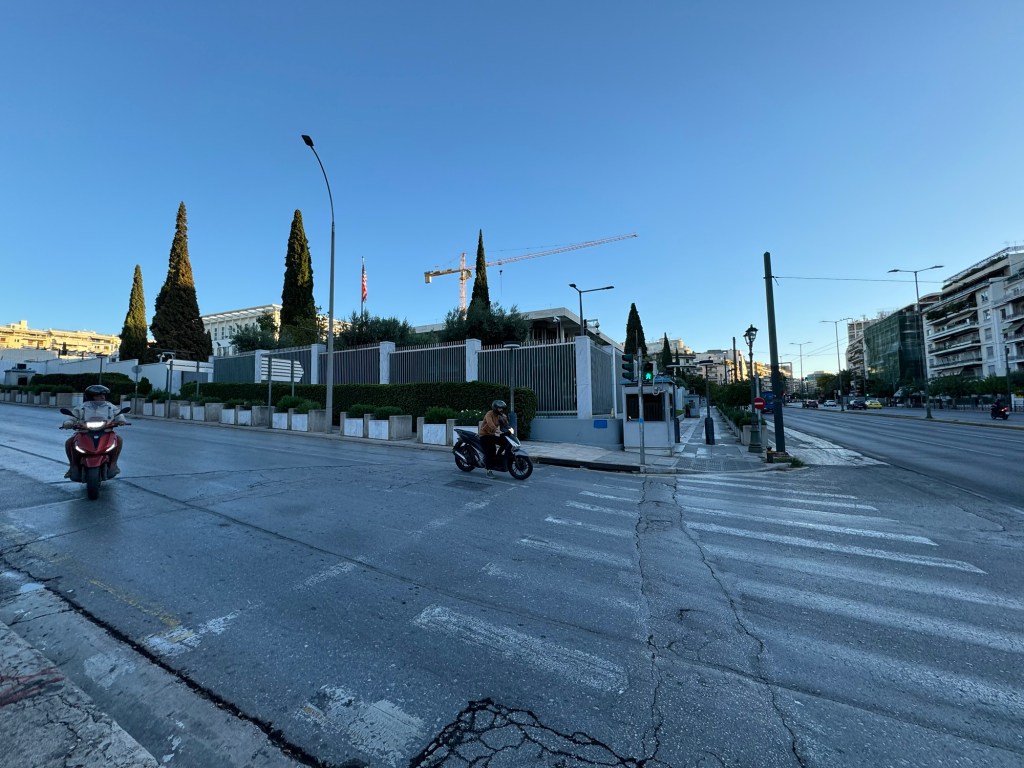
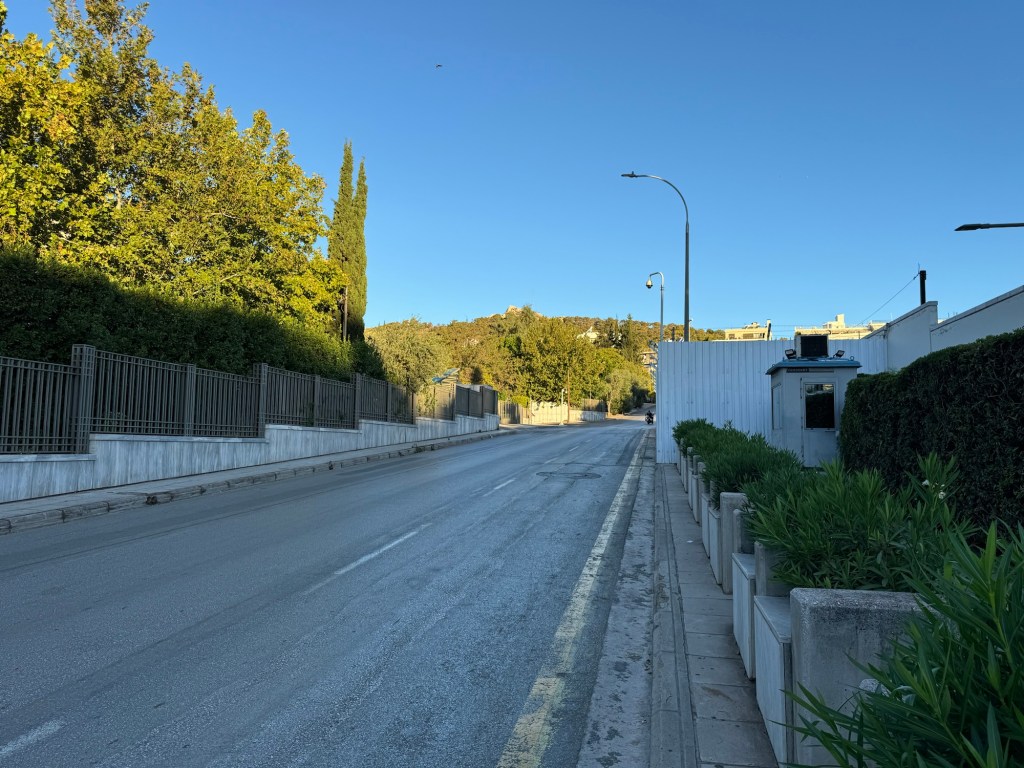
Just in time, I reached the perimeter fence of the Embassy, where I took a break to check up on an interesting story I had heard the previous night….
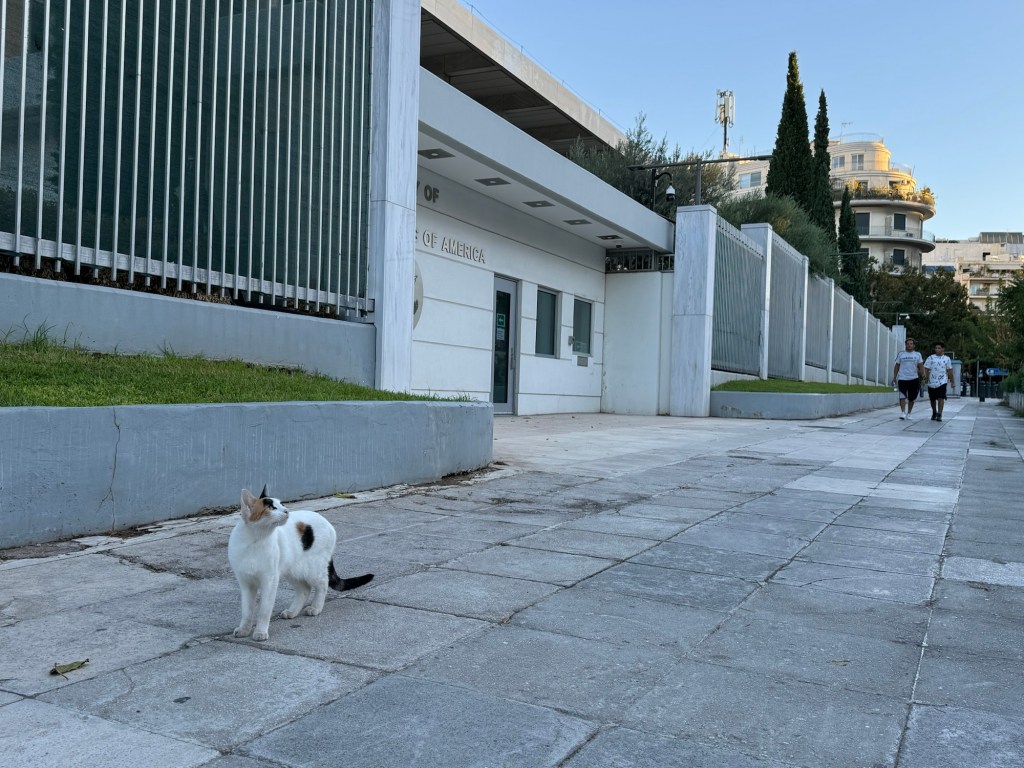
While having dinner with Wendy, my Curaçao born colleague from Luxembourg, images had surfaced of a cat, which had been noticed by several delegates of the nearby held conference for sitting completely motionless and seemingly oblivious to any passing pedestrian, next to the pavement, constantly monitoring the fence and the Embassy building behind it. This unusual behaviour had raised the question, if following the previous examples of trained dogs, rats, dolphins and even beluga whales, foreign adversaries had now enlisted also a cat for their surveillance tasks.
A story just too good, not to be investigated I thought….
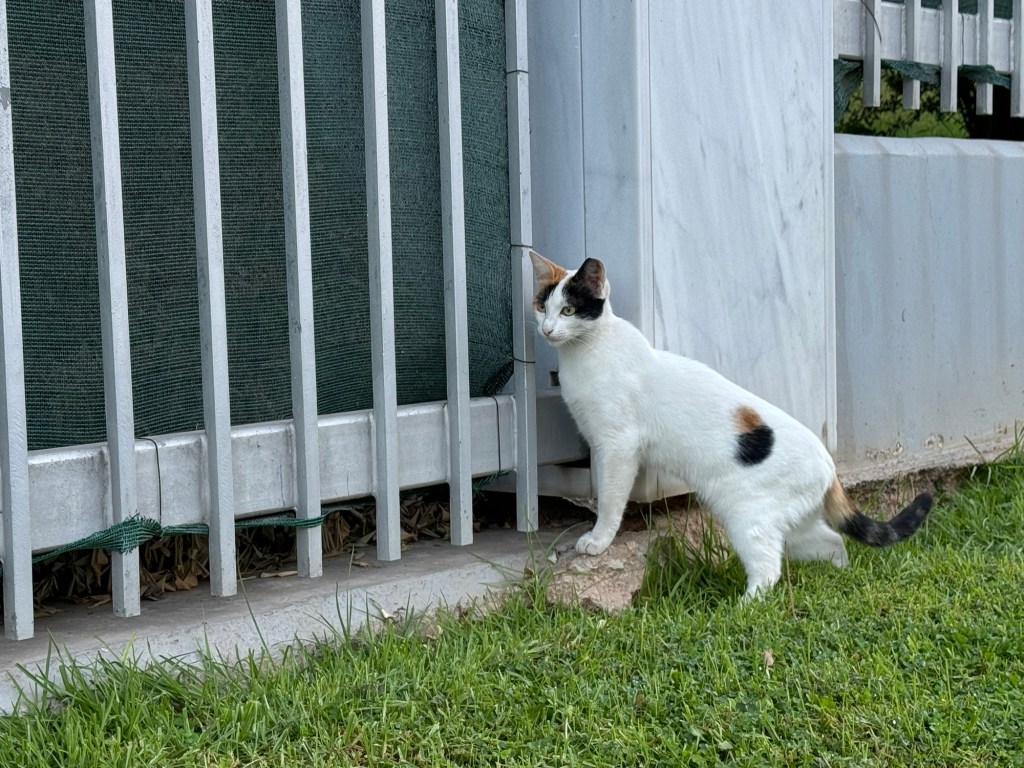
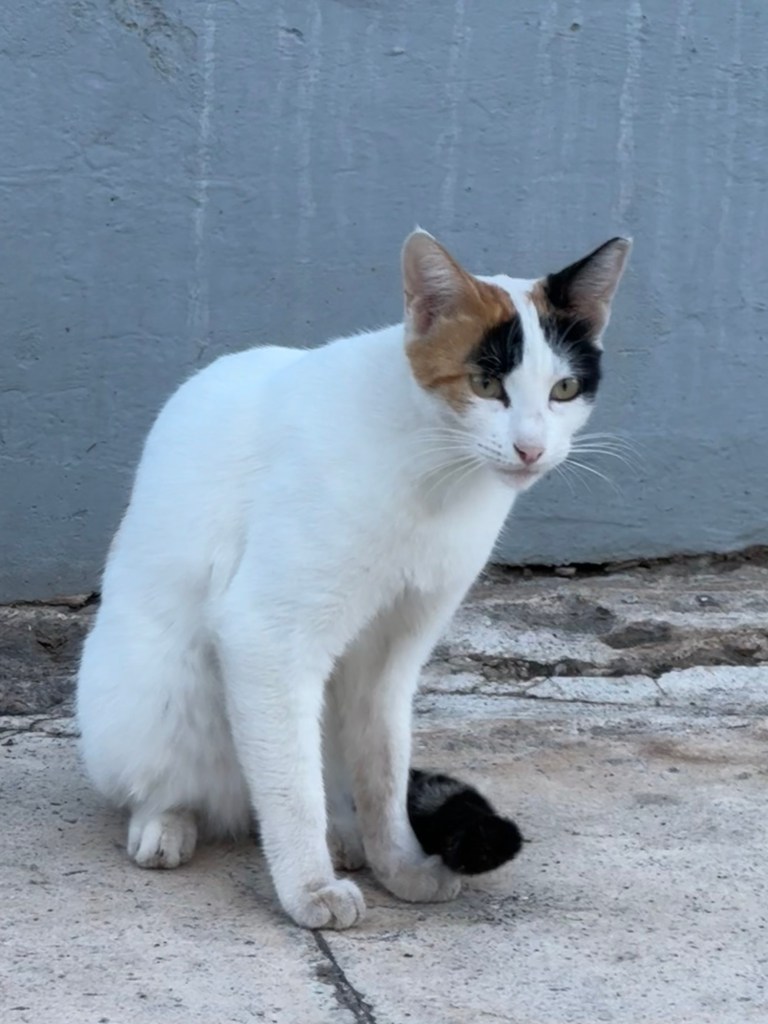
Sadly, when I arrived at the pivotal point of my run, there was no cat in sight. Just as I was about to leave though, suddenly, from behind the fence, the infamous feline emerged and after investigating me briefly, continued with her morning routine of cleaning herself and observering the grass on both sides of the fence.
As curious as last night’s story was, here I found just a perfectly normal, clever urban cat, that was using the near impenetrable border of one of Athens’ most guarded residences as a means of camouflage to stalk rodents on the other side of the fence.
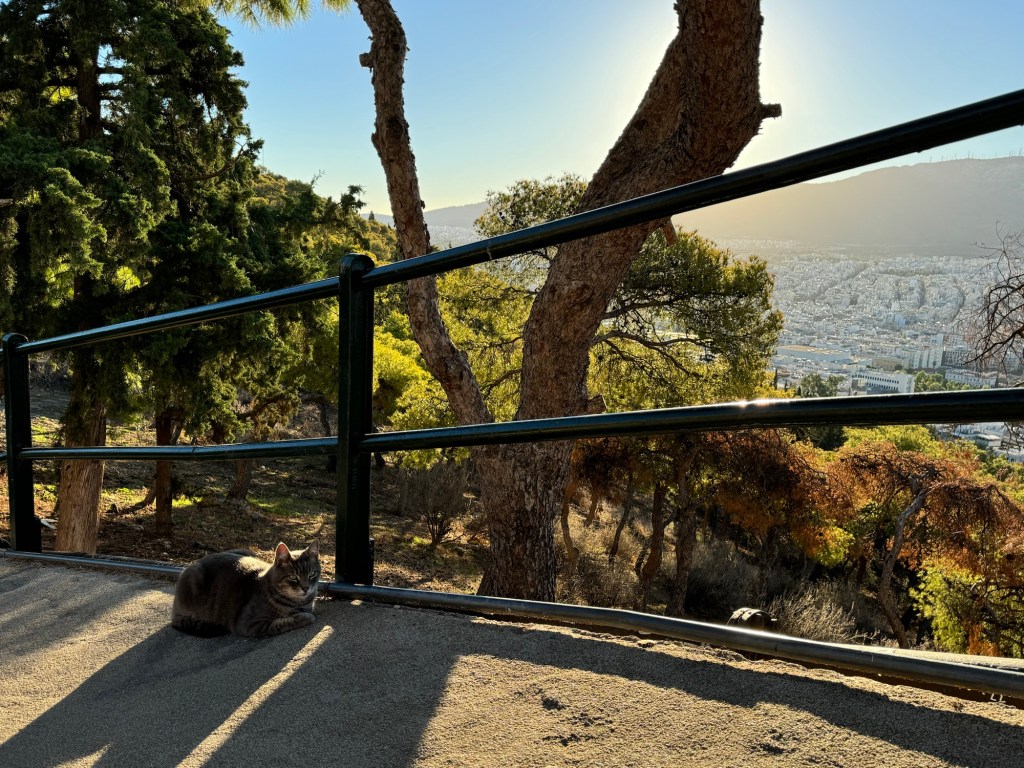
After taking a few photos and just before drawing too much attention to myself as a potential spy, I took my leave and was now heading for the physically most challenging part of the run: all the way up the Eastern slope of Lycabettus.
Lycabettus, one of the natural elevations within the inner city, is another obligatory site to visit when travelling to Athens. The somewhat demanding climb, which is best done early in the morning or in the evening just before sun set, to avoid both the crowds and the heat in the middle of the day, will be rewarded with a stunning view of the whole city, of the surrounding mountains and beyond the Parthenon and the Acropolis, of Piraeus and the Mediterranean Sea in the South.
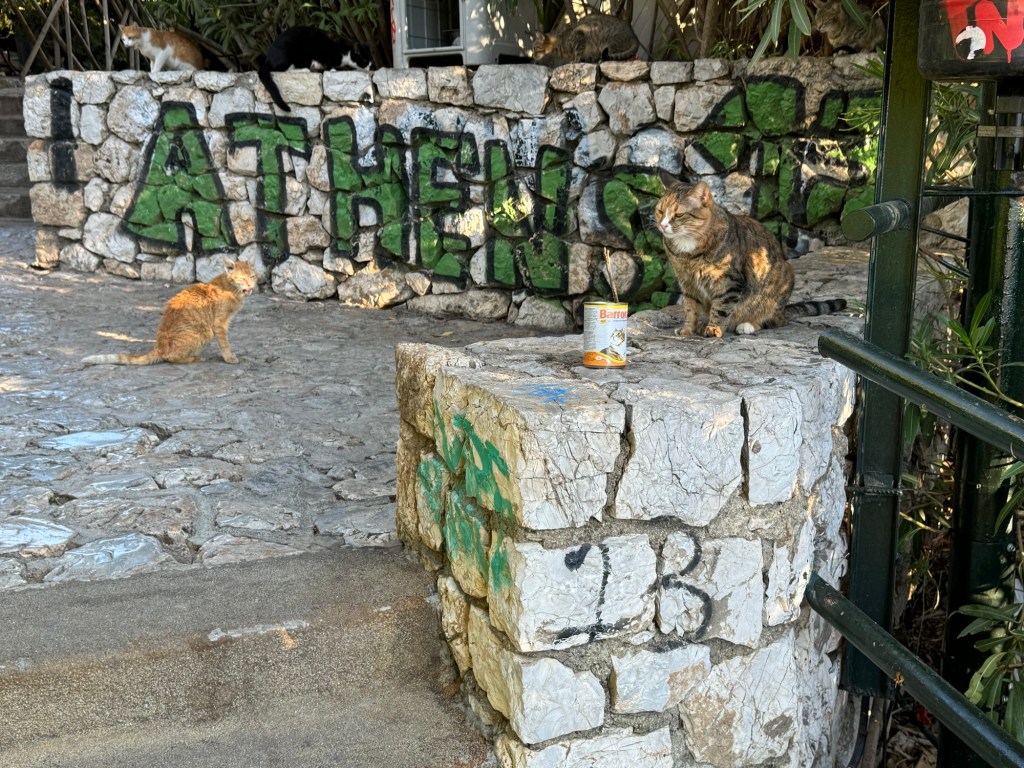
Just as the bells of the Holy Church of St Georg of Lycabettus were ringing for its 8 o’clock service, I had managed to pass the giant amphitheatre, dodged numerous spiky agaves and opuntia cacti and had made the brief acquaintance of more Greek cats, who called this hill their home,
and I emerged at the still fairly empty viewing platform and by this at the highest point of my run.
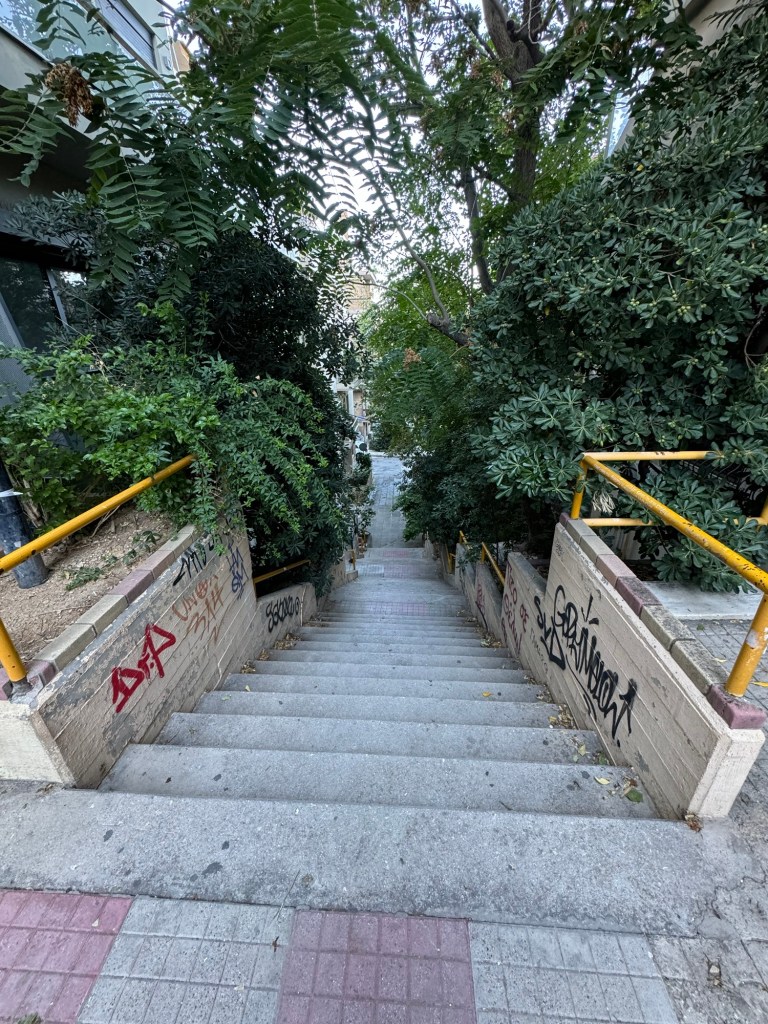
From here the remaining distance back to my hotel could be covered with ease, as the trail was now downhill and once again in the shade nearly all the way.
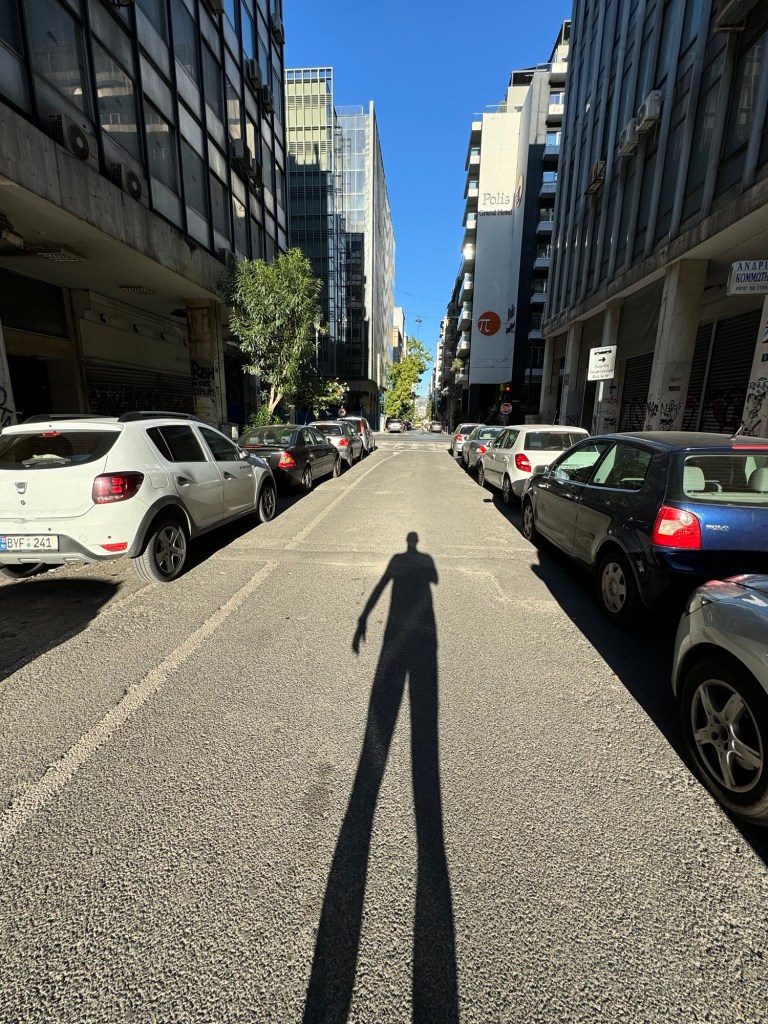
Only when I found myself among the high-rise buildings of the city centre, did my body throw a long shadow over the slowly heating asphalt, marking the end of another memorable early morning run.
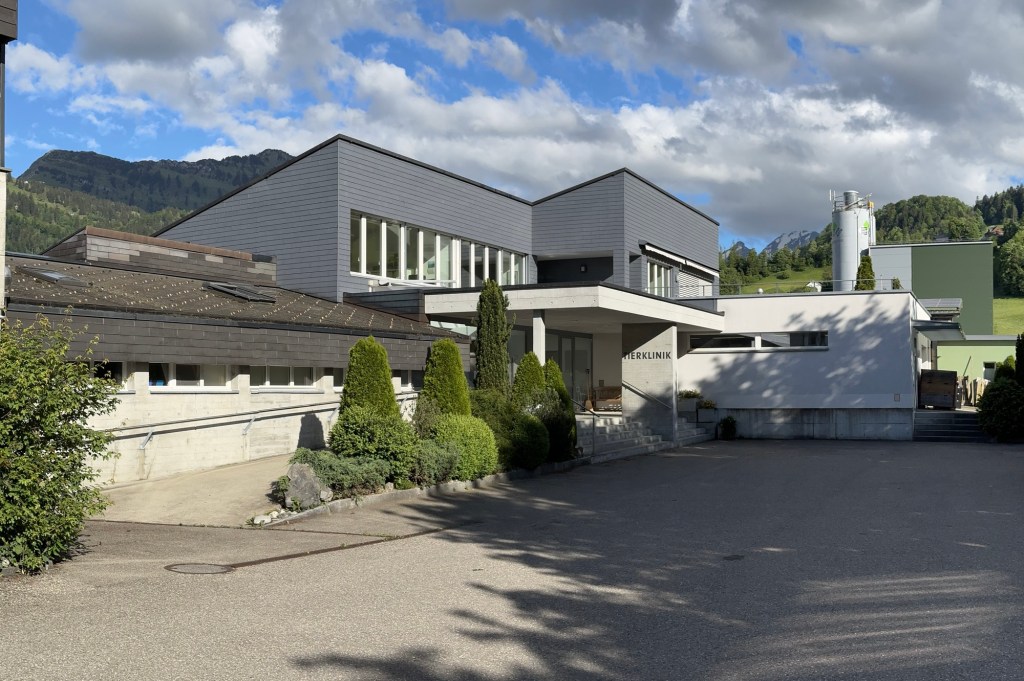
It was the beginning of the summer, I was back in Switzerland and this time I was in love…
It was a clear case of “Love at first sight”, if this term can be applied to a veterinary clinic or to a place of work in general.
By now, I have had a number of opportunities of working at this clinic, which, after having seen and visited a large variety of veterinary establishments over the previous five years, is in my eyes getting very close to being “perfect” for me.
Let me explain….
Getting there for the first time, wasn’t that easy: Driving South from the Eastern shores of Lake Constance, I had to follow the juvenile Rhine, which is separating Austria from Switzerland, nearly all the way to the principality of Liechtenstein, a place of just below 40 000 inhabitants, signified mostly by expensive cars with unusual number plates and by one of the highest per capita incomes in Europe.
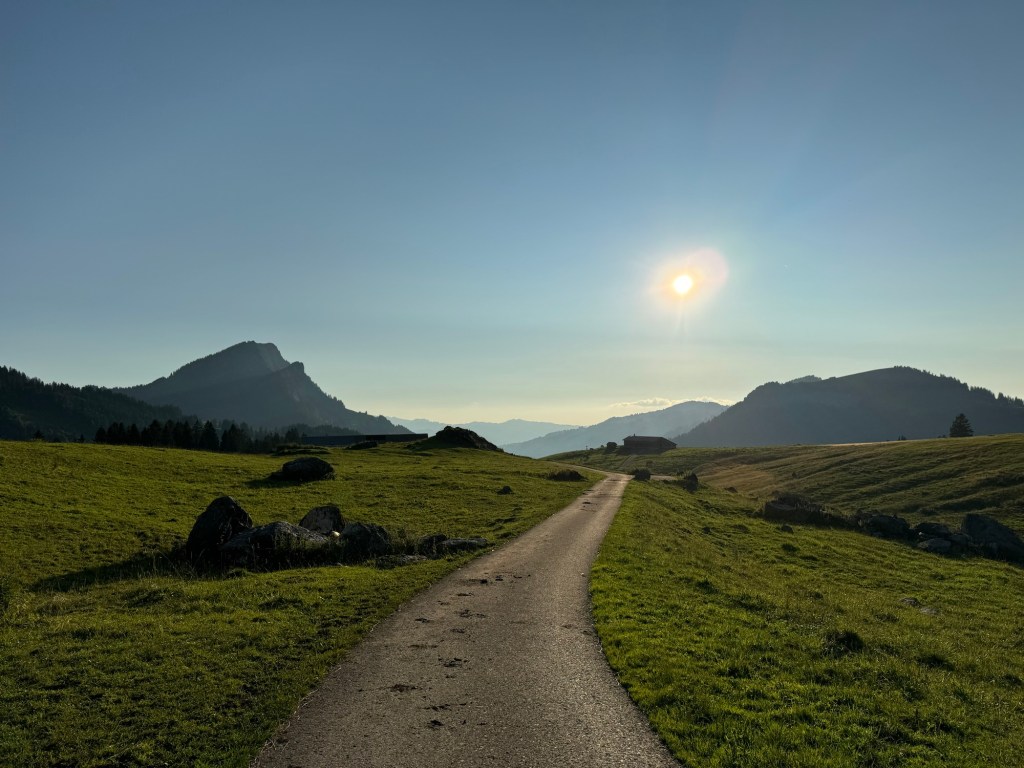
Just before crossing the invisible border into its capital Vaduz, I had to take a sharp right turn and followed the road, that was now climbing steeply into the mountains on the Swiss side. The Diesel engine of my old BMW was put to its physical limits along sheer endless serpentines and as the Rhine Valley disappeared slowly underneath a layer of clouds, I finally arrived at the small ski resort of Wildhaus, at just above 3500 ft. From here the road led through a number of high alpine plateaus, with the “ Churfirsten”, a ragged chain of mountain peaks, that resemble a row of shark teeth, to my left
and the towering summit of the Säntis mountain to the right. What I had entered, was the Toggenburg region, home to a thriving farming community where cows, sheep and goats outnumber the human population, where the main reason for road blocks are herds of livestock, being moved by men and women in traditional costumes from one pasture to another,
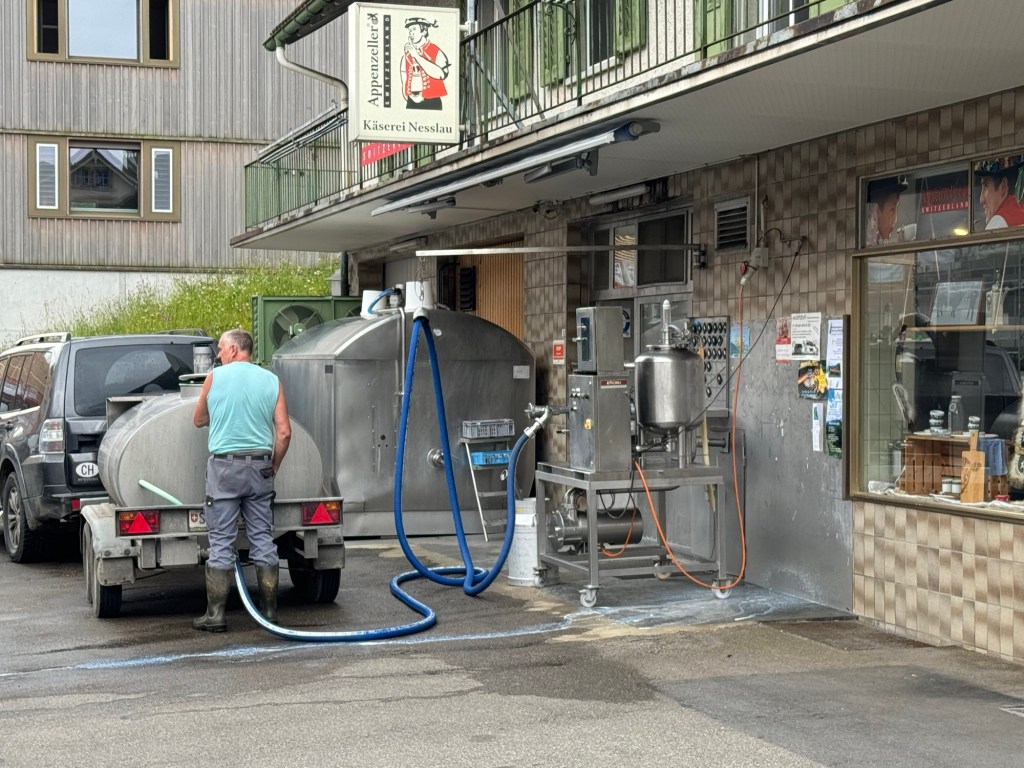
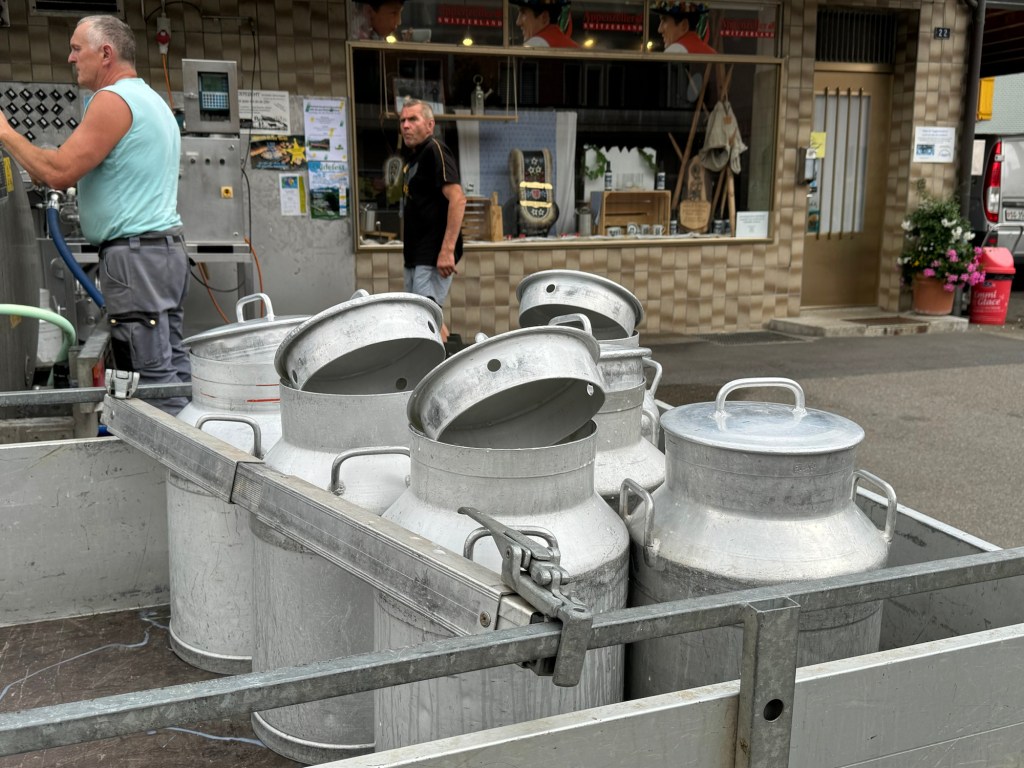
and where SUVs gather in the morning not at petrol stations to fill up with fuel, but instead at the local dairies, to offload their yield of the previous night’s milking sessions,
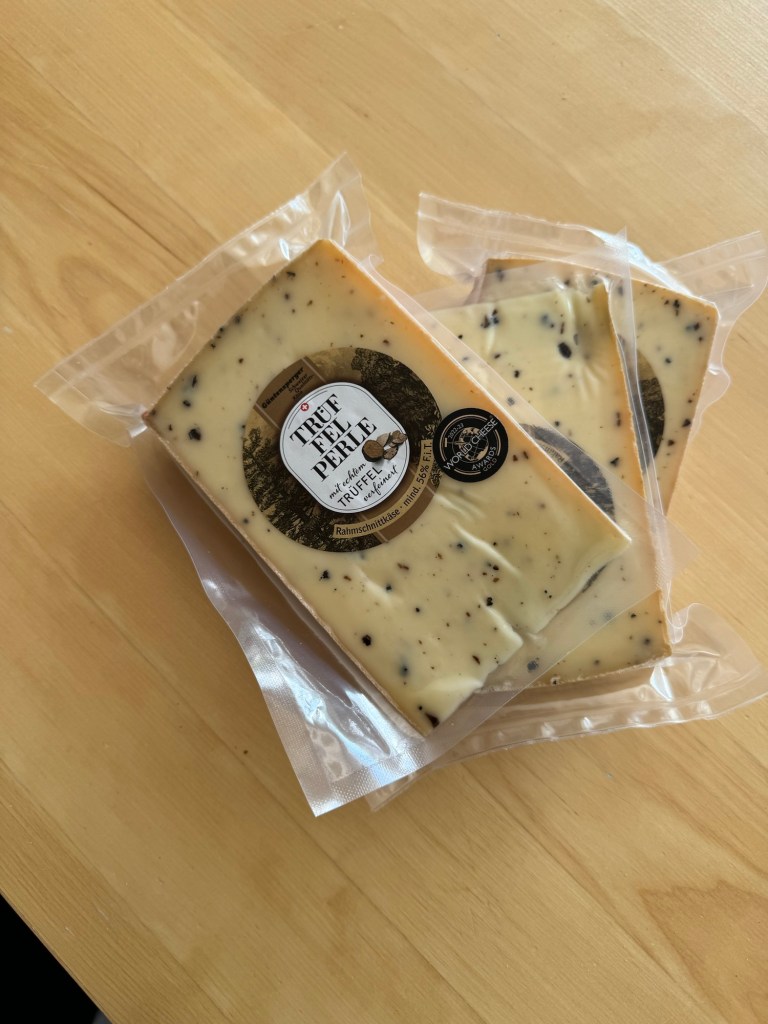
to produce the world famous Appenzeller cheese.
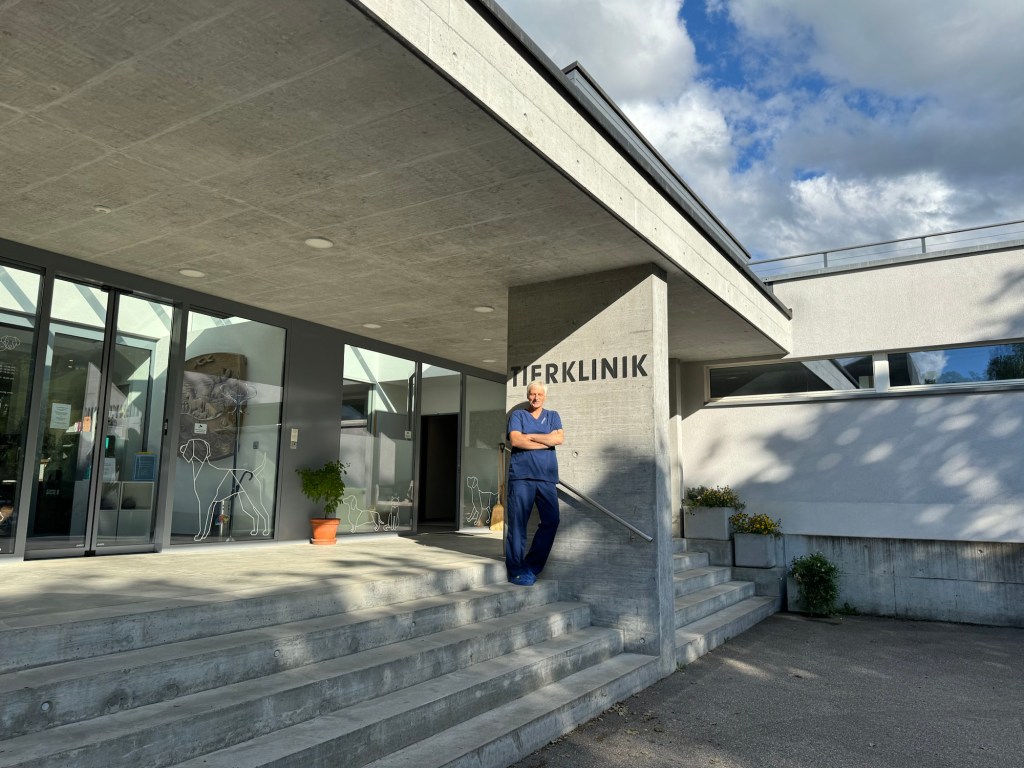
Here, surrounded by a landscape of mind-blowing natural beauty, just outside of the small village of Nesslau, Carla and Dani Leutenegger, a local veterinary couple, realised some years ago their dream: to build a meticulously designed veterinary clinic together with boarding kennels and a cattery right next door.
Although no longer owned by these amazing colleagues, the place still bears their handwriting in every tiny detail, all based on decades of professional experience paired with the ingrained Swiss love for tidiness and precision.
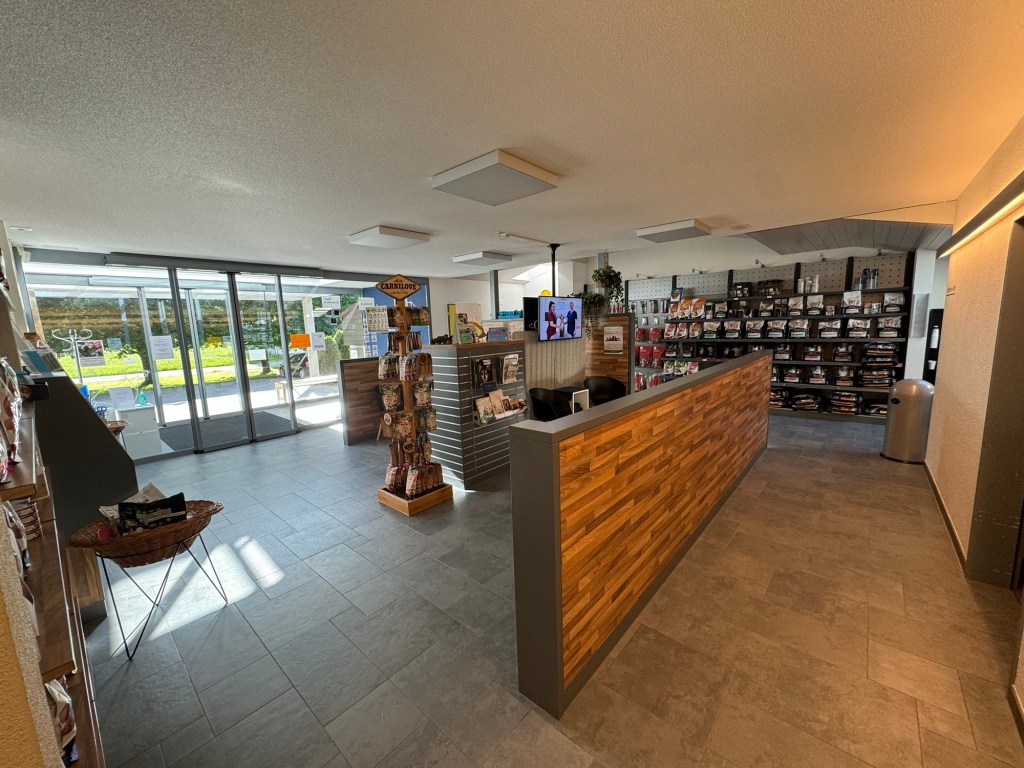
Nothing at this clinic was at its place by coincidence. Every piece of equipment, the fittings, the furniture and even the quintessential Swiss coffee machine were all of the best quality and a delight to operate or to work with. No expenses had been spared for the benefit of the patients, but also for the people who are working here. Everything was labelled and there was a clear and obvious system in each draw and in every cup board.
The well lid consulting rooms were clear cut, spacious, very clean and uncluttered.
For dogs and for cats there was a separate waiting room area and individual inpatient facilities. The place featured not only a couple of operating theatres, but also a lot of diagnostic tools, as well as a CT.
At many occasions I caught myself thinking : “Oh, that’s the way we should have done it at my clinic in Surrey.” or “I wish, I would have had this hand tool or this machine…..”
The pleasure I took in the working facilities was matched by that for the Swiss and Croatian team that welcomed me. Always friendly, always polite, competent and always happy to help, especially when this involved translating for me frequently the challenging Swiss accent of our clients.
While living at the clinic, I could take Mia, my trusted Vizsla, for morning runs on the foot path along the Thurgau creek, that was running with its clear water through the freshly cut fields, just a stone throw away from the building.
In the evenings after the last patients had left the clinic, I could put on my hiking boots to explore together with my lucky canine companion the well signed trails of the Stockberg, the mountain I could see during the whole day from my consulting room window. Behind the building the more remote Ijental was waiting,
as was the Schwägalp on the other side of the village, just a short drive away. Here one had access to the Säntis, a mountain of more than 8000 ft altitude and to the whole Alpstein massif.
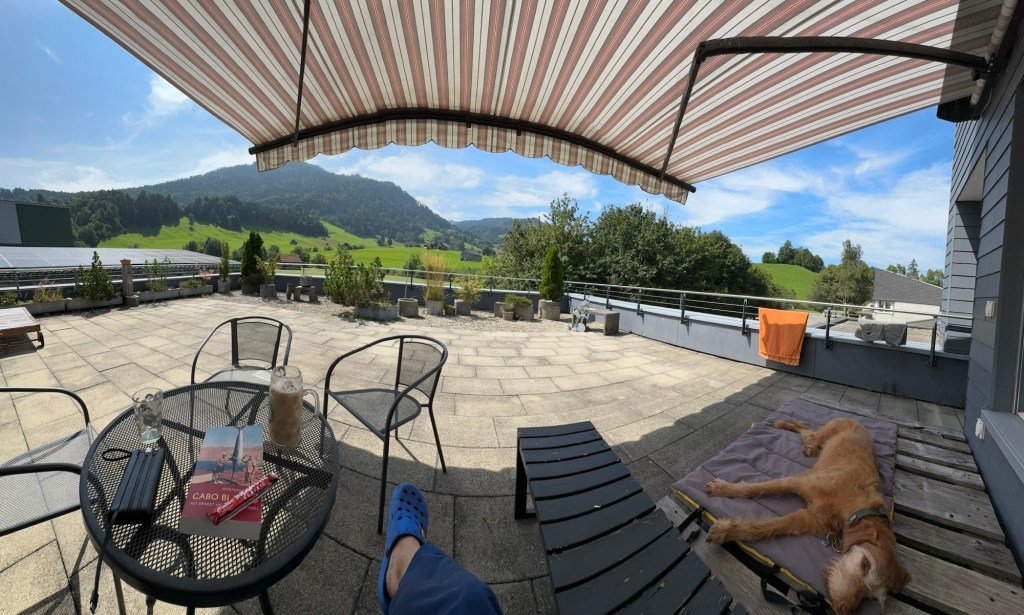
One morning, while sitting on the roof terrace of my new found veterinary Nirvana, enjoying my archetypal Bircher Muesli and the serene landscape around me, I, not for the first time, realised how hard and full of deprivation the life as a travelling veterinarian was….
There was no point to scream, as there was no escaping from it anyway…
With some surprise I realised, how many nerve endings could be found on the surface of a human body, while several layers of my skin were removed by a bearded stranger I had never seen before. I just tried to dig my nails deeper into the marble slap underneath me, while wondering what pain relief I might employ, once this unexpected assault had finished ……
“Go to No 5!” was what Irakli, the Georgian film director I was staying with, had replied to my question, where to go to experience one of the most intense sensations travellers have enjoyed for centuries when visiting Tbilisi.
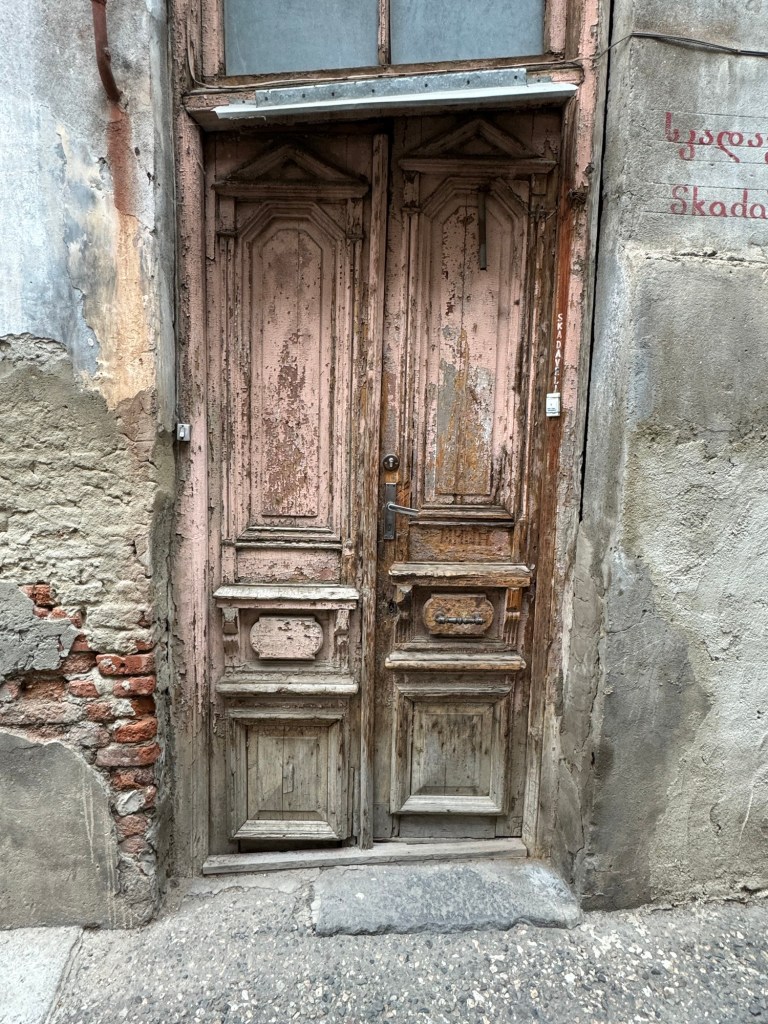
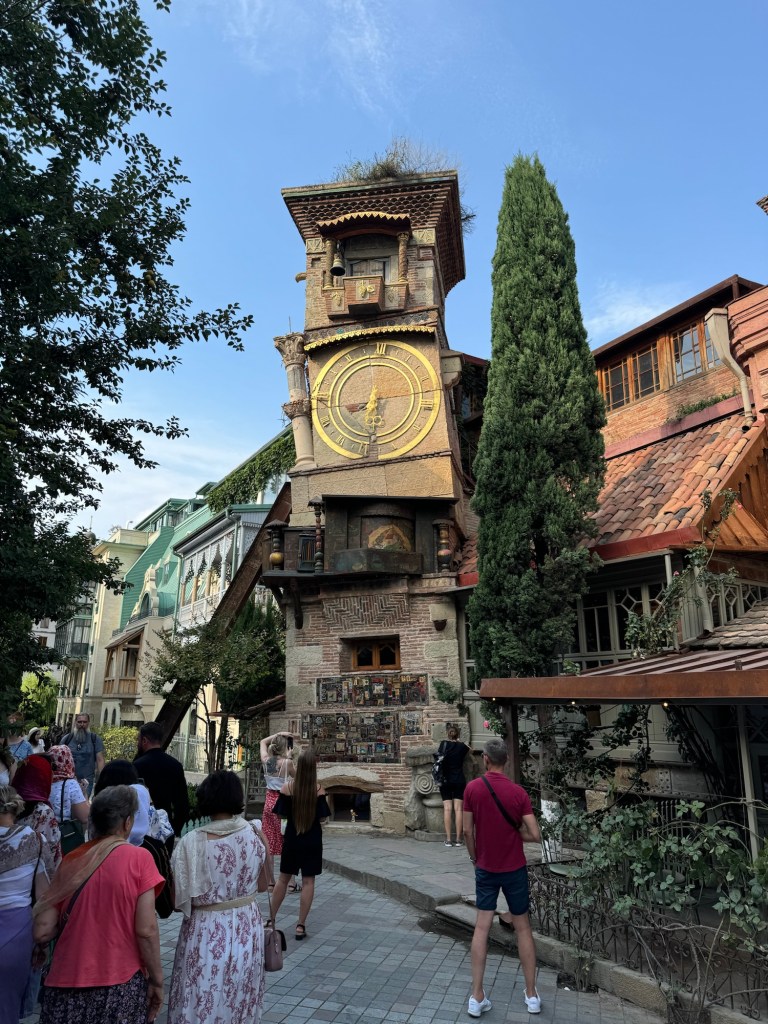
We had been sitting on the landing of “SkadaVeli”, his unassuming, somewhat dilapidated house, right in the centre of the Old Town of Georgia’s capital. Despite its not very appealing outside, his place was a hidden gem with surprisingly modern rooms and a spotless bathroom and kitchen, which usually featured a good bottle of Saperavi. Here, one was in easy walking distance of the city’s beautiful churches and the cathedral, of the best cafes and restaurants, of the futuristic Bridge of Peace, which like a shiny reptile spans the dark water of the Kura river and just a stone throw away from the quirky clock tower in Ioane Shavteli Street.
Irakli was a well of knowledge when it came to Tbilisi, his city, and I was happy to follow his recommendation for a final excursion into the subterranean life of the Abanotubani district, before leaving Georgia.
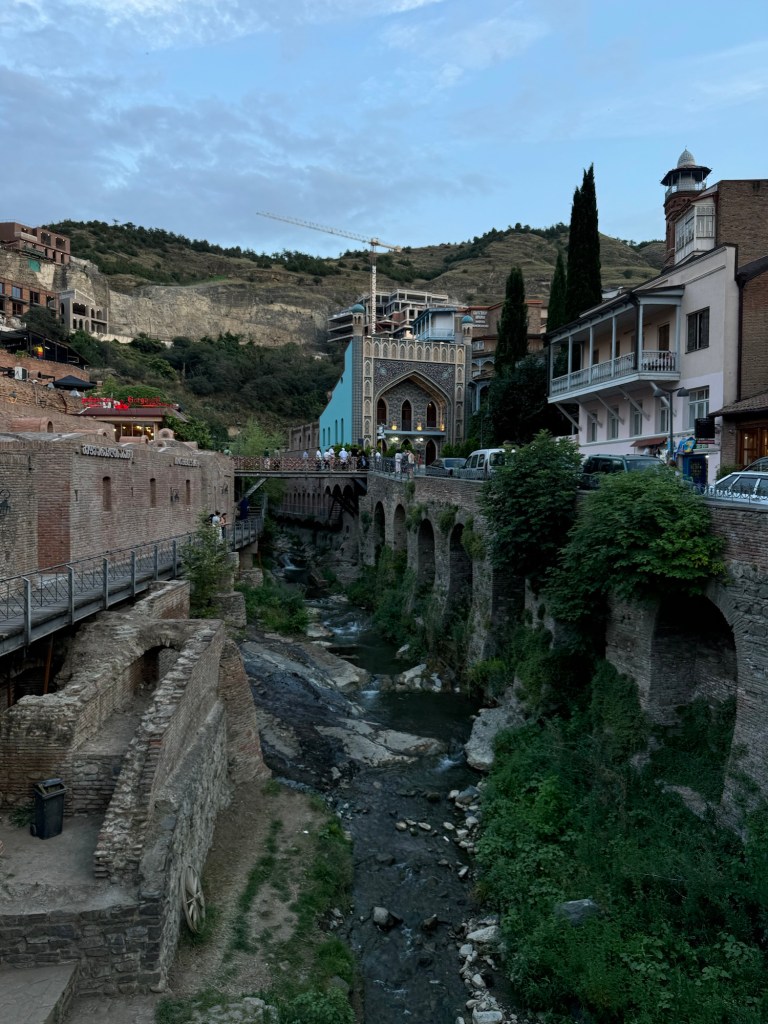
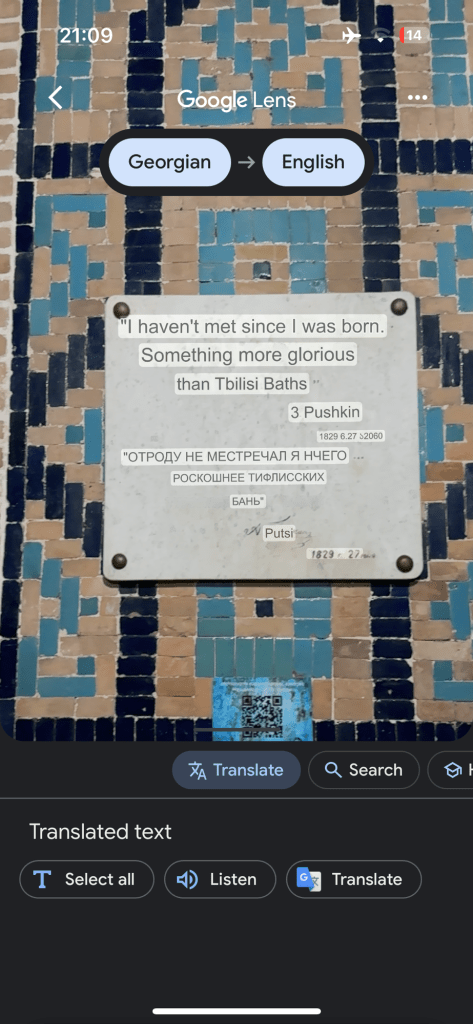
Abanotubani is home to a dozen bath houses, all connected to the hot sulphur springs, which are emerging here from the ground. Their 40 degree warm water is running through a small stretch of land before disappearing into the nearby river. The hot springs had given the city its name and many visitors like the great Russian poet Pushkin have written about the memorable experience and about the health benefits of visiting the local bath houses:
Today’s bath houses vary greatly in design and in comfort and it is possible to book both private rooms or to visit the public areas which are gender separated.
I was travelling alone and to get a more genuine impression how the locals were using their bath houses, Irakli had suggested to visit one of the two public bath houses.
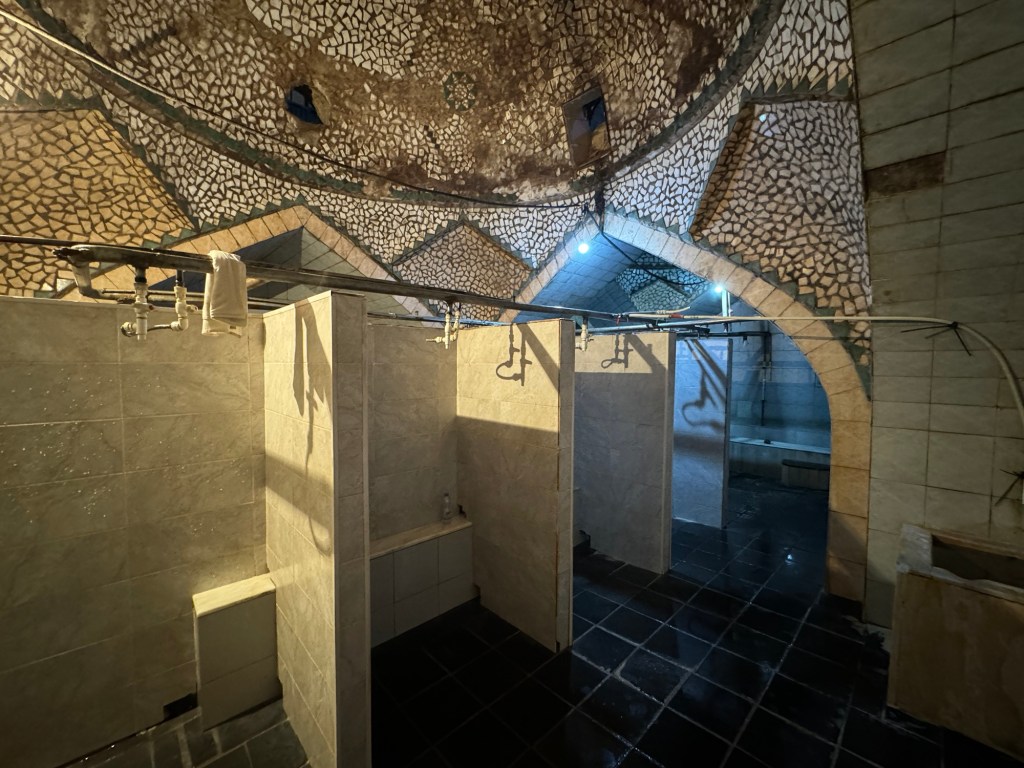
Less than an hour later, I was standing in-front of “Public Bath No.5” – an institution in Tbilisi, with a history that is dating back nearly 100 years. Both the hammer and sickle emblem on the front, as well as typical soviet style mosaics in the rooms downstairs confirmed that this was a place more for the local community, rather than the more upmarket and elaborate decorated Orbeliani Bath nearby, which was the preferred choice for foreign visitors.
10 Georgian Lari, equivalent to less than £3, got me inside without the need for a reservation, and a further 2 GEL secured me a cup of tea for the end of my visit.
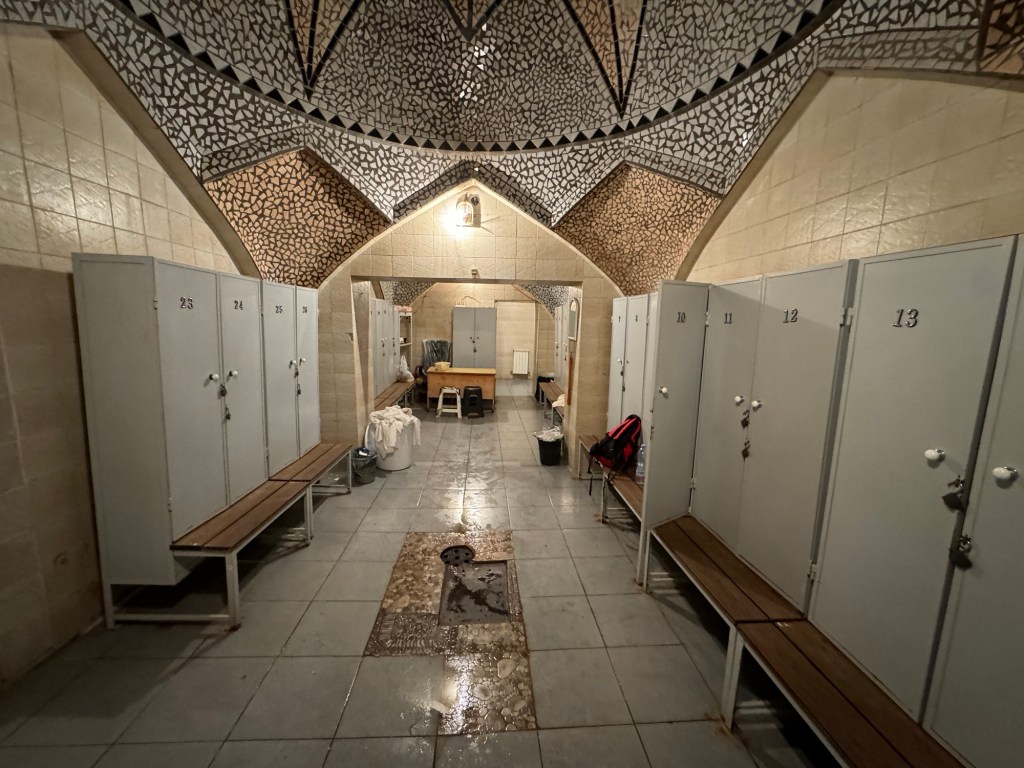
Once I had placed my clothes into one of the spare lockers, I was issued with a pad lock (without a key) by the supervisor, who looked like an archetypal Caucasian prison guard, wearing above his trousers just an undershirt instead of a uniform. A large ring on the table in front of him, featuring the keys for all the pad locks that had been issued, left no doubt that no one was leaving this place without the consent of this man….
Dressed with just a towel, I progressed into the main room, where I managed to take a shower once I had found out, how to create an ambient temperature, by operating the different taps protruding from a complicated system of leaking plastic and copper pipes above the shower cubicle.
Next I immersed myself into a pool of boiling hot water which – as I felt – far exceeded the 38-40 C that had been advertised.
Only with a fair amount of will power, I lasted close to 5 minutes in the pool and – before passing out – I felt ready to progress to the main part of the procedure – the “Kisi”.
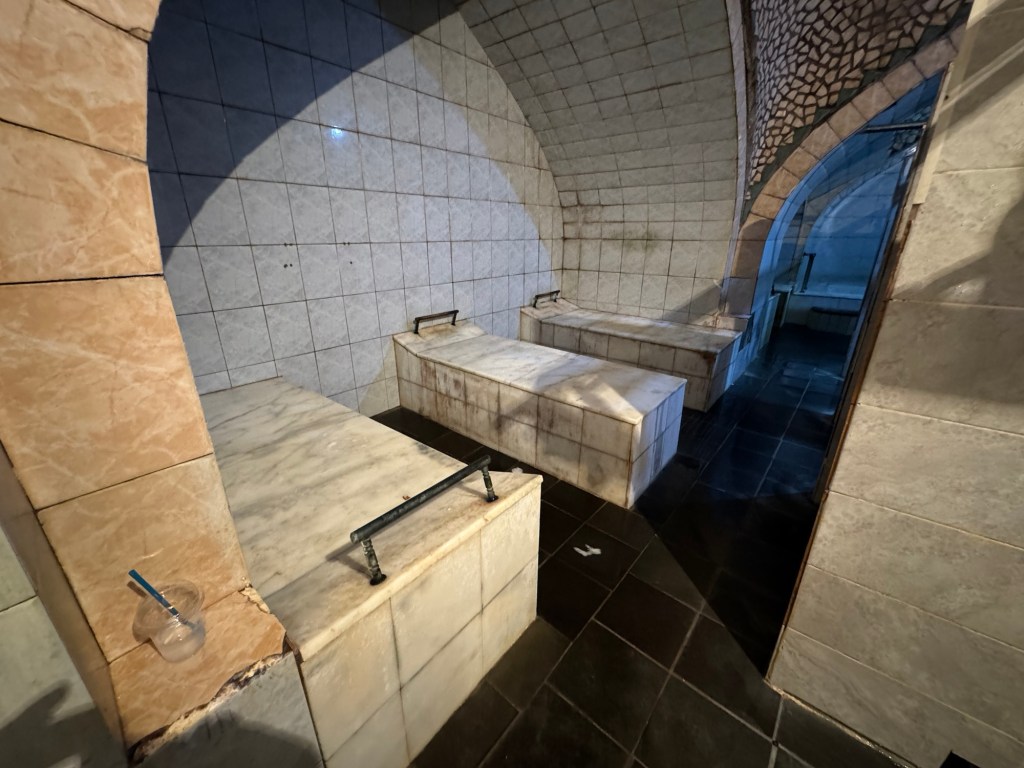
Red like a lobster and still slightly dizzy, I stumbled over to one of the nearby marble benches, where the Mekise or “Head-Scrubber”, who looked like the angry brother of the supervisor, motioned me to lay down, before setting to work…..
And here, any resemblance to what could have been considered something like a massage, immediately vanished…..
The “Kisi” – as I now found out – is more of a thorough cleaning procedure, where, with the help of a glove, which has a surface similar to the outside of a coconut shell or to an industrial utensil that is commonly used to remove congealed food particles from frying pans, the unexpected and – through the heat of the hot bath – sensitised surface of the skin is mechanically stripped away…..
While the glove was doing the damage, I was wondering, how desperate Pushkin must have been to write poems about this place and that he must have considered the bullet that eventually killed him, as the lesser evil.
When my skin was just a single raw nerve, a bucket of water was poured over what was left of me and my body was lathered with a thick layer of soap, which was then washed off with another bucket of water.
Eventually I was allowed to stagger away from the marble slap and while my place was taken by the next victim, I tried to regain consciousness with the help of a cold shower.
A short while later, I was sitting back in the spartan locker room, with the domed ceiling as the only decorative feature, and while my still shaking hands were holding a small glass of black tea, the prison guard inquired, how I had enjoyed my first stay at a Georgian bath house….
The sun had already set when I re-emerged from the bowels of Bath No 5 and while walking back to the safety of “SkadaVeli”, I was surprised that my body wasn’t in more pain. It was followed by an excellent night’s sleep and when I woke up the next morning, I felt so great, that I am already looking forward to my next visit to Tbilisi and to the bath houses of Abanotubani.
I was in a bad way….for a whole day and for a couple of nights I had been struggling with abdominal pain and none of the painkillers I had thrown at it, had made much of a difference. Declaring defeat, I had managed to get a last minute flight with a Ukrainian carrier out of Tbilisi and via Kyiv to the UK.
My monosyllabic taxi driver had refused to issue me with a receipt for the cash I had given him for his reckless driving through the unlit suburbs of the Georgian Capital. At least he had dropped me at the airport in time and at that point I just didn’t had it in me any more to pick a fight over it. Eventually the crowded Tupolev lifted off the tarmac and we were heading North over the Caucasus mountains towards Russia, while I was emptying the remaining content of my stomach into the waxed paper bag, that I had found just in time in the back pocket of the seat in front of me……
This was eight years ago and it had been a miserable way to finish my first visit to Georgia. And while a couple of gastric ulcers and a gallstone were telling me, that I had taken on a bit too much by running my own veterinary clinic and at the same time trying to attend a lot of vet meetings all over Europe, I knew that I had to be back to this city and to the colleagues there.
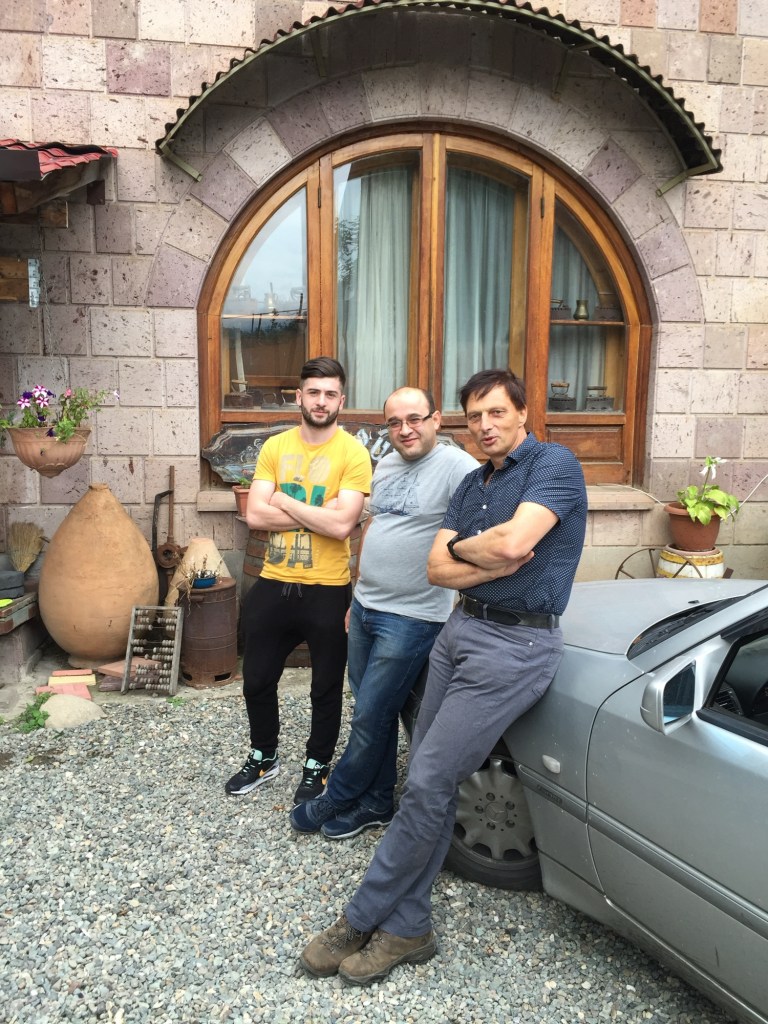
Much had happened in Georgia, when I finally shook hands again with Giorgi and Dato, who had once taken me on an epic road trip across the country and along the unstable border with Azerbaijan to the North of Armenia.
The state of the roads, the speed and the insane overtaking of and by cars still gives me nightmares.
It was a good, not only to seeing them both alive and in good health, but also to learn that Dato had finally disposed of his Mercedes, the deathtrap that had undergone a DIY LPG re-fitt, resulting in a sizeable liquid gas canister placed right behind the rear seats (where I was sitting….).
Several completely burnt out car wracks alongside the road had indicated that this, in combination with a non-existent traffic etiquette, had been a very bad idea….
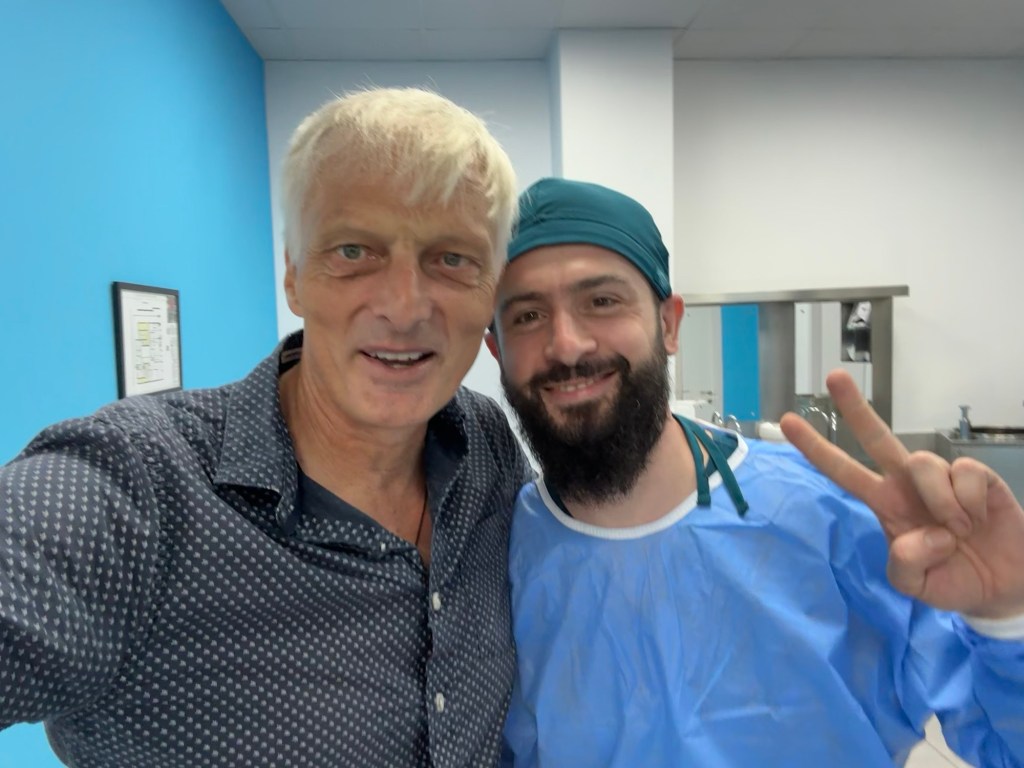
This time around with the help of my local colleague and fixer Mariam Chkhikvishvili, I was able not only to reconnect with Dato and Giorgi, but to visit also their places of work.
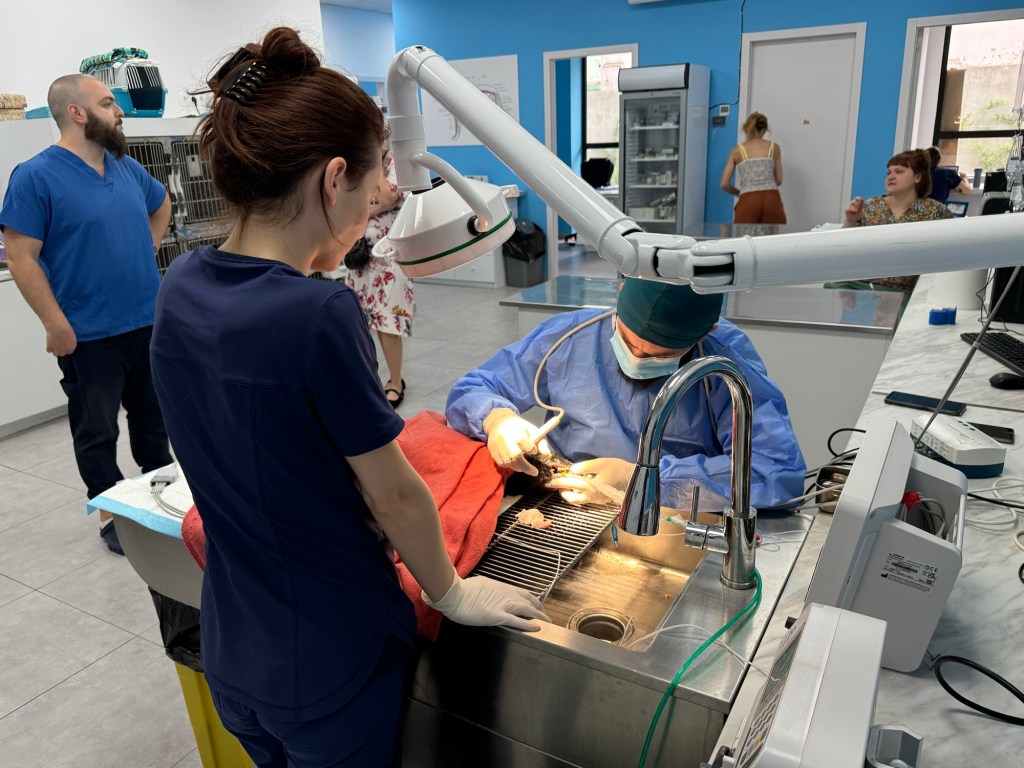
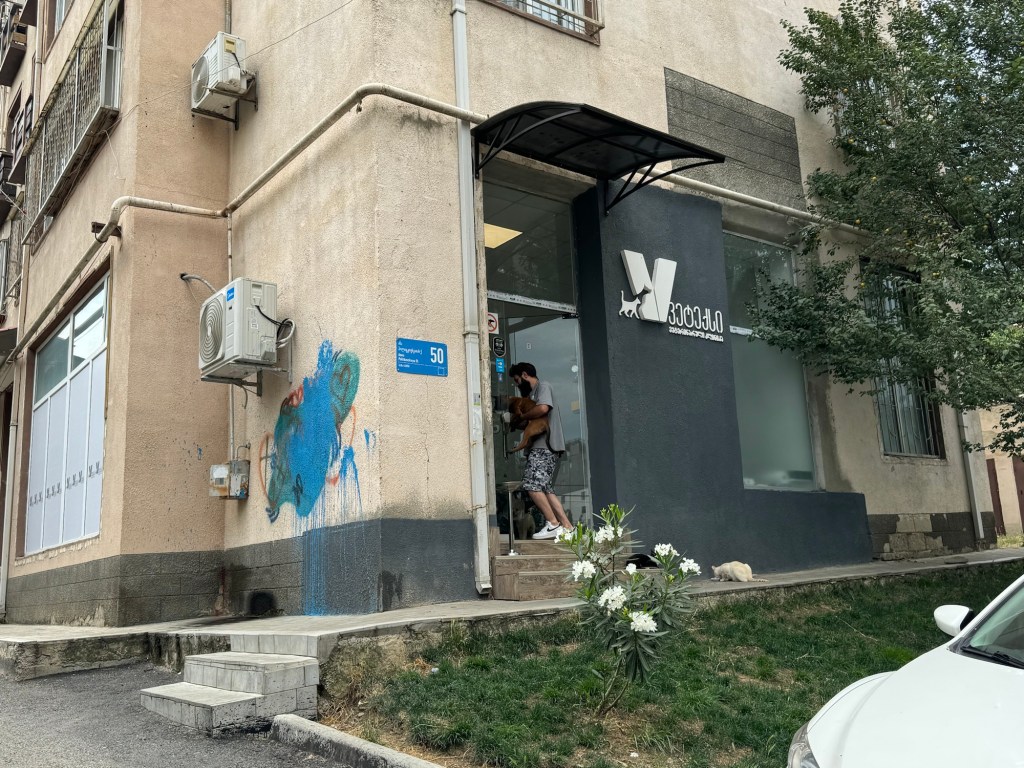
Giorgi was busy performing a dental procedure on a small dog, when I visited him at Vetlife, a new and well equipped clinic in the city centre.
Providing a 24 hour service for their clients and placed in the ground floor of a multi-storey building, this small hospital employs a number of veterinary specialists, able to see patients in six small consulting rooms with a minimalistic interior design, making them perfect especially for feline consults.
The clinic features both a CR radiology system as well as ultrasound facilities in dedicated rooms. A large preparation area in the centre of the hospital leaves ample space to perform both dental procedures and to get patients ready for surgery in the well equipped operating theatre.
Vetlife is a fairly new set up and the place wasn’t overly busy when I visited.
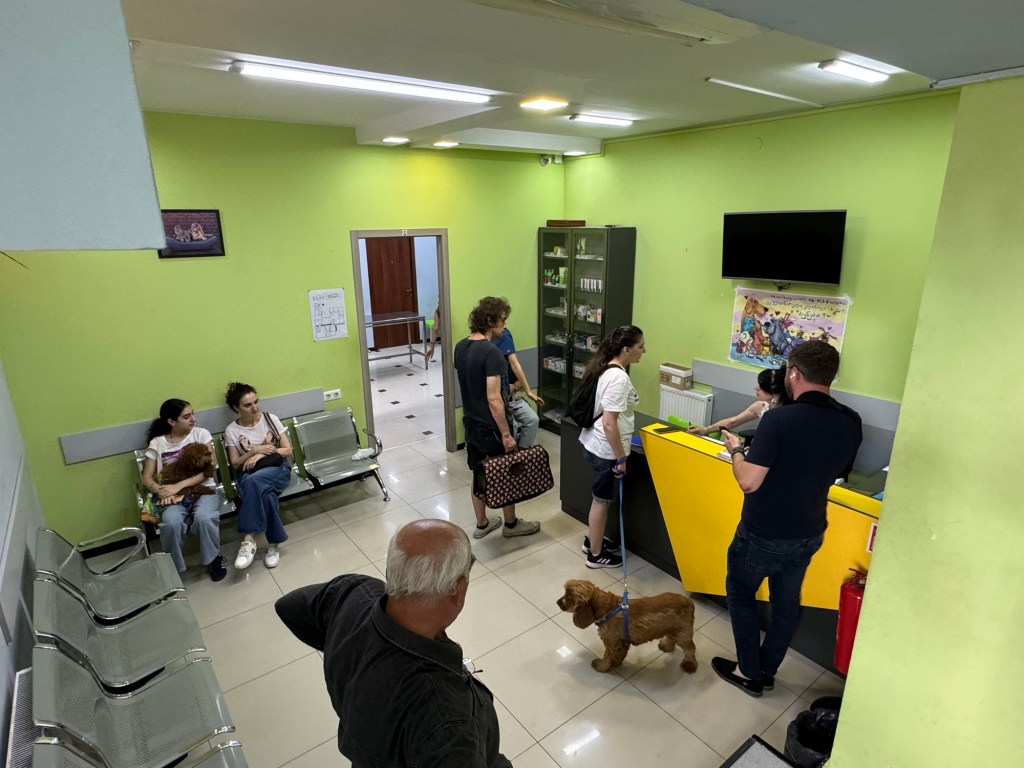
This was different at Dato’s place, which struck me as a pet owner’s dream and a nurse’s nightmare.
The clinic was heaving with clients, staff and patients, with no defined distinction between the public and the private areas, probably with the exception of the operating area.
Clients clearly loved this busy place and quite a few of them were staying with their pets, while these were receiving their treatment. As Dato was once again busy risking his life on the unpredictable Georgian roads, I was greeted by the always positive and smiling Izi Miminoshvili and by Tamuna Kakubava who was managing the whole place in a calm und controlled way.
As in most urban practices these days, the majority of the patients were cats and smaller breed dogs, plus a not inconsiderable number of large and sometimes very large guard dogs.
With no own testing and licensing organisation for veterinary medicines established in Georgia, the permission to sell and to use these drugs is mainly based on previous FDA or EMA accreditation. In addition to this, a lot of human medicines are been used on pets in Georgia.
Vaccines are readily available, but often declined by pet owners as being too expensive or considered unnecessary, despite the fact that cases of distemper, parvovirosis and even rabies are not uncommon in this part of the world.
Unsurprisingly vector borne diseases like ehrlichiosis, anaplasmosis and leishmaniasis are a common presentation as well, usually due to the failure of using the prophylactic treatment options available.
The use of monoclonal antibodies for atopic or arthritic patients, as well as any online pet health services have yet to arrive in Georgia.
Pet health insurance is at the moment not available and clients have to expect to pay between 30-60 Lari (GEL)/ £10-20 for a first opinion consult in Tbilisi and probably less in the countryside.
At Mariam’s clinic I noticed another feature that I had so far just seen at vet schools: an examination room with several consulting and treatment tables !
Client confidentiality is far less of a concern here and pet owners don’t mind watching another animal receiving treatment on the table next to them or that the treatment of their own pet is being conducted in a semi-public space. The more important issue is, that they are allowed to stay with their pet.
While most clinics didn’t open their doors before a very civil 10 am, the work for most Georgian colleagues is then often relentless, with hardly any time for a break until the doors close at about 6 pm – as always – subject to emergencies…..
Some of the Tbilisi practices offer an out of hours service, but there is no obligation to provide it and there is no centralised organisation of the service.
All clinics I visited were computerised and card payment was the universally accepted way to settle the vet bill.
Getting post graduate training is not easy for my Georgian colleagues. With only a small companion animal veterinary association with less than 100 members at the best of times and with virtually no funding, it is difficult and financially risky to organise continuing education events. The vet schools, of which there are now several, mostly privately run establishments, provide very little companion animal education for qualified vets, so that colleagues have to travel abroad, commonly to Turkey or to Russia, to acquire new skills.
So far there are no corporate veterinary groups in Georgia and clinics are owned by individual owners or by veterinary partnerships. With no training courses available for veterinary nurses, the teams usually consist of vets with different levels of experience and lay staff running the reception and performing unskilled work. Young graduates or final year vet students are often task with nursing duties.
Unsurprisingly Georgia and especially Tbilisi has over the last two years seen a considerable increase of Russian and Belarusian pet owners. These are met by an similar influx of – predominantly male – veterinarians from these countries. A development that is seen with mixed feeling by the local profession. Some veterinary businesses have integrated the newcomers into their teams, often resulting in English been used as the lingua franca in the clinics, while others are less inclined to offer any employment, seeing them as potential competitors in an already tight market.
Georgia and the Caucasus region as a whole, have always been a meeting point of different cultures, religions and people and its complex geo-political position has had a great influence on the veterinary professional in this region as well. Georgian colleagues like Izi, Mariam, Dato and Giorgi are providing a truly remarkable service to their clients, despite an often challenging working environment and with very limited resources. This has only been possible by remaining responsive and open to changes and to opportunities when they arise and by understanding themselves as members of an international profession with the open sharing of skills and knowledge for the benefit of the patients in their care.
Let’s hope that at my next visit to Tbilisi, they have progressed further on this journey.
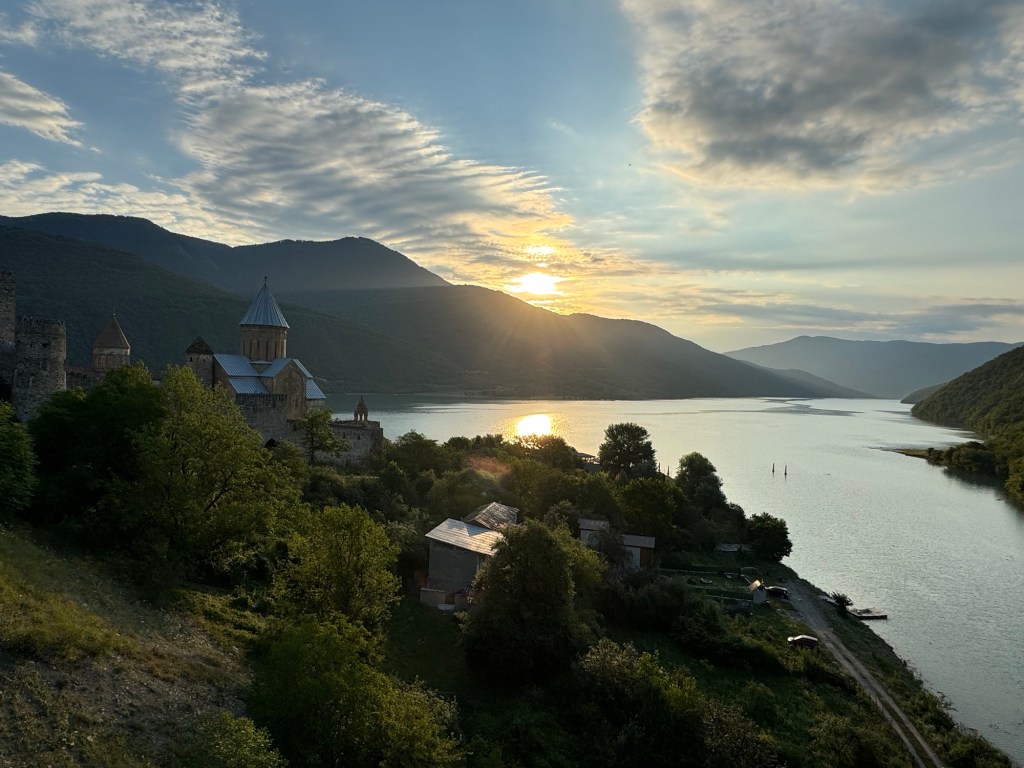
Driving along the Georgian Military Highway, leaving behind me the world heritage site of the castle of Ananuri,
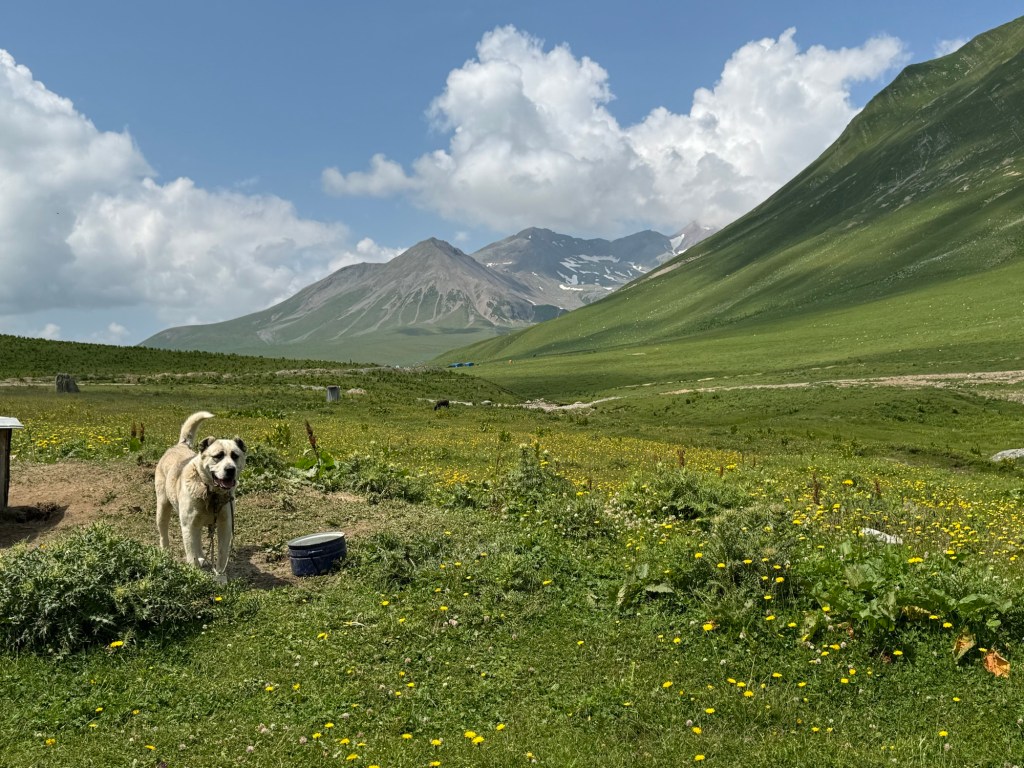
and heading North towards the town of Stepantsminda, I had to cross the over 2000m high Jvari Pass, where the green meadows of an Alpine plateau offers an ideal pasture for large herds of sheep.
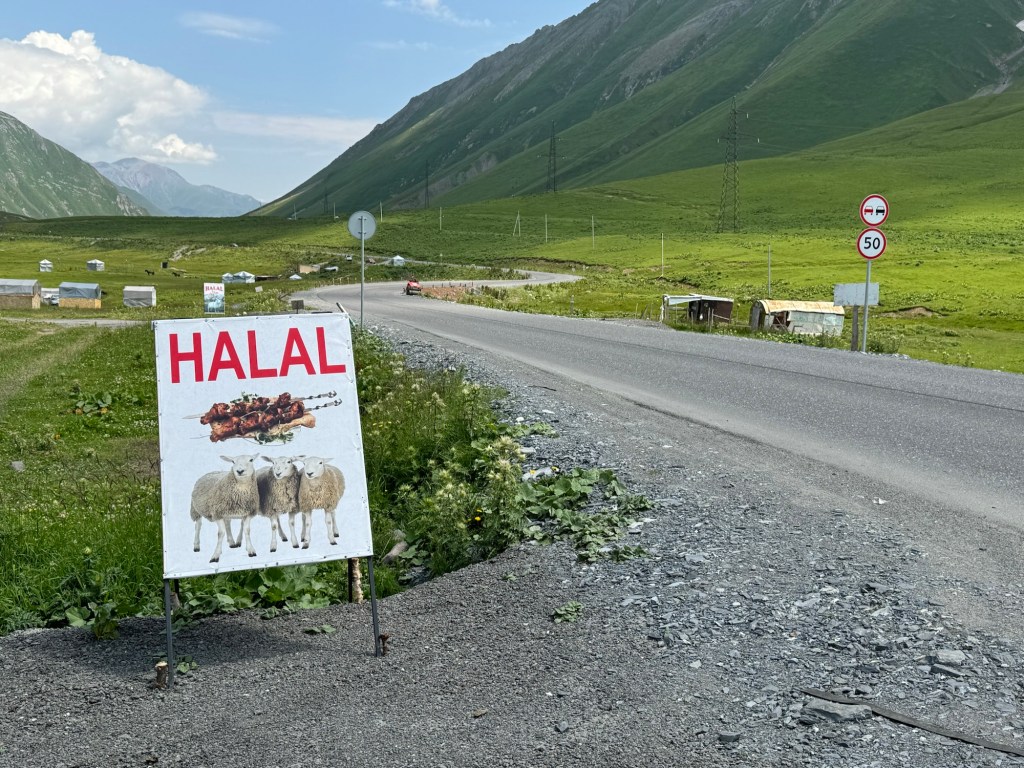
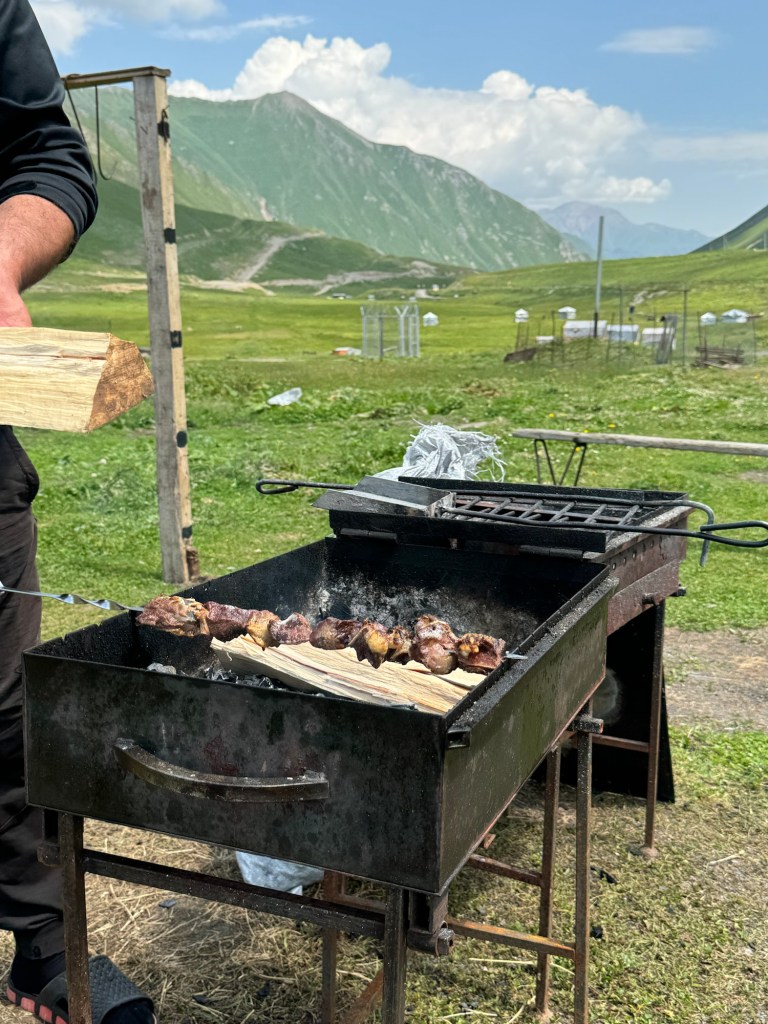
Crossing the highest point of the pass, it was impossible to ignore the numerous wood fires places and the corresponding “Halal” signs at the side of the road.
Here the local shepherds were offering their fare to hungry travellers.
I personally found the signs, which were indicating that here the sheep were exsanguinated without prior stunning, somewhat off putting, but I appreciated that this was the traditional way of slaughter, that had been practiced in these mountains for hundreds if not for thousands of years and that, if done correctly, the suffering for the animal would be fairly brief (and yet still too long if you looked at it through the eyes of a vegetarian…..). Furthermore, taking a more holistic view, I thought that these animals had probably a far better life, than their cousins in our world of industrialised farming. Rather than being kept in narrow enclosures to grow and being, at the end of their lives, transported over long distances to a slaughterhouse, these sheep were born on these mountains, free to roam under an open sky for most or for all of their lives and then finally killed in a (hopefully) fast and efficient way in familiar surroundings.
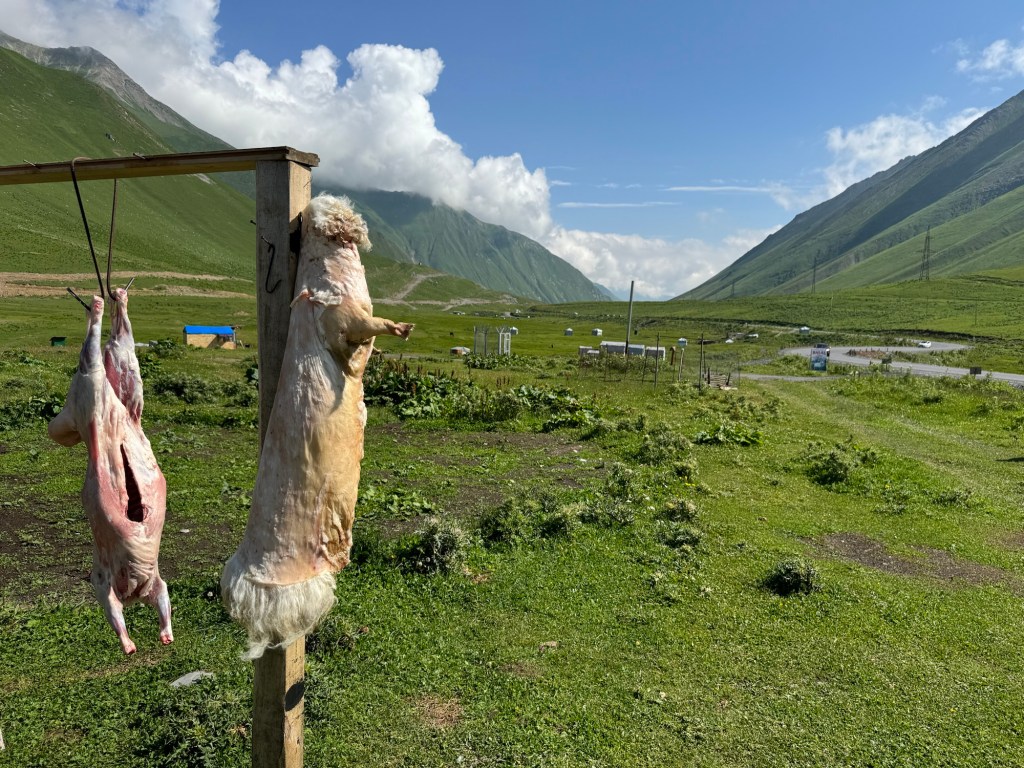
When stopping my car and walking up to one of the fireplaces, I realised that I had arrived too early for lunch. A freshly slaughtered carcass was hanging on a hook,
but the fire hadn’t been lid yet.
“Dicid minut ! Ten minutes!” the shepherd shouted in my direction, being uncertain if I was Russian or someone from further afield.
Taking him by his word, it left me with enough time to have a closer look at his dogs….
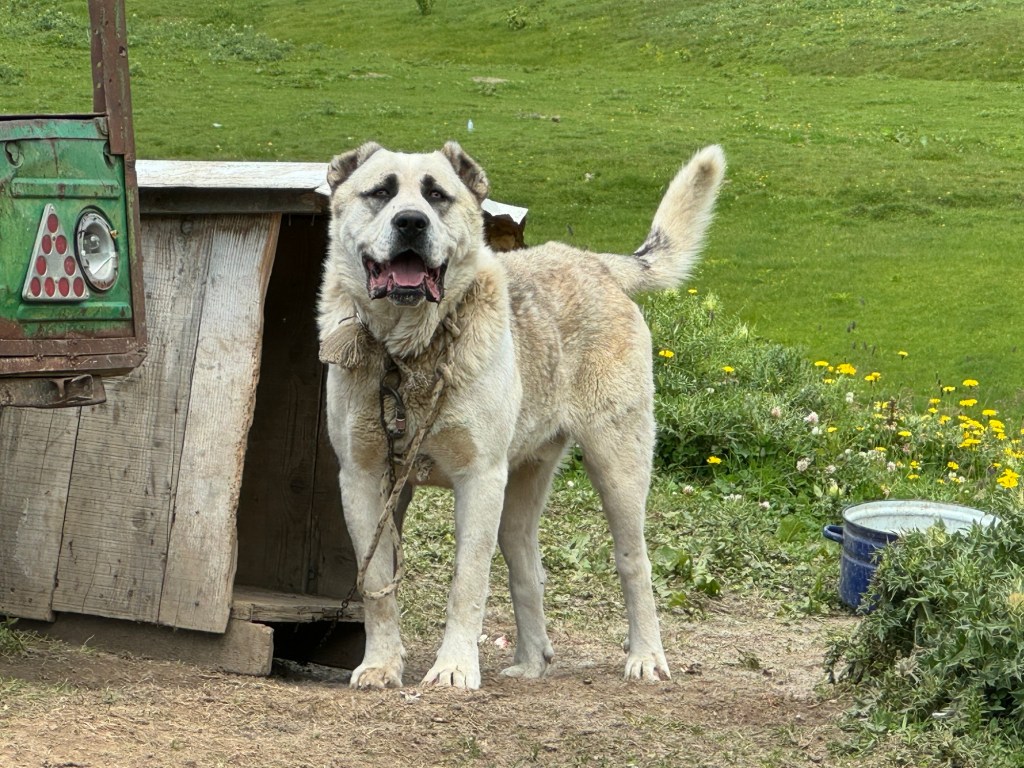
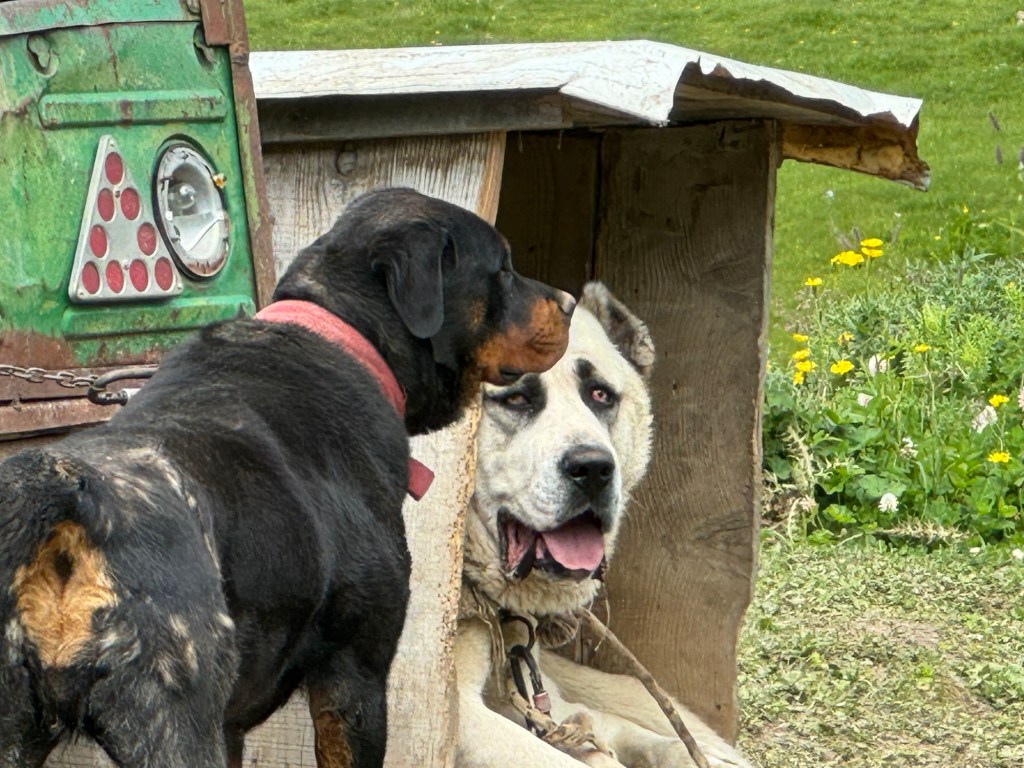
Not far from the fire place, there was a huge Caucasian Shepherd, which dwarfed the Rottweiler that kept him company.
Both dogs remained relaxed and not overly interested in my presence, but I have to admit that I was relieved that they were kept on a chain and I remained at a safe distance.
The purpose of these dogs, which grow up together with sheep, is to guard, rather than to herd the flock. In this part of the world (and now also in many parts of western Europe), these dog have to stand up to, and to fend off predators like wolfs and bears, for which a domestic sheep or lamb would be an easy catch.
When hiking in the mountains – even worse if you bring along your own dog – you certainly don’t want to come across one of these canine giants near a herd of livestock….
You rather meet a wolf or a bear!….
I didn’t envy my Georgian colleagues, who occasionally have to treat these huge animals.
“ The Rottweiler is useless and the Caucasian is small for his breed.”, the shepherd said in broken English, standing suddenly next to me. It appeared that he had figured out that my Russian wouldn’t get us very far…..
“The meat is ready!” he added, before walking back to the barbeque.
Not even eight minutes had passed and sure enough, a large skewer with big chunks of coarsely cut meat was waiting for me.
A pinch of rock salt was the only seasoning and a large piece of plain breed the only accompaniment.
And yet – it was delicious !
The meat was firm but not chewy, it had a distinct ovine taste, somewhat amplified by the salt, but not adulterated by additional herbs or by a sauce. Eating it with a hunting knife and bare fingers as the only cutlery, under a blue sky, surrounded by Caucasian mountains, certainly enhanced the experience and I couldn’t think of a more fitting dish, when travelling in this part of the world.
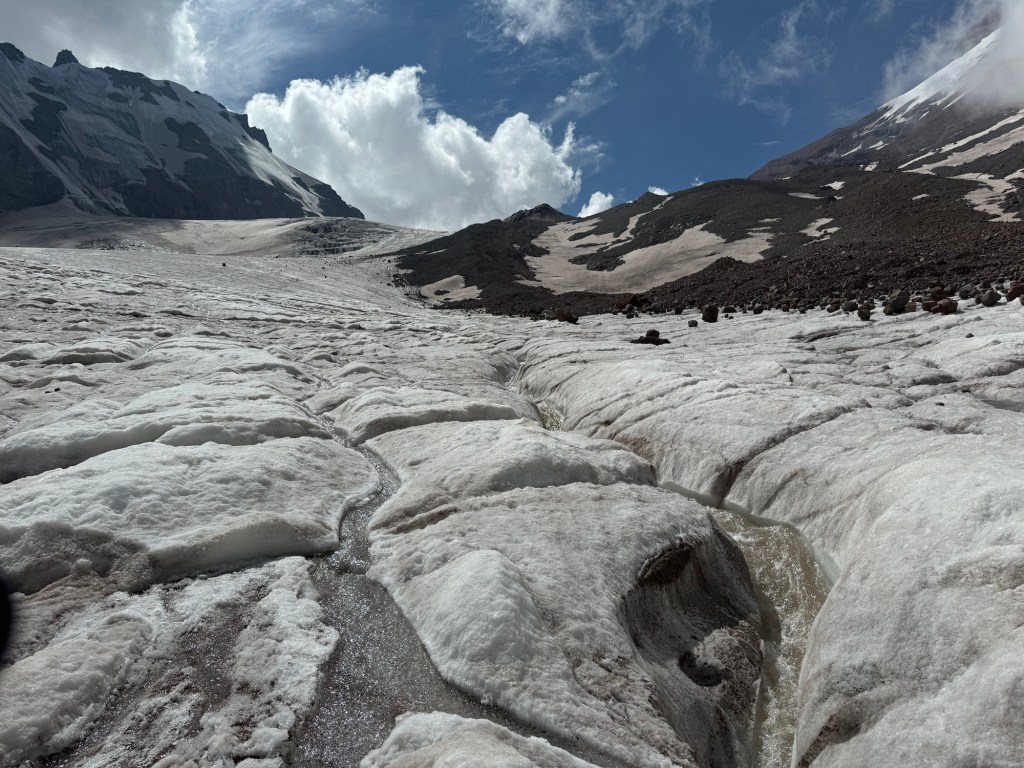
Not for the first time, I had to throw common sense over board and break all the rules. I was standing at an altitude of 3200m above sea level at the bottom of the Gergeti glacier in the Georgian part of the Caucasus, not far from the border to Russia, about to do something really stupid….
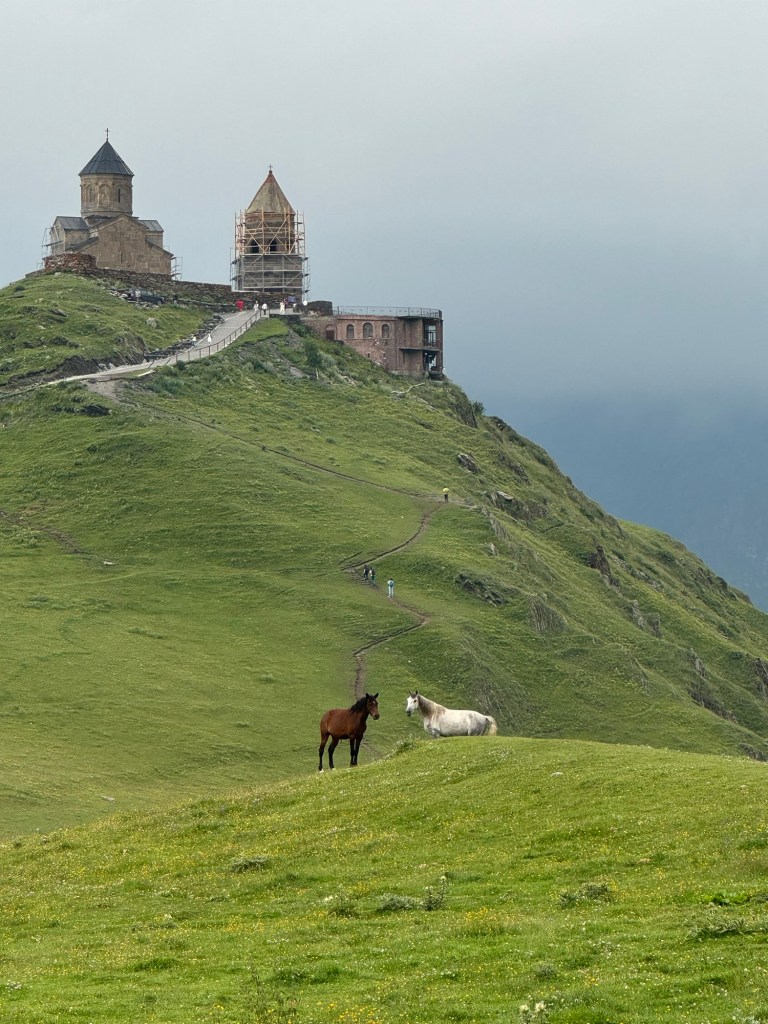
To get to this place, I had flown at short notice to Tiblisi and had driven across the mountains, before leaving my car near the iconic Holy Trinity Church, which is arguably the most famous motif in the whole of Georgia.
Ascending constantly for 2 hours, I had reached the Arsha Pass at nearly 3000m.
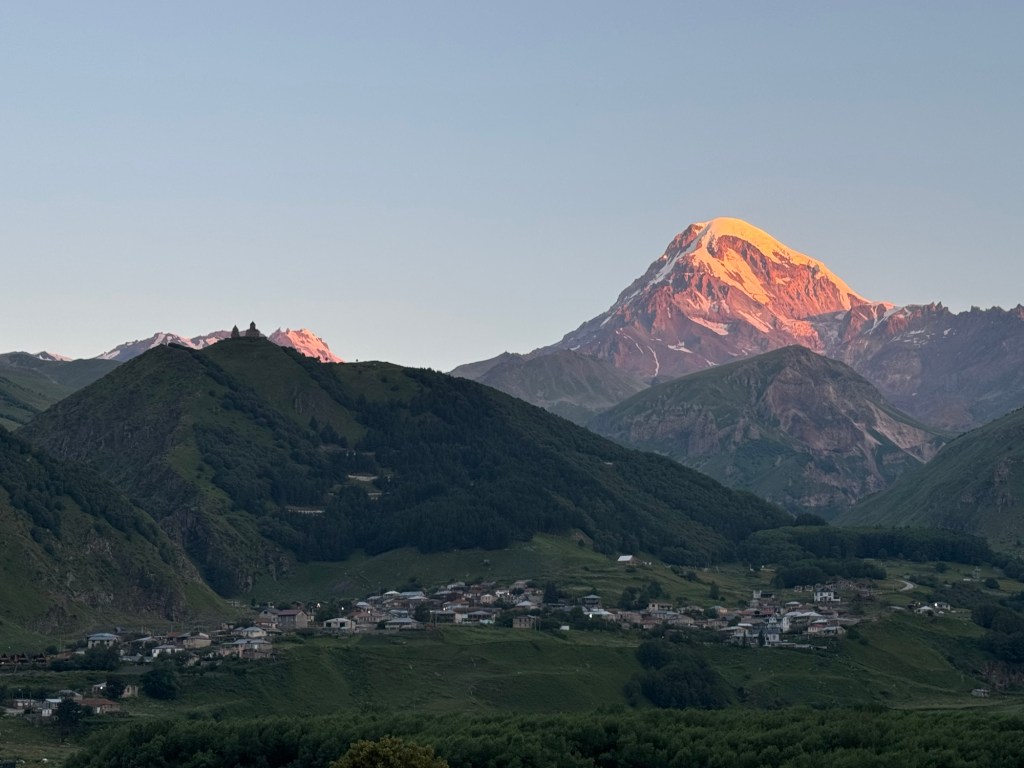
What awaited me here was probably one of the most stunning mountain views I have ever seen: Mt Kazbeg, towering by a large margin over the surrounding summits, was right ahead of me, but separated by a deep gorge, which had been cut in millions of years by the once giant glacier.
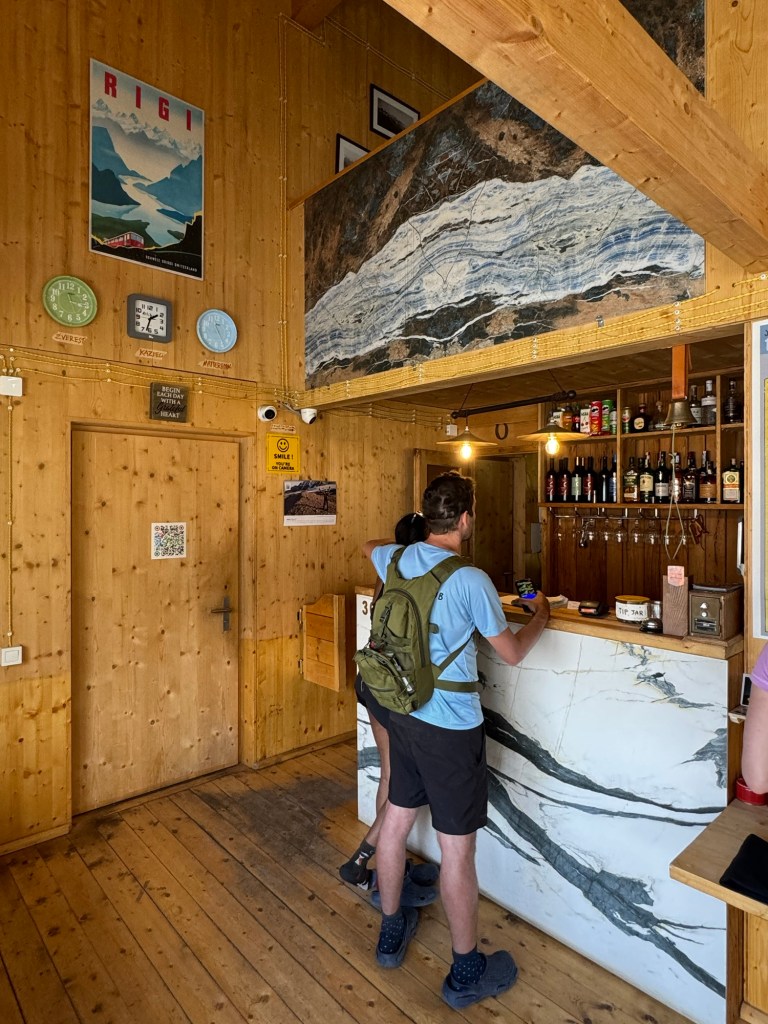
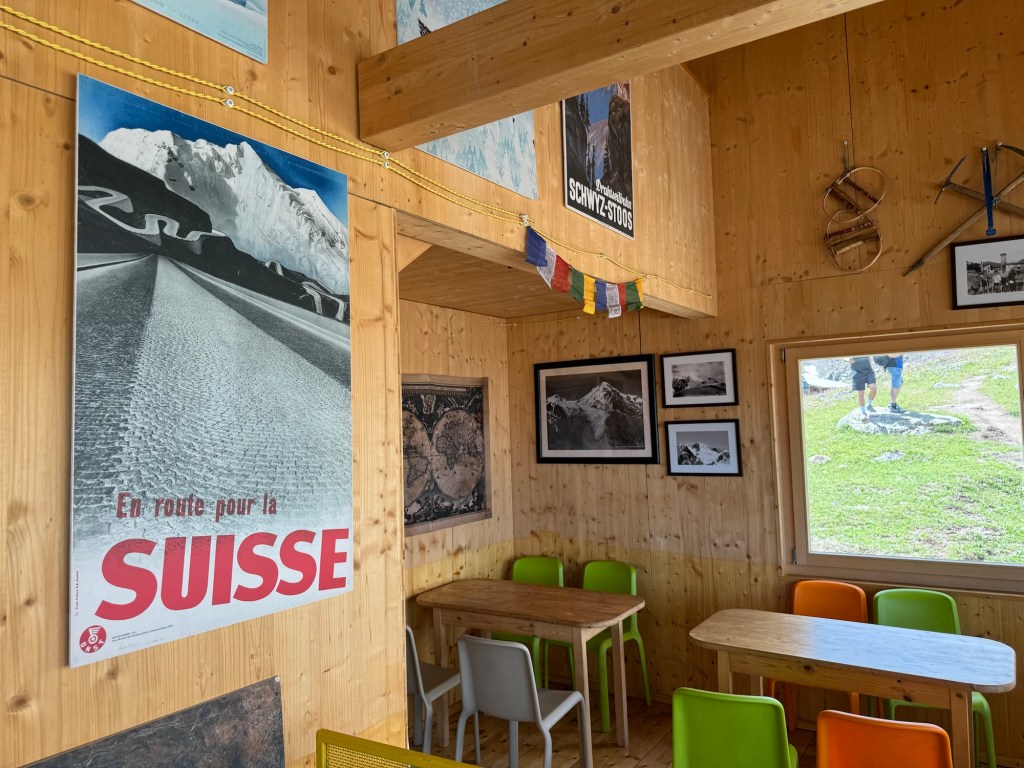
After resting there for a short while and enjoying the view, I had then carried on pass the beautifully located and expertly built Alti Hut. Its more Alpine design had its origin in a cooperation between a Georgian business man and Swiss, German and Czech carpenters and engineers and some considerable EU funding. The wood panelling as well as the vintage posters of well known Swiss ski resorts and mountains on the inside walls of the guest room looked very familiar to me.
From here it had been a more gentle incline to the glacier, but walking at this altitude, each step took considerably more time.
Standing at the bottom of the glacier, I recalled the lessons I had learned at a glacier course in Norway many years ago: “Never walk on a glacier on your own. Always rope up. Inform people where you are going and when you are planning to arrive…”. All very sensible points, but all not very practical in my situation and hence all to be ignored…… At least I had the good sense to bring along light crampons and a sturdy hiking pole, which had to make do instead of an ice axe in case that I slipped.
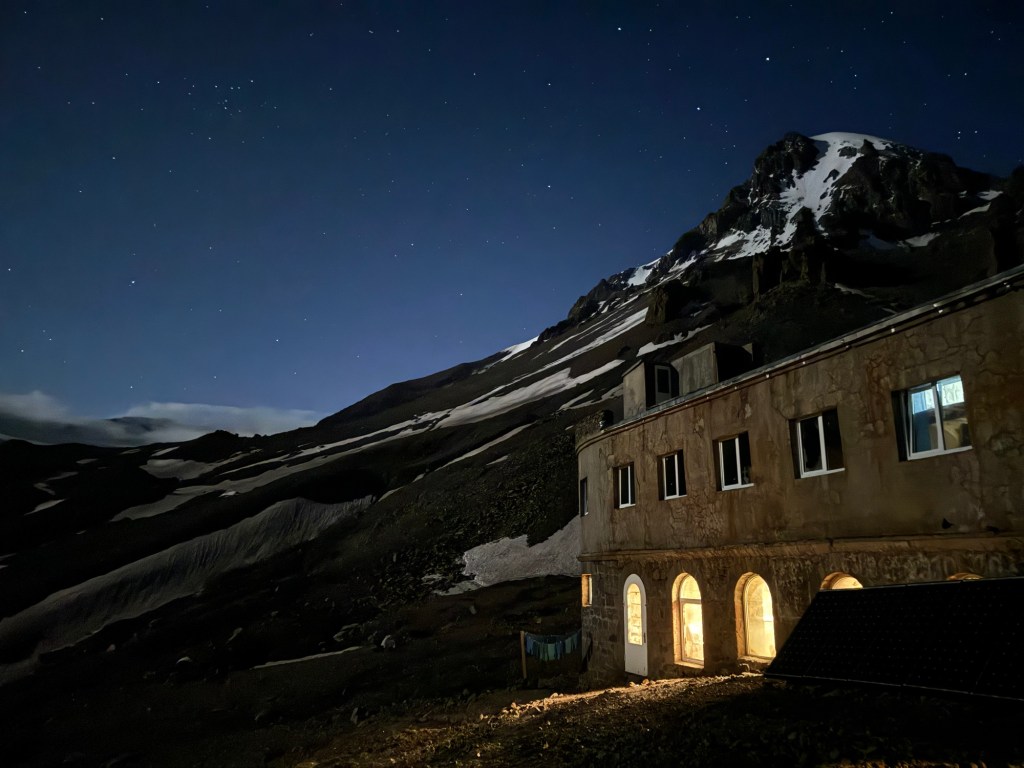
The glacier had to be crossed to reach my place to stay for the night – an old disused Russian weather station, also known as Bethlemi Hut, at 3650 m above sea level, half way up to the summit of Mt Kazbeg, the fabled mountain, which according to legend had been the site where the Titan Prometheus was chained to a rock after stealing the fire from the Olymp to give it to humanity. To make his fate a bit more unpleasant, he was then visited every day by an eagle, which was feeding of his liver…..Being a god himself, this didn’t kill him and he even regrew a new liver over night, but the eagle had the bad habit of returning every day….
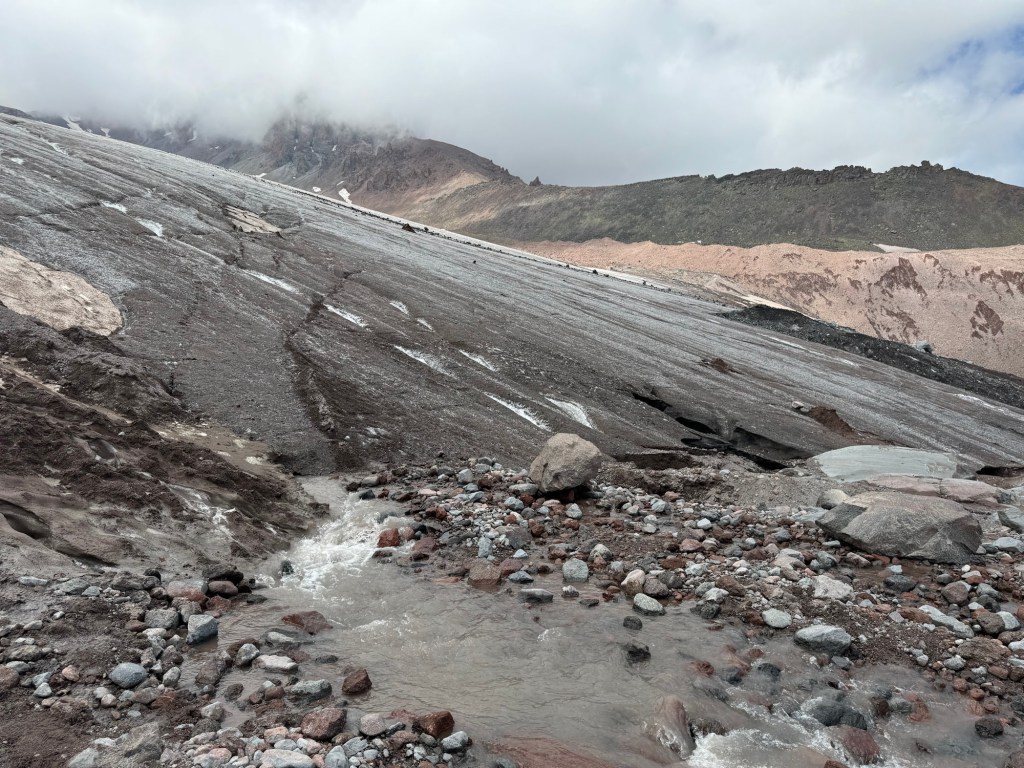
This admittedly was the least of my concerns when I started walking up on the solid but very abrasive ice of the glacier, which was covered with rocks and with centuries worth of decaying plant and animal material. Slipping here would have been painful and would probably have resulted in a certain wound infection.
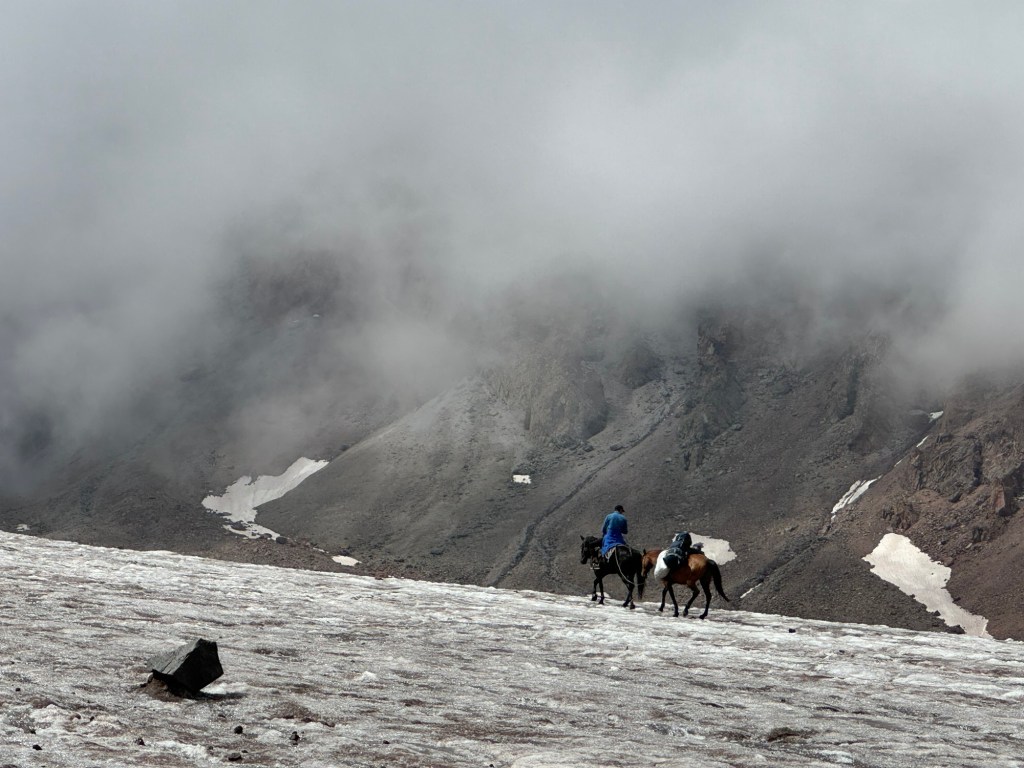
While progressing slowly but with a lot of care, I suddenly heard some steps behind me……a rider with a pack horse was passing me! This was both an unexpected as well as a welcoming sight: if a horse could make it across the glacier, so could I!
And sure enough, following roughly in the track of the horses, I eventually made it safely to the other side.
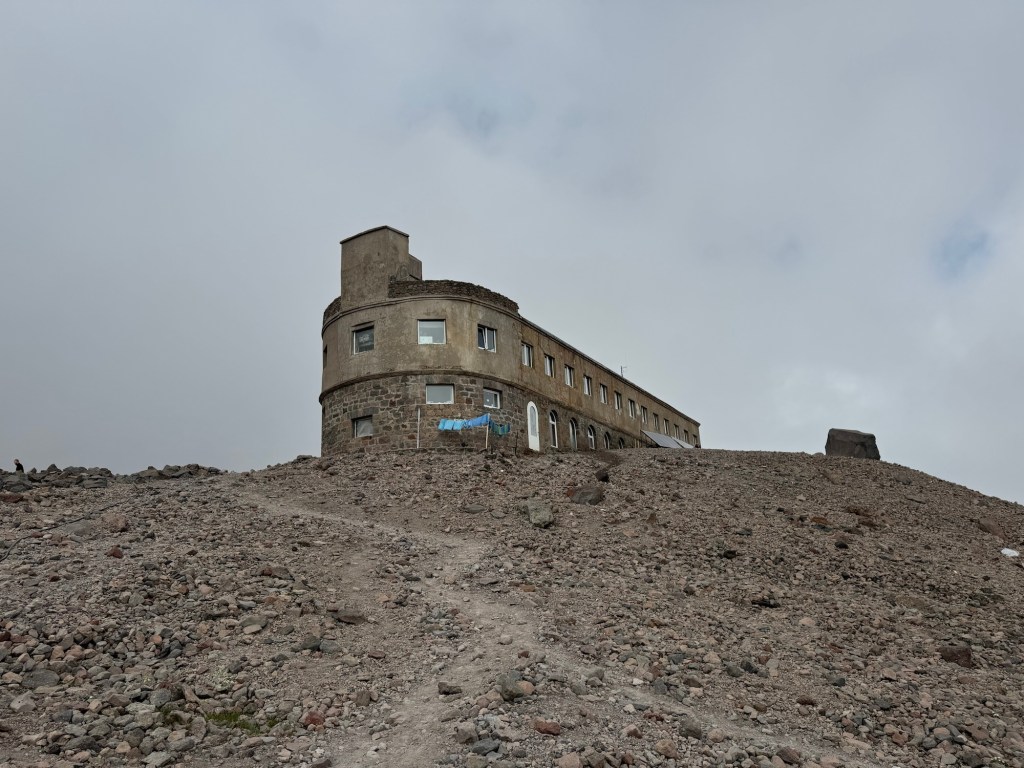
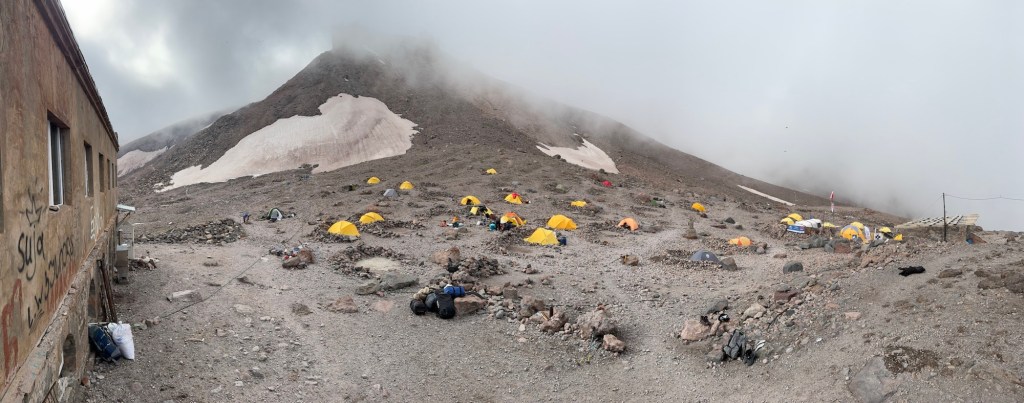
Climbing here another steep 100 or so meters, I had arrived at the iconic building, which, as I would soon find out, presented me with the two sides of the old Georgia and of travelling in many parts of Eastern Europe in general.
During my research for this adventure, I had come across a number of stunning images of this former meteorological station, which is now used as a mountain refuge and the basecamp for all ascents of Mt Kazbeg.
But what I found was sobering…..
A run down, unheated building, that could easily have featured in a Solzhenitsyn novel. Filthy, unlit corridors, some broken windows and no proper sanitation. The communal area, which was hard to find, was cluttered and uninviting and the whole place was in a state of neglect, which was testament of the absence of a well organised and funded national mountaineering association. This certainly wasn’t the Alpen Verein….
No wonder that most professional tour organisers preferred to let their clients stay in tents around the building, despite the ground been littered with pieces of broken glass, rusting metal and various sorts of rubbish in general.
A small private enterprise had occupied the (also unheated) basement, where they provided some form of hospitality by selling poor food for horrendous prices.
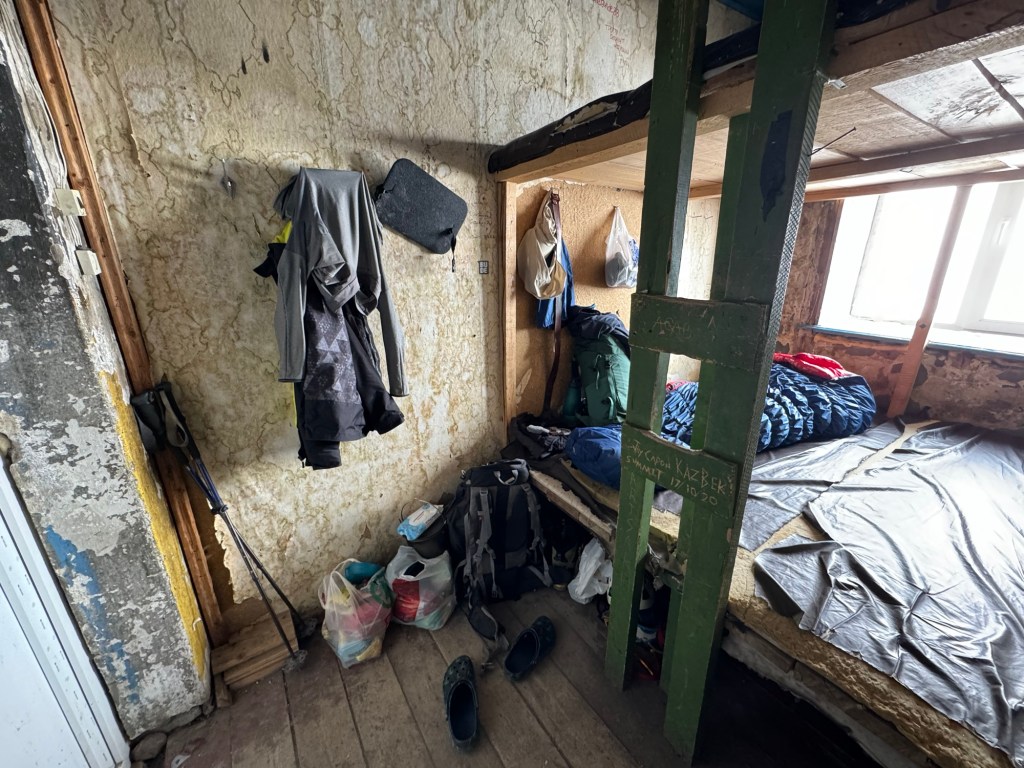
Matters didn’t improve, when I was shown my place for the night….
A damp, also unheated room, where the remnants of cheap soviet style wall paper was peeling of its mouldy base; with four bunk beds, which were thankfully covered with a faux leather lining, that regretfully, after having seen decades of use, was torn in several places.
Welcome to the Gulag…..
On the bunk next to me I found Dimitri, who was just half conscious and trying to find some sleep, after having successfully attempted to summit Mt Kazbeg in the early hours of the morning.
When matter couldn’t deteriorate much further, I decided to find a reception to at least pay for my night’s stay. But then, everything changed….
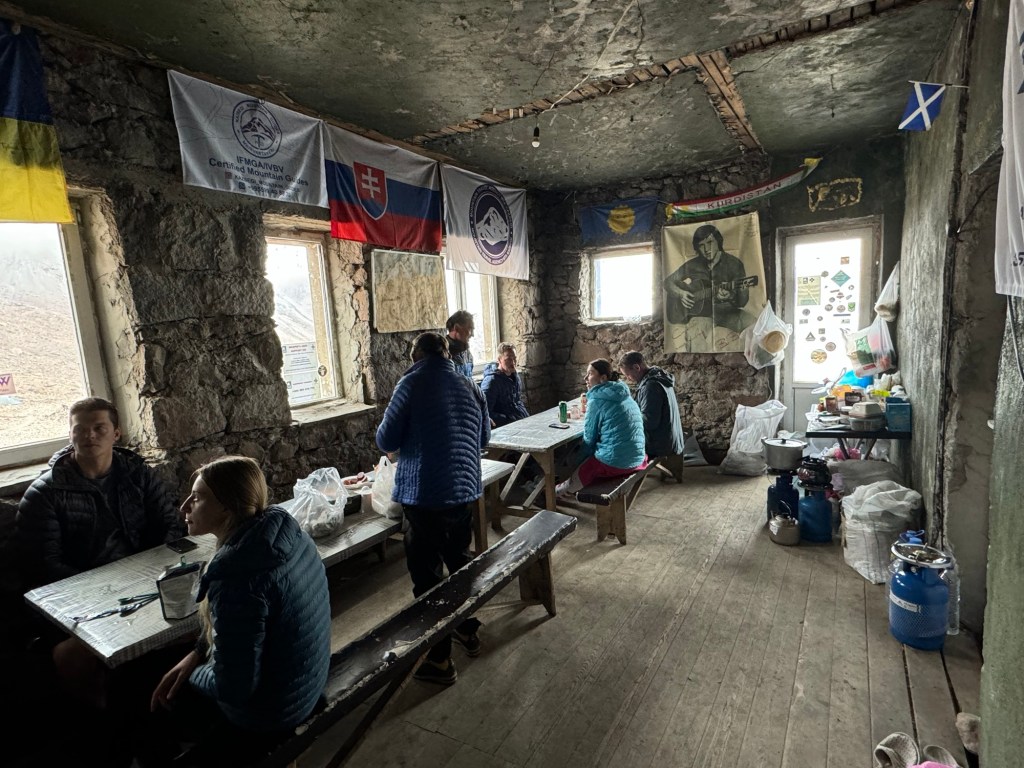
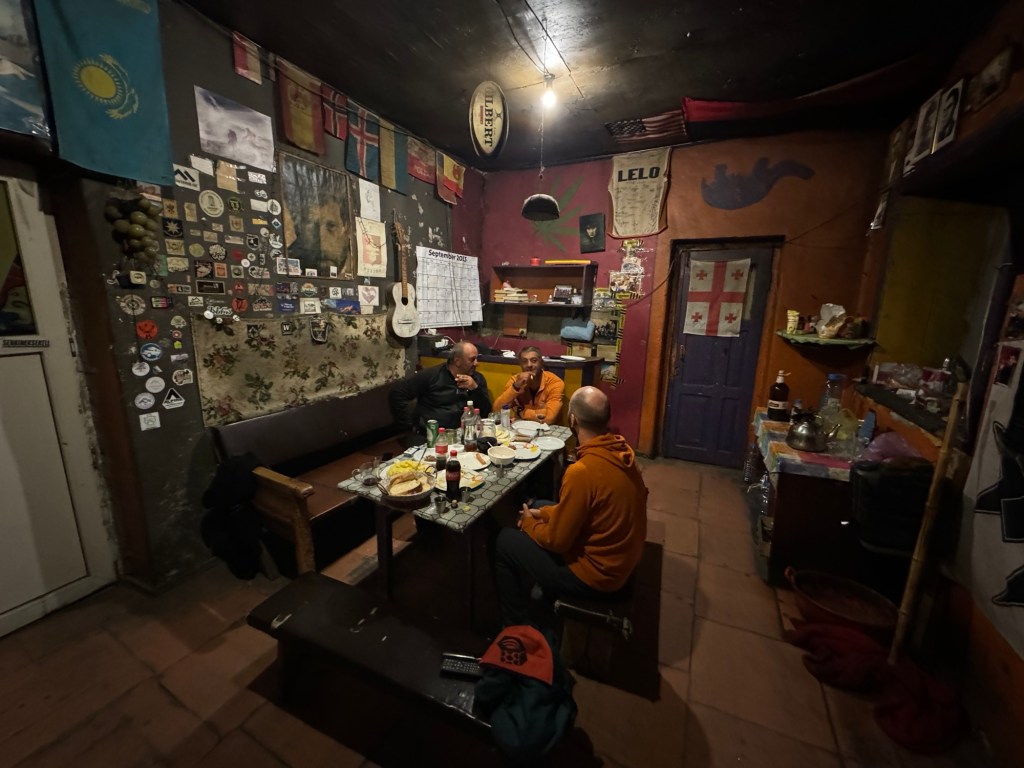
Down the corridor, there was a single glass door that emitted some warm light and when entering, my whole body felt the presence of a small wood burner at one end of the room.
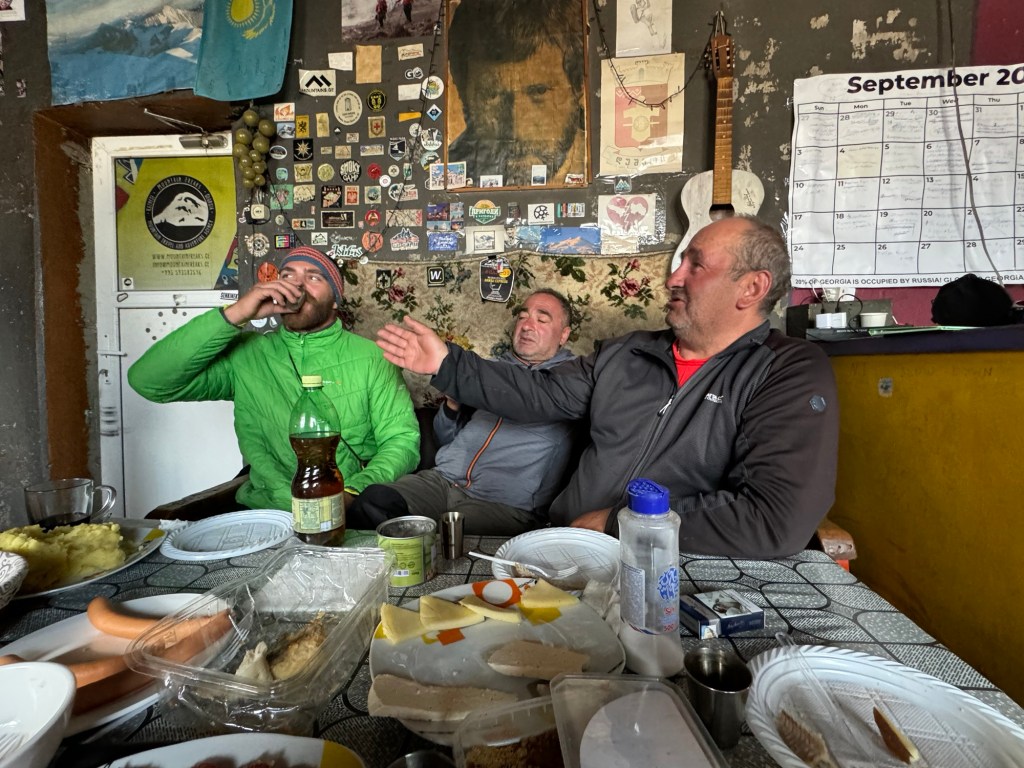
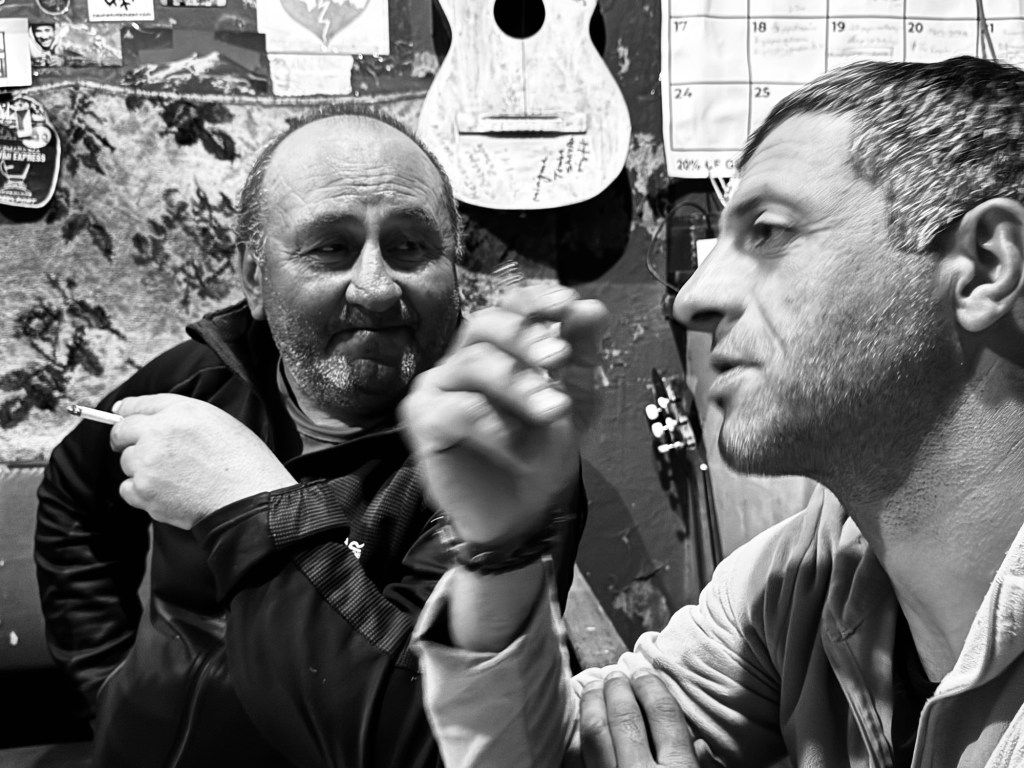
Here a group of men were gathered around a table which was laden with bread, cucumbers and tomatoes, cheese and cold meats, while red wine and home made brandy was flowing freely. The lively conversation, that had accompanied the feast, stopped abruptly when I passed through the door – I had entered the realm of Jonny, the custodian……
Once I had introduced myself, referring to the reservation I had made just the previous day with the help of my Georgian landlady, I was invited to the table to sample some quite remarkable homemade brandy, which was then followed by the insistence to try the bread, the cheese and well pretty much everything on the table.
It soon became clear, that this was the only show in town and there were just two ways to stay in it – by telling some good stories or by contributing to the feast. By being both a vet and a traveller, there was no shortage for the former, while the latter could be organised in form of another bottle of wine from the small restaurant (which unsurprisingly had no guests….).
As the evening drew on, it turned out that over the decades, famous mountaineers like Reinhold Messner or the Russian singer and songwriter Vladimir Vysotsky had been sitting at this table and attended Jonny’s or his predecessors’ court.
Jonny was one of these fascinating individuals who don’t need to travel to meet people or to see the world – the world was coming to him.
Sitting in this small, somewhat cluttered room, adorned with images and memorabilia of friends, mountain guides and personalities of the last 100 years, with pack horse drivers, mountaineers of different nationalities and Georgian guides entering his court at regular intervals, Jonny just had to lean back, chain smoke his thin hand rolled cigarettes, enjoy whatever beverages his visitors had carried in their backpacks or on horse back across the glacier and be entertained.
With steadily increasing alcohol levels, it then became time for the – at least in this part of the world – inevitable toasts. They included not only absent friends, friendship, the mothers (and women in general) and – on my account – a praise to the Georgians as the Caucasian unifiers, which was – needless to say – well received.
As the evening drew on, Lasha, a bearded mountain of a man, sitting on the other side of the table, got hold of the battered guitar, that had been resting on the floor next to the table, and gave a perfect evening the final touch with some Georgian songs.
Yes, may be I had to climb a mountain for it, but finally I had found it, the famous Georgian hospitality !
In the meantime even the sky outside had cleared up and the mountain tops around us appeared in a warm evening glow, so that the whole atmosphere around the Bethlemi Refuge didn’t appear quite as depressing.
The conversation, the smoking, the laughing and the drinking went on well into the night and probably much longer than would have been acceptable in a much more organised refuge, but as I finally settled into my decrepit bunk next to the now snoring Dimitri, I thought to myself that such is the life in the Caucasus – not everything is perfect or working as it should, but this in return leaves room for spontaneity and human warmth, which so often appears to be missing in our over-regulated societies.











































 The Blue Vet Diary