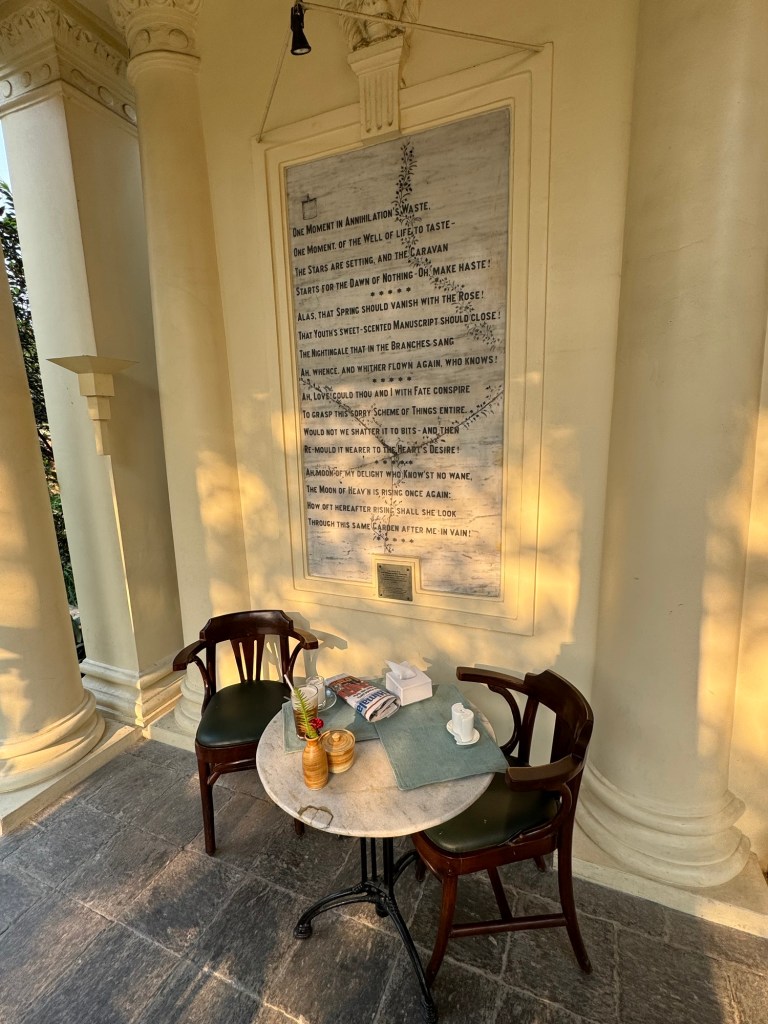
starts for the dawn of nothing – Oh, make haste !”
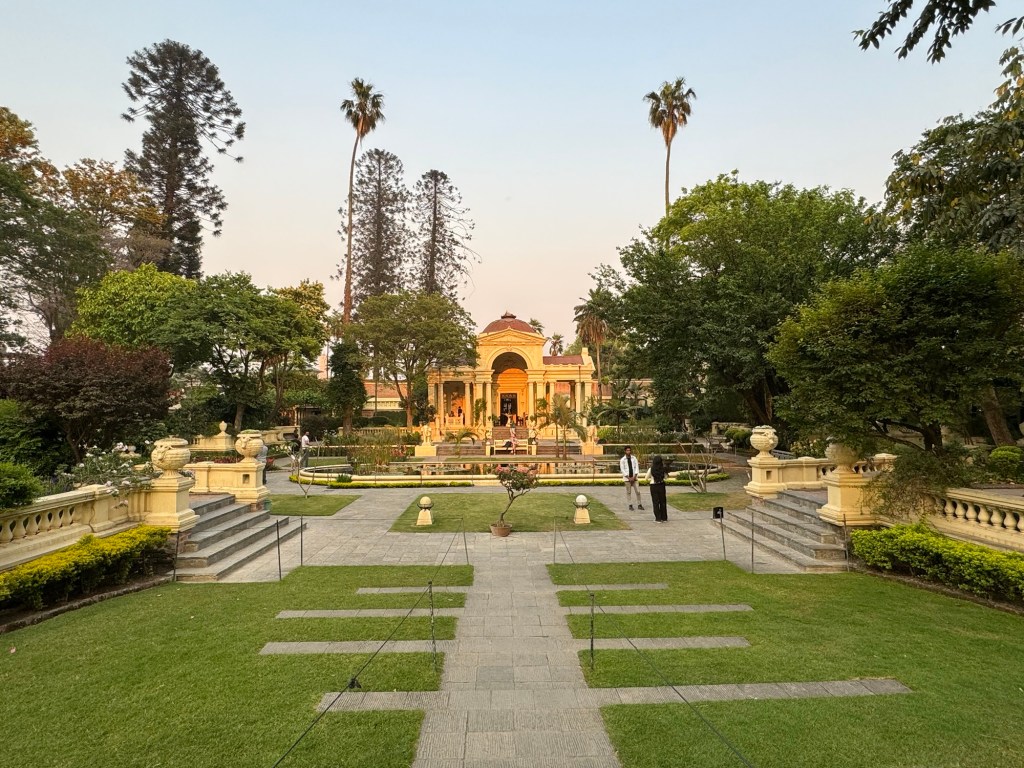
Once again I was enjoying a quiet moment at the “Garden of Dreams” – one of my favourite places in Kathmandu.
Sitting underneath the sacred words of the Persian Sufi poet Omar Khayyam, I was appreciating how true they still felt even after a thousand years had past and how relevant they were for my own journey to Nepal.
The “Garden of Dreams” had fascinated me, as soon as I had set foot in it at the beginning of my trip.
To understand this, you need to understand Kathmandu.
Nepal’s capital is dirty, noisy, chaotic, at times confusing and yet…beautiful!
It has nothing of the wide spaces of the countryside of Nepal’s borderlands to India. The perennial smog obscures the view of the tallest mountains of the planet and the fumes constantly attack your airways, resulting in a chronically blocked noise and a lingering cough.
But then, Kathmandu is so different, so unruly and in that aspect so entertaining, compared to any place you might find in Europe or in North America. It is no surprise that this was one of the favorite hideouts for the hippy generation, half a century ago, which still is fondly remembered in places like Freak Street.
However, walking through a small opening in the wall of Kaiser Mahal on the outskirts of Thamel, you find yourself in a completely different world.
Suddenly you notice birds singing, there are less traffic fumes and the greyness and the dust of the streets is replaced by the green colour of a nicely maintained lawn and of the leaves of trees, by colourful displays of flowers and by the calming effect of the clear water of beautifully arranged ponds and fontaines.
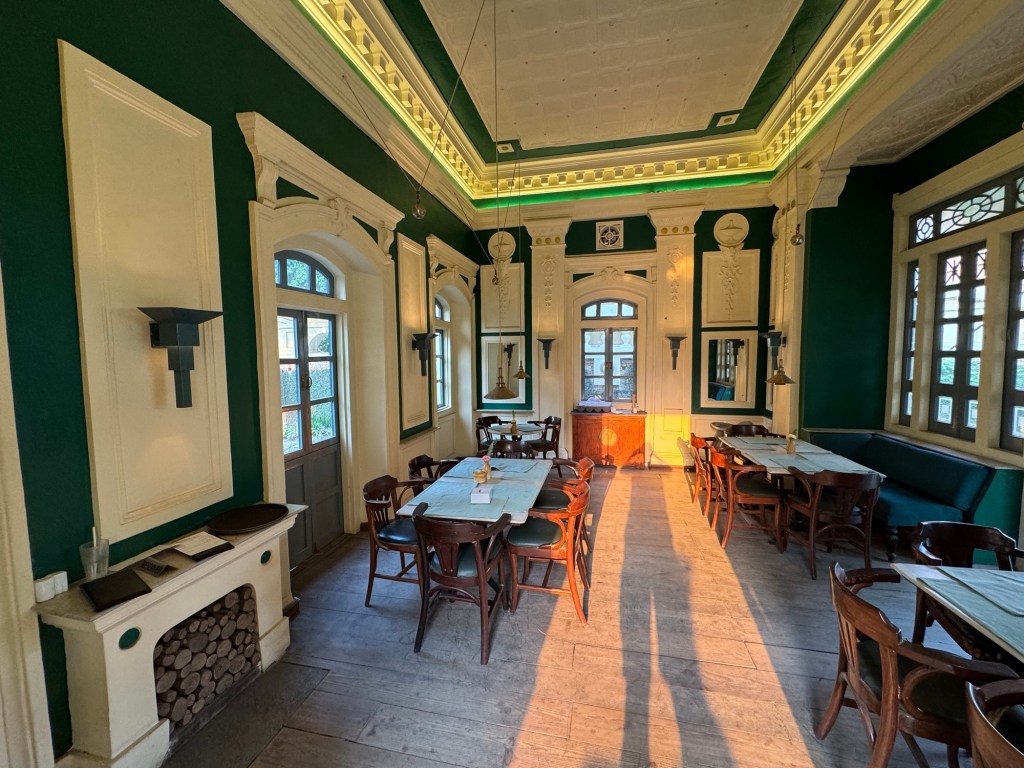
When sitting down for a drink at the colonial cafe
a chipmunk might be running over your shoes on its search for the odd bread crumb and you start noticing a strange crop of bats in the trees above you , waiting for the sun to set at the other end of the Garden.
Exploring further the playful beauty of the place, you will come across a hidden water cascade behind a false perimeter wall
and you will find a statue of Vishnu’s consort Lakshmi, promising worldly riches just around the corner, once your have passed a decapitated sphinx…..
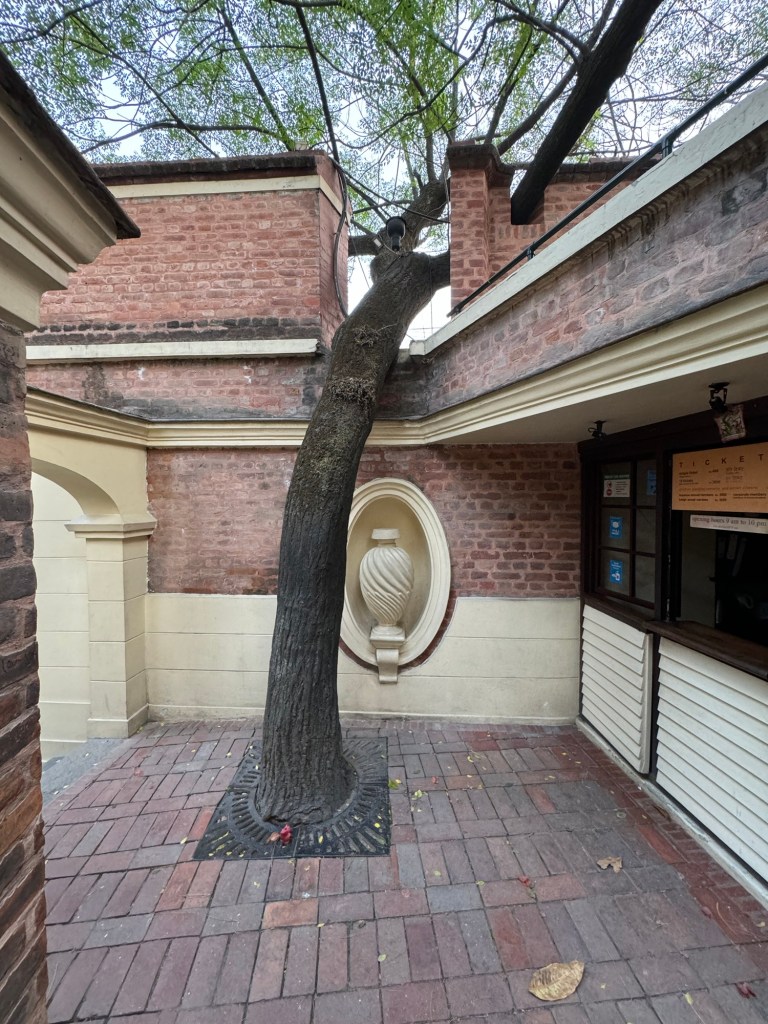
Not far from there, a quote from Voltaire’s “Candide” reminds us of the importance of cultivating our gardens and it appears that here even the walls have made room for the trees….
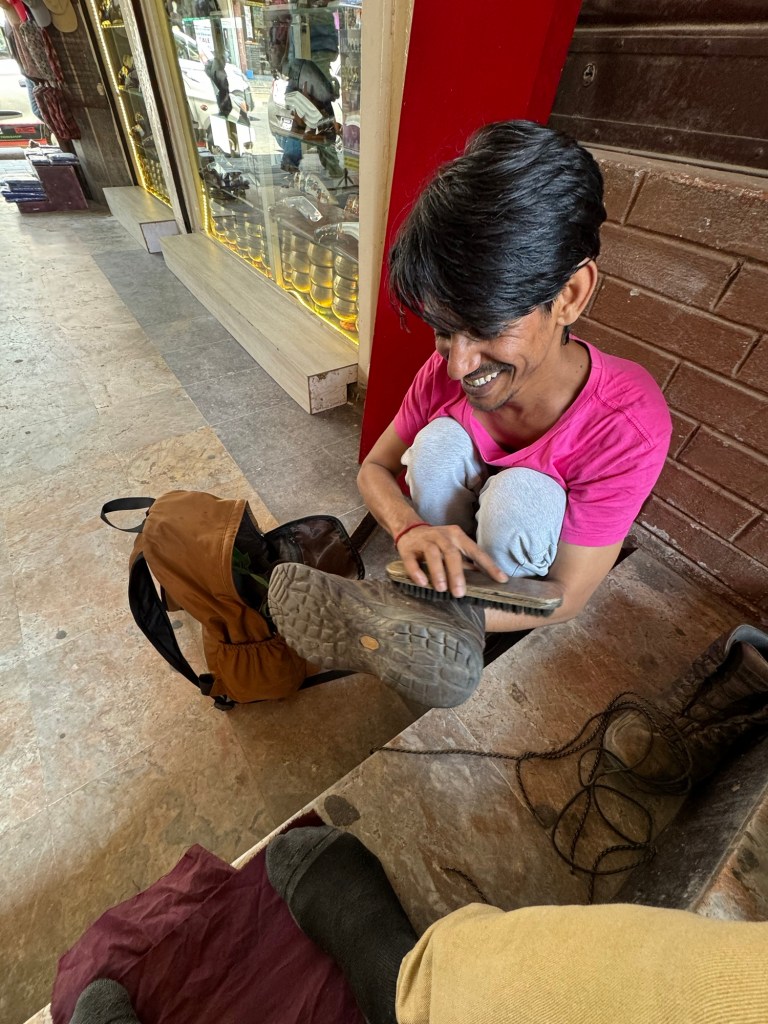
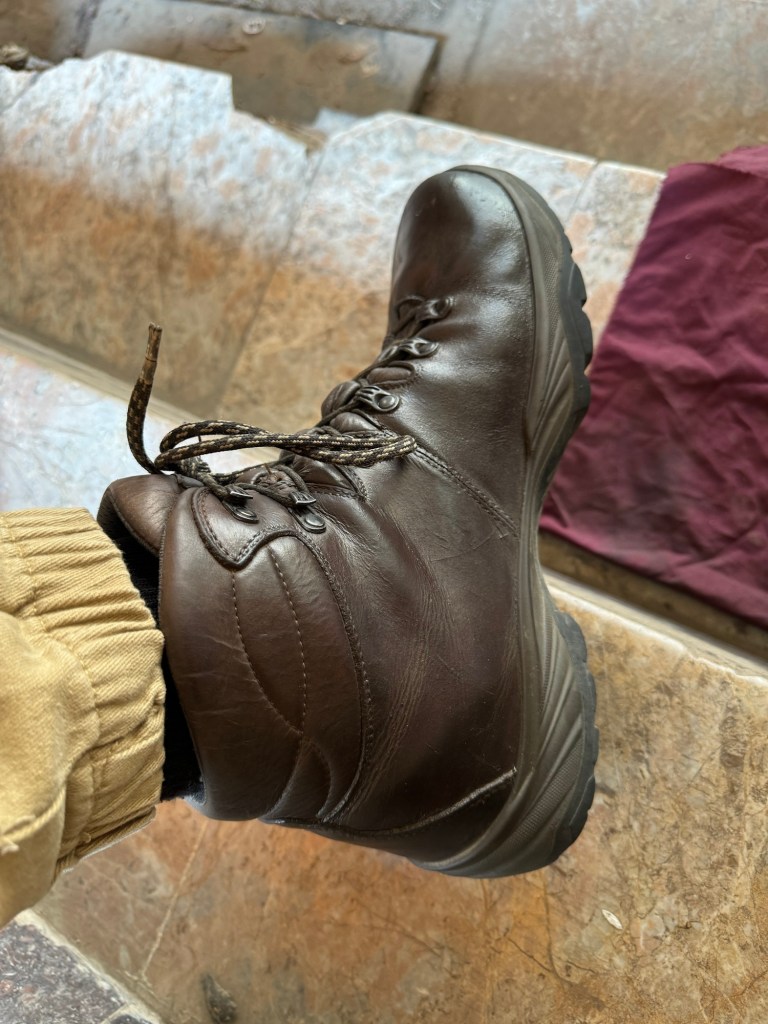
I was coming to the end of my journey to Nepal and my boots were bearing the marks of over 300 kms of rugged mountain paths, of the exposure to snow and ice and of getting drenched during downpours and river crossings in the Manaslu and Annapurna regions. They had been caked in mudd and dust in the jungle and the grasslands of Chitwan and from walking through the traffic and the leftovers of human habitation in Kathmandu and Baktarpur. The leather was bone dry and at places it was still covered with the silt of the banks of the Rapti River. Most of the profile of the soles was gone and the strings were struggling to hold the boots on my feet.
It was then, when I was approached by mobile shoeshiner Rakish, who offered to take care of them. After retreating from the blazing sun on Tridevi Sadak to a shadded set of stairs nearby, Rakish set to work and we started talking….
After having to close his shoe repair shop a while ago, Rakish had moved into the mobile shoe care business and while my boots underwent a complete transformation, he talked about the life in Kathmandu away from the tourist areas, of his family, of the daily struggle to make ends meet, but also of the beauty and joy of the multiple festivals and celebration in his city.
Eventually, my boots looked better then when I had bought them
and I had found the perfect companion for a final adventure in Kathmandu.
After all, there was one more place I had planned to see and this had to be done at night…..
Just before sunset the next day, Rakish and I squeezed ourself into one of the numerous, hopelessly overcrowded minibuses, where my average European physique put me at a clear disadvantage, unless my legs miraculously would have grown another set of joints.
But the contorsion didn’t last very long and after a jouney of about twenty painful minutes, we exited this rolling tin can and found ourselves just off Kathmandu’s Eastern Ring Road, not far from the banks of the Bagmati River.
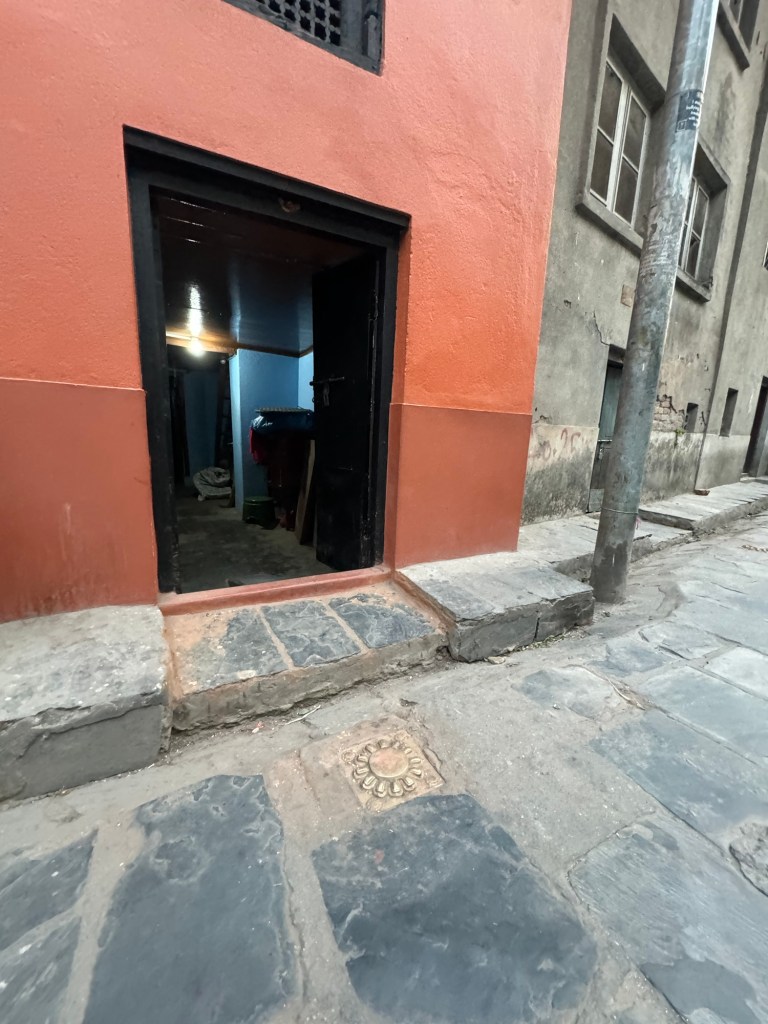
Descending towards the river bank, the streets became narrower and more crowded. Infront of every house, I noticed golden flagstones, most of which were covered with orange paint and small offerings of marigold flowers , various fruits and grains of rice, to honor the Hindu deity protecting the individual dwellings.
At a small ashram, we came acrossed the first sadhus, who exchanged some kind words with Rakish. But rather than carrying on towards the river, we then turned North and moved away from the crowds along the river bank, until we stood in nearly complete darkness infront of a large Hanuman statue that was covered entirely in orange dye.
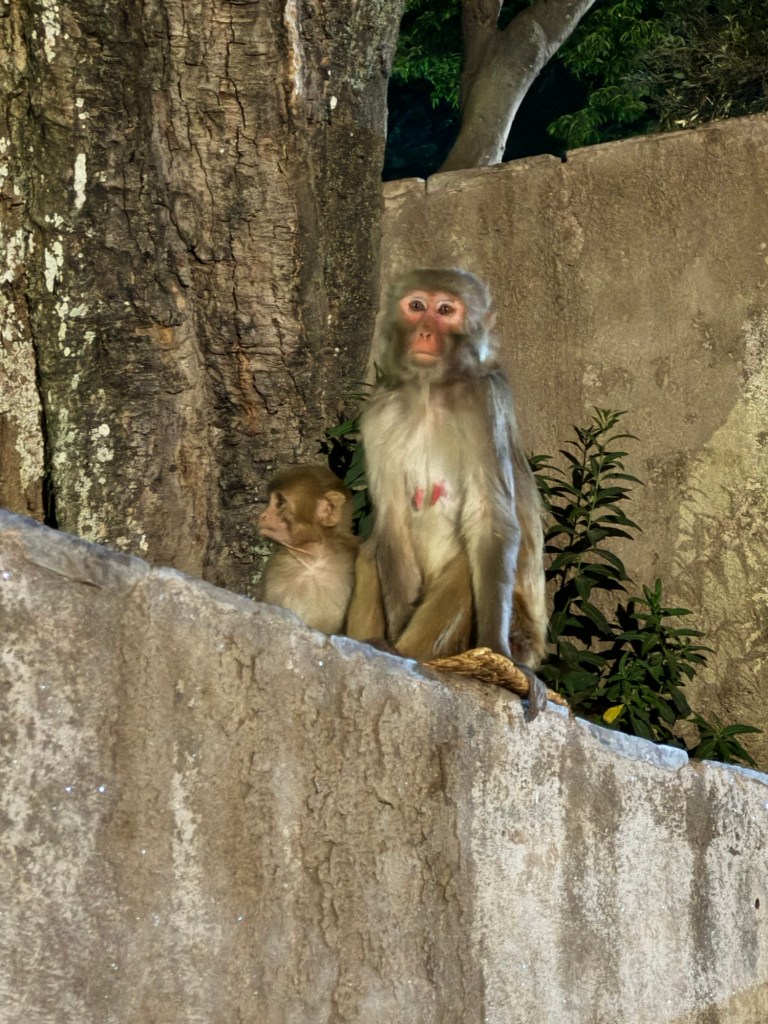
We had arrived at the now deserted Gauri temple, placed right next to the dark, putrid water of the river. Only when climbed up towards the nearby bridge, I noticed that there was a lot of movement on the steep river banks and underneath the bridge and just then it became apparent to me, why this place was dedicated to the Monkey God….
Now on the other side of the river, we climbed a small hill and passed some more temples, before we then followed a narrow track into a small forest. Stumbling over a number of tree roots, I appreciated that I had chosen my warm, but sturdy hiking boots for this nocturnal outing.
Eventually we had reached the highest point of the path and now, heading South again, we were walking towards a magical bright light, rhythmic music and the clapping and cheering of a large crowd.
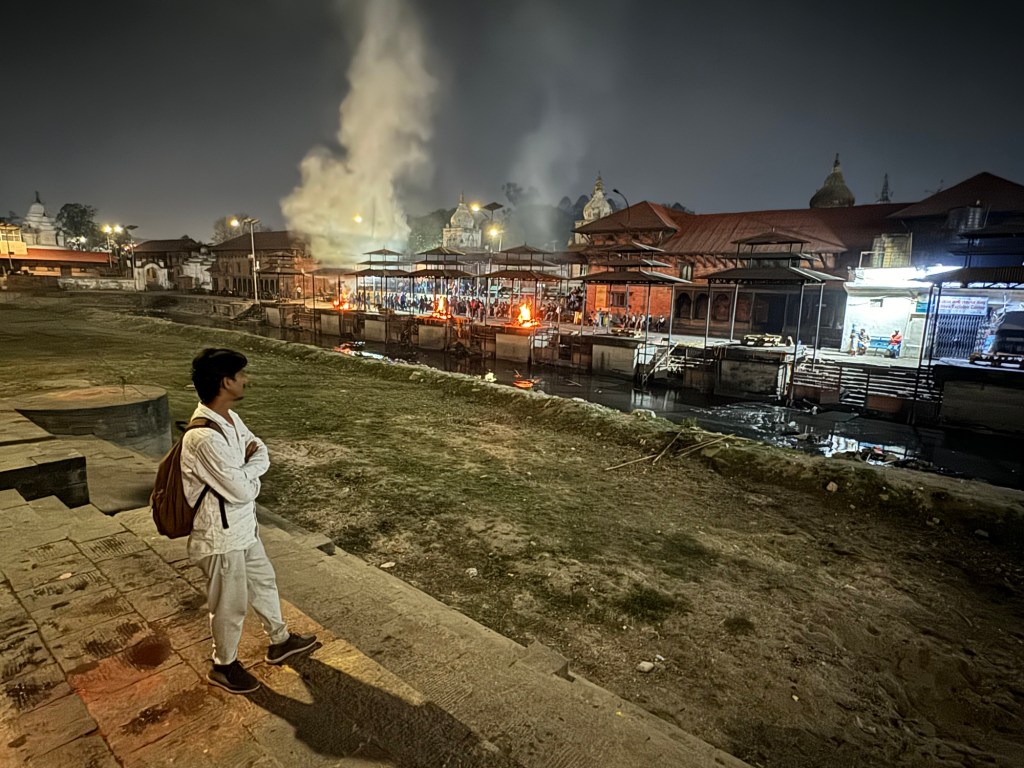
In front of us, stretched out on both banks of the river, lay Pashupatinath, one of Nepal’s largest and most revered historic Hindu temples, dedicated to Shiva, the goddess of fertility, but also of death and destruction.
Here, witnessed and celebrated by well over a thousand spectators, the bodies of recently deceased citizens of Kathmandu, wrapped in orange shrouds, were been burned on piles of wood, doused in oil.
Several of these fires were lining the Western bank of the river, while on the other side of the river there was singing, clapping and a colourful display of religious flames. On the roof of the temple a woman was wildly dancing in a trance, while down in the river a poor soul was busy moving on with the help of a metal pole, the remains of the funeral piles, which had been dumped into the water.
Groups of colourful sadhus, visitors from all over the World, numerous stray dogs and an equal number of monkeys, who both kept a respectful distance from one another, as well as local citizens, some in brightly coloured sarees, others just in their street clothes, were lining the steep river bank to give the deceased a dramatic sending off.
Before us was a spectacle that has been as old as the place itself and a tradition that, despite the already terrible air quality in the Kathmandu valley, is very unlikely to change or to disappear anytime soon.
Witnessing the burning piles for a while and absorbing the singing, the chanting and the shouting around me, it once again reminded me, why Kathmandu continues to be such a strange, chaotic and yet enchanting place.
Eventually the fires burned down and the crowd, at least for that night, dispersed.
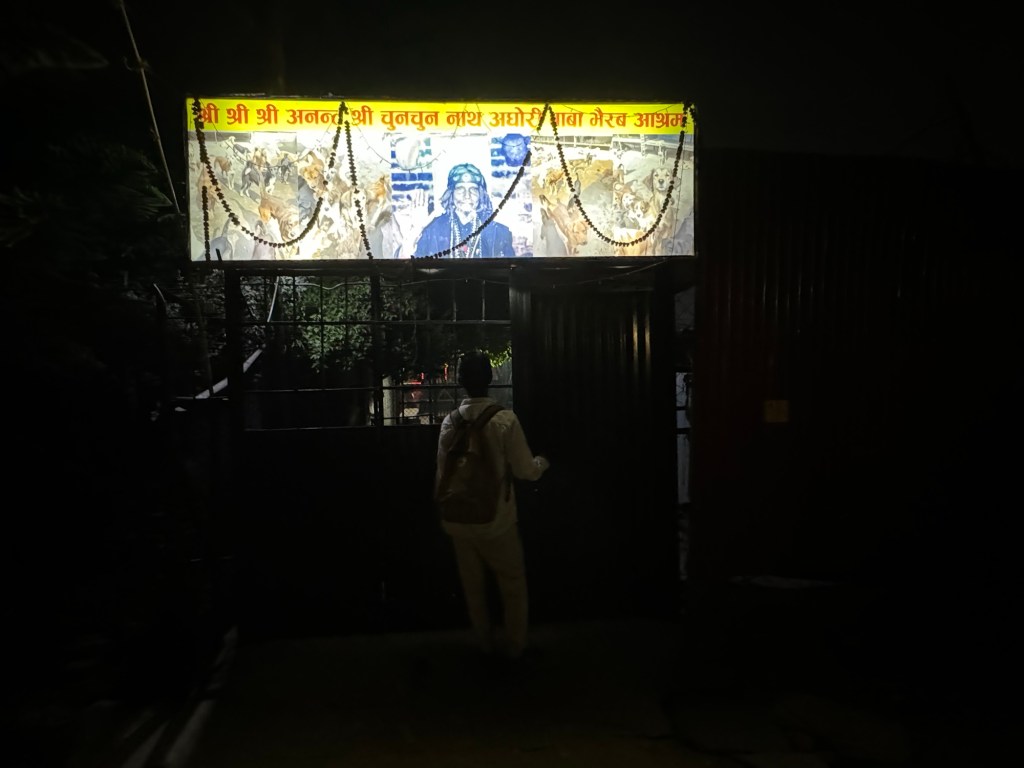
But rather than calling it a night, Rakish, because of my profession, was insistent that we paid the Chunchun Baba, a sadhu for dogs, a brief visit.
Tucked away in a number of shacks made of corrugated iron, just a stone throw away from the world famous temple, a holy man and his dedicated followers were looking after more than 200 dogs.
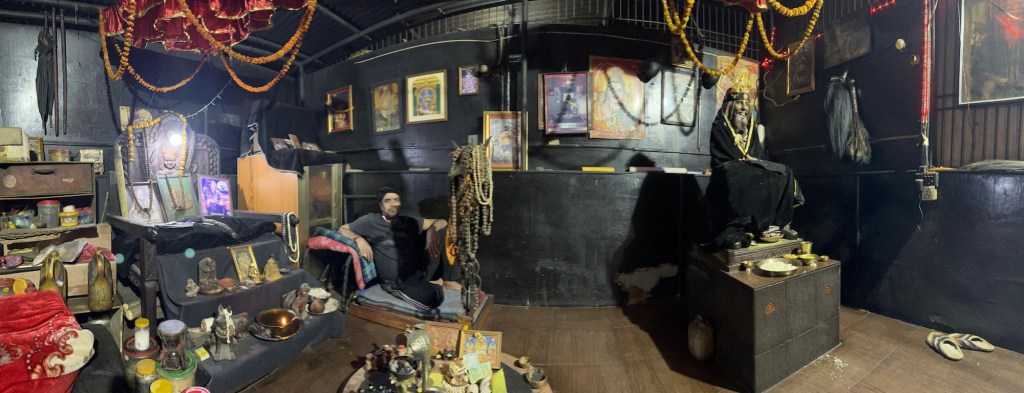
Been invited on to the complex despite the time of the day, the “Baba” explained that he was the Fourth in a line of devoted men dedicating their lives to the caring for Kathmandu’s dogs.
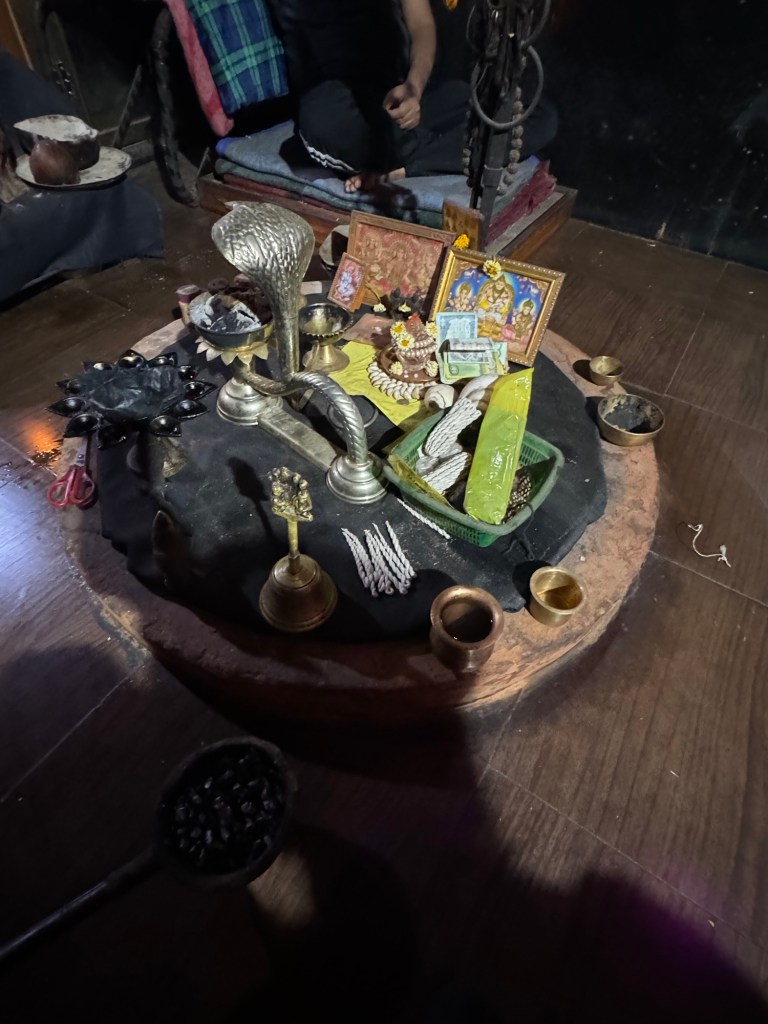
Passing a huge pot on a wood fire – containing the following day’s meal for all canines on the site – the Baba was leading us to his small ashram, where the center piece was a lifesize, decorated copy of his predecessor, Having spotted just a few dogs kept in small cages or on a chain over night, I did not feel too inclined to investigate this place much further and I sensed not for the first time, that deeply rooted religious beliefs were not neccessarily a guarantor or even a useful basis for good animal welfare, especially when it involved the day to day care for large numbers of animals.
Leaving the Baba some banknotes to fund a few more pots of canine dinners, we left the compound and after passing a similar facility next door, which was dedicated to bovine species, we decided to end this memorable nocturnal excursion and by this, my journey to the East.
Early the next morning, there was a plane to catch and another part of the (veterinary ?) world to see……
It was surprisingly easy, finding a cab at 5 AM in Thamel and with the exception of the discomfort of riding in a car with a completely worn suspension, my short jouney to the magnificent stupa at Boudhanath went very smoothly.
Nepal is predominantly a Hindu country, but especially in the mountainous North, there is a strong Buddhist presence, due to the influence from neighboring Tibet. Stupas, gompas, mani stones and poles with colourful prayer flags had been common sights for me, while I was hiking in these regions.
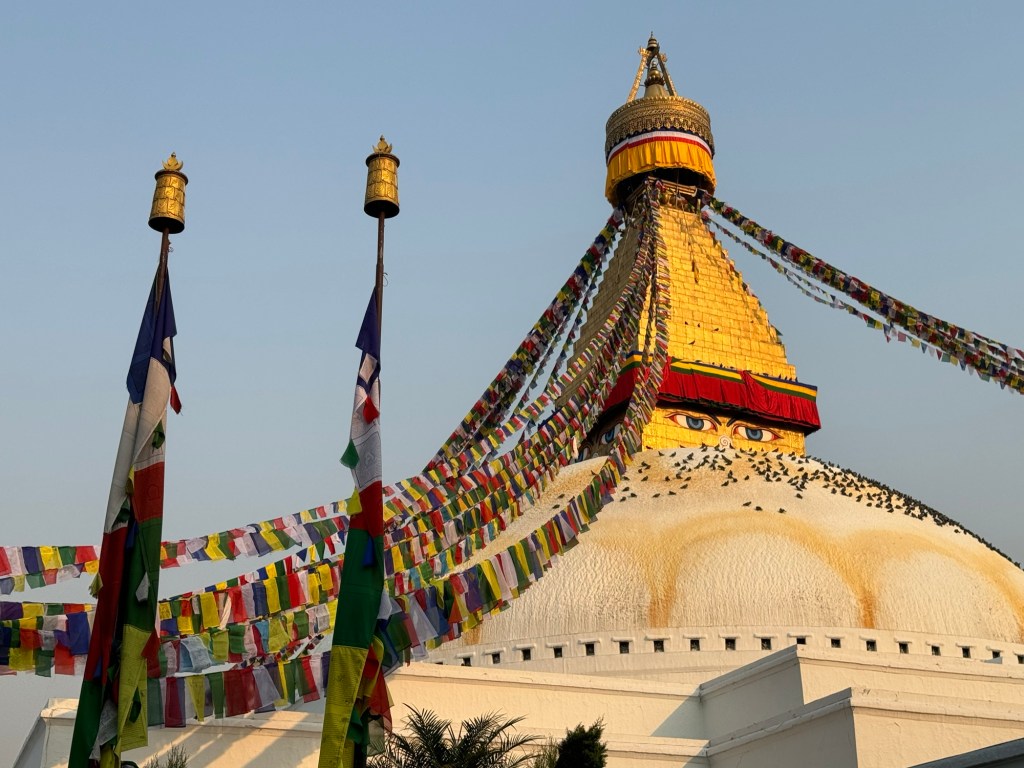
The large stupa at Boudhanath, in the North-East of the Kathmandu valley, is one of the most important Tibetan Buddhist monuments outside of Tibet and many devotees of this peaceful religion, living in the South of the country, are gathering here.
Arriving early in the morning, was making for a more intense experience, as most shops and restaurants were still closed and the site was mainly left to worshippers. Many of them were humming the sacred words “Om mani padme hum” (“Praise to the jewel in the lotus”), while performing “kora”, a steady, strictly clockwise walk around the monument.
Some were making use of the prayer wheels, which were placed along the outside wall of the stupa, others were carrying their own permanently rotating prayer wheels, while a few were even prostrating themselves in regular intervals all the way around the structure.
Behind a low wall, inside the outer rim of the structure, were a few mats, where more prayers and prostrations were performed.
As in the mountains, dried juniper twiggs and herbs were smoldering in low fires in metal drums and red clad monks were walking at the outside of the kora with small smoking metal containers in an act to enhance their prayer and to fend off evil spirits.
The same devices could later be found at the entrance of all shops and restaurants around the site.
Similar to many religious sites in Nepal, a number of local dogs found a peaceful existance here
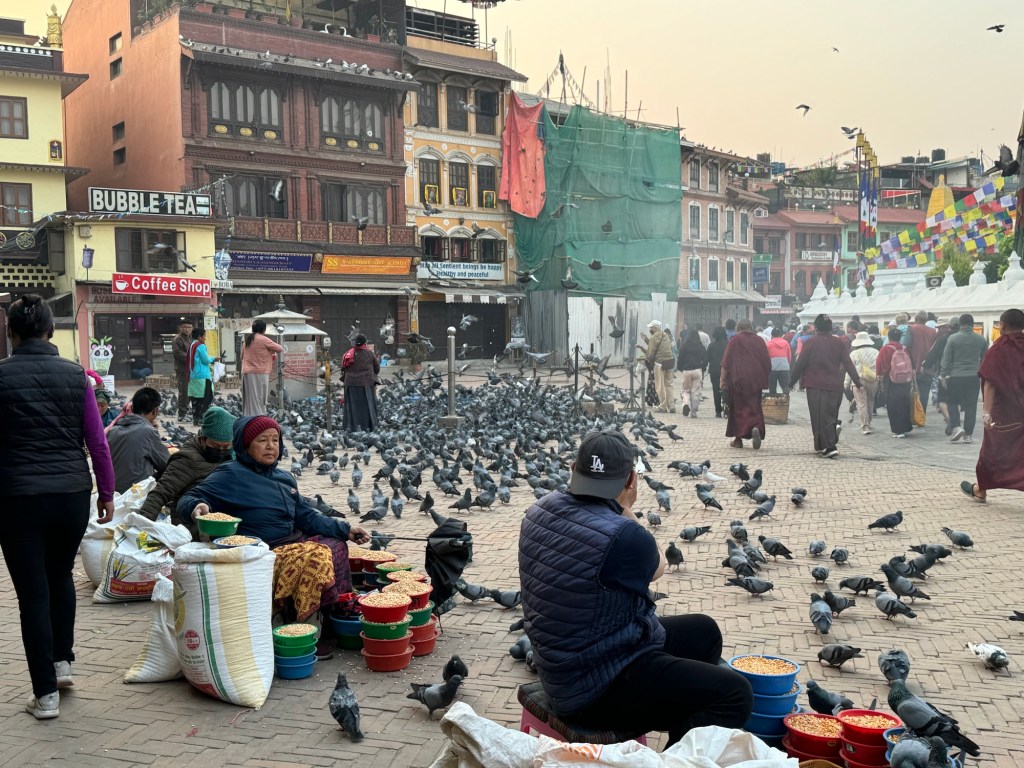
and considerable sums of money were spend by the visitors on bowls of corn and grains, to feed a huge flock of resident pigeons,
of which many had made a temporary home on the huge dome of the stupa. To meet all needs of these residents, plastic basins were regularly filled with fresh drinking water, so that the birds could quench their thirst and take a morning bath.
From the gompas outside the square, the monotonous and yet so characteristic chanting of the monks, the sounds of their horns and of their drums was adding to this sea of colours, smells and noises, as the sun was starting to illuminate the top of the building, which was displaying the watchful blue eyes of the Bhudda, below the thirteen golden steps leading to Nirvana.
Although whole football teams could be seen partaking in this active form of worship, the majority of people performing the kora appeared to be of an older generation and for many of them, the colourfully dressed local women, offering warm tea from large thermos flasks on a low ledge, covered with isolation mats, were providing a much appreciated opportunity to rest and to observe the atmosphere in peace and thoughtful reflection.
A truly memorable way to start another day in Kathmandu….
Despite the best preparations for your travels, it is unavoidable that you sometimes come across something completely unexpected….
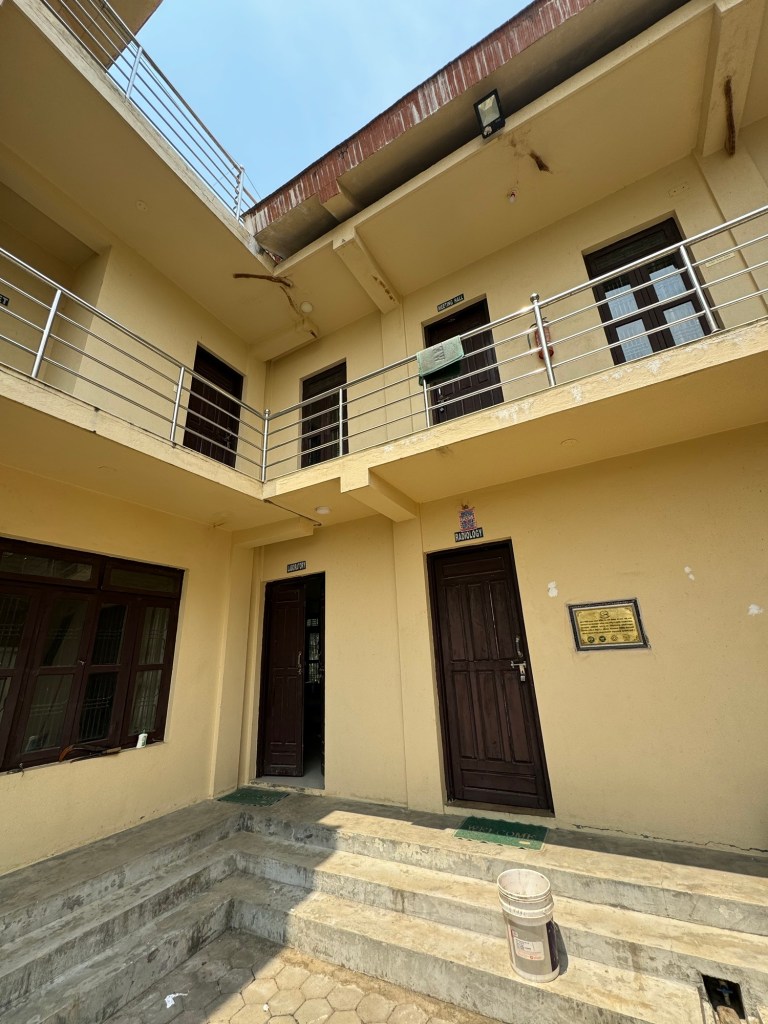
This is what happened to me, when I was standing in front of the impressive gates of the eye catching wildlife hospital at the head quarters of Chitwan National Park in Sauraha.
I had never heard of it and in my reading up for this trip, I had found no references for it.
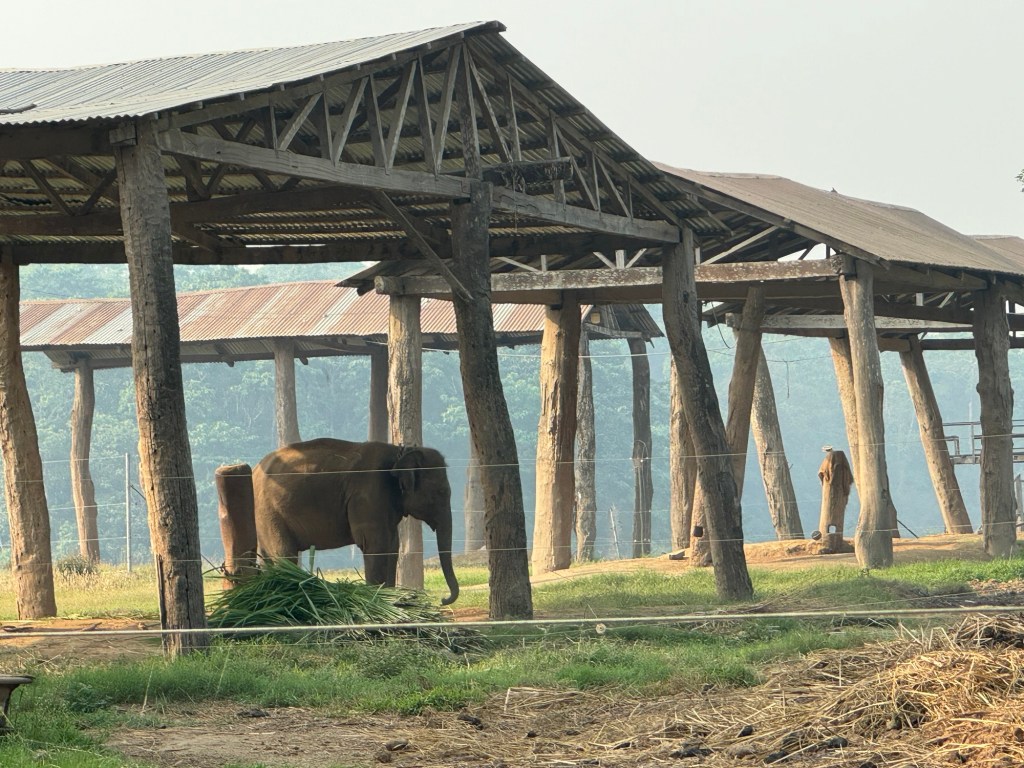
The only reason I had stumbled across it was, that I had visited the local wildlife museum and wanting to investigate some working elephants further down on the premises,
I found myself standing in front of it.
First however a few words about the museum:
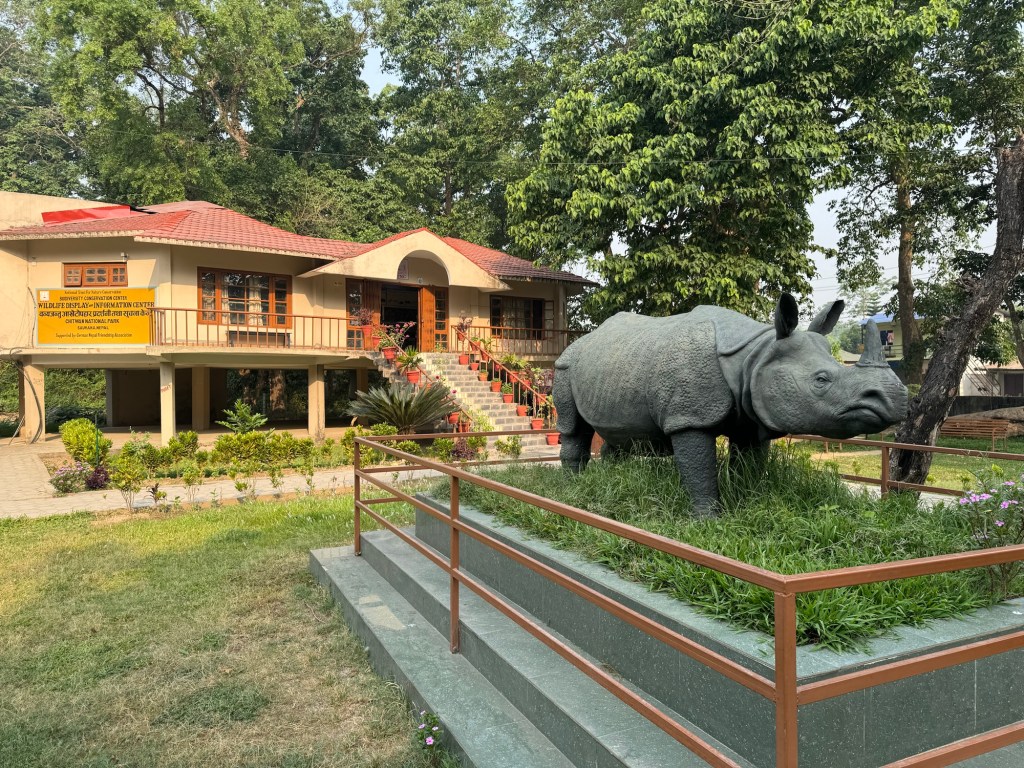
Considering the equally impressive front of the building, including lifesized models of an Asian rhino and of a huge ghadial, I had been more than happy to part with the modest entrace fee of 100 rupees ( 70 cent).
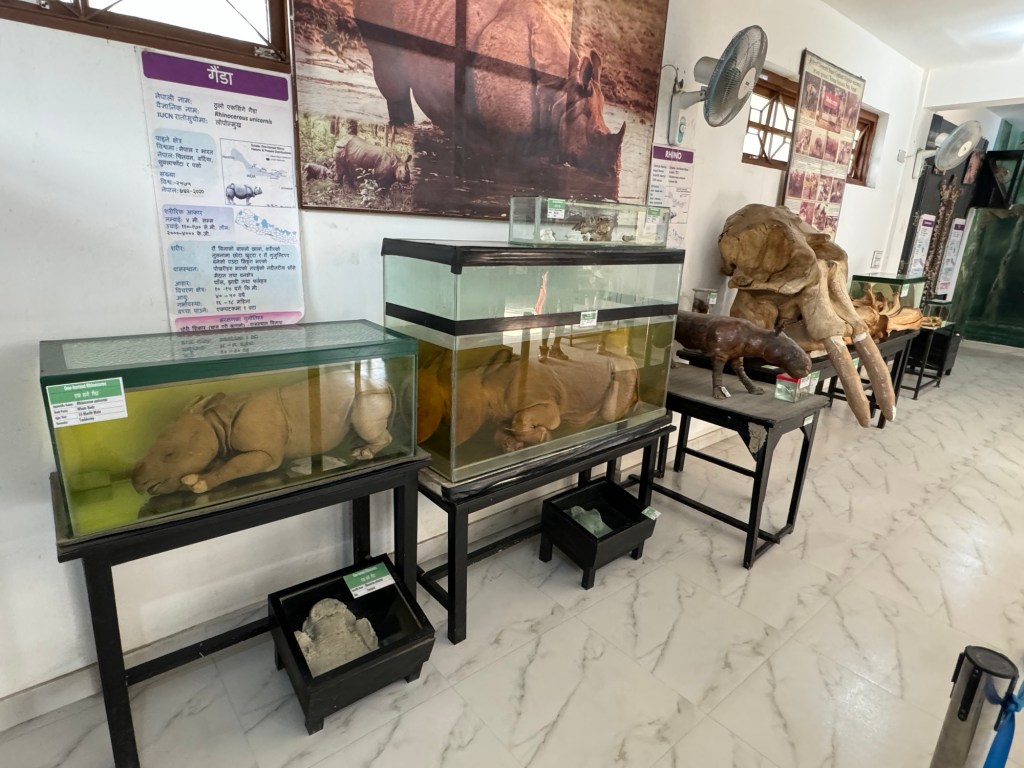
Once entering though, I found myself inside a horror cabinet of pickled animals of all sizes, which would have rivalled a Damian Hurst exhibition on its curiosity level. Everything that can and should and everything that should not be displayed in a glass jar could be found here…..
On the acceptable side it arguably included rhino foetuses and a number of smaller fish species, but finding wild cats, pocupines, a pangolin or small songbirds submerged in large quantities of ethanol, just looked wrong and it didn’t get much better, when I came across the exhibits of two rare ganges dolphines, which despite all efforts to preserve them, appeared in a miserable state.
It all reminded me of a short story by the famous German author Siegfried Lenz, where the protagonist during the black market years following the second world war, ran a brazzing trade by providing American GIs with endless quantities of alcohol for their parties. Only when the booze ran out on a specifically wild occasion, so that the narrator had to turn up unannounced at his supplier at the natural history department of the local university, the source of the moonshine became apparent…..
The twist in the tail was, that when he returned to the party with fresh supplies, his customers were so happy, that they insisted, that he had to join them for a few drinks…….
The exhibits at the wildlife museum, which had avoided the pickling treatment, had been equally unfortunate, as they appeared to have fallen into the hands of a class of novice taxidermists or they must otherwise have been the handiwork of someone who should never have taken up this trade.
The beautiful body of a once lean leopard balanced bloated on top of a tree branch, with its limbs twisted in unnatural angles. A new born rhino looked more like a charred Pompeian house hold pet or like a piglet in the final stage of spit roasting.
Now to the wildlife hospital:
Despite its shut gates (it was the weekend after all…), I had much higher hopes.
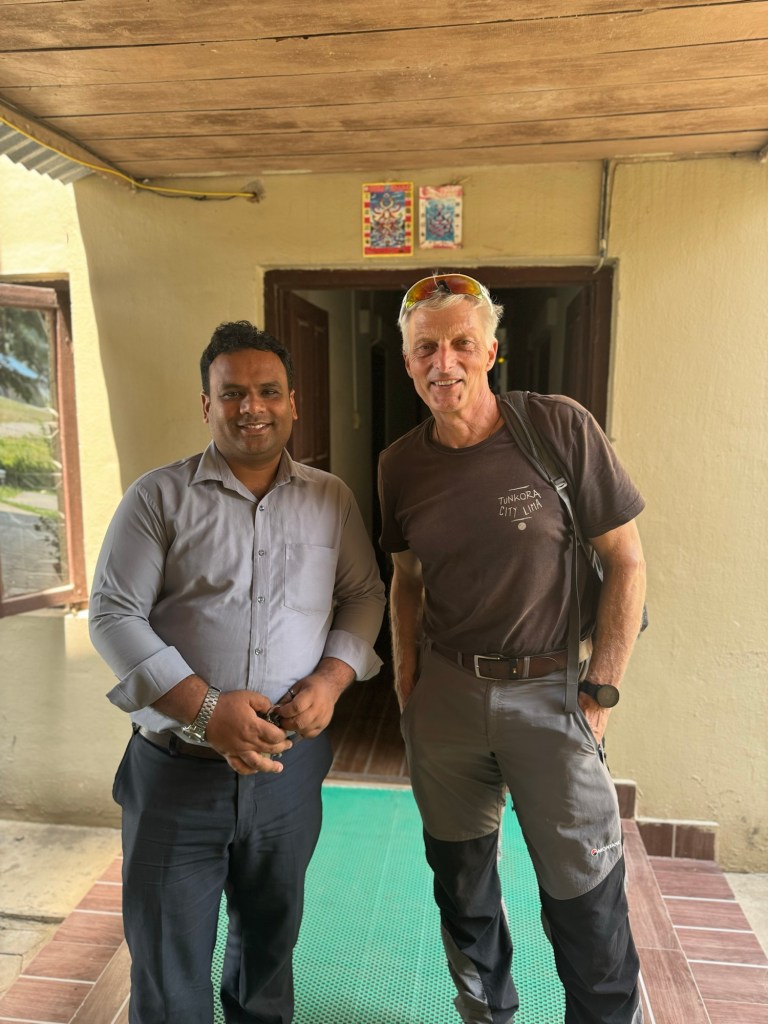
Over the following two days, I made a number of enquiries, but only a couple of hours before my (thankfully) delayed return flight from Baratpur to Kathmandu, I was fortunate enough to meet up with my local colleague Dr Bikalpa Karki, who was kind enough giving me a brief guided tour.
What I saw though, was sobering….
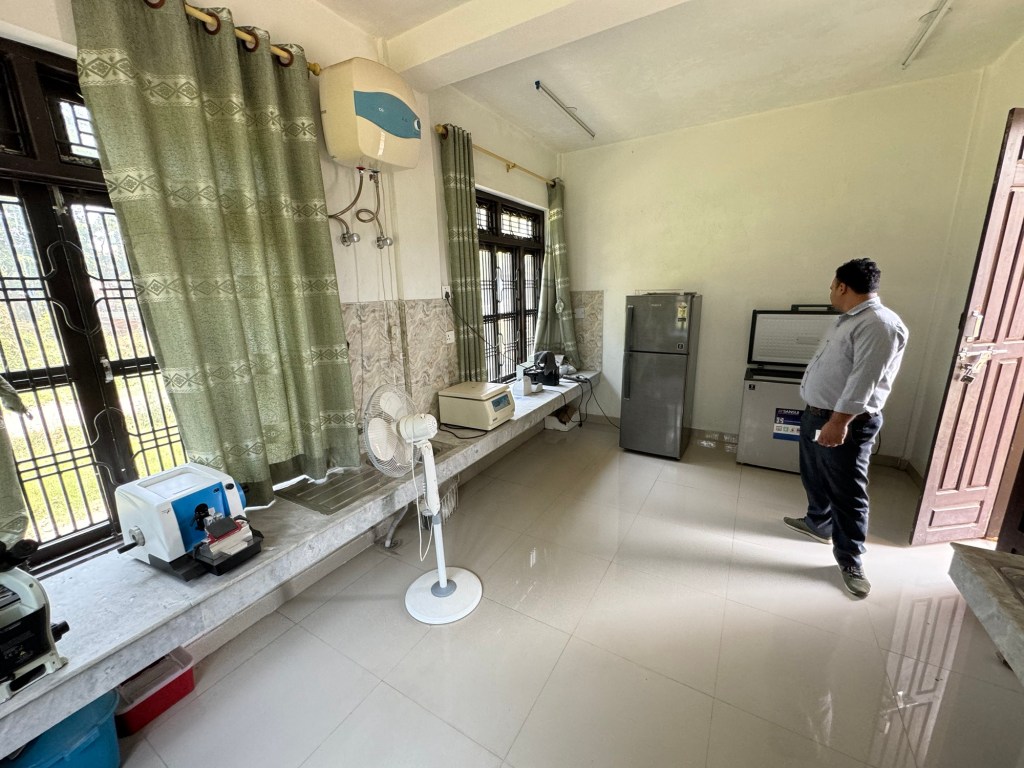
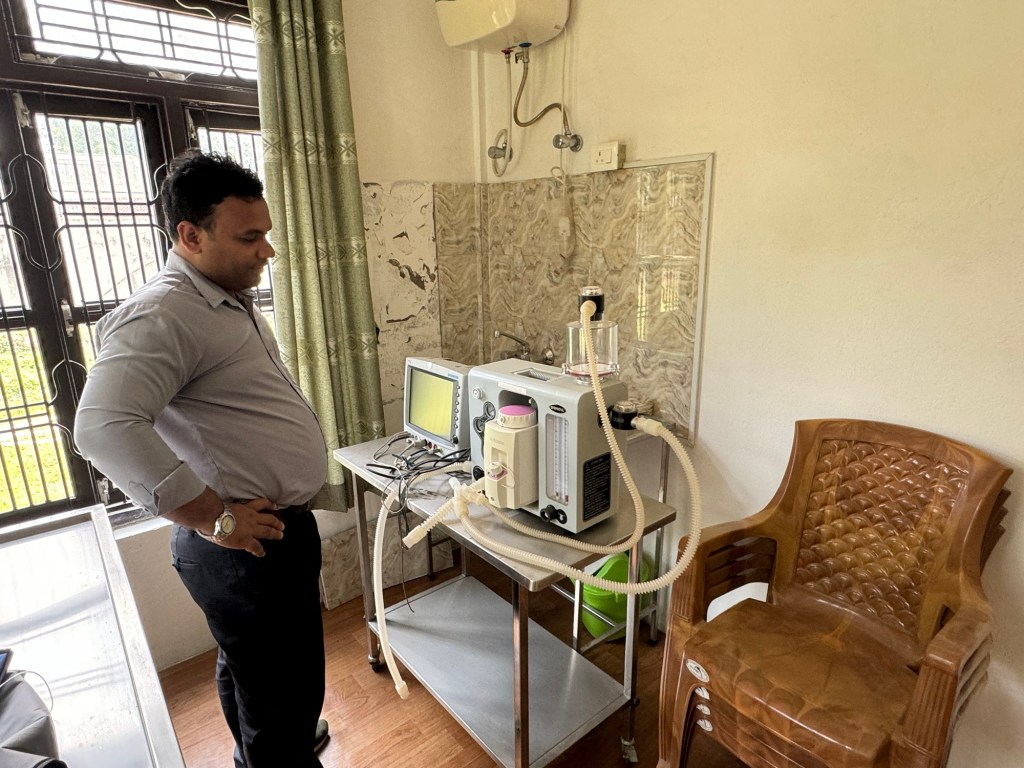
As impressive as the building had been on the outside, the rooms inside were mostly empty, with laboratory and anaesthetic equipment that was not functional, where essential supplies were missing or where my colleague and his team had no received any training on how to use it.
As it turned out, the majority of the team’s workload, partially due to the size of their patients, was still ongoing as ambulatory activities in the field.
Working with injured wild animals isn’t without a risk, with accidents unfortunately not unusual to happen in Chitwan, so that it was not too difficult for me to accept, when my colleague was somewhat reluctant to show me the only inpatients of the clinic, two tigers, which were held in a compound adjacent to the hospital.
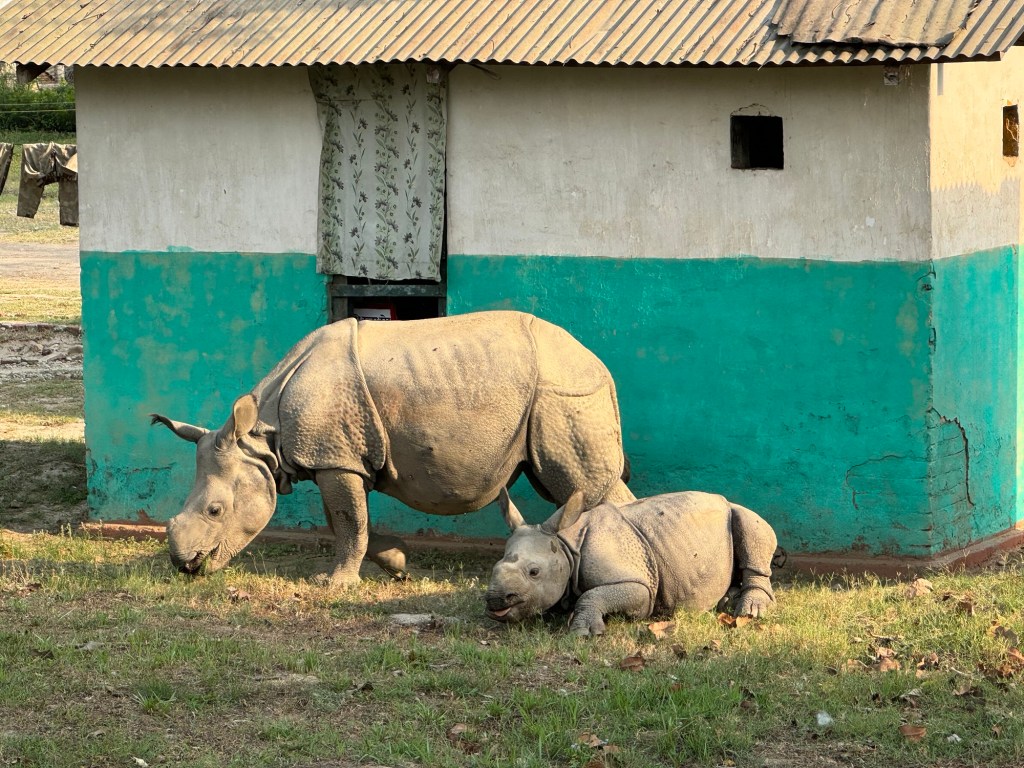
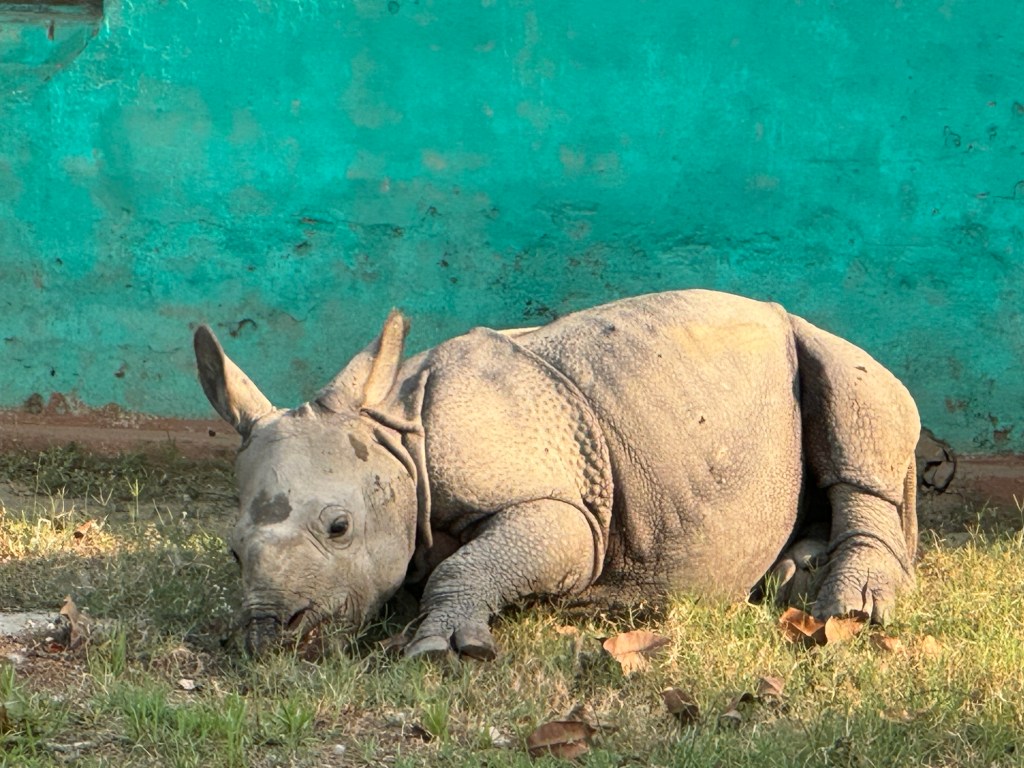
A success story however appeared to be the rhino orphanage. A small group of three juvenile rhinos of different ages were living on the compound which the hospital shared with the Nepalese army. The three youngsters appeared to have a well protected life among the military barracks.
The example of the museum and the hospital showed, that buildings can only be a start and that both skills and gear are needed to make a great idea a lasting success. Time will tell, in how far this will be the case in Chitwan.
(If any my colleagues reading this entry is planning to visit Chitwan National Park in the nearer future, please do get in touch with me directly on vet@bluecat-ltd.com , if you are interested to support the veterinary team at Chitwan NP with your knowledge or with much needed equipment.)
When the sun sets at Chitwan National Park in the low lands of Nepal, it is strictly forbidden and also certainly not advisable to set foot in a jungle where well over 100 tigers, a similar number of leopards, some wild elephants and over 20% of the world’s population of Asian rhinos are roaming free. And I haven’t even counted in the odd sloth bear, the mugger crocodiles and a number of poisonous snake species which you also don’t want to run into, in the middle of the night…..
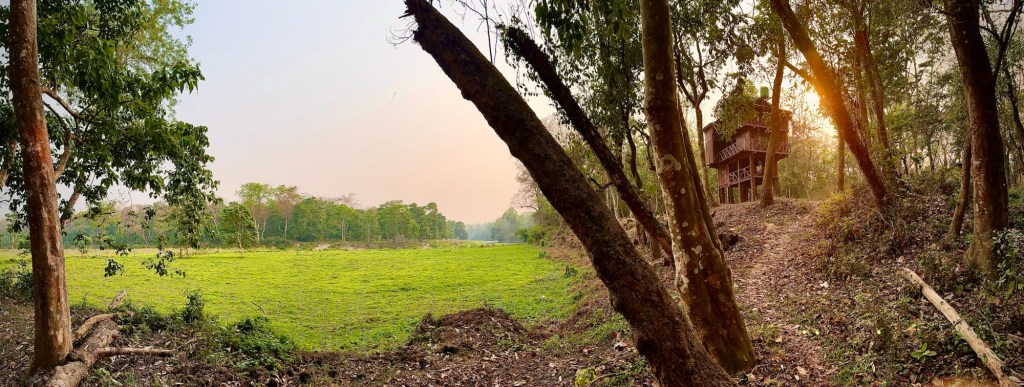
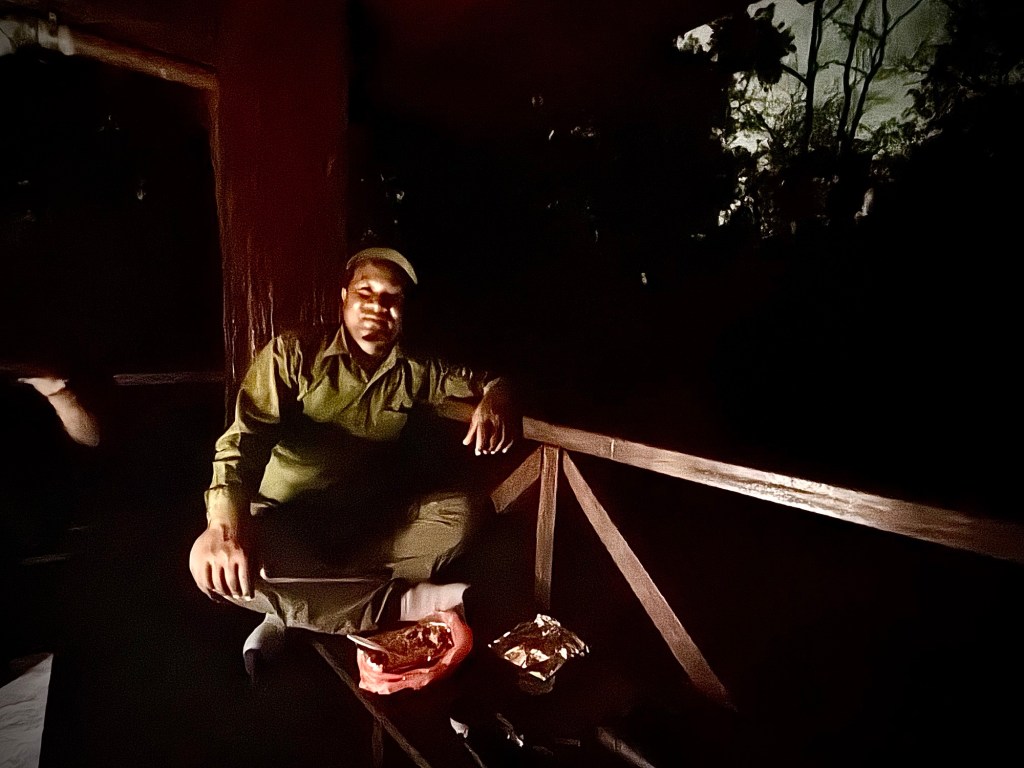
This rule, enforced by the Nepalese army, has one exception : together with a native guide, you are allowed to spend the night at one of the few watch towers, which are located for research purposes in the middle of the park…..
It was just after 4 pm, the air temperature had just started to drop below 40C, when Jivan, my local guide, and I set out, armed with two solid sticks, our dinner of Dal Bhat and the all essential two pint bottles of Gurka Premium (still cold !) to our lodging for the forthcoming night.
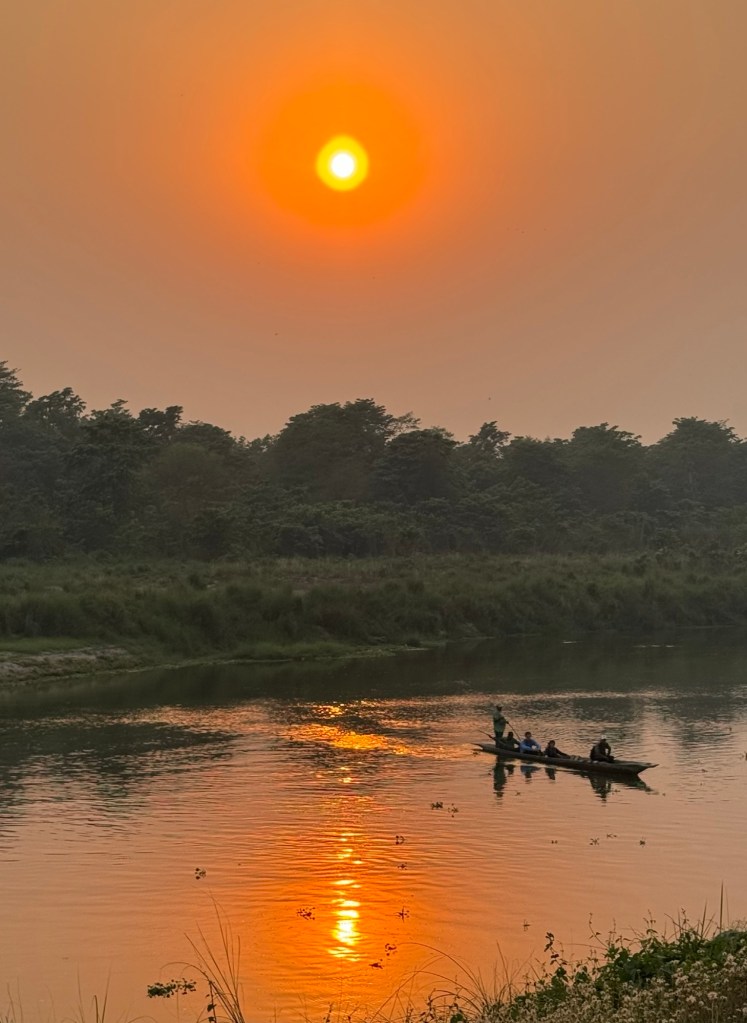
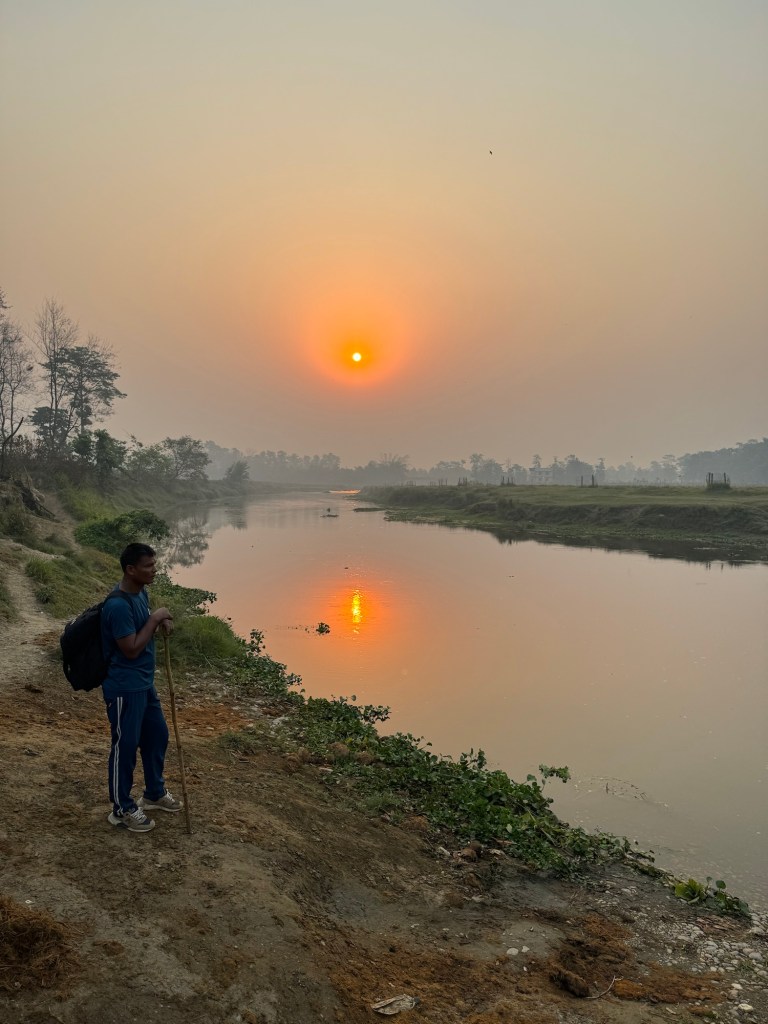
After a short tuktuk journey, we had to cross a small contibutory to the Rapti river with a dugout canoe,
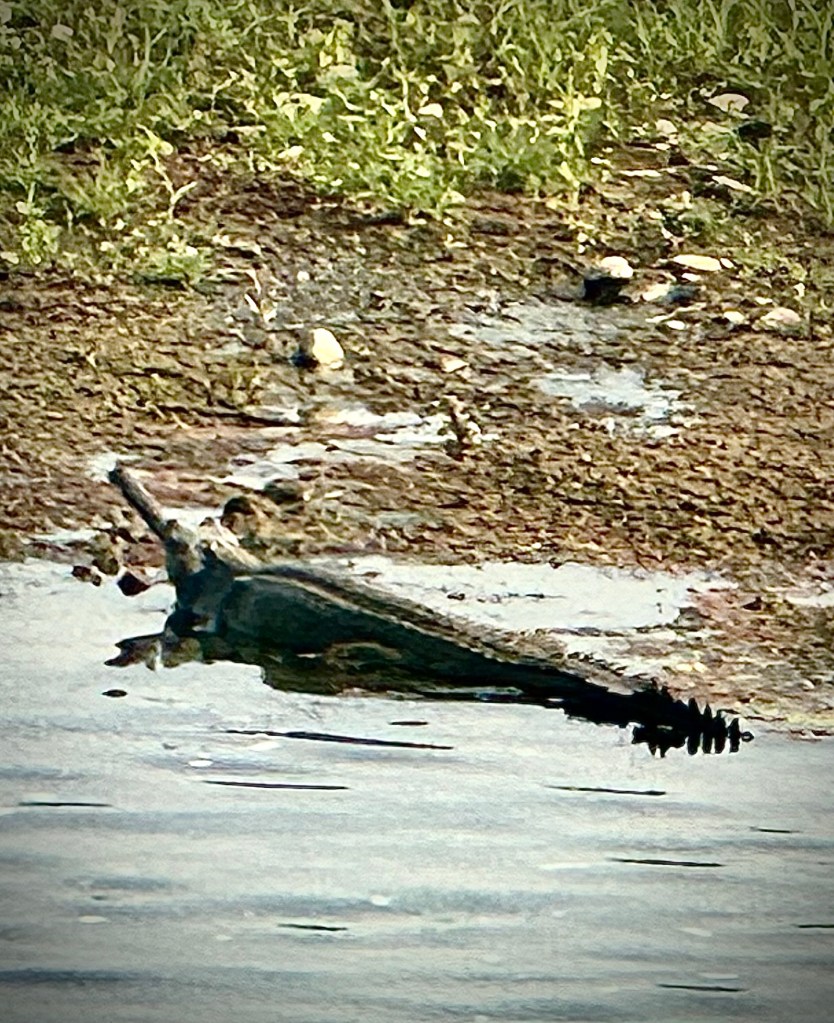
while a rare gharial was enjoying the slowly fading sunlight just a few meters away.
We then followed a small path through the thick forest, where we came across a our first spotted deer.
As beautiful as this was to watch, this was also the prime food source for larger predators. And sure enough, the presence of a tiger was confirmed by some fresh paw prints in the middle of the path a few moments later.
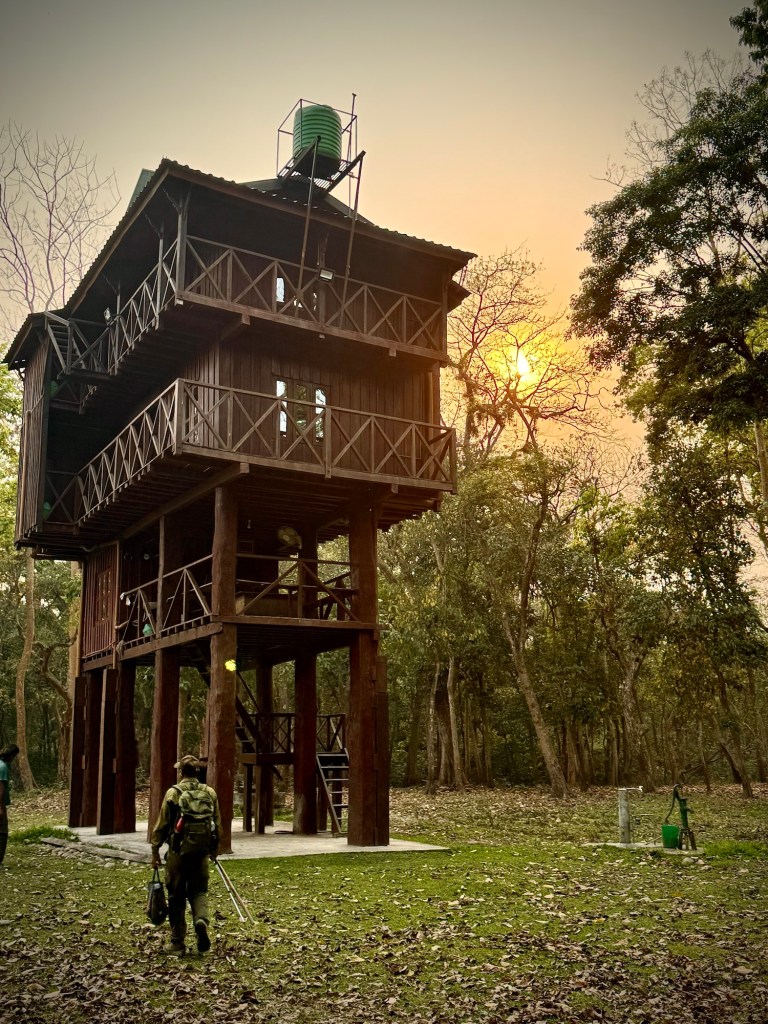
Continuing to walk at good speed now, we managed to arrive at the watch tower, just in time before sun was setting.
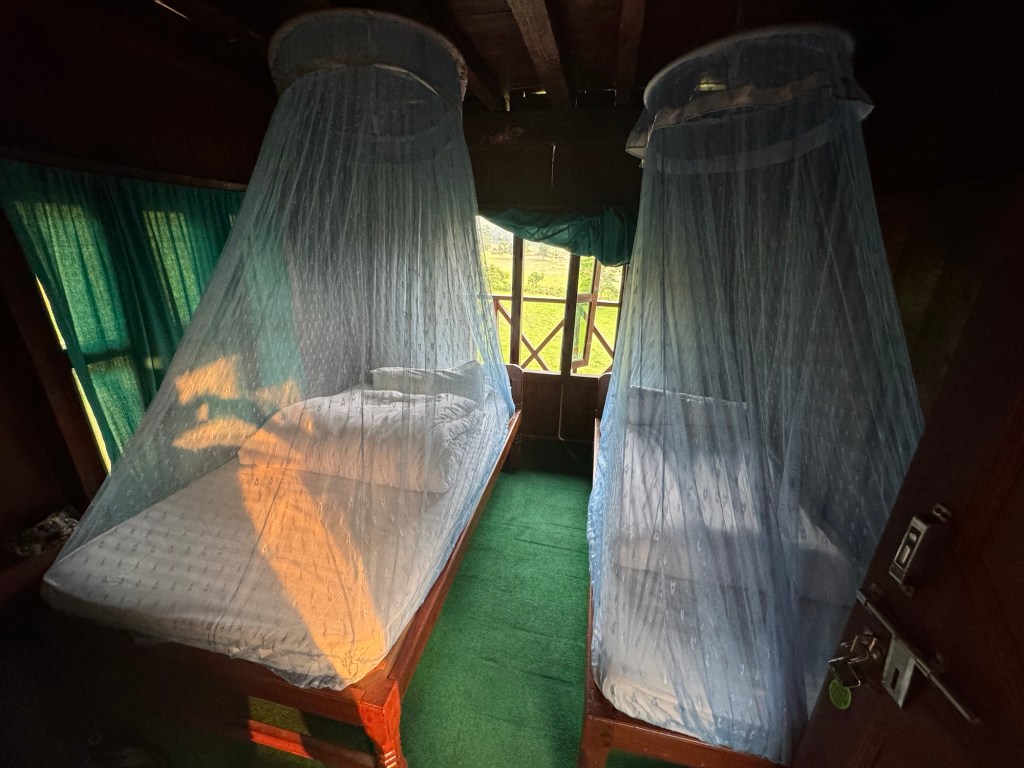
The tower was much larger than expected and it was a pleasant surprise that there was not only a bed with mosquito netting waiting for me, but the tower featured also the luxury of a toilet, which made a risky venture into the bushes surrounding the tower in the middle of the night superfluous.
After spending a short time on the ground below the structure, we noticed that the number of deer around us and near the local river started to increase, so that Jivan felt it to be wise for us to retreat to the safety of the tower and – similar to a medieval fortress – to lower the draw bridge at the top of the stairway to make the building big cat proof.
Time to open the – still somewhat cold – beer and to wait and see, what was coming to visit us….
As soon as darkness descended, the air was filled with the sounds of cicadas, frogs, night jars, the odd distressed lapwing, owls and pygmy cupwings. Then the first fire flies appeared among the trees and…. eventually something larger approached from the depth of the jungle towards the clearing near the river, where a group of deer where now feeding off the fresh green grass……
A dark shadow appeared, paused a couple of times and passed then at more speed the tower, before moving towards the deer…..
Ok, not quite a tiger, but a wild boar was also a creature, which I wouldn’t have enjoyed encountering on the ground at this time of the night.
Eventually, we were surrounded by total darkness and we had to depend on the light of the powerful torch which Jivan had brought along, to investigate the sounds around the tower.
The problem with larger cats though is, that they are – like their domestic cousins – noiseless hunters and if you hear a sound, it is usually too late already.
Eventually there was some movement and the beam of the torch homed in on a tree, 10-15 m away from the tower. Some dark shadows were moving up and down the trunk before appearing again on the neighboring tree – some rare Black Giant squirrels, with up to 2kg bodyweight the largest squirrels in the world, which even Jivan with his 14 years experience as a ranger had never seen before.
Having had this unexpected surprise and with the beer now finished, we agreed to make it an early night with the hope for some further sightings at first light the next morning.
Sure enough, just after 5 AM Jivan woke me up and pointed towards a large rock near the river….
It took me a moment to figure out what he meant, when the rock suddenly started to move slowly among the grass….a large Asian rhino had taken its morning bath and was now enjoying its breakfast !
It was exactly what I had hoped for when travelling to Chitwan – to see one of these gentle giants in its natural habitat. Seemingly not in hurry, the rhino remained long enough at the river bank for me to take a few photos, before disappearing then into the tall grass.
There were no further sightings that morning and before the temperature had once again risen to an unbearable level, driving both animals and their human visitors into cooler hiding places, we found ourselves back at the river, finishing our night at the watch tower.
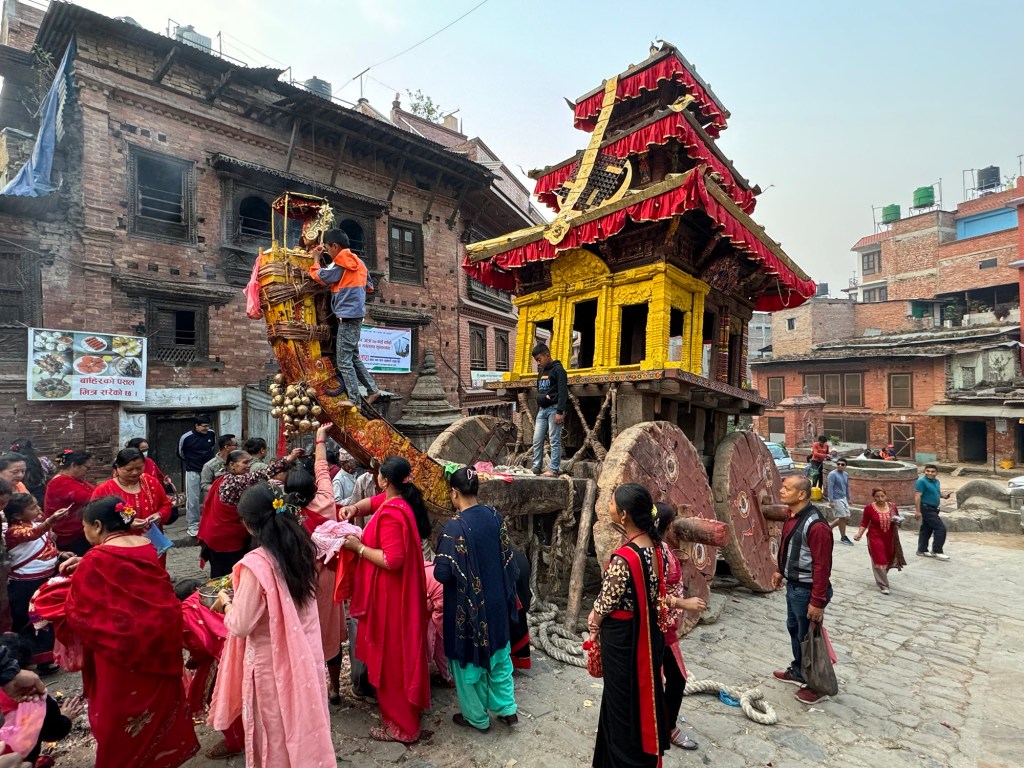
The year had just turn to 2081 and the New Year celebrations were still ongoing, when I travelled to Baktapur in the Kathmandu valley.
Nepal is in so many ways different from the rest of the world, and this includes the Bikram Sambat calendar, which is roughly 57 years ahead of the Gregorian calendar….
Baktapur is the birthplace of my local colleague Pranav Joshi, who very kindly allowed me to visit his clinic and to see a few cases together with him.
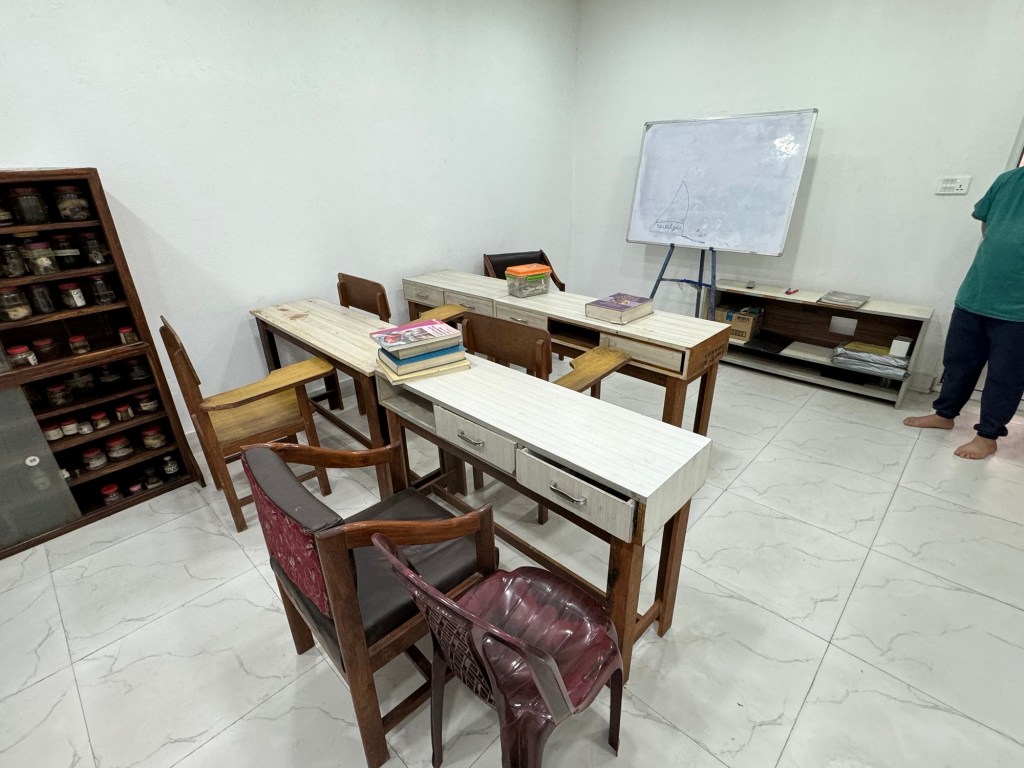
In a small sidestreet in Baktapur, Pranav is running together with his brother Sandeep, who is also his practice manager, a small veterinary practice and a basic learning center where he is trying to pass on his clinical knowledge of companion animal medicine to his younger colleagues. A deeply spiritual man, Pranav is always trying to combine his strong pantheistic believes with evidence based science.
The veterinary course in Nepal provides graduates with very limited skills and these center predominantly around the treatment of livestock.
The care of companion animals is left to just a small number of practices in the Kathmandu valley and even here only a few pet owners see the need to spend money on veterinary fees for their dog and even less for their cat. This is reflected in a maximum consultation fee of 1000 Nepalese Rupees in Kathmandu, which are circa £7/8 US$. It is half that or even less elsewhere.
Pranav and his brother are operating two sites: the smaller, but traditional one in Baktapur and a larger, more spacious one in an upmarket residential part of Kathmandu.
The latter site seems to fund the former, where only very limited services can be provided.
Pranav’s main caseload consists of family dogs of both Nepalese and foreign pet owners. Cats and other species are seen far less frequently.
Vaccinations, including protection against rabies and corona virus, play an important role and so does regular preventative treatment against ecto and endoparasites.
Commercial pet foods, produced in Nepal or in India, have a bad reputation, so that the majority of dogs receive home made diets instead. Unfortunately these in many cases are lacking sufficient amounts of Calcium and vitamin D, resulting in poorly mineralised long bones and ribs and subsequently in pathological fractures. Another common metabolic issue are, according the Pranav, dogs been fed strictly vegetarian diets developing cardiomyopathies.
Tick bourne diseases, including Ehrlichiosis, Anaplasmosis and Babesiosis, or a combination of all of these, are another problem frequently encountered and once stabilised, patients have to remain for weeks on medication.
Interestingly, Leishmaniosis doesn’t appear to be an issue in the Kathmandu valley, possibly due to the absence of its vector, the sandfly. The disease (Kala-Azar) is however of great concern for humans and for pets in the South-Eastern part of the country, as well as in parts of India and in Bangladesh.
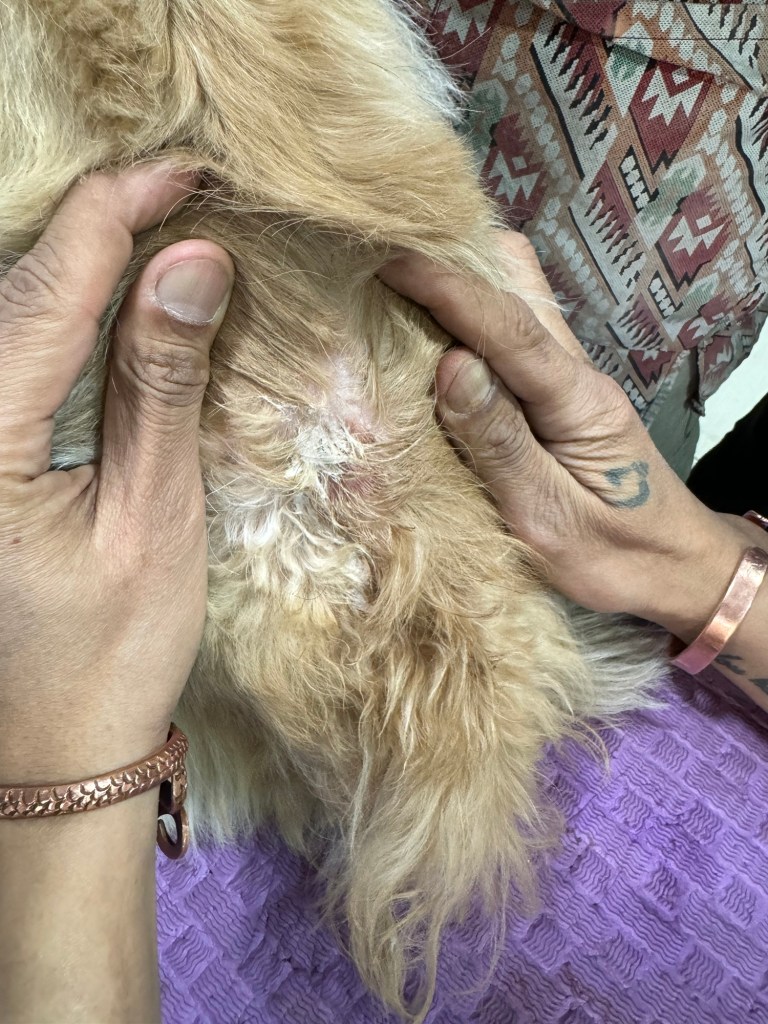
Skin conditions like Hot Spots or lick granulomas are reflecting the UK caseload in a typical warm late summer. Here, similar to the UK, predominantly larger and long haired dog breeds are affected.
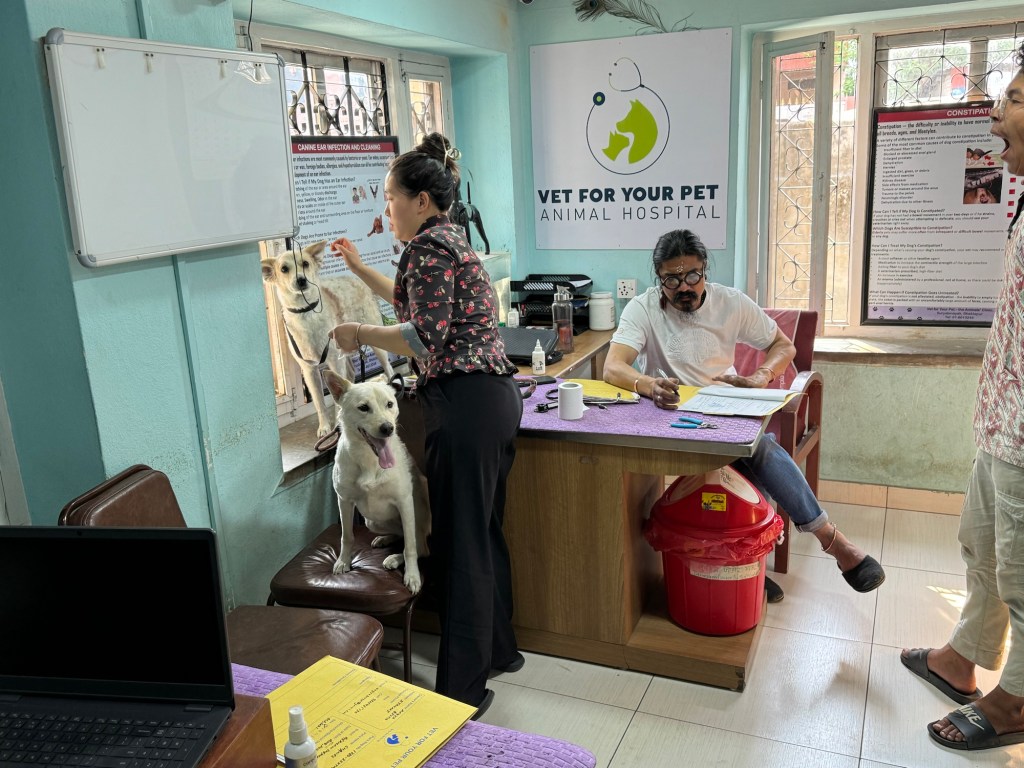
Pranav’s consulations are very social affairs with him being joined by usually two assistants and his patients usually accompanied by two or three family members.
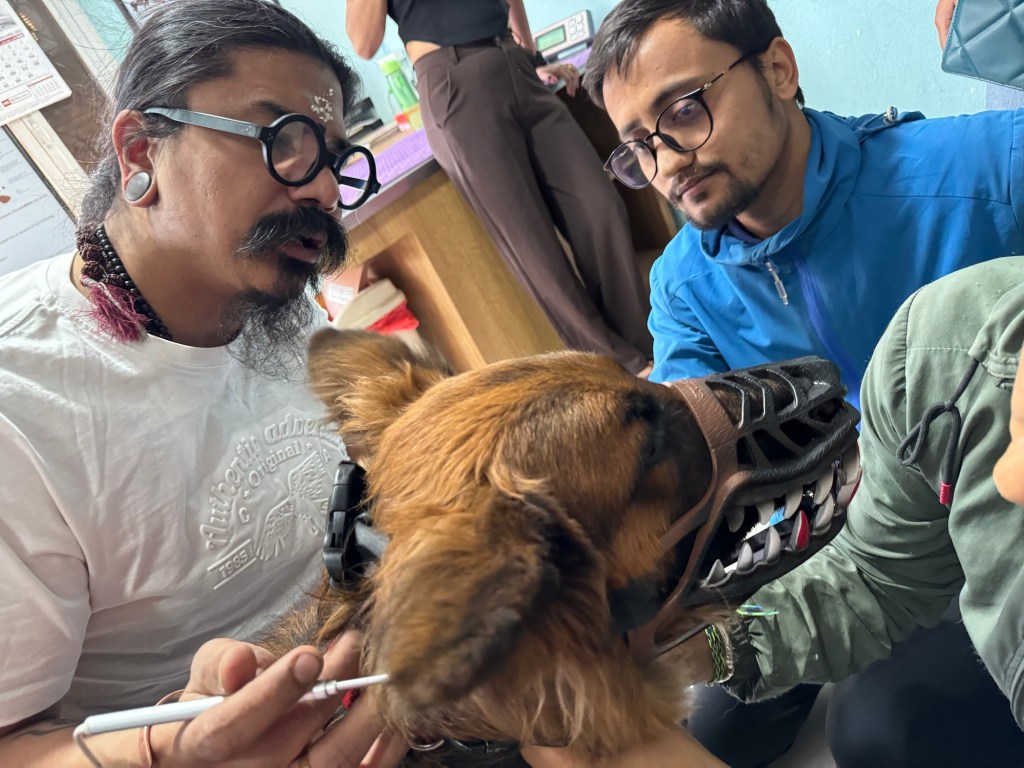
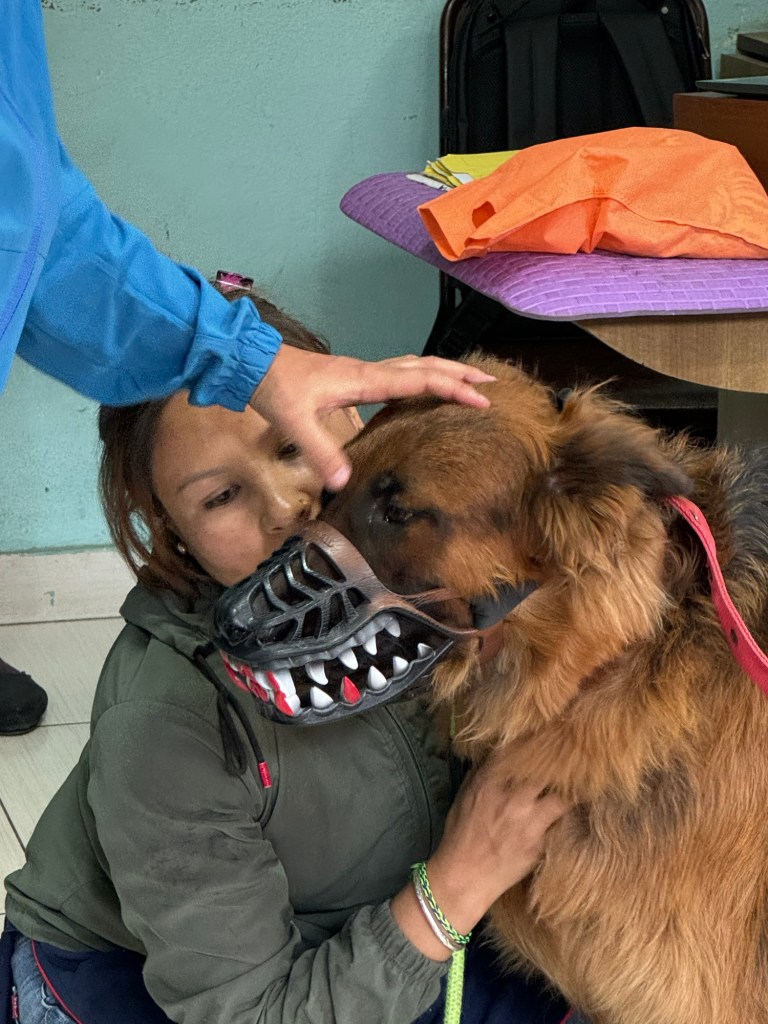
Something that was new to me, was this unusual version of a Baskerville muzzle ……
As much I can see the comical side of it, I found that this would make it very difficult to read a dog that is stressed and I can not see the design catching on in European veterinary practices.
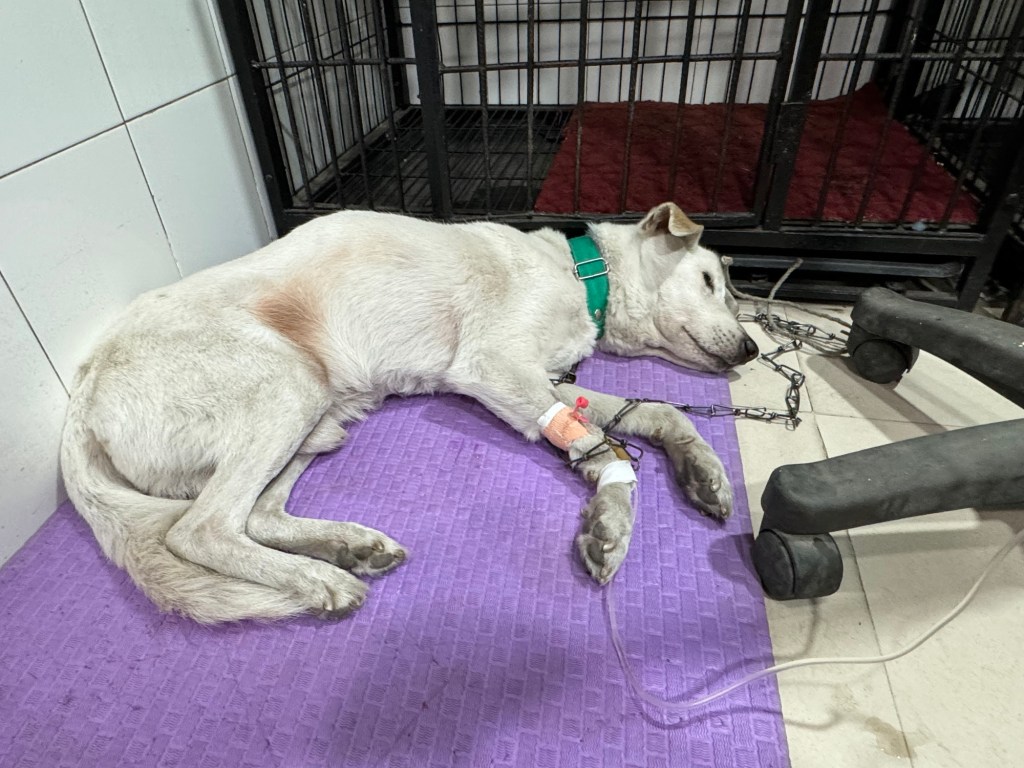
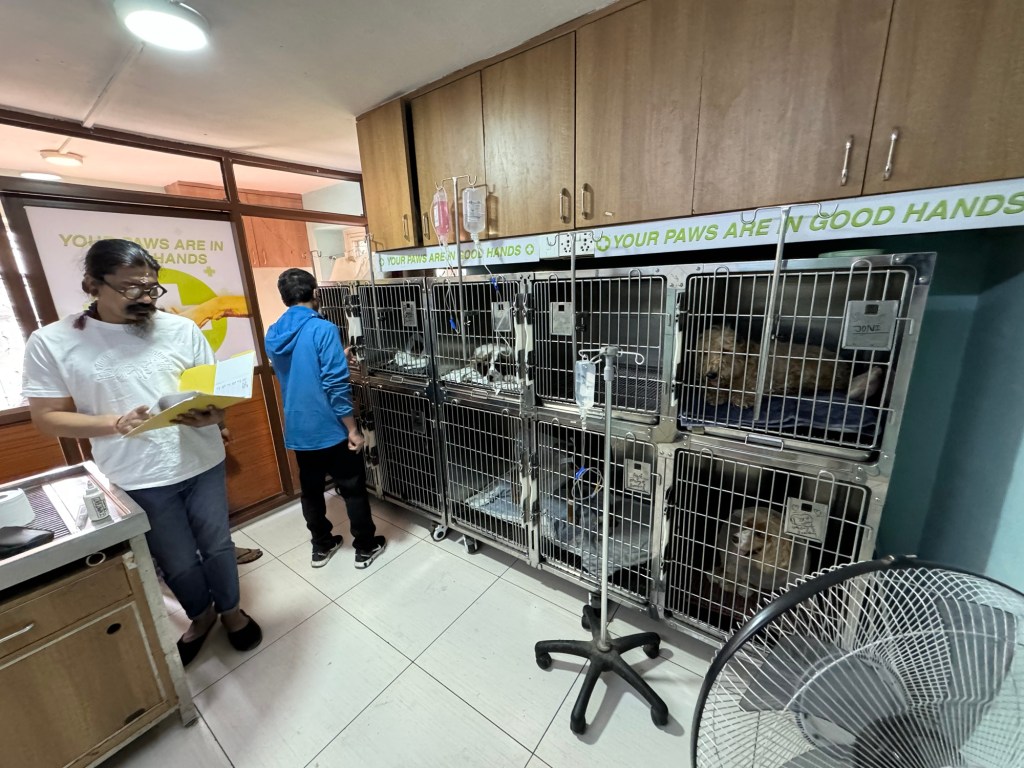
The clinic in Kathmandu is one of the very few places in Nepal with an inpatient area and the ability to offer hospitalisation over night and on weekends.
Numerous newspaper articles and thank you cards displayed on the walls in the waiting room leave no doubt about Dr Joshi’s popularity as a vet and people are prepared to travel long distances to see Nepal’s “Dogfather”.
It just wouldn’t be right to talk about hiking through the Himalaya as a veterinarian and not to dedicated a few lines to the canine inhabitants of this region.
The dogs of this harsh environment differ somewhat from the ones I came across in Kathmandu.
In the city, clearly size matters. Not too small, to be able to compete with other canines for sparse food resources, but also not too big, for not appearing to be a threat to humans in their environment.
Most of these usually very gentle creatures, all cross breeds of some sort, don’t seem to have a specific owner, they rather claim a defined patch on a street and are there tolerated as part of the street life. They live off whatever is given to them by caring residents and shop keepers, and they are at times surprisingly choosy about what they eat and what not.
Pretty unfazed by what is happening around them, they are no real car or motorbike chasers, but unusual vehicles (eg street vendors with recorded anouncements or irritating tunes) can quickly rise them from their state of slumber.
Near butcher shops (usually operating without any means of refrigeration….) and religious sites, the number of dogs tends to increase and here also packs of dogs are a not uncommon.
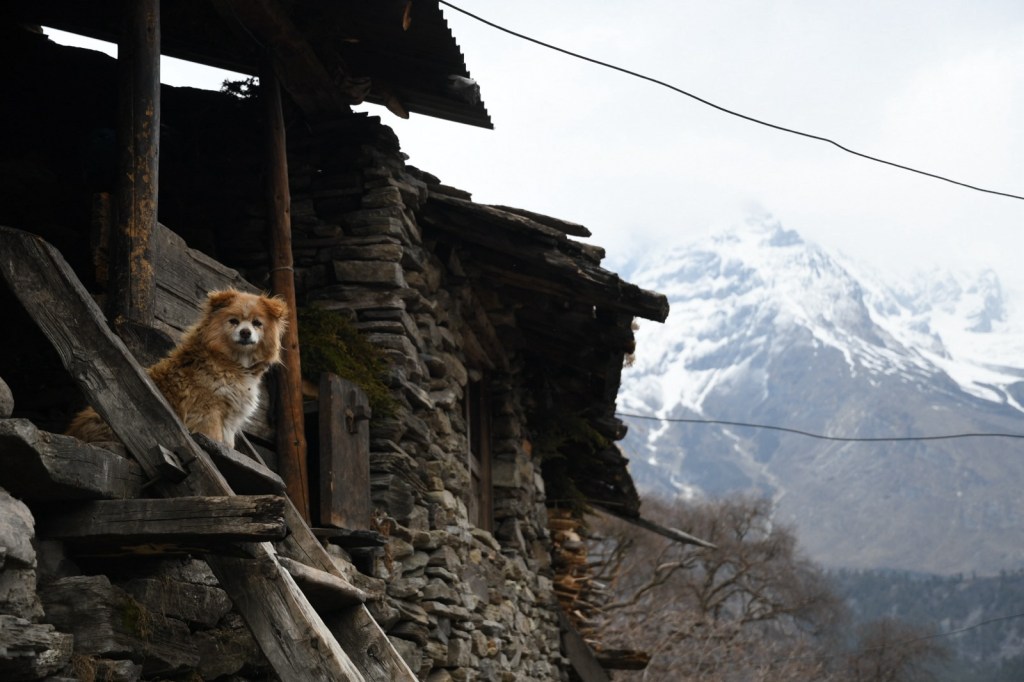
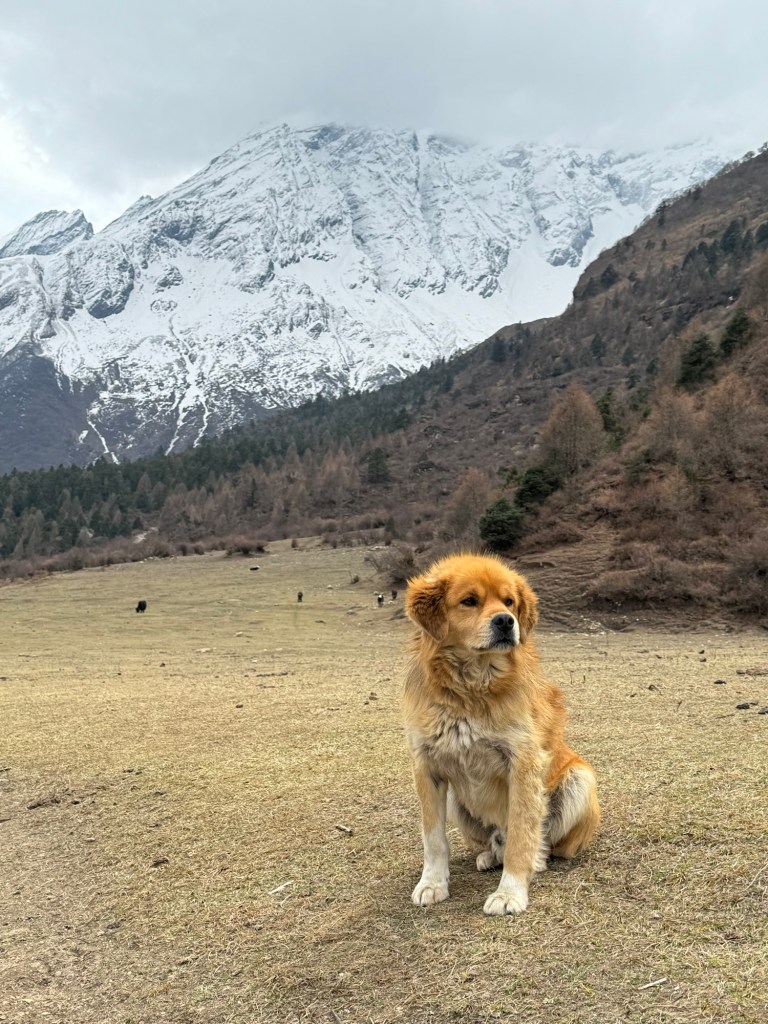
In the mountains, the size of dogs tends to vary more and with most dogs being connected to a specific household, their physique needs to meet the requirements of their purpose.
Small spitz and terrier like dogs are not uncommon and nothing coming near a dwelling is missing their attention.
(Image courtesy of Jeremy Rothschild)
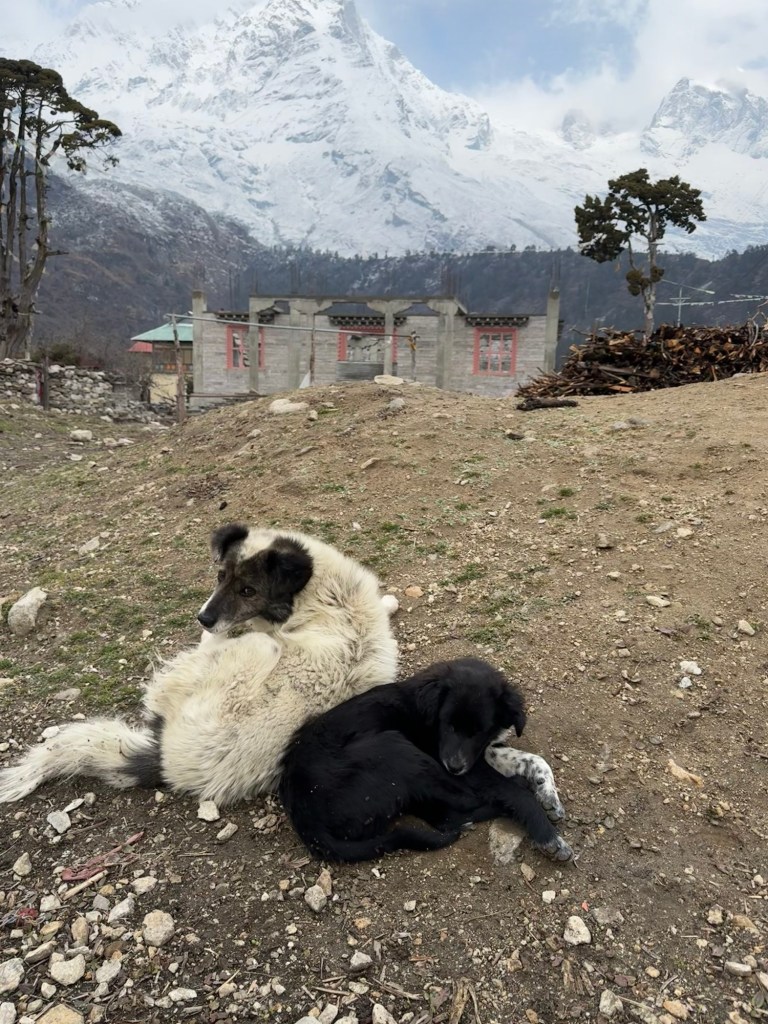
At higher altitudes, thick fur is a basic requirement, especially if dogs are kept outside the whole year. These dogs are usually not allowed into the upstairs living quarters in traditional houses, but they live together with or near the livestock in the basement or in the yard.
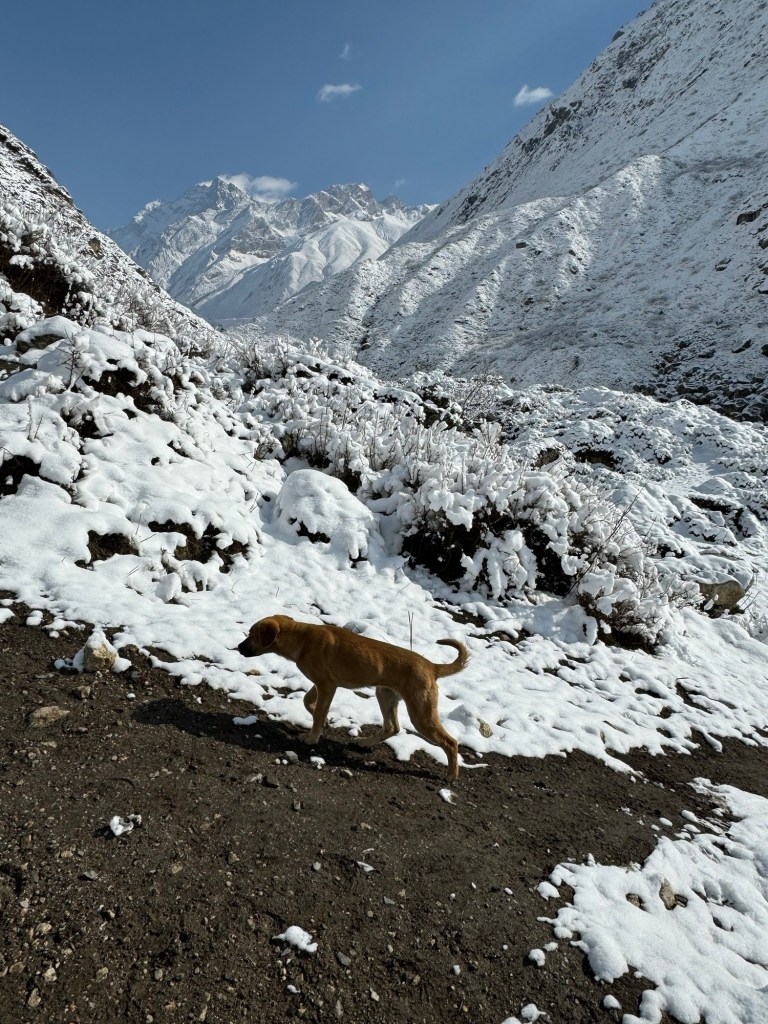
Seeing chained dogs was thankfully a rare sight and in most cases dogs had the freedom to roam, which might include accompanying a hiker from one village to the next, as in the case of this adventurous canine.
Despite a lot of young lambs, kids and chickens being a constant feature along the path while walking through mountain villages in the Himalaya, I never witnessed one of these dogs chasing them or trying to chase any of the local wildlife.
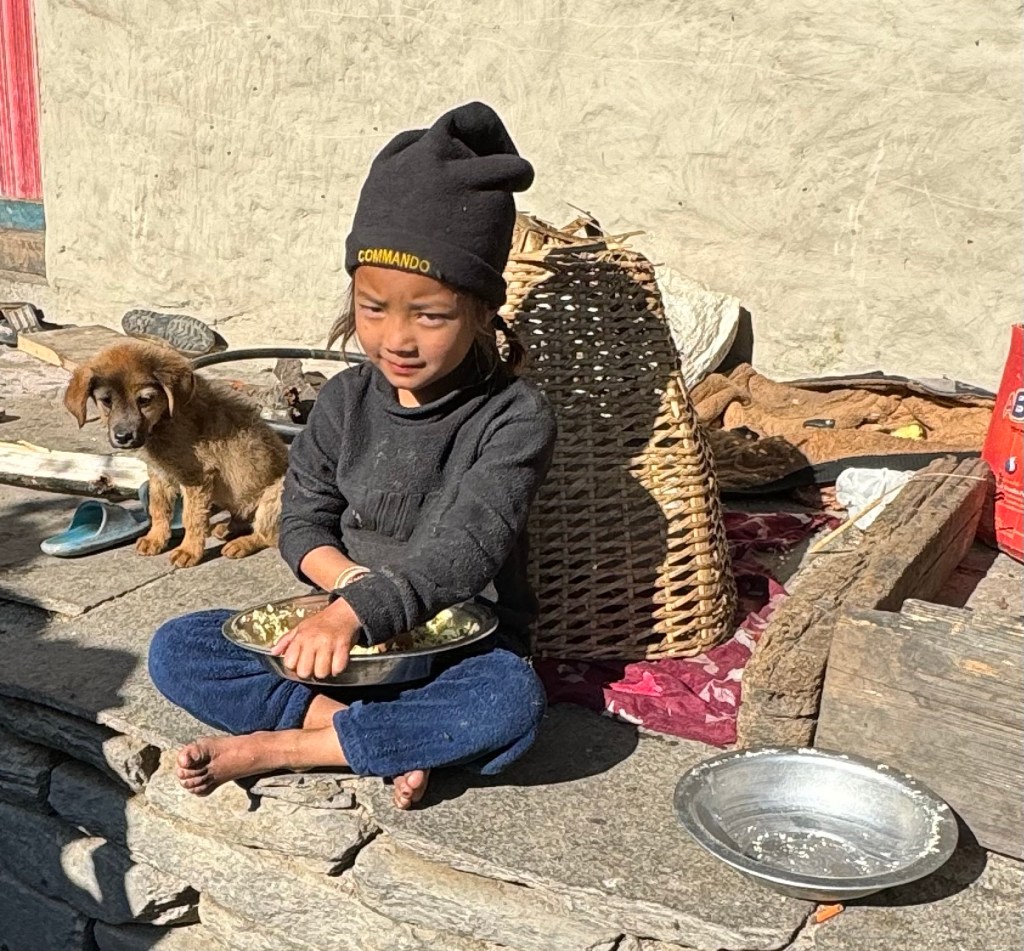
Clever dogs learn early in life, to stick closely to the youngest members of a family
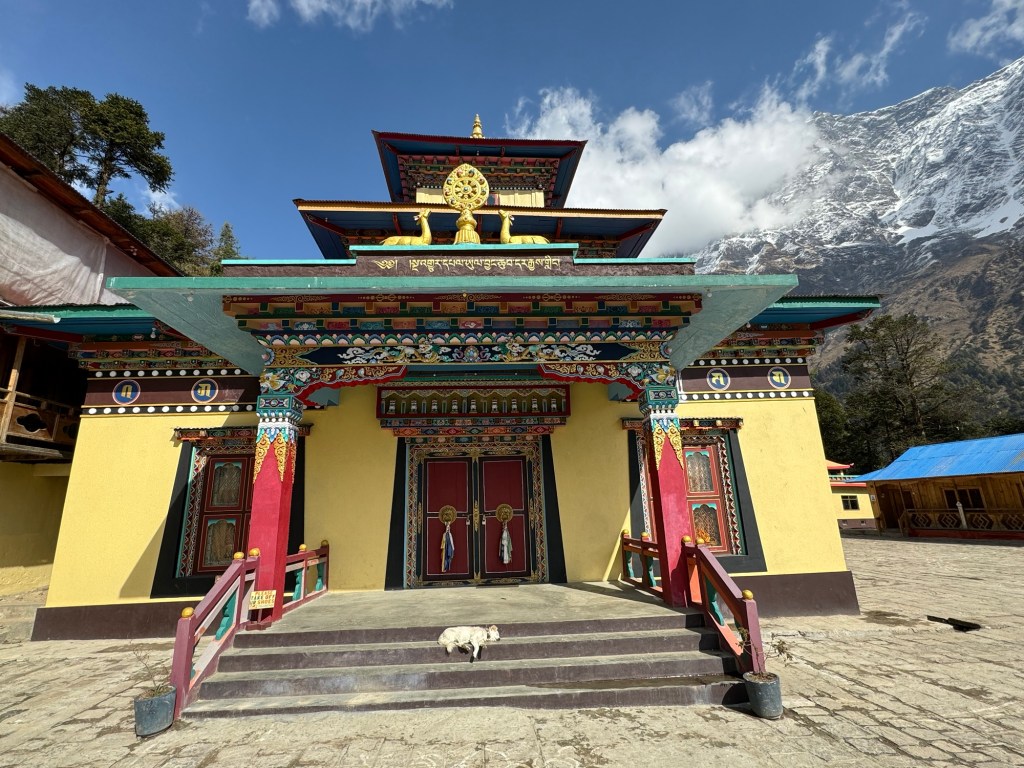
and the ultimate state of existence is definitely to find yourself as the resident canine in a Tibetan monastery…..
Regardless of a mostly inadequate diet of human food scraps, livestock fodder, mule dung and whatever can be scavenged on the trail, and living a life in the abscence of any kind of meaningful veterinary care, most of these dogs of the mountains were in a pretty good overall condition, usually somewhat undernourished, but without any overt signs of skin or fur defects, growth deformities or signs of infectious diseases.
And what about cats one might ask?…….
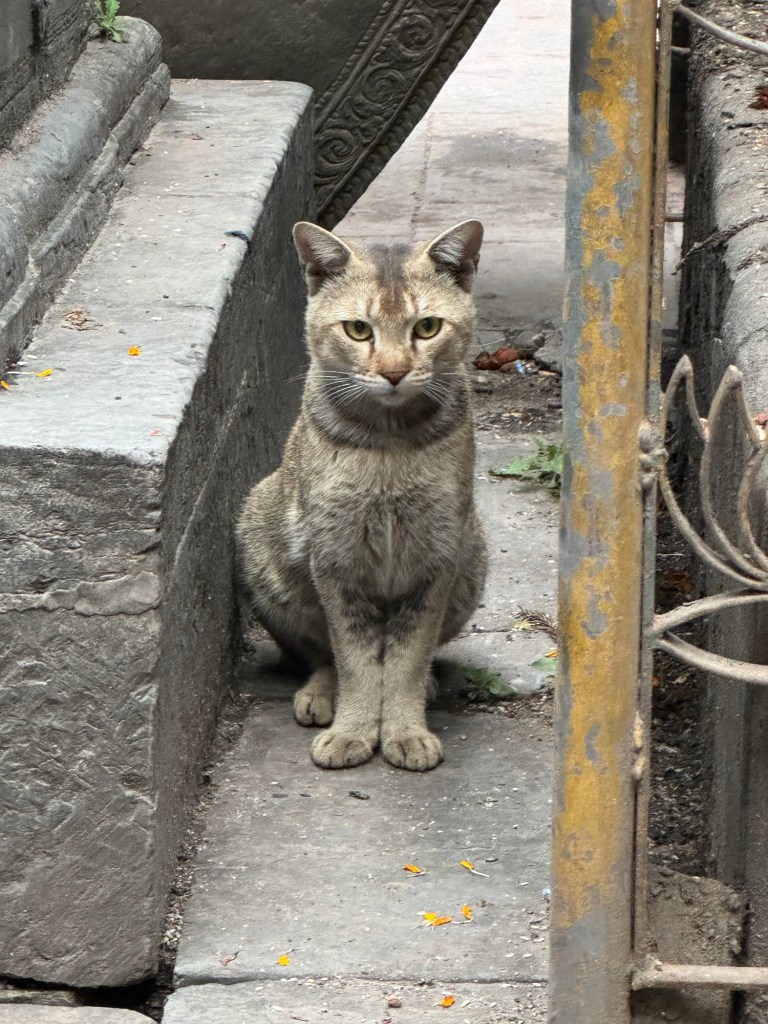
They too exist in the remoteness of the mountains, but due to the competition from dogs, monkeys and indigenous wild predators, who might even consider them as a potential food source, cats in general appear to have a far less visible existence in Nepal and they do not enjoy the same life as eg their Mediterranean cousins.
When I woke at two thirty in the morning, I noticed that more snow had fallen and the water bottle I had forgotten outside, had frozen solid over night. After adding another layer of clothing, I staggered out of the cave of damp and mouldy matresses, which I had shared with Ryan and Jeremy, my two Canadian fellow hikers, for the last few miserable hours.
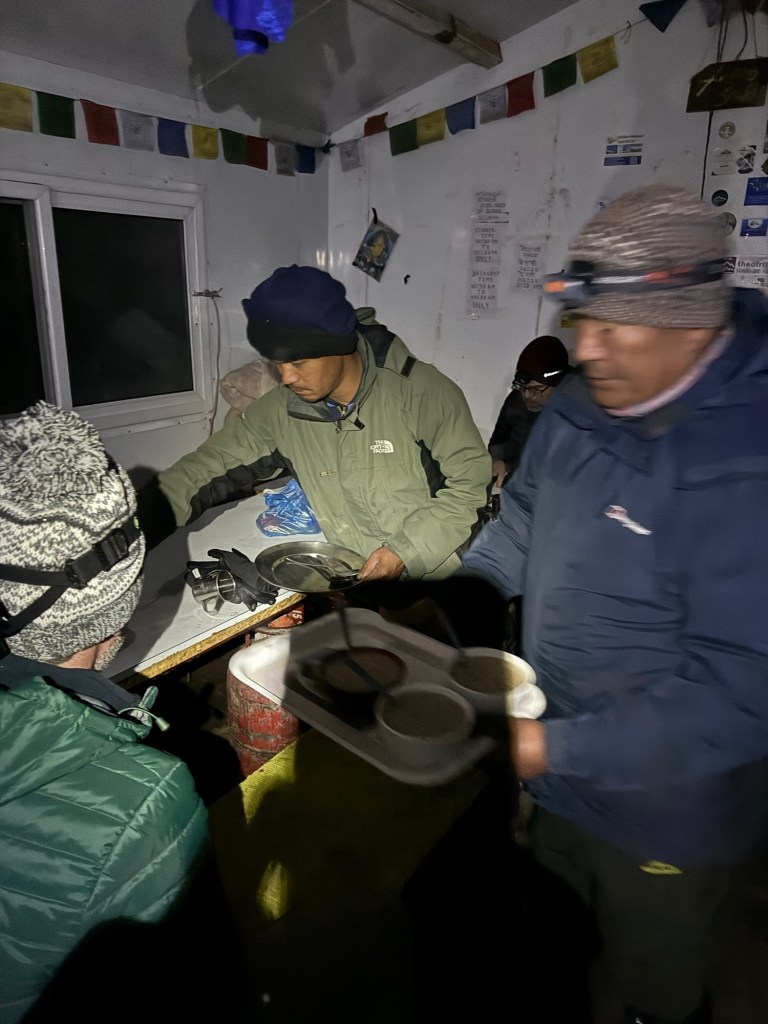
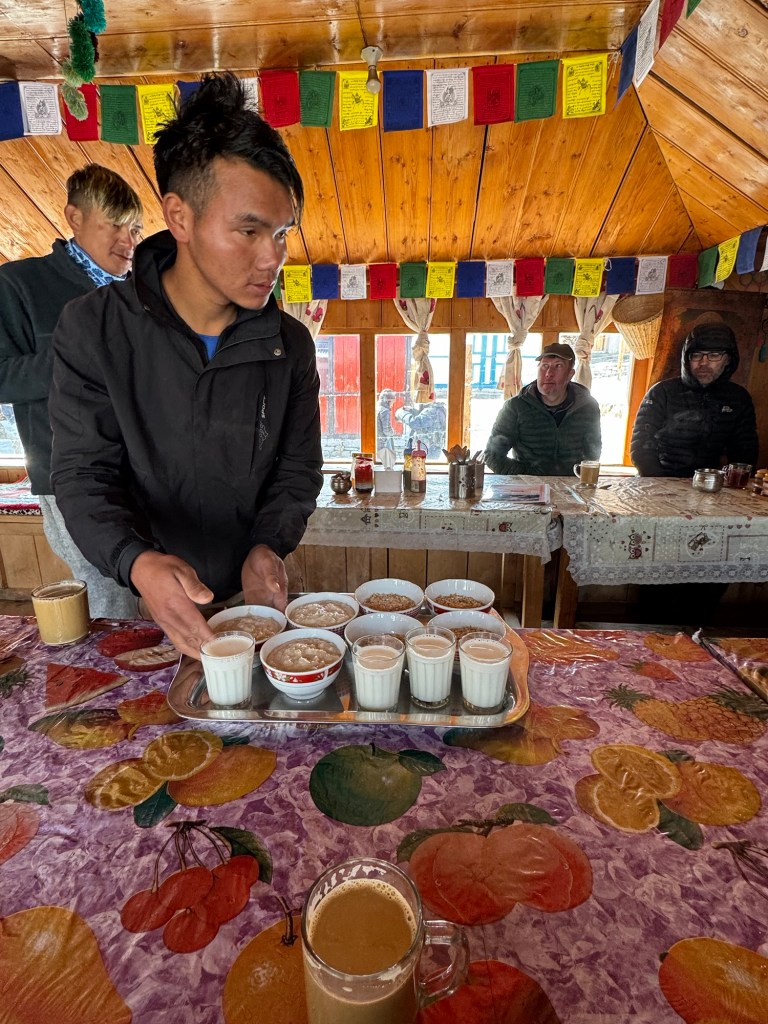
In the dining hall, as far as one could call it that, at least some hot tea and porridge was waiting for us.
We were in Dharamshala, which, at 4400 m above sea level, is the last human habitation before crossing Larke Pass at over 5000 m.
As high camp go, ever considering the remoteness and the limited means of supply, Dharamshala was still a shit hole. Kumar, our trusted mountain guide, had warned us to stay clear even of Dhal Bhaat here. The Nepalese national dish is normally a safe choice (if no meat is involved….) in tea houses in the mountains.
However, it was the best shit hole and in fact the only place in this remote part of the country, not far from the border to Tibet, where one could get a few hours of rest and shelter before crossing the pass.
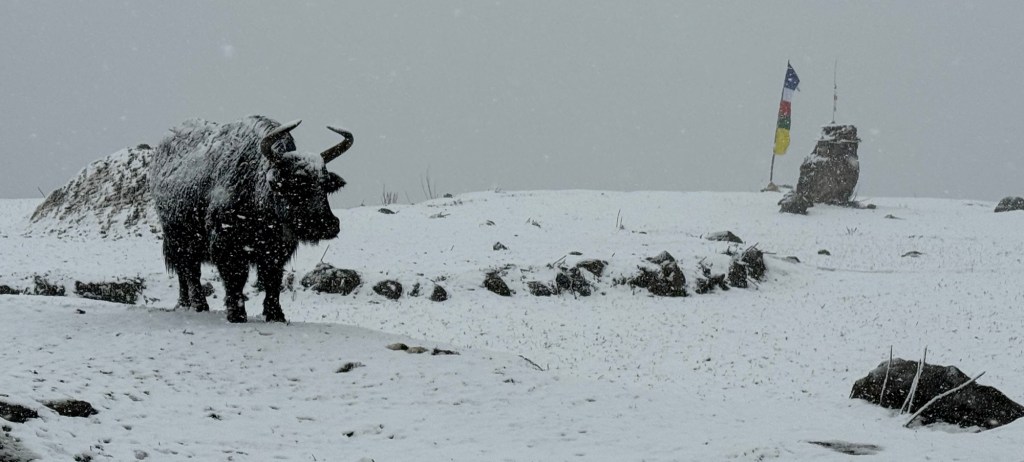
Over the last couple of days, we had left even the hardiest yaks and most of all alpine vegetation behind us and only a few solitary birds were able to survive in this hostile environment.
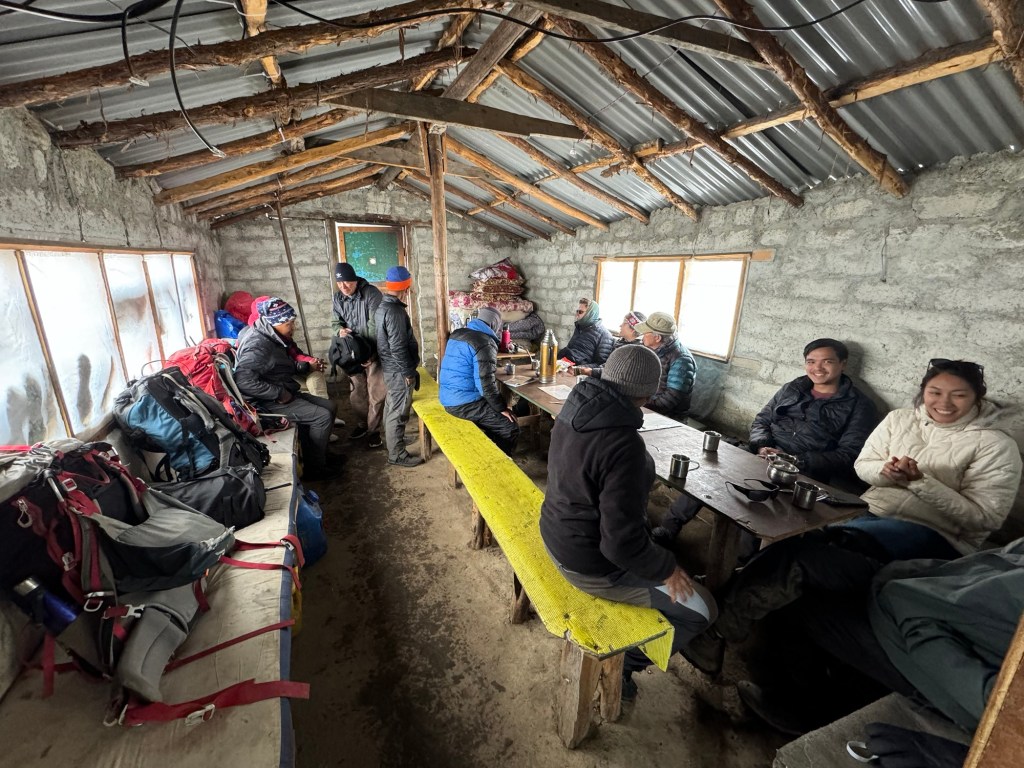
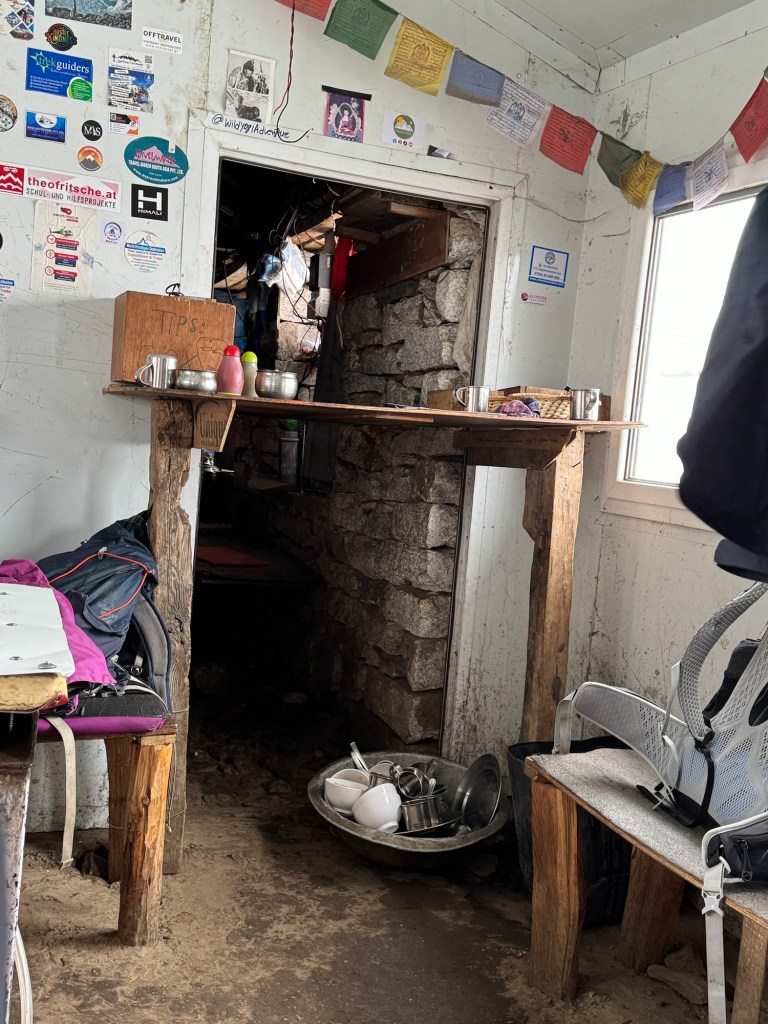
The main – of course unheated – room, where we had spent most of the time since our arrival the previous day, reminded me of the inside of a refrigerator, that hadn’t been cleaned for a while.
One of the windows was shattered and an icy wind was entering through a large gap in the door frame, with the door being kept shut with the help of a couple of abandoned shoe strings.
And yet – we were the lucky ones, having found a place here and not in the building next door, which consisted of plane breeze block walls and a roof of corrogated iron, which was supported only by a few flimsy sticks.
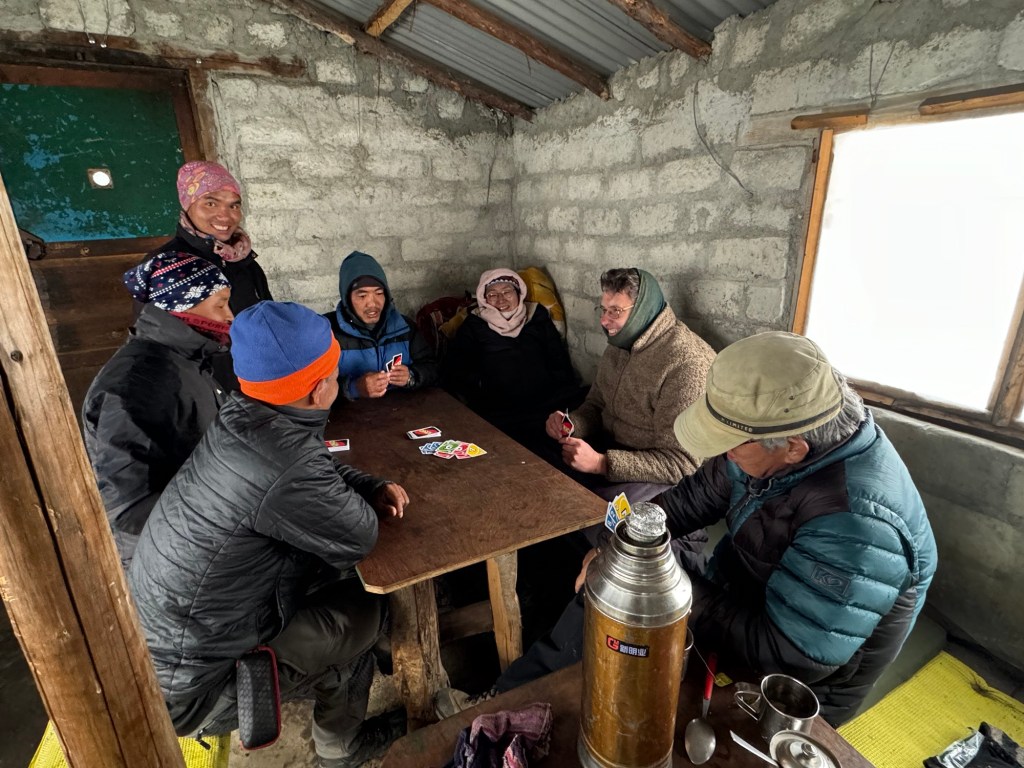
Whiling away the time here, with the help of meaningful conversation or the odd card game, only worked so long……
If the dining room was bad, the kitchen, which for good reasons was poorly lid, was worse and only recently boiled or deep fried food items could possibly be consumed here.
The cutlery and crockery for nearly one hundred people was rinsed without the visible use of any detergent in the nearby stream.
Thankfully someone must have had the good sense to position the toilet shags a bit further downhill….
No surprise then, that despite the early start, we were rearing to leave this place to cover the final 700 altitude meters on our circuit around Manaslu, one of the fourteen 8000+ meter giants of the Himalaya.
Most members of our team were by now on various means of pharmaceutical support, with a combination of Diamox and Paracetamol having been the overall favourite choice.
At exactly three o’clock, being led by the imposing figure of Pasan, an experienced native mountain guide, who had crossed the pass many times before, we started walking slowly uphill, but without the help of any way signs whatsoever.
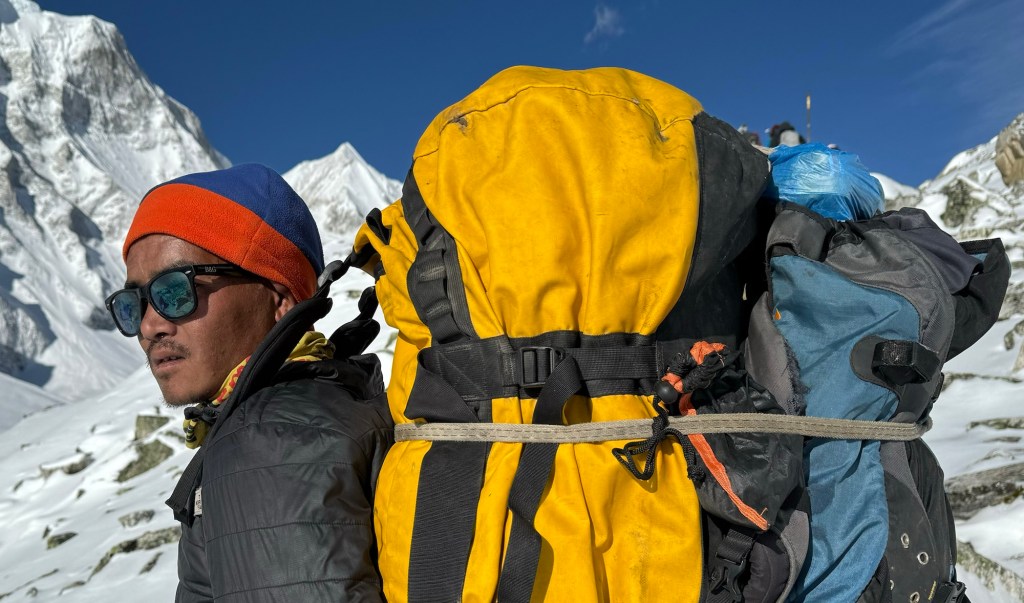
Soon we were overtaken by our porters, who despite their small frames carried up to three times the weight of our own backpacks.
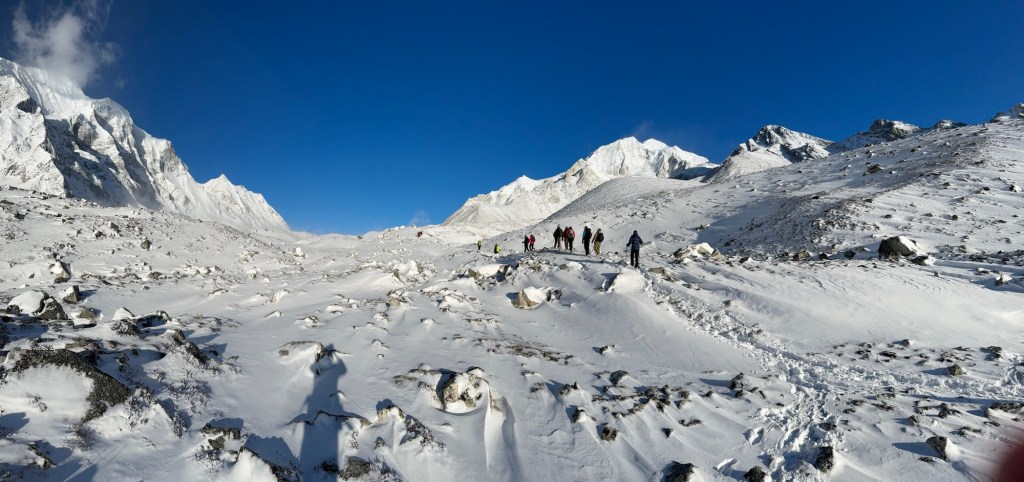
After a while, a few black and yellow metal poles started to appear, confirming that we were indeed on the right track, along the Northern edge of the remainder of the Larke Glacier. As the darkness lifted slowly, the landscape around us revealed itself as generally very forgiving , with no steep drops or exposed passages. Just gentle, but relentless hills to climb, with numerous false summits.
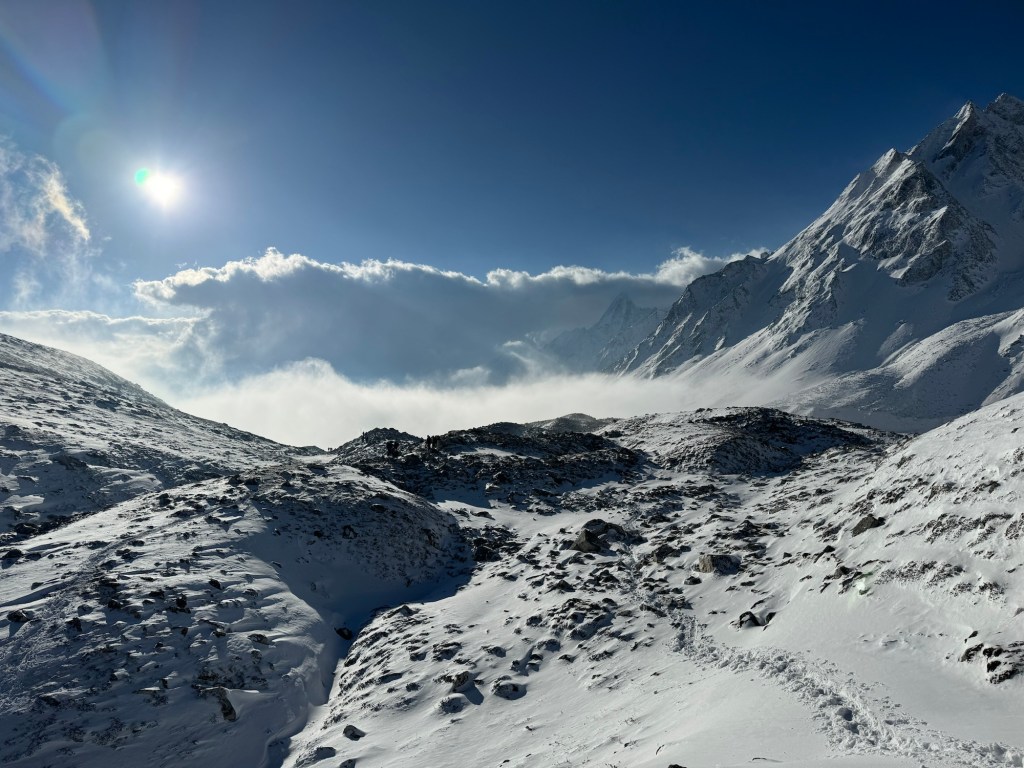
Eventually, as the rising sun started to burn the clouds away, we found ourselves in a grand theatre of white mountain tops including Larkya Peak, Cheo Himal and Hindu Peak, which were towering above a sea of white cotton wool that extended all the way into the horizon.
As the altitude increased, our progress slowed dramatically and short breaks became more frequent. I started to feel dizzy and noticed a slight headache, but thankfully no nausea, so that my rich supply of chocolate bars continued to provide me with much needed substinence.
Passing the 5000 m bar, was a small achievement, but it still took nearly an hour, before the remaining 100+ altitude meters were finally covered. While stopping once again to catch my breath, my thoughts went in deep admiration to alpine pioneers like Reinhold Messner, who had been able to function and to eventually scale Mt.Everest, which was another 4 kilometers higher, without the use of supplementary oxygen.
I decide that 5000 m above sea level would be my personal limit and that I would be happy to leave much higher peaks forthwith to someone else. There is enough to see and to enjoy at lower altitudes…..
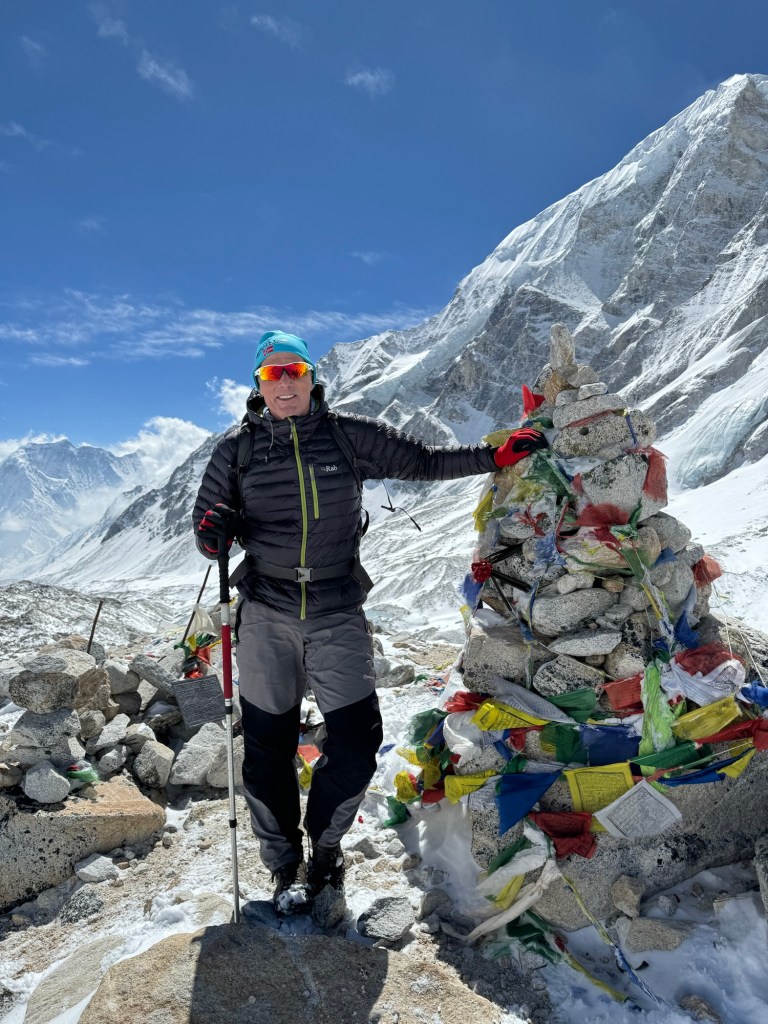
After nearly eight hours of climbing, we finally reached the pass, but unsurprisingly it was a pretty windy and not particularly welcoming place. Hands were shaken, a few obligatory photos taken and then our guides were keen getting us to a lower height as fast as possible.
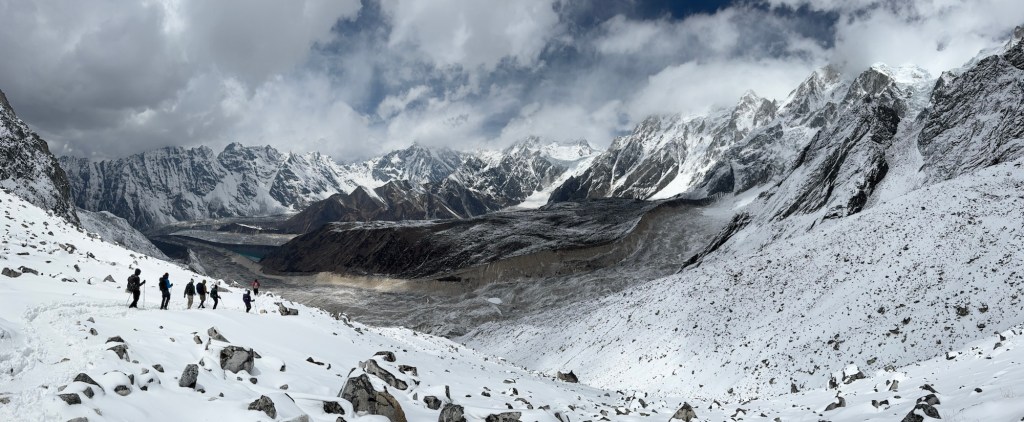
The descent into the Pongkar valley was much steeper than the previous climb and the use of light crampons proved essential to avoid any slipping.
Slowly the much darker panorama of the Annapurna range was opening up in front of us, and below the moraine of the once giant Ponkar glacier, which appeared to have all but melted away.
The descend took another six hours and just when fresh snow was starting to fall in heavy flakes onto the path, we arrived in Bimthang, where a wood panelled dining room with a blazing central fireplace and much needed hot drinks were awaiting us.
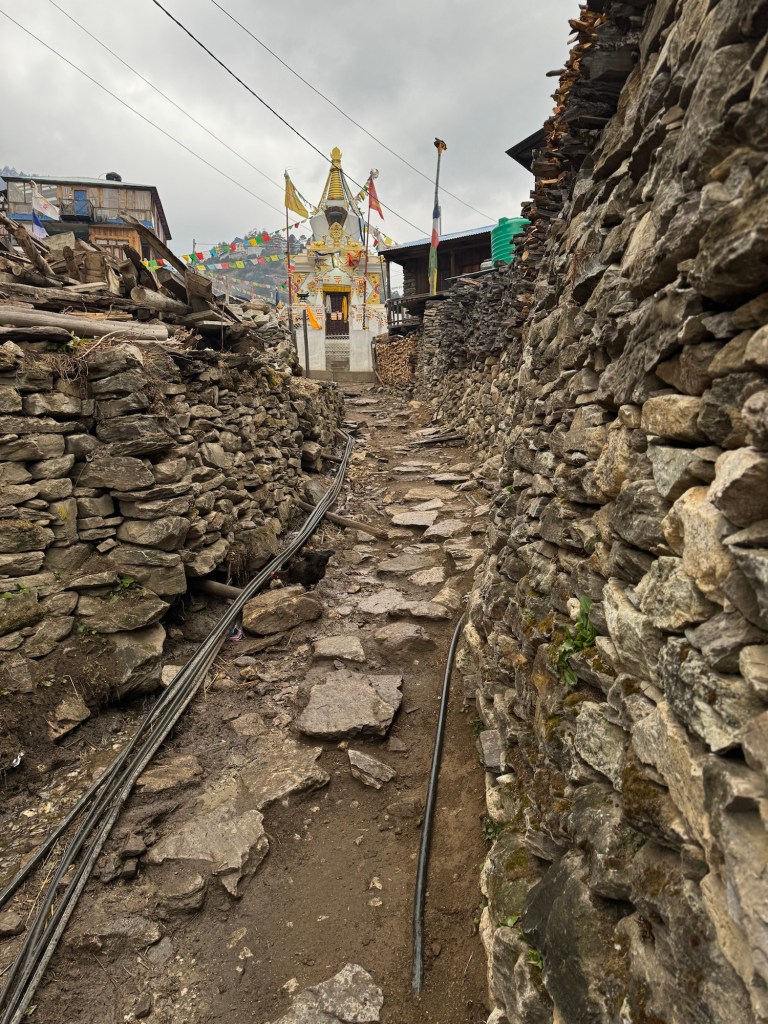
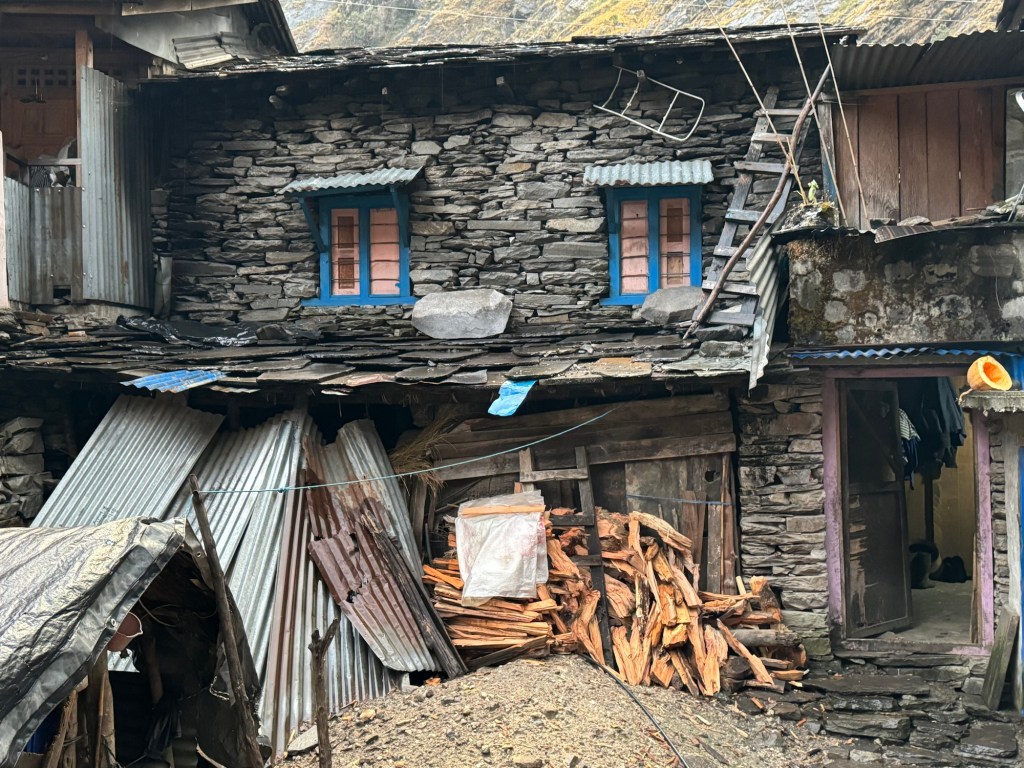
What awaited us in Lho, was a truly medieval scene:
On the unpaved road we walked in a mixture of drenched soil and mule dung. Chickens, cattle, dzos and an ownerless horse were blocking our progress, as the rain was just starting to fall in heavy drops like lead from a grey sky.
The eyes of small children with dirty faces were following us from a safe distance, from unlid living quarters above low stables in the basements of ramshackle dwellings.
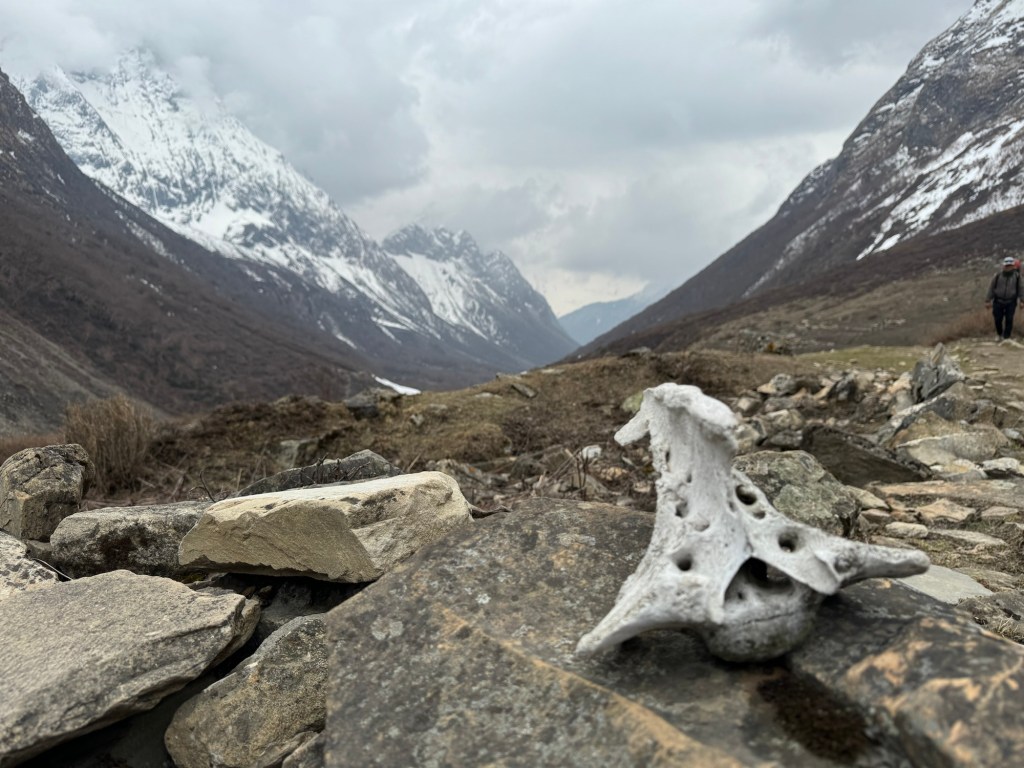
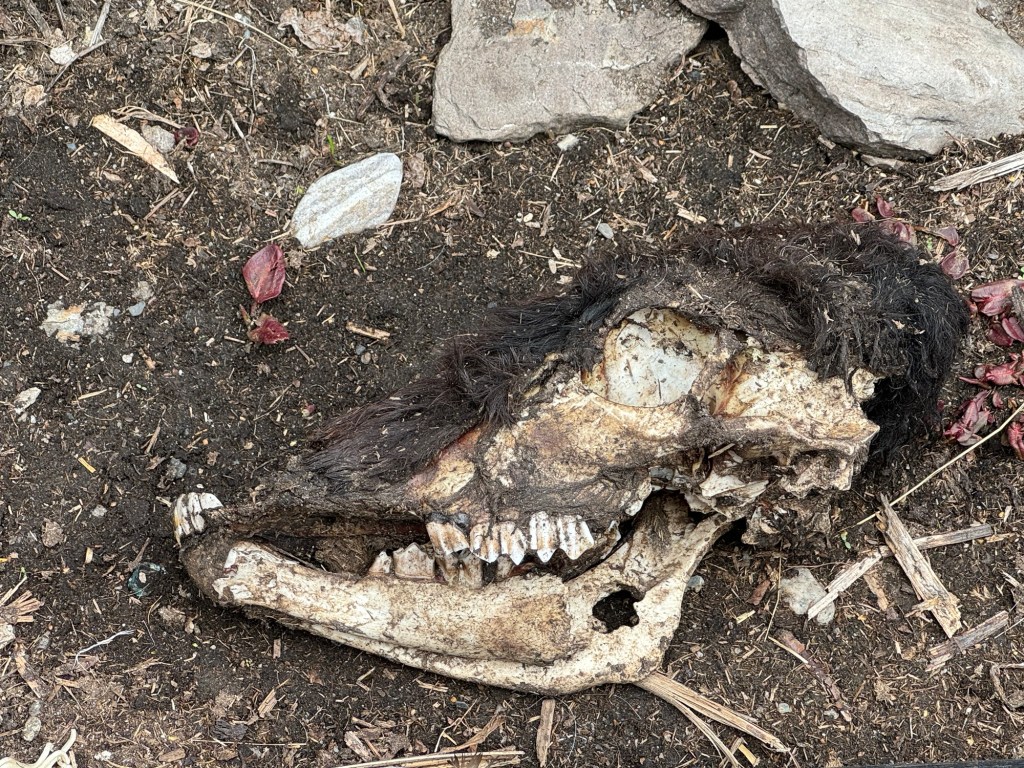
Various bones and a discarded mumified yak skull were littering the road.
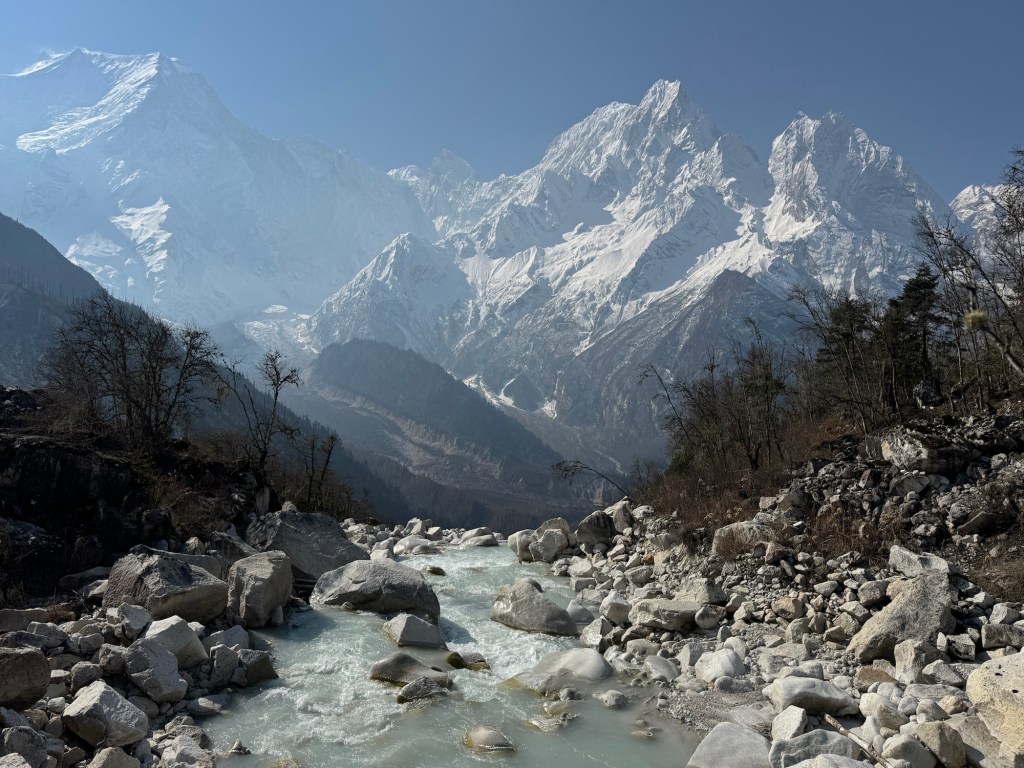
It had been a long hike today. Starting at the small hamlet of Ghap on the Manaslu Circuit Trail, we had trekked along the steep banks of the Budhi Gandaki River in the heart of the Himalaya. With the help of precarious suspension bridges, some of which showed signs of severe battering from falling rocks, we had crossed the river a few times.
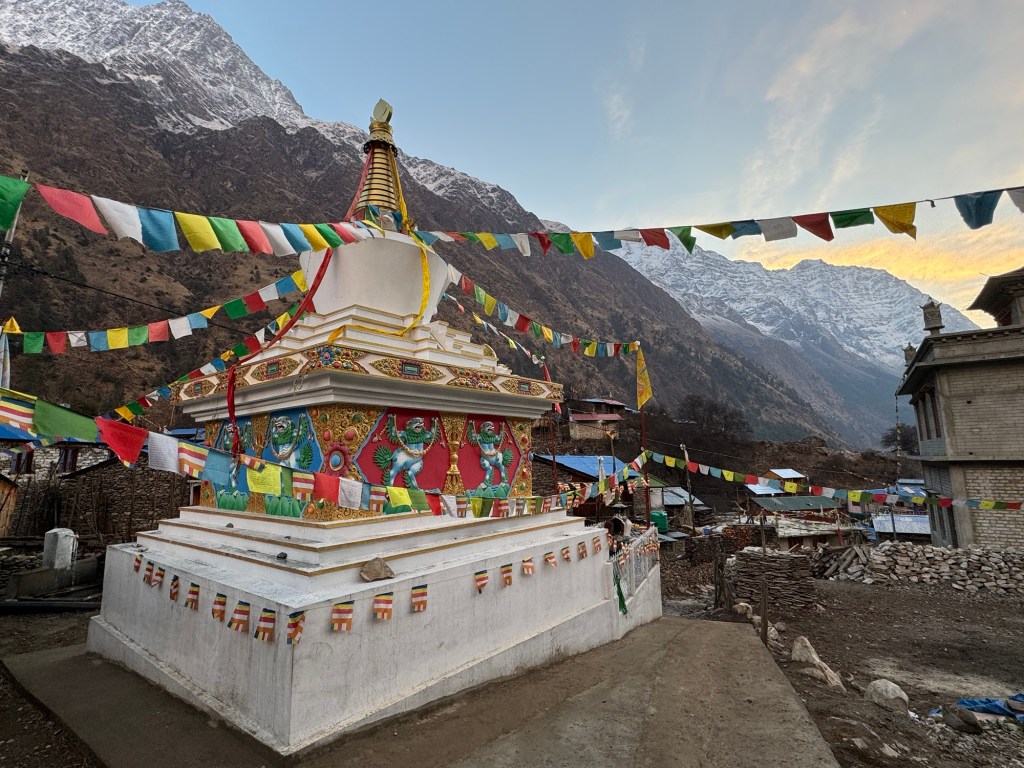
Walking into the centre of the village, we passed a white stupa, where dried juniper twigs were smoldering on a small fire. After enjoing a few final meters of solid pavement, we finally arrived at our destination, the somewhat misleadingly named “Hotel” Tasidele.
Here our room for the night consisted of two beds, four walls, a not consistently working power socket and at one end of the room there was a small window, that was so dirty, that it was impossible to look outside. At the other end of the room, the window consisted just of a pair of closed shutters, with the rest of the window missing all together.
However, the place was occupied to capacity and once entering the dining hall on the first floor, which appeared like stitched together by planks of wood and single glazed windows of various shapes and sizes, one was enchanted by the warmth of the central fire place and by the cacophony of English, Nepalese, Korean, French, German and of all the other languages that are spoken on the great hiking trails of the world.
Soon a bottle of the local beer and the customary Dhal bhaat appeared on the table in front of me and the day finished in lively conversation coupled with a sense of belonging to a community of likeminded hikers and travellers. Despite the material shortcomings of the place, here was something that is so often missing in our digitally controlled and regulated, but socially sterilized modern world.
On the next morning, the weather had changed and while the sun was rising on a cloudless sky, the village awoke being surrounded by snowcapped mountains. A few villagers were attending the central giant prayer wheel
and once again the smoke of burning juniper branches was engulfing the stupa.
Looking up at the hill in the West, there was a tryptichon of the local monastery, framed on each side by the golden summits of Naike and and for the first time of Manaslu .
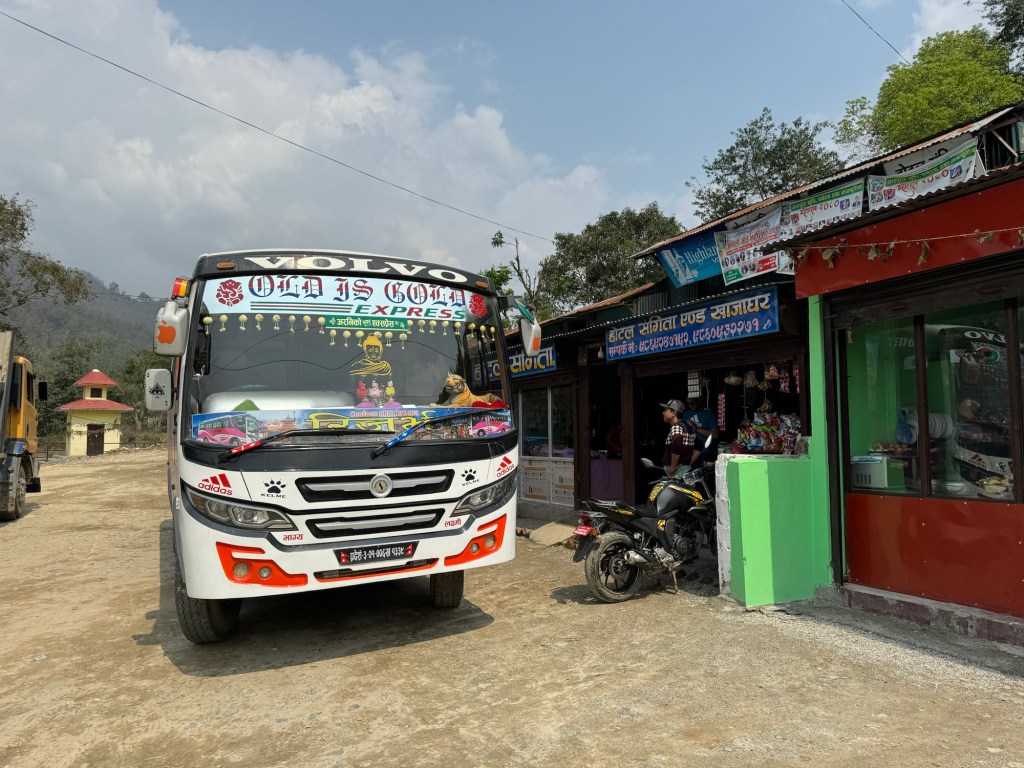
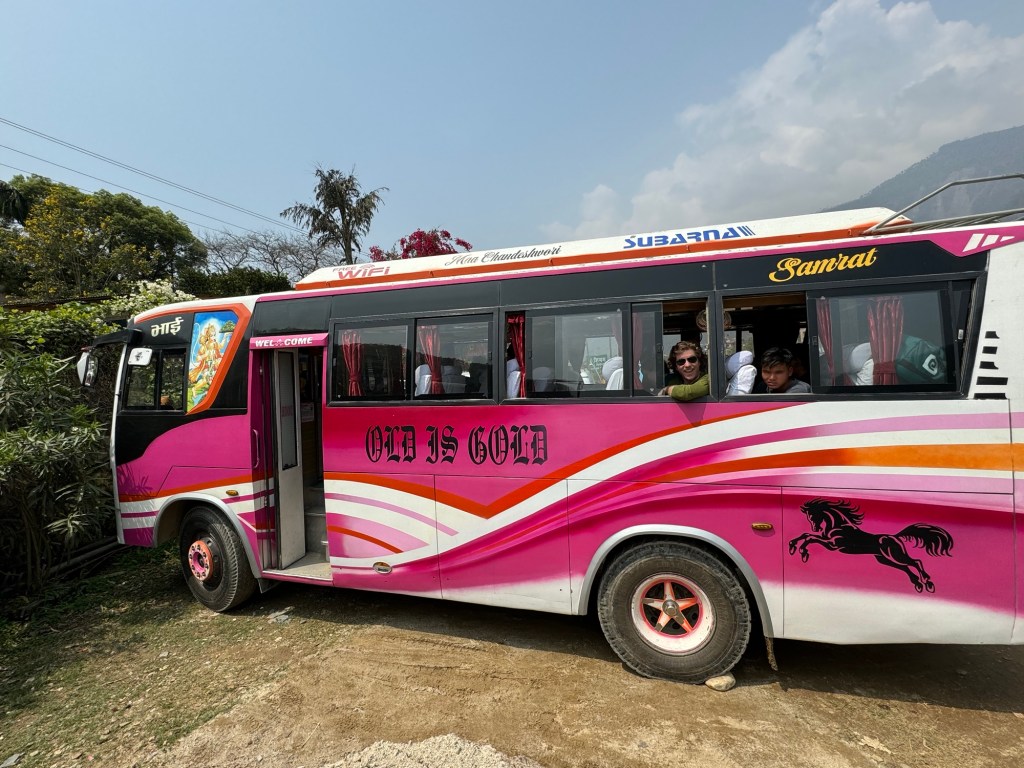
“Old is Gold” was printed in fat letters on the windscreen of the vehicle that was standing in front of our hotel in Kathmandu the next morning.
While feeling slightly mocked by this statement, this slogan wasn’t helping to instill more confidence in me about travelling in Nepal.
There is the common misconception, that hiking on the mountain paths of the Himalaya is dangerous. The mountains are safe (may be with the exception of the very high altitudes), the real danger here is found on the roads and in the air. Nepal has one of the worst road traffic accident statistics and I was more concerned about the six hour journey (which then turned out to take nearly nine hours….) to the mountains in this giant steel tin, than about the whole hiking trek ahead of us.
Thankfully the discomfort from my infected tooth had settled and , pumped full with a cocktail of medication and with encouragement from hiker friend and dentist Graham and his daughter Angela in the UK, I had finally decided at least to give it a try and to go for a couple of days into the mountains, before coming to the ultimate decision to continue or to turn.
Leaving everything that I didn’t want to carry over the next 18 days at the Royal Singi Hotel, we – a team of British and Canadian hikers, together with our Nepalese guide – were setting off.
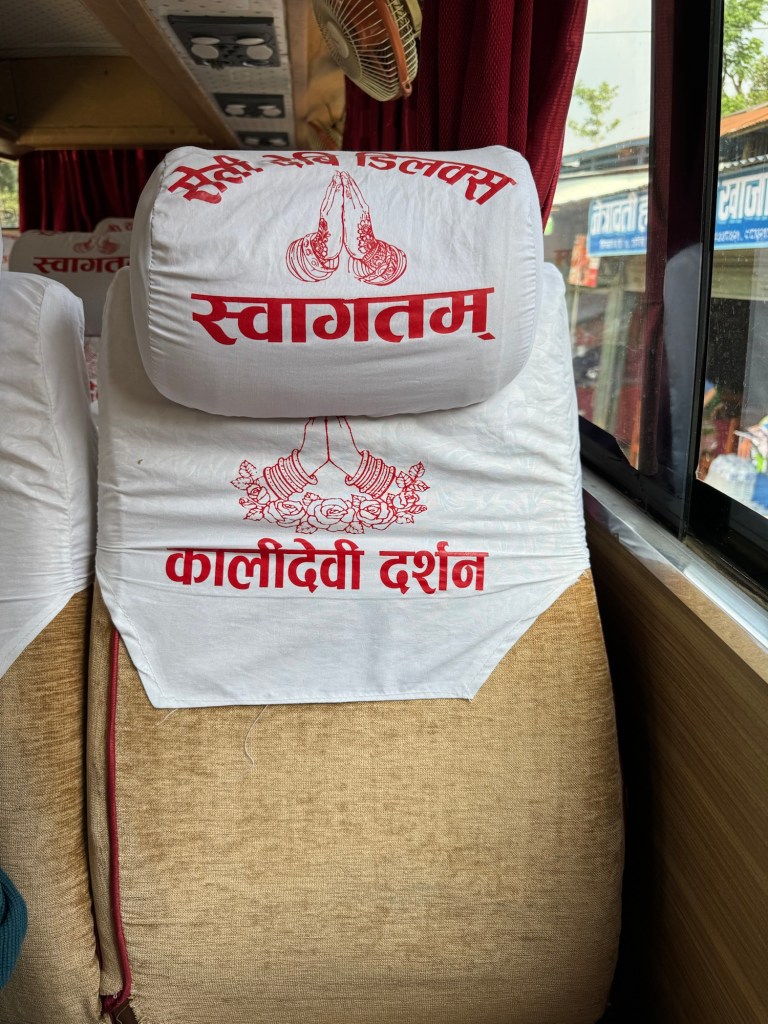
Taking one of the seats in the front of the bus, I noticed, that we were under the protection of both Hindu deities Ganesh and Kali.
In addition to this, each seat was fitted with a depiction of a pair of hands in a praying position. What could now possibly go wrong ?…
I have to admit that the reassurance resulting from this, convinced me less than the sizable “Volvo“ sign at the front of the bus.
Trusting that at least the vital parts of the chassis of the vehicle had its origin in Sweden – the interior fittings definitly had not……- we started slowly rolling out of the city, heading West towards Pokara.
The eternal traffic jam out of Kathmandu had not only the effect that our journey took much longer than expected, but the advantage that we were driving past abyssmal drops next to the road with an agreeable speed, especially while our driver was busy having extended conversations on his mobile phone (with Ganesh ?!…..).
Finally we turned off the main road and the direction changed from West to North – towards the deep valleys of the Himalaya.
Steel and rubber were now stressed and strained at their utmost and I pittied the old diesel engine while the bus laboured uphill on untarmaced roads.
Here, another definitley non-Scandinavian retrofitted feature of the bus came into its own : a multitone church organ, which sounded the first few tunes of “Happy Birthday to You” ahead of each turn we took on the mountain roads.
This, together with a firm belief in Darwin’s law of the survival of the fittest (or largest), ensured that we avoided any head on collision with any (bigger) vehicles and we finally arrived unscathed at the trailhead.
Our adventure to round the Manaslu Himal could finally start.






































 The Blue Vet Diary