Sitting in a street cafe over my copy of the The Himalayan Times, I am treating myself to the customary milky tea and a deep fried doughnut. My breakfast is not likely to cost more than 50 cent, a mere fortune compared to the 5 rupees ( 4 cent) I had paid for the newspaper….
The day hadn’t started well. I had struggled to find some sleep and when looking into the mirror in the morning , my face was lopsided due to a painful swelling below my left eye.
The most likely cause for this was a molar abscess and with the help of my local contacts and following the advice of my dentist friends Angela and Graham in the UK, I had no other choice than checking myself in with one of the dental clinics in Kathmandu.
Bad timing ….. the probably most serious health issue I had for the last ten years, had struck me just a day before meeting up before a three week hiking trek, that is due to take me to some of the remotest parts of the Himalaya, where even the most basic medical care will be several day marches away…..
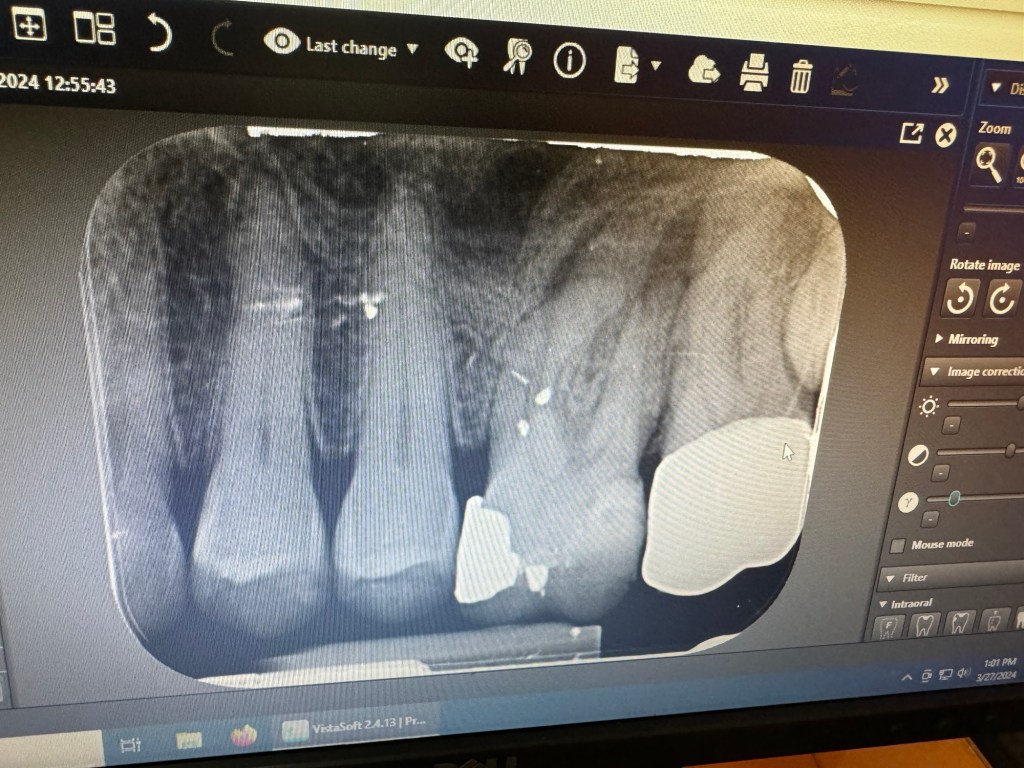
Fast forward three hours and I have made the aquaintance of Luna, my local dentist in Kathmandu. After popping the abscess with her dental probe (which seemed to give her more pleasure than me….) and taking an X-Ray, to my surprise, Luna declared that I could keep my tooth. After having three root canals drilled out and the abscess flushed, I felt much better. To make the most of the still lasting local anaesthesia, I headed straight for the Kaiser Cafe in the Garden of Dreams, one of the few green spaces in the city, and enjoyed a slice of cheese cake and a latte before the pain was due to set in….
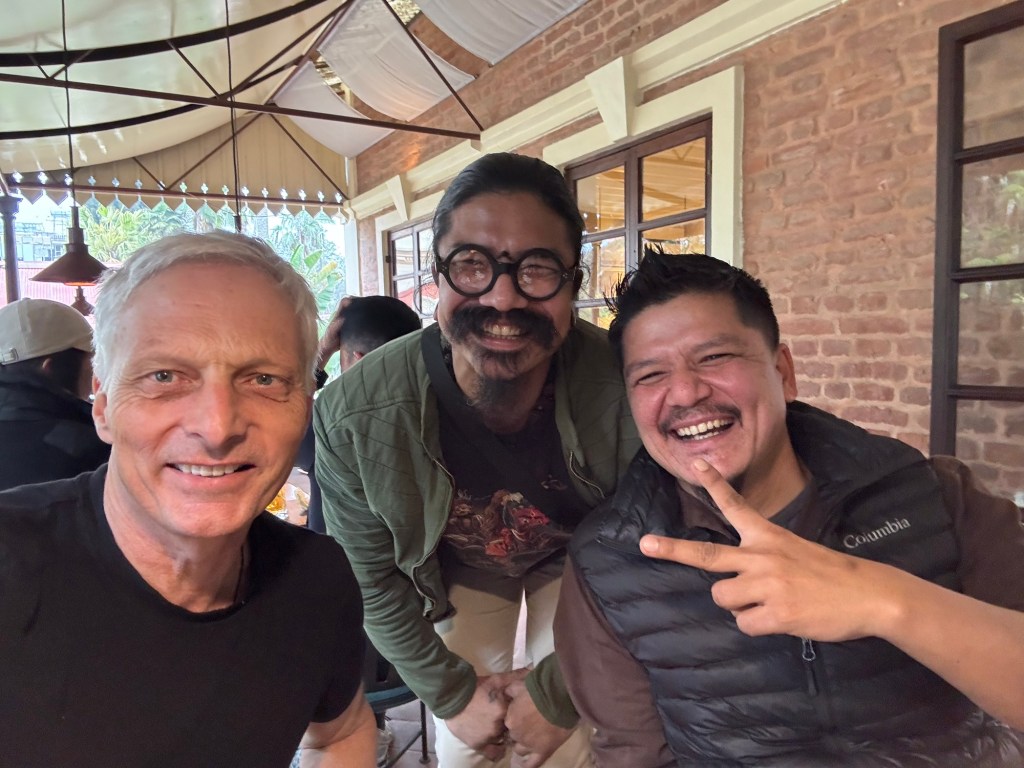
Even better, I was joined by my colleague Pranav from the neighboring city of Baktarpur, who had seen a few cases at his branch in Kathmandu.
Buoyant and still completely painfree the next morning, I was confident that I could start on my trip the next day and with a swing in my step I saw Dr Luna for a follow up check. What I had expected to be a brief procedure, lasted another 45 minutes with a lot of probing and prodding, with the result that in the evening, at the meeting with my team, I was , despite the antibiotics I was already taking, in agony…..
With the help of some painkillers, I managed to survive the evening, but it didn’t help, that we all had to sign a declaration that we were aware, that an emergency airlift from the mountains would cost at least 7000 $, and that we ultimately would have to pay for it.
With me already on medication even before the trip, I wasn’t very confident that my travel insurance would bail me out if it would come to this…..
Another sleepless night and serious doubts if I should start this new adventure…..
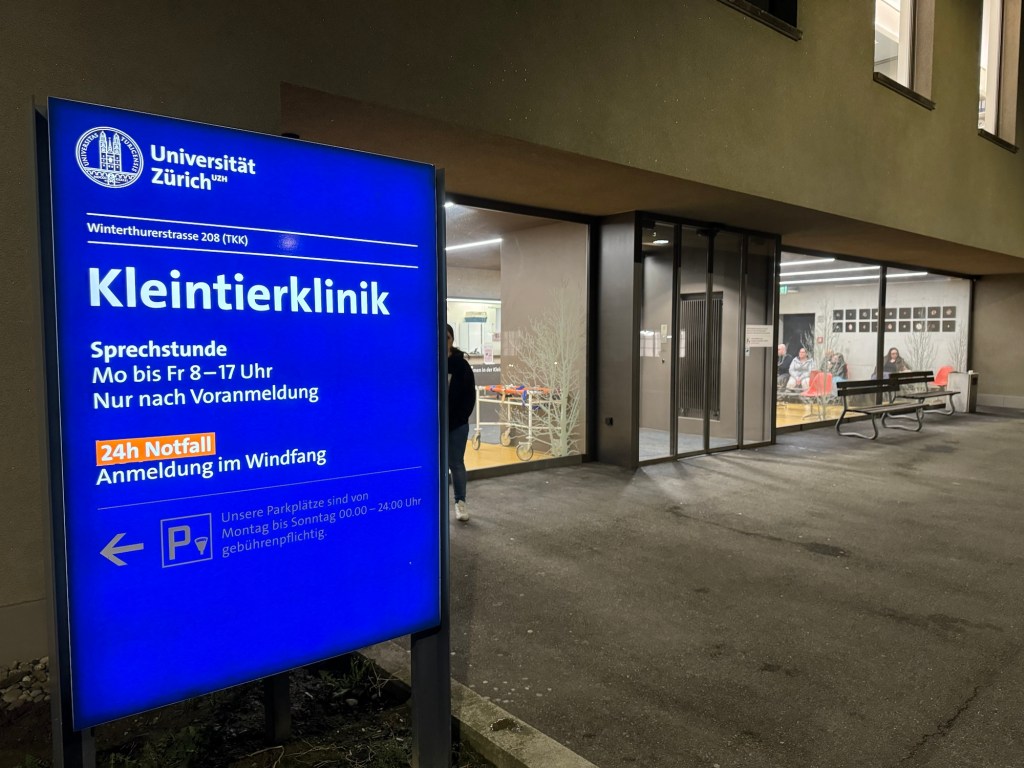
Not a lot of vet schools can claim to have their own subway station and the one at “Tierspital” in Zurich, is making for a pretty cool entrance. Walking up the ramp to the exit, surounded in neon-blue light, gives me the impression of walking on the bottom of a swimming pool or of entering a fancy night club.
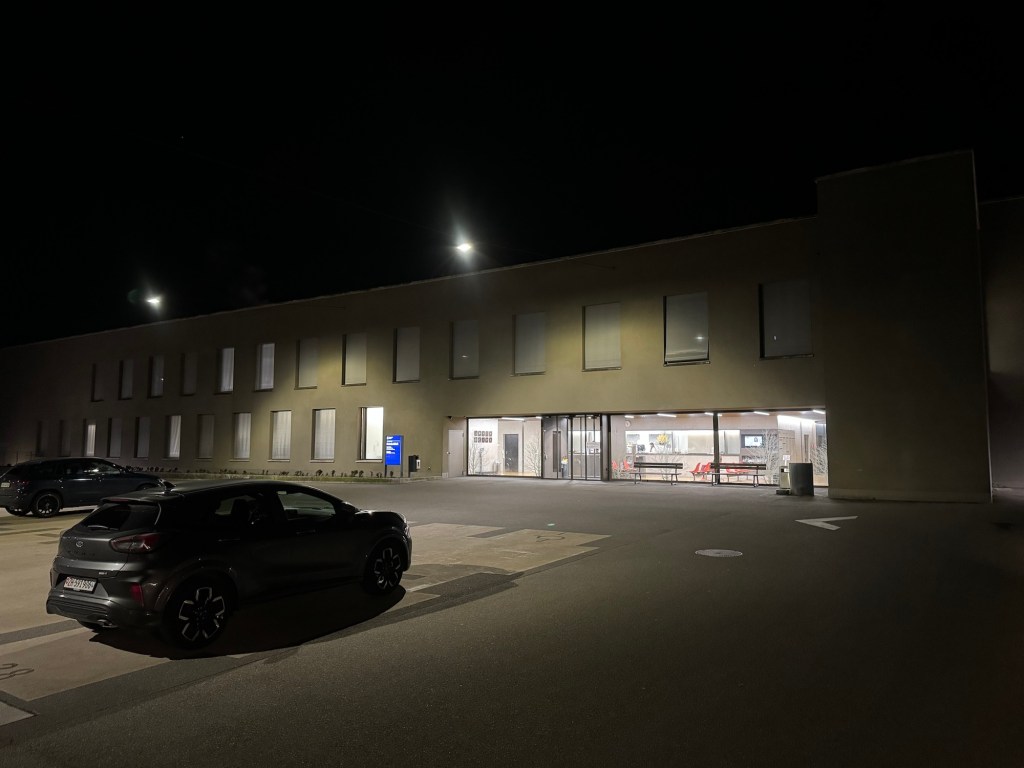
For a change (due to my working commitments during the day), I am visiting this veterinary faculty not during daytime, but at night and my guide this time is not the dean, but an equally unique vet student.
Luregn and I had met in Lima at a conference and it had taken me a while, before taking him up on his offer to show me their small animal clinic and – even more interesting for me – the university’s skills lab, where artificial models of animals and their organs offer an alternative to painful procedures on living patients.
First a visit of the small animal clinic though….
At night veterinary clinics all go into their very own stand by mode. With the waiting rooms and the halls mostly devoid of pet owners, the work of the remaining staff is focused on the care of the inpatients and due to the lower risk of being interrupted, on the writing of scientific papers on brightly lite computer screens.
For us too, it is a good time to take a closer look
at the green and red illuminated, state of the art, temperature and air controlled, noise reduced recovery cages ,
at the sophisticated air lock systems, which help to keep pollutants as low as possible,
at the batteries of simulantiously running infusion pumps, which are always a good indicator for the complexity of the treatment the patients at an intensive care unit receive,
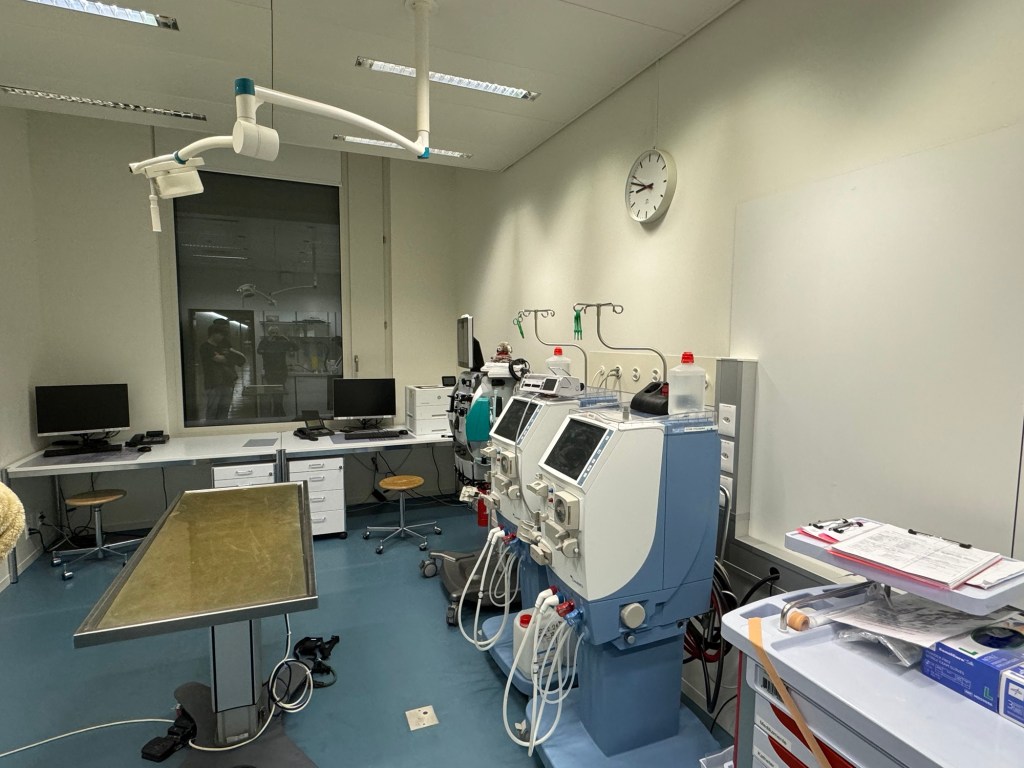
at a room which is exclusively dedicated to dialysis, where the lives of patients with renal failure can both be saved and maintained without functional kidneys for a while,
and basically at a good example of how the clinical training of veterinary under graduates in the 21st century can look like.
Luregn is making an effort to make the tour of the clinic as comprehensive as possible, so that it is already late, before we are entering the skills lab in one of the historic buildings of the faculty.
You might be forgiven for forgetting that fact, when entering the futuristic looking central area of the lab.
Here models rule and no living creature is coming to any harm…..
The dark horse on the right side of the room, fitted with all the important internal organs for students (and vets) to touch during a rectal examination looks familiar :
It costs about the same as a small car and I have seen one just like it over a year ago in Dubai. Most modern vet schools seem to have one these days and in the case of Zurich, the head of a second, equally expensive one (made to 100% from silicone) is resting wrapped up in moist towels in a huge refrigerator near by, to maintain it in pristine condition.
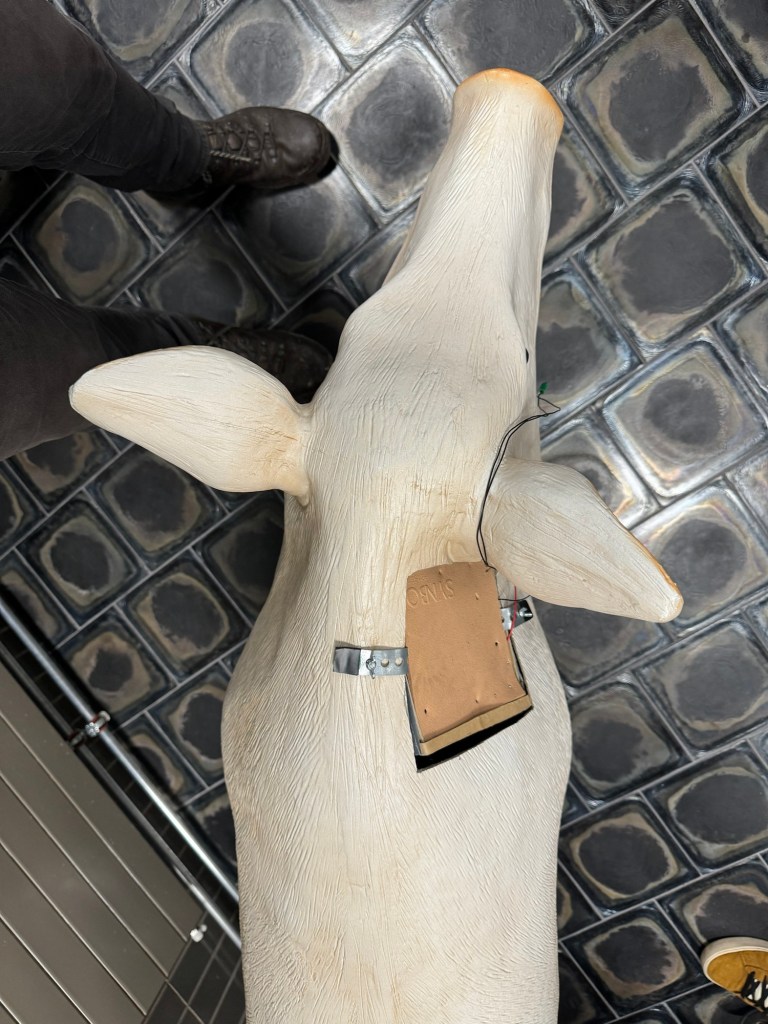
The large pig on the left side of the room is new to me and the injection side on the neck , fitted with an electronic sensor to confirm the correct needle placement, is looking well used.
Luregn opens a draw and out come the at first sight bizzare looking heads of a dog and a cat. Certainly not something to hang on the wall, but instead very useful probs to practice the intubation of these species for anaesthesia or resuscitation. However – made in blue or in green, they would have looked friendlier….
There are a fair number of fluffy dog and cat models, which very much remind me to the ones I had built some years ago at my clinic to be used at the First Aid courses we where running for clients for a while.
The models here are also fitted with artificial hearts and lungs and the model of a frontlimb of a larger breed dog is inviting even the most unskilled vet student to take a blood sample, without being afraid to fail the dog or – even worse ? – infront of an expectant owner.
Turning off the light and putting these patient and never complaining creatures back to bed, I appreciate how much veterinary education has progressed, even just during my lifetime.
Passing well attended “Shrimp Cottage” on the right side of the road,
this one is taking me all the way downhill to the shore and by that, to one of the UK’s last remaining working fishing harbours, where trawlers of various shapes and sizes share the calm but tidal waters of the Channel with a small marina of sailing and leisure boats – all sheltered by a half a mile long break water.
Today, it may be a good place to spot purple sandpipers, but this used to be the site from which over 2000 American soldiers departed for Utah Beach, now nearly 80 years ago, to risk their lifes to free not less than a whole continent.
I am in Brixham, on the coast of Devon.
Driving here from Surrey, I had passed Stonehenge.
Watching hundreds of visitors circling the monument at a great distance, I remained puzzled about the appeal of the place.
I have to admit, that I consider it as one of the most overrated tourist attractions on the Globe. In my ignorance, I see it as not much more than a circle of a few big stones on a field, which can – very comfortably – be seen from the inside of a car while driving along the nearby, usually congested road.
Investing not less than £23 (!), one can obtain the permission to do the same on foot, from more or less the same distance. One will not be allowed to touch a stone, one will not even be allowed to walk among the stones…..
In contrast, the real attraction of this part of the world – I would say – lies right ahead of me this morning , and there are nearly 3000 miles of it, which can be walked and run on, which can be touched and can be thoroughly enjoyed for free around the year. It is called the “English Coastal Path”.
May be a bit long for a single morning run, but filled with endless artefacts of history and art, unique wildlife, a fair amount of wind, rain and bad weather in general, plus never ending stunning views – especially here in Brixham.
Having enjoyed the colourful, iluminated view of the fishtown area of Brixham the previous night,
I am heading East this morning, towards Berry Head.
Ignoring the puzzling stare of the old fisherman at Grenville Cottage,
I narrowly avoid being pounced on by a blue silverback with fetching sun glasses……
Pressing on, I pass a stretch of beach, that contains the largest collection of perfectly shaped skipping stones I have ever come across.
Sorry, but no time to try it out though….
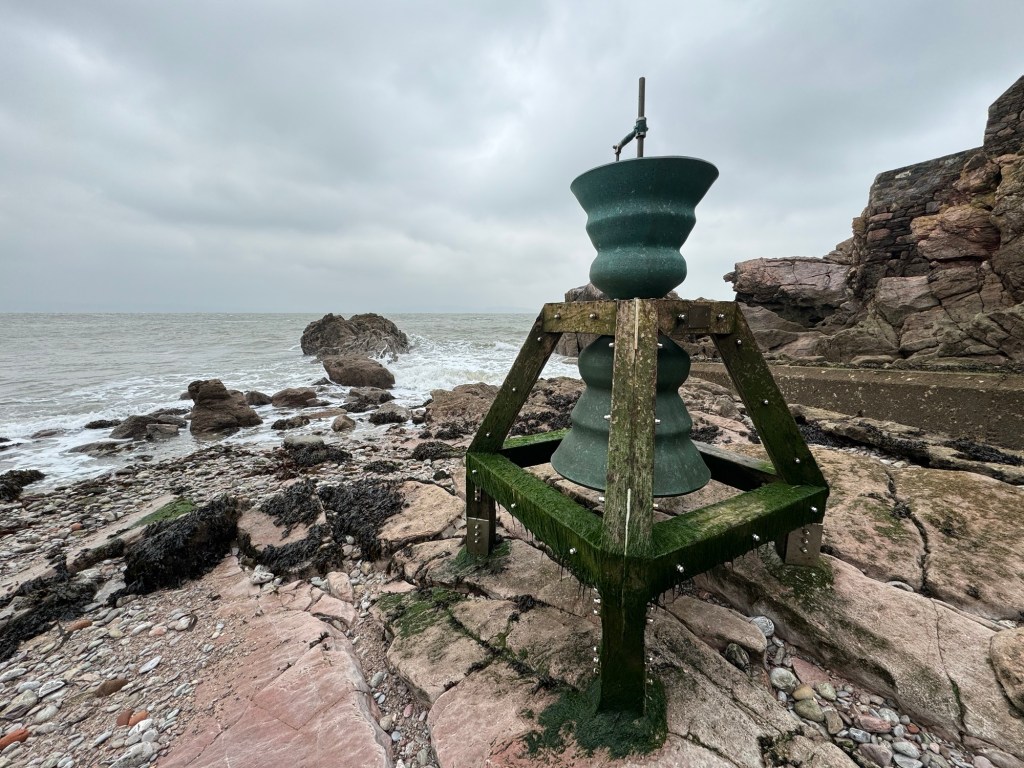
This is followed by one of the UK’s tide bells (above) , which is part of an art installation, that is supposed to remind us of the fast changing climate and of the rising sea levels as a result of it. But at least today, I am in luck and the bell is not ringing….
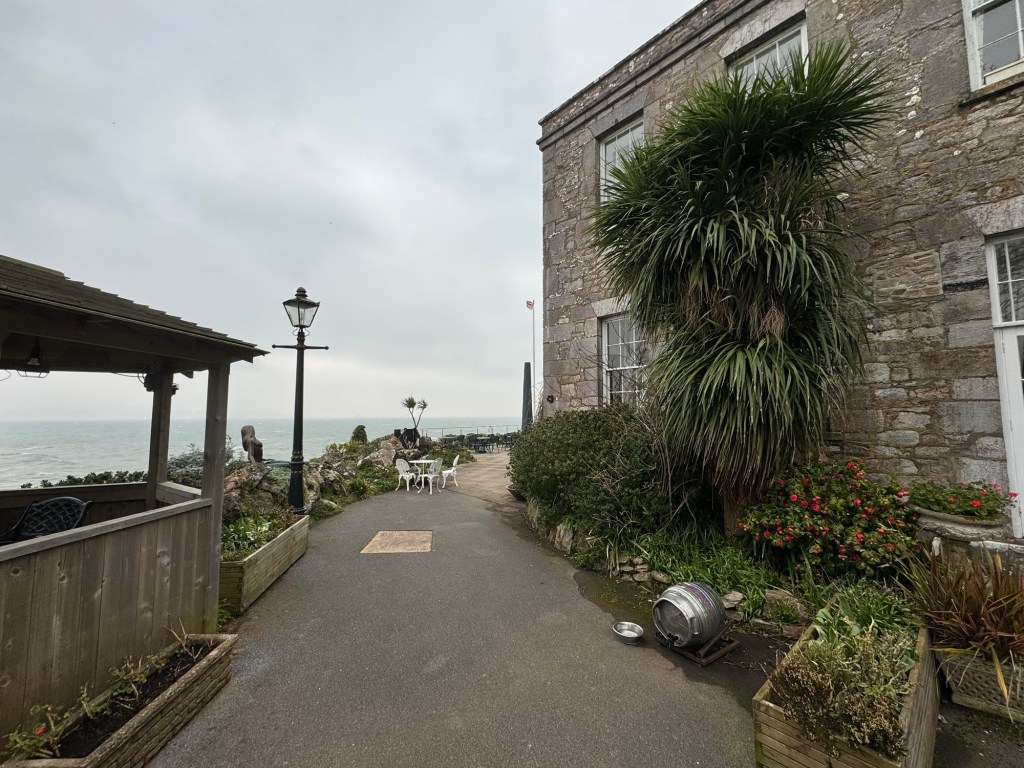
Following the now ascending coastal path, I am first trespassing on to the terasse of the rather grande Berry Head Hotel,
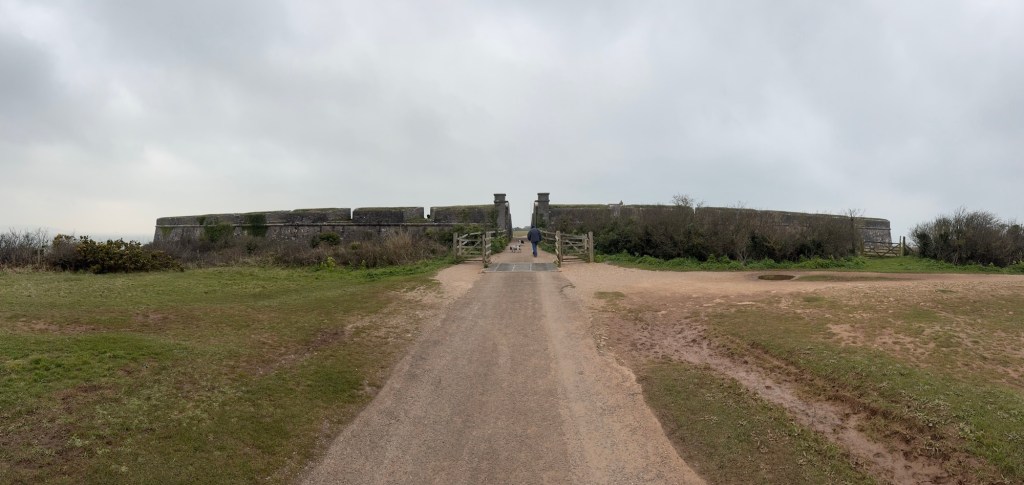
I am crossing a stretch of Northern cloud forest and finally I find myself faced by the barrels of the sixteen cannons of an old battery.
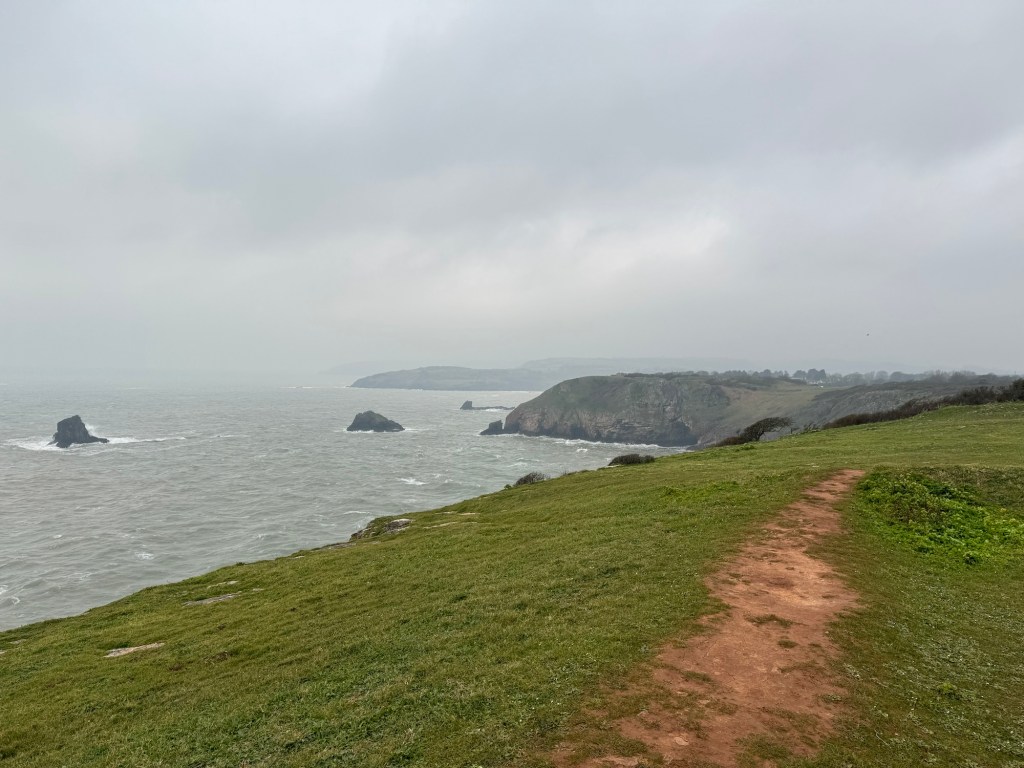
Luckily there is a small gap in this imposing defense installation, so that after all , I manage to reach the lighthouse on the top of the cliff and with that, a spectacular view of the South facing coast and of the English Channel.
Here the exposure to the wind and to the force of the waves, which are working relentlessly on the rocks, is very different.
Now it is all the way a combination of tail winds, downhill running, but also passing of a large number of dog walkers with happy canines and even of a single lifesized metal sculpture of a rhino in a frontgarden, before I return to the starting point of my morning run .
I doubt that a few large stones in a circle on a field can match this…..
“He’s a good chap in his way. Serious. Not one of those noisy bastards at the Continental. A quiet American.”
This is, how Fowler, the main protagonist in Graham Greene’s novel “The Quiet American” describes Pyle, the charcter in the centre of his narrative. It is set during the French Vietnam war, when Greene was stationed as a war correspondent for “The Times” and for “Le Figaro” in Saigon. Written between 1952 and 1954, he correctly predicted in this novel that America would eventually been drawn into the conflict.
Considered by Greene as one of his “entertainment” works, the story also contains numerous autobiographical parallels to the life of the author at the time.
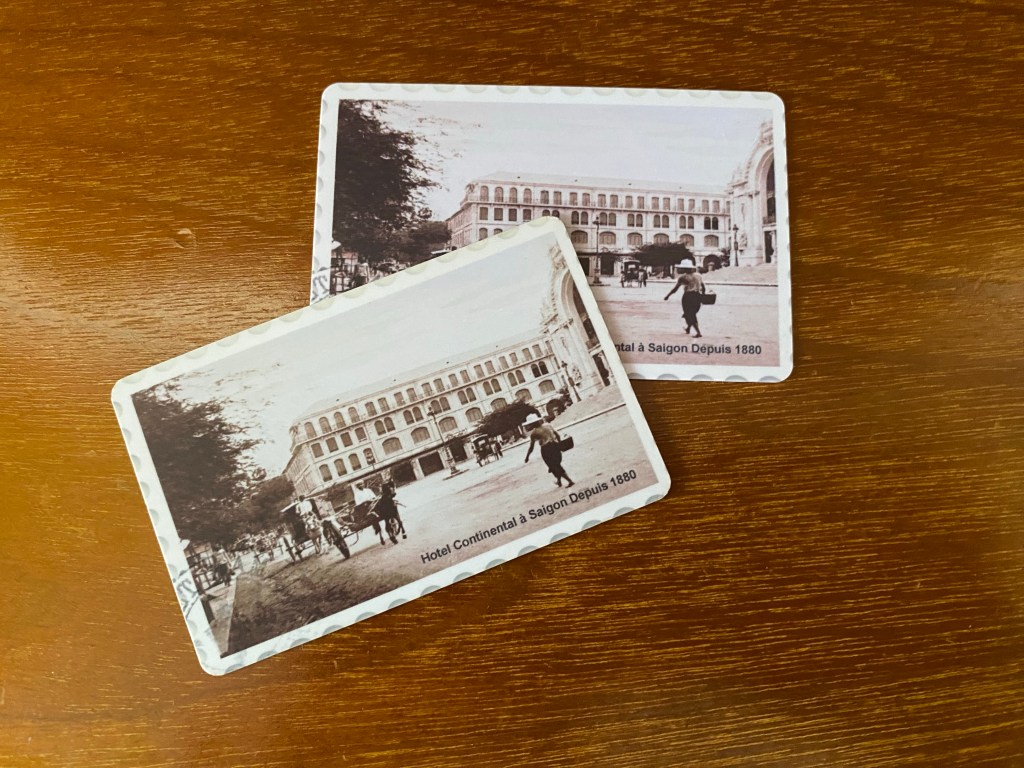
Like Greene, Fowler is a middle aged man, caught in an unhappy marriage with a catholic wife who is dening him a divorce. Fowler is portrait as worn, bored and cynical. Like the author he his struggling with periods of depression. He works as a reporter for a British newspaper and he is a frequent visitor of the Hotel Continental, at that time one of the most famous buildings in Indochina.
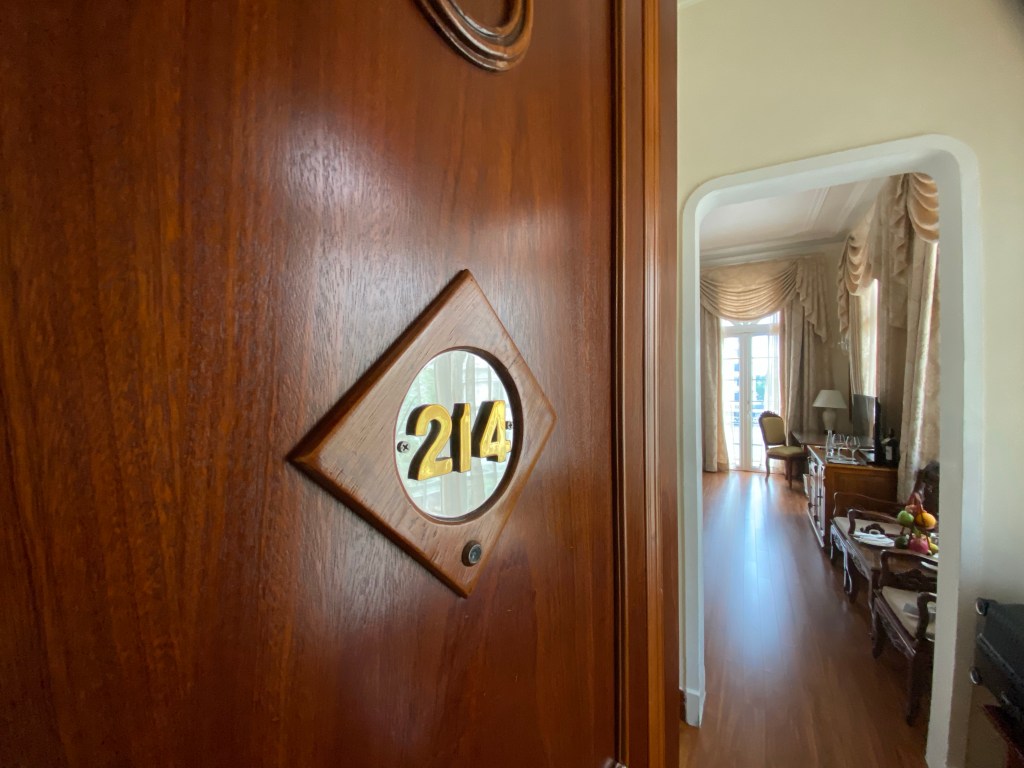
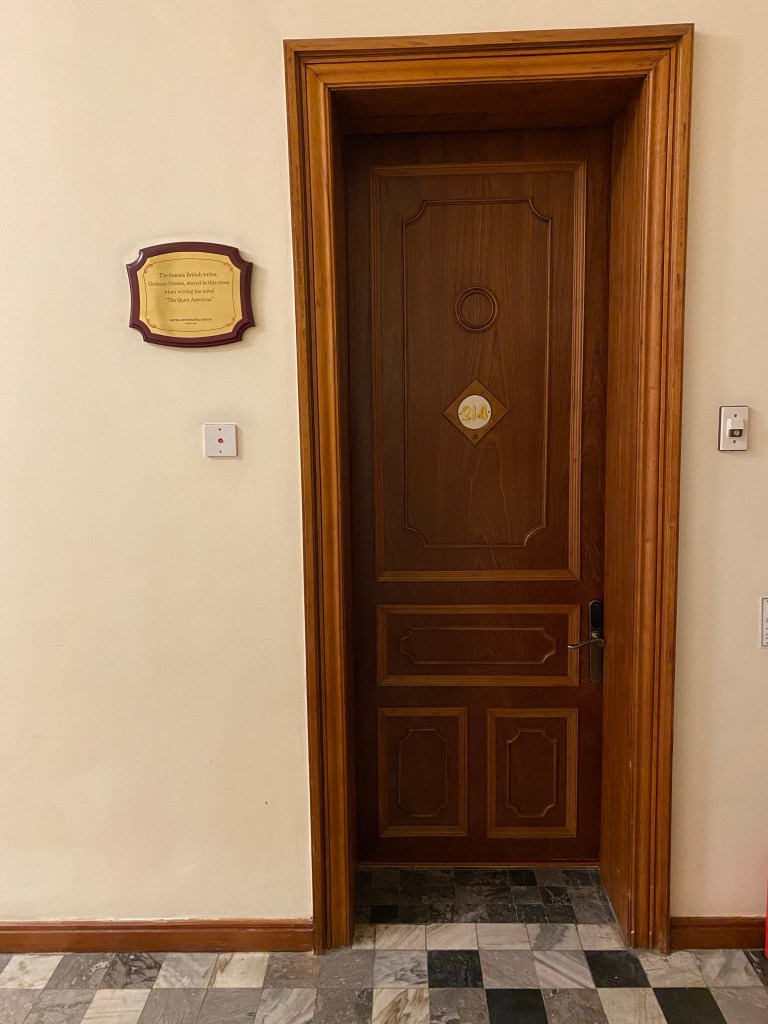
But unlike Fowler, who has his own, very humble flat just off Rue Catinat, now Durong Dong Khoi, Graham Greene used to stay directly at the Continental and if so, then always at room 214.
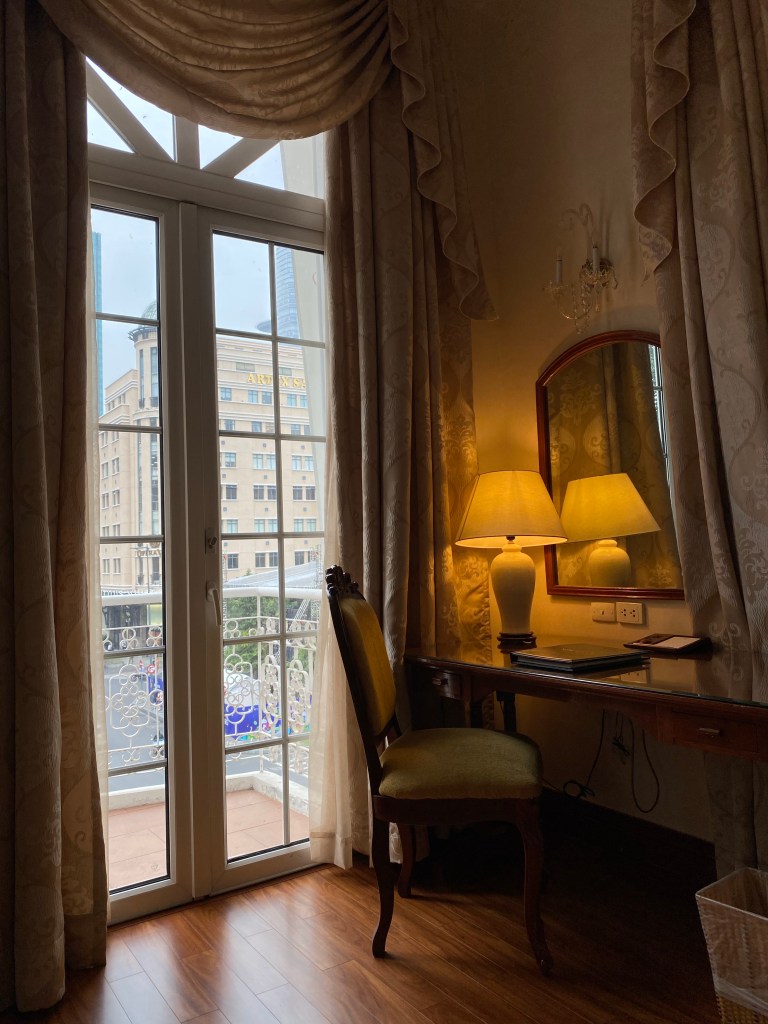
Located at the corner of the building, on the second in an elevated position above the street, the room allowed an excellent view of the square infront of the Opera and of Rue Catinat – more or less the centre of Saigon.
It is said that Greene preferred this room, because he could see from there, while writing, who was coming and going in Saigon.
This is reflected in the novel, as Fowler would have had to position himself at this part of the hotel to state that : “I had seen him last September coming across the square towards the bar of the Continental: an unmistakably young and unused face flung at us like a dart.”
Most – if not all – of the book was conceived in this room and after thoroughly enjoying it as my travel companion while touring Vietnam, some parts came so much more to life, once I had grasped the opportunity of staying at this room at the end of my trip to this country.
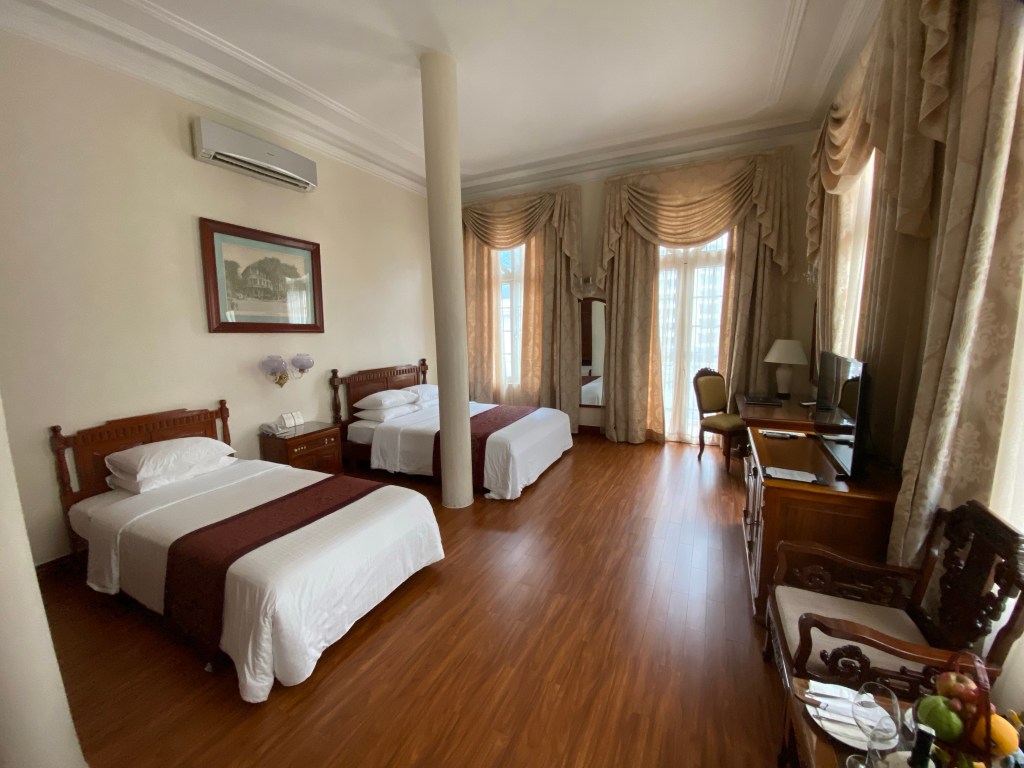
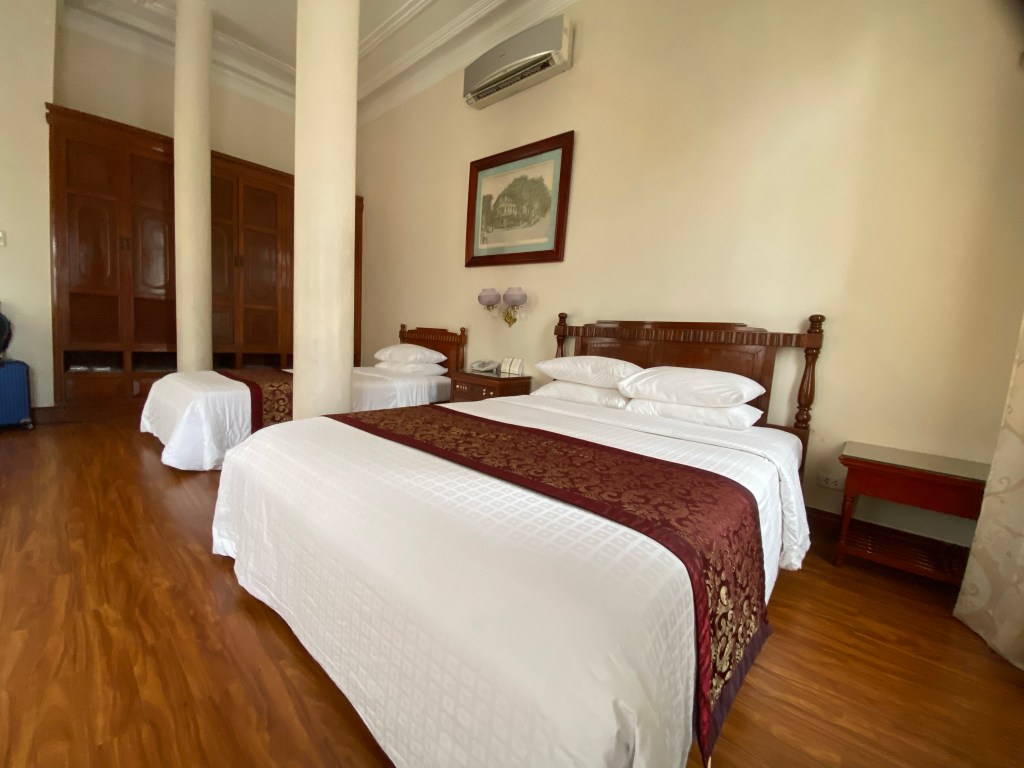
Although most of the interior is unlikely to be the original from the time of Greene’s stay, the hotel has tried its utmost to preserve the overall atmosphere of the room.
Imagining Greene sitting by the window (probably without airconditioning), the room – facing South – must have been very hot at times. I wondered if he managed to stick to his customary 500 words a day writing routine during that time, while filing at the same time his regular reports to London.
An unusual feature – I found – were the two columns that are right in the middle of the room. How many times did he run into one of them I wondered….
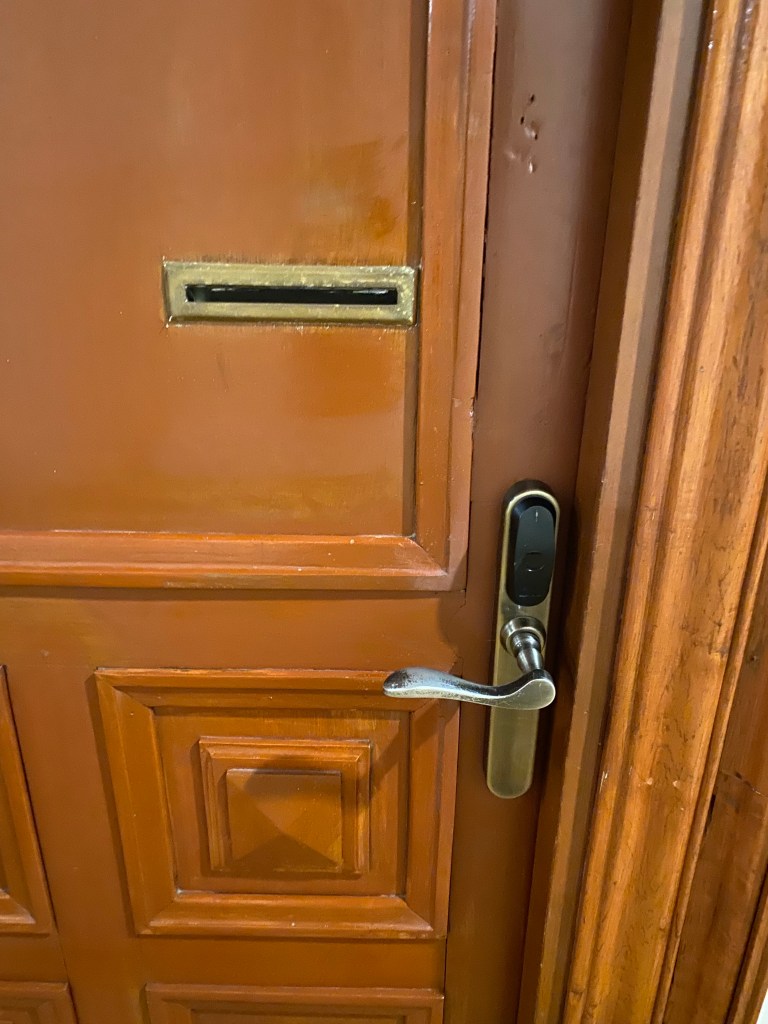
Another detail I noticed, which is likely to have remained from the time of Greene’s stay, were the very low set door handles. It was the same with all the doors in the hotel. Placed in the lower third of the door, they probably reflected the average height of the builders over 100 years ago. Today’s visitor they strike as unusually low placed and this stand in a stark contrast to the height of the ceilings.
The hotel used to be one of the main meeting places of politicians, military leaders and journalists from the end of the Second World War until the end of the Vietnam War in 1975. One can imagine all the important and at times historical conversations and events that took place behind these unusual doors.
The Continental is no longer the most luxurious hotel in town. The view from the room’s window towards the Mekong is obscured by modern high rise buildings that are dwarfing the old colonial dwellings and if you are looking for a well frequented hotel bar, it is probably better to head for the roof tops of the near by Rex or for the Majestic Hotel next to the river.
However, the hotel still has its charm and staying at room 214 made reading “The Quiet American” a far more intimate affair.
There were two things that had to be done while travelling in Vietnam – taking a motorscooter taxi and visiting a veterinary clinic.
Throwing all caution to the wind, I found myself on the backseat of a Honda Airblade within 30 seconds of ordering a ride on “Grab”, the Vietnamese version of Uber. How dangerous could it be?…
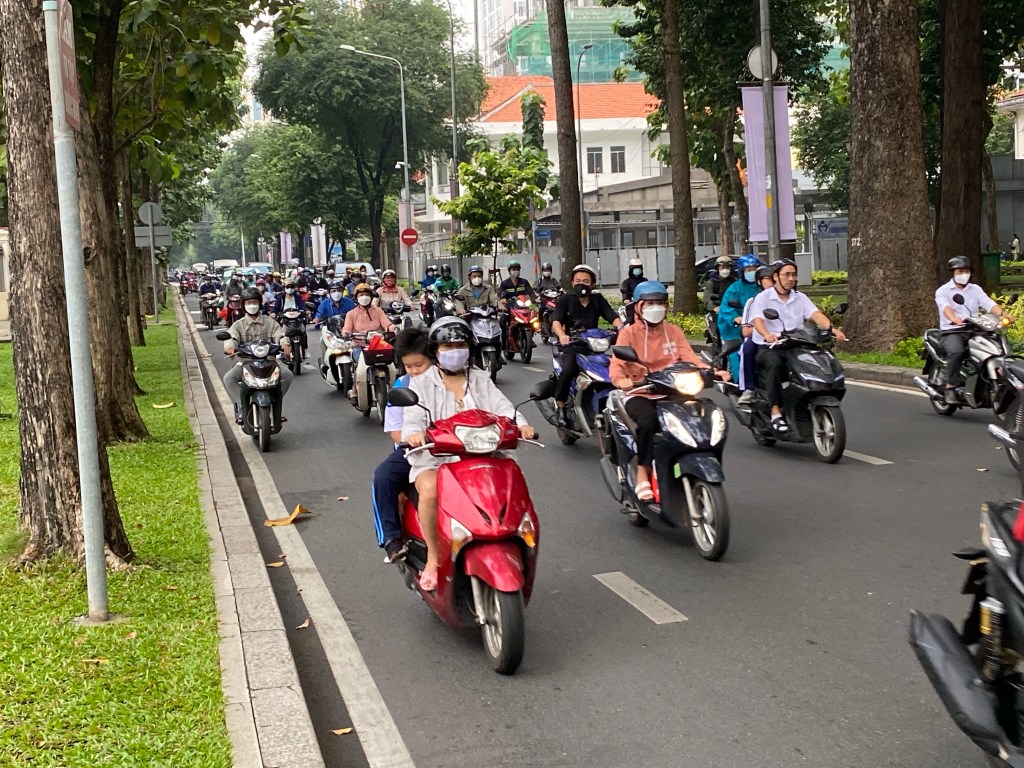
Squeezing ourselves through the dense traffic in District 1 wasn’t a big issue,
but speeding with over 80 km/h over the bridge to the other bank of the Mekong, was certainly not for the faint hearted…..
The local motorscooter helmets, which resemble just a harder version of a baseball cap, offered very little re-assurance.
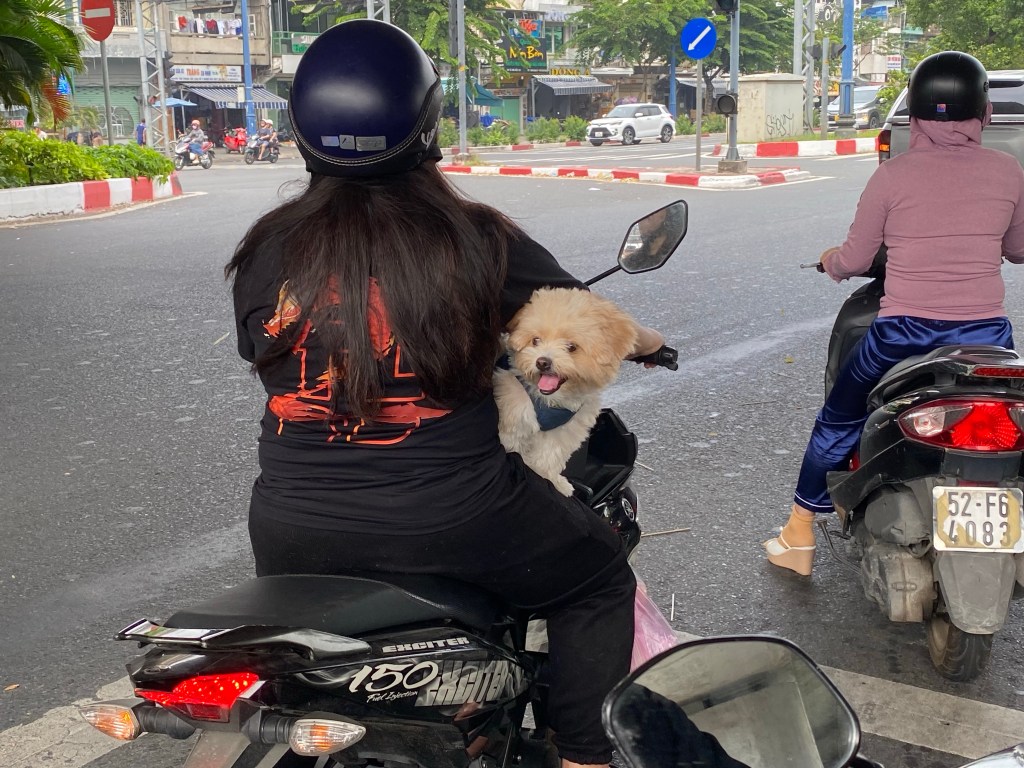
During our ride I spotted the first scooter riders with pets. Without doubt, most of these predominantly small dogs clearly enjoyed their ride and appeared to have adapted re-markably well to this unusual form of transport. Some even sported a safety harness and most of them were quite protective of their personal carriage.
Both small children (usually without a helmet) as well as pets were transported this way and I never saw a single scooter accident. So it probably wasn’t that dangerous after all ?
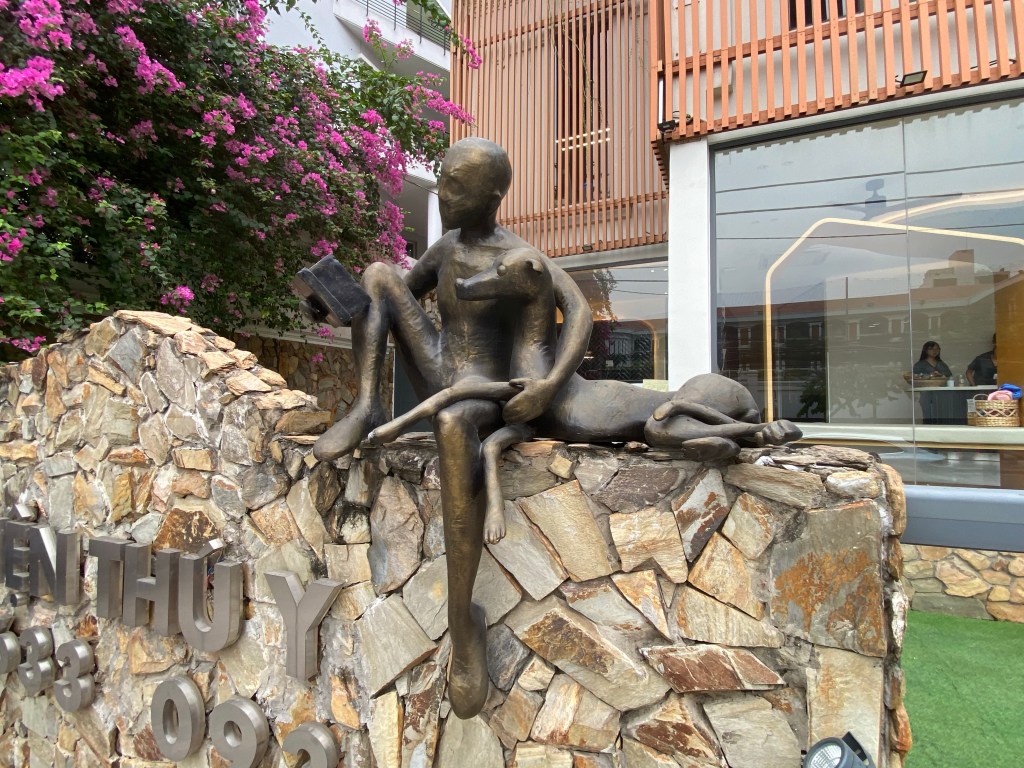
Finally we arrived in front of the British International School in Ho Chi Minh City. On the other side of the road, a 3 m tall red cat was just about to scale the side of the building,
while a young boy was sitting on the wall below , reading from a book to his Greyhound.
These two sculptures were my first inpression of the world of Animal Doctors International, a British run veterinary group operating in Laos, Cambodia, Vietnam and now also in Thailand.
Will Thomas, its founder and CEO, had very kindly agreed to meet me at their clinic in Thao Dien.
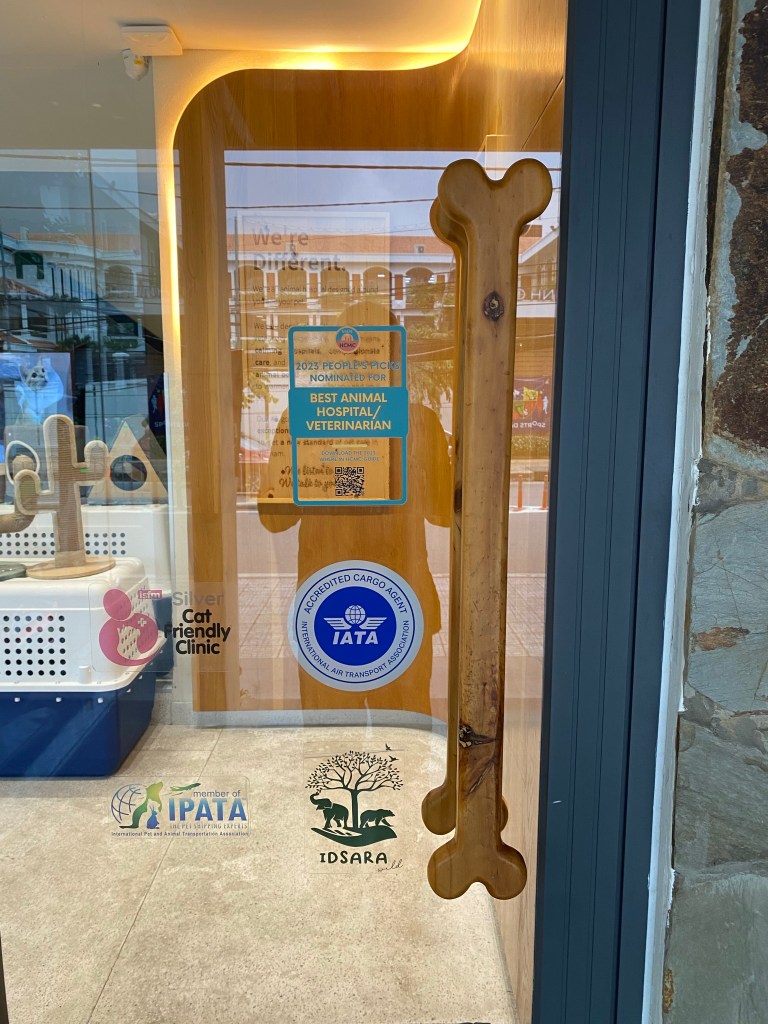
The visual journey continued when I entered the waiting room area, passing on the front door plaques of IATA, IPATA, an isfm Cat Friendly Clinic Silver award plus a 2023 nomination for the Best Animal Hospital in Vietnam.
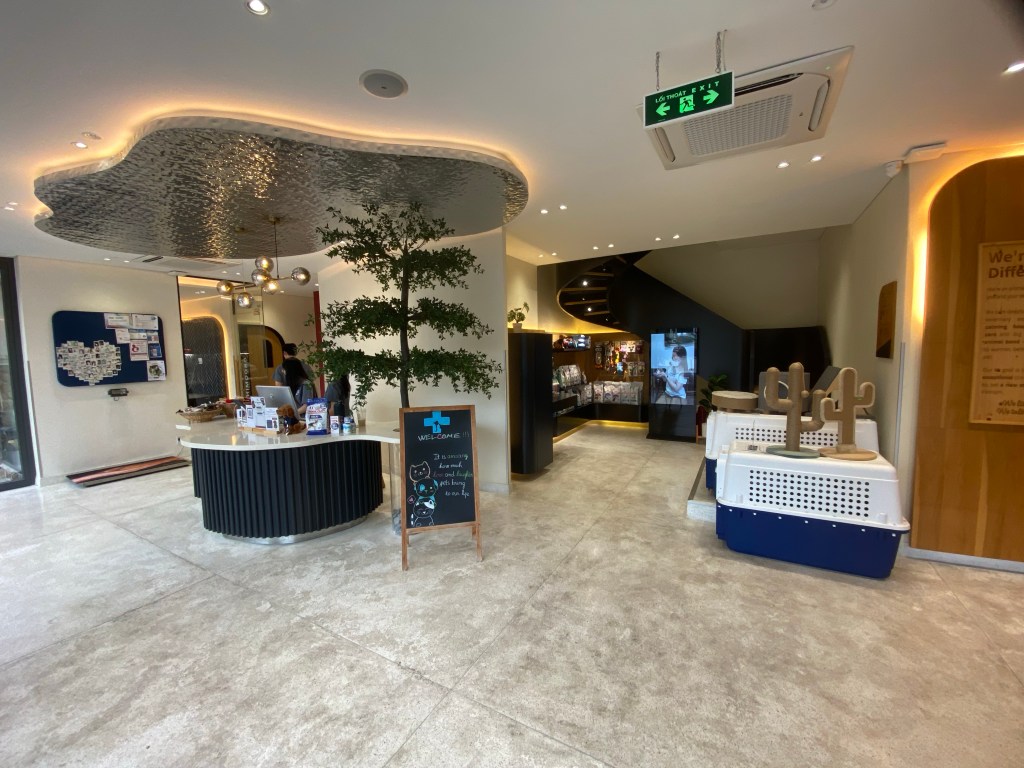
Using an appealling combination of bamboo, marble flooring, indirect lighting elements and a small tree growing through the reception desk,
I was not only impressed, but I also felt that if so much thought had gone into every detail of the outside appearance of a practice, it would be highly unlikely that this standard wasn’t matched by a similar degree of clinical excellence behind the scenes.
I wasn’t to be disappointed.
First I met Will, a Bristol graduate and certainly not your usual company CEO. Very down to earth, in T-shirt and with a large colourful tatoo decorating the length of his left arm, he welcomed me in the clinic’s board room.
As remarkable as the man, was the story of his veterinary business.
“ It all started when I travelled to Laos. I fell immediately in love with the place and I never returned home!”
This – as I found out later – was less than 10 years (including a global pandemic !) ago and since then Will had established ten clinics all over Indochina, in countries with different political systems and different native languages. All of theses clinics provide a standard of veterinary care for companion animals, that was completely unheard of in most of these countries.
In addition to this, ADI is doing a lot of conservation work, runs an elephant clinic, organises spay and rabies vaccination clinics and provides continuing education for local veterinary colleagues.
Following my visit to Will and his team, I found visiting their website at http://www.theanimaldoctors.org both entertaining and quite impressive. The website even offers a 360 degree walk through the clinic in Saigon.
Back to my visit though…..
Will explained, that small animal veterinary medicine is still very underdeveloped in Vietnam, but undoubtedly the demand for state of the art veterinary care was absolutely there.
Will’s teams consist of a combination of both local and foreign veterinarians with a huge range of different academic backgrounds.
Native vets are providing nursing tasks and are at the same time upskilled by their foreign colleagues. Postgraduate education of staff members is happening online or by attending international congresses in Asia or further afield.
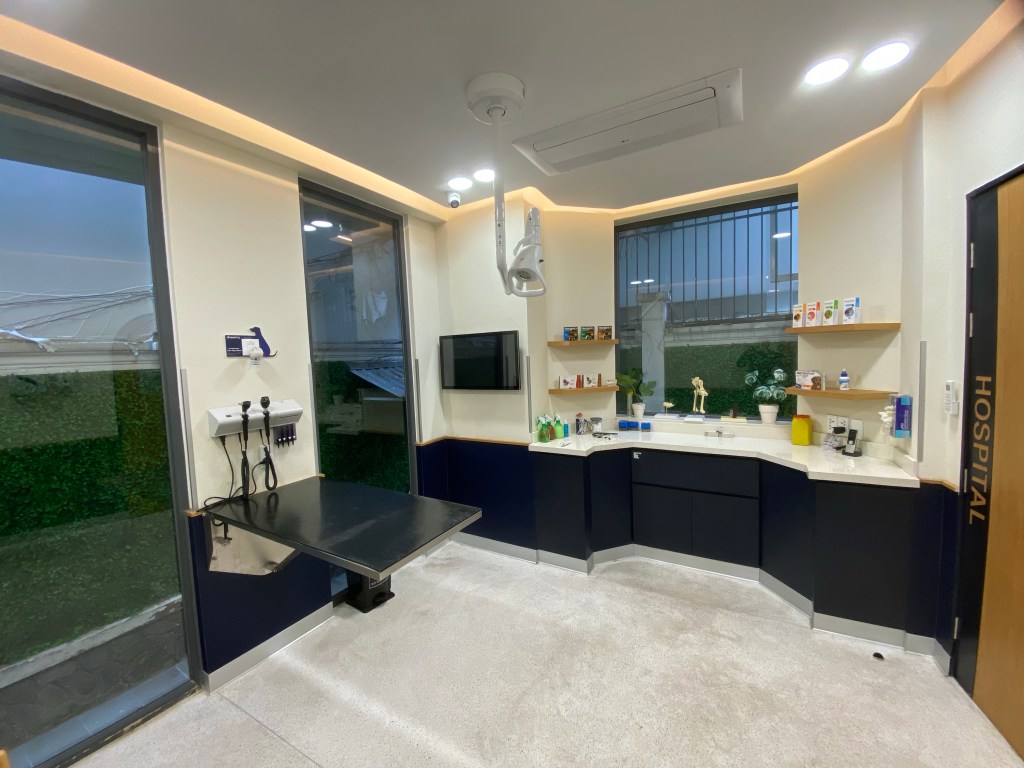
The consulting rooms of the clinic were functional, absolutely spotless and fitted with well thought through features like wall mounted examination tables and climbing opportunities for cats (some of them may be a bit too high ?…..) and all rooms were fitted with anxiolytic pheromone diffusers.
There was a large, well equipped prep-area and separate in-patient areas for dogs and for cats. Modern diagnostic imaging equipment in a dedicated room, as well as an operating theatre with an oxygen generator and a lot of monitoring equipment were further features.
The clinic offered boarding facilities and had a separate physio therapy area.
Veterinary fees at ADI, with a price of about 20 $ for a consultion, are understandably higher than at other small animal practices in Saigon (where some vets are only charging for any treatment provided), but they are still considerably lower than at similar clinics in Europe or in North America.
ADI’s clients are according to Will a combination of mainly Vietnamese pet owners and understandably a fair number of expats living in HCMC.
There is a large case load of infectious diseases, including parvovirosis and distemper, but thankfully only very few cases of rabies in all of Vietnam and no recent cases in Saigon and the Mekong delta.
Another frequent problem are tick borne diseases and parasitic diseases in general.
“And trauma cases ?” I asked, wondering about all the dogs I had seen riding motorscooters.
“Ah those……Lots! We see them all the time!”……was Will’s reply, before I got ready for my next scooter ride back to the other side of the Mekong river……
It was not even six o’clock in the morning, when I opened my eyes and I knew that it was already too late…..
As the regular reader of these accounts will be aware, I like to go for a run, and – if staying in a interesting city – then ideally early in the morning, when the air temperature is still bearable and when more sensible people are still asleep ……..
But there is no such time in Saigon……
Stepping out of the door from the comfort of an air-conditioned hotel lobby, 30C and over 80% humidity will hit you and will make you sweat, even before you have decided in what direction you want to run.
This is, if you manage to run at all……
Even at this time, the roads were packed with never ending waves of motor scooters, skilfully maneuvered by both men and women, with every third rider (as it appeared) on a mobile phone, some of them clearly reading or sending text messages.
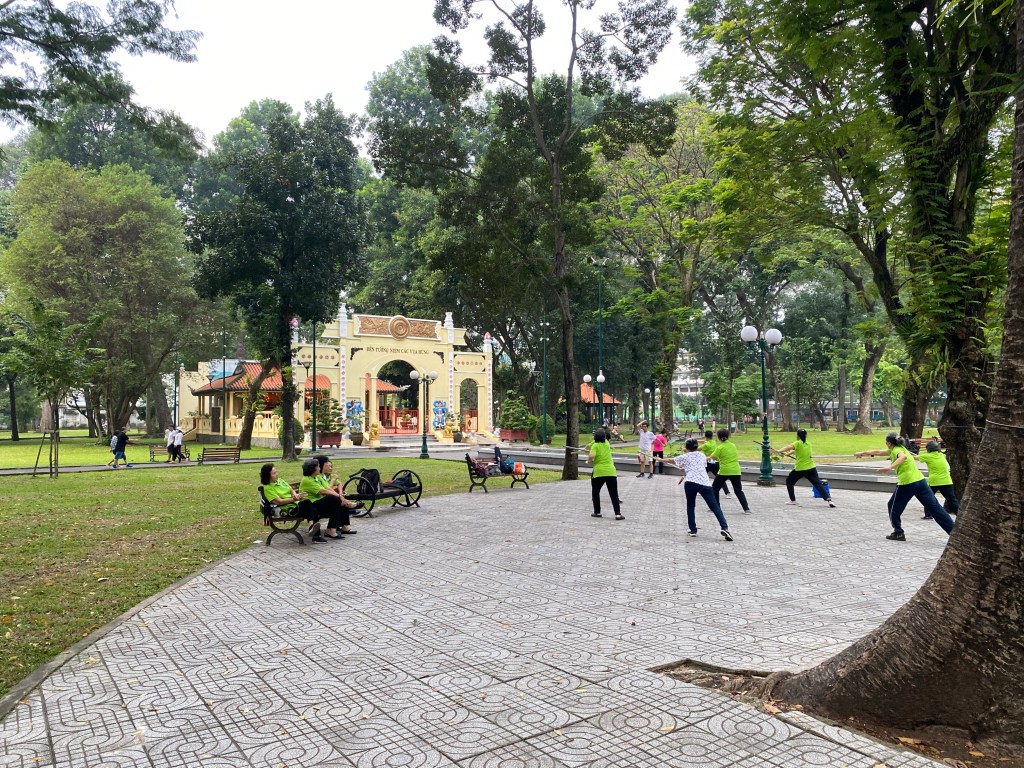
The only spot of green to speak of on the map in Saigon’s District 1 appeared to be the garden of the Palace of Independence and the Tao Dan Park right behind it.
From there I had also hoped to be able to cross over to the French colonial city hall and then to run along the pedestrianised Quang Truong Nguyen Hue to the Mekong river. But this had to be abandoned, as it would have been near impossible to cross any of the roads inbetween and I probably wouldn’t have lived to tell the tale.
Instead I joined the local crowd and limited the range of my exercise to the small park and to the outside perimeter of the palace grounds.
The park was – as expected – packed with joggers, Tai Chi enthusiasts and a group of middle aged women going through sword fighting routines. A couple of times I passed a dog that was resting on a park bench.
It struck me, that he probably regarded this sea of pointless and seemingly disorientated exercise fanatics with an element of utter disdain….
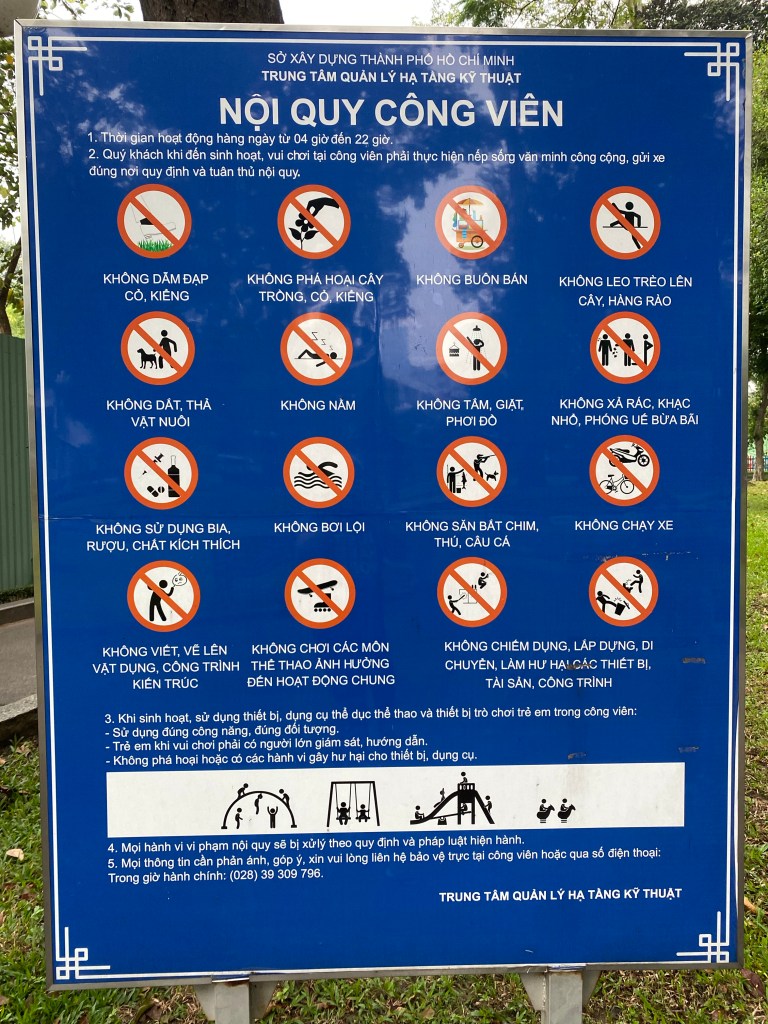
When I noticed a sign board that listed so many things one was not allowed to do, I considered myself lucky that at least I was at liberty to breathe.
Finally I left the park, heading for the perimeter wall of the Independence Palace.
Sticking just to the pavement here – which was what all the local runners did – the clear advantage was, that at least no roads had to be crossed.
The building in the center of the complex used to be the Palace of the South Vietnamese Head of State. At least until a North Vietnamese tank crashed through its front gate on 30th April 1975, which was universally interpreted as the end of the Vietnam War.
Passing the gate a couple of times, I noticed
– that a full circle around the palace grounds was just short of a mile
and
– that Vietnamese runners appeared to be much slower and had more of a tendency to stop running, compared with European or American runners (it was something I had observed in Hanoi as well).
Just before feeling smug about this, it dawned on me that it was probably not due to a lack of fitness, but a precaution to avoid inhaling too much of the fumes of the nearby traffic……
It was high time to return to the hotel (and to the air conditioning), following an exercise not to be repeated in the foreseeable future.
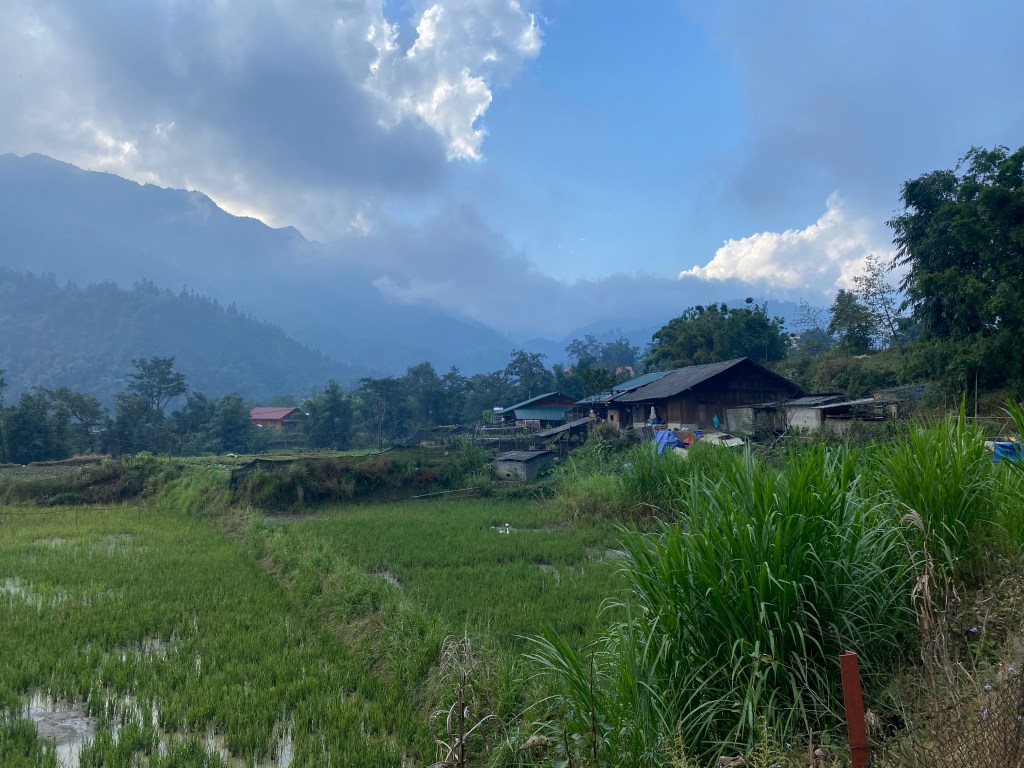
Lao Cai lies in the far North of Vietnam, right at the border to China.
It is not the most charming place in Vietnam, but it is the gateway to the more scenic town of La Pa, to Farsipan – Vietnam’s highest mountain – and to the Great Northern circle, covering a string of formally French colonial out-posts along the borders to China and Laos.
The most exciting option to cover the distance I thought, was to make use of the old French colonial – of course metric – railway system, where an overnight sleeper train is covering the nearly 300 km in about 8 hours.
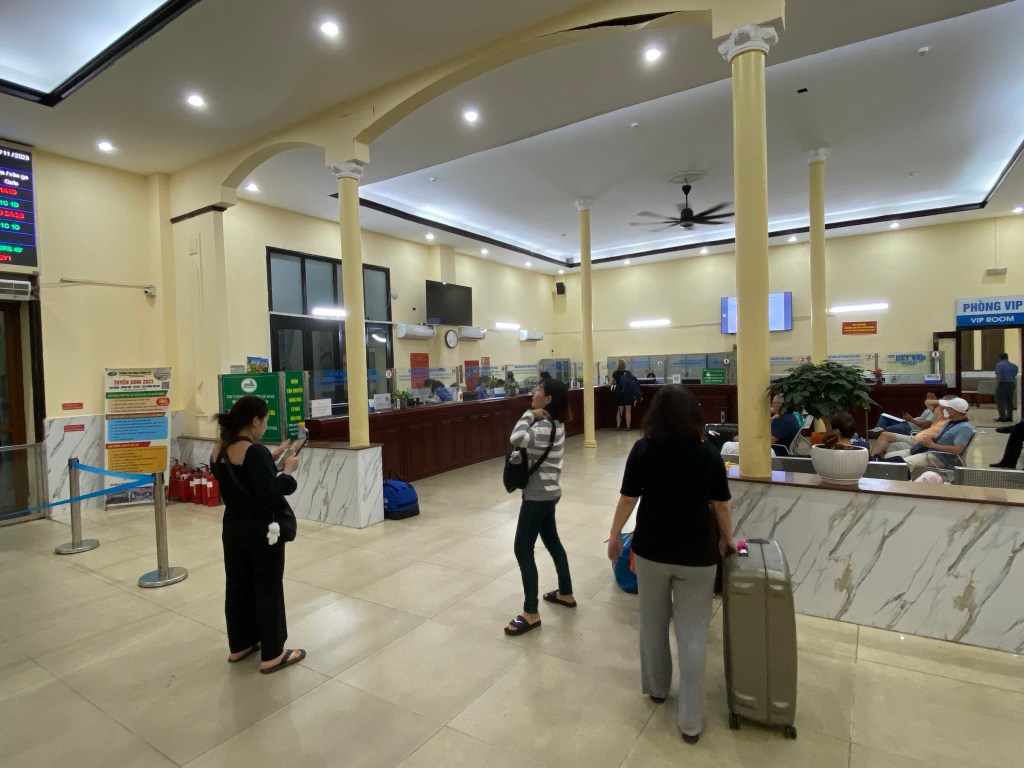
Following dinner in Hanoi’s Old Town, I arrived with good time at the Central Railway station, expecting an organised chaos, very much in line with the mostly motorscooter driven road traffic, that similar to a system of capillary bloodvessels is oxigenating even the smallest corner of this huge city. What I found though was a nearly empty station hall, where only a handful of travellers were occupying the few available seats.
Far gone are the days of Paul Theroux’s Railway Bazar scenes. No street vendors were in sight, trying to sell last minute vital provisions to excited and slightly disorientated travellers. No French nobility or American heiresses with a multiple of their own body weight in Louis Vuitton luggage and with the necessary support staff to shift it. Compared to Waterloo station at this time of the day, this was a graveyard.
Why was that? ….
Well, taking the train – as in so many other countries today – isn’t the done thing anymore, especially if a comfortable shuttle bus with onboard wifi service can cover the distance in not more than 4 hours.
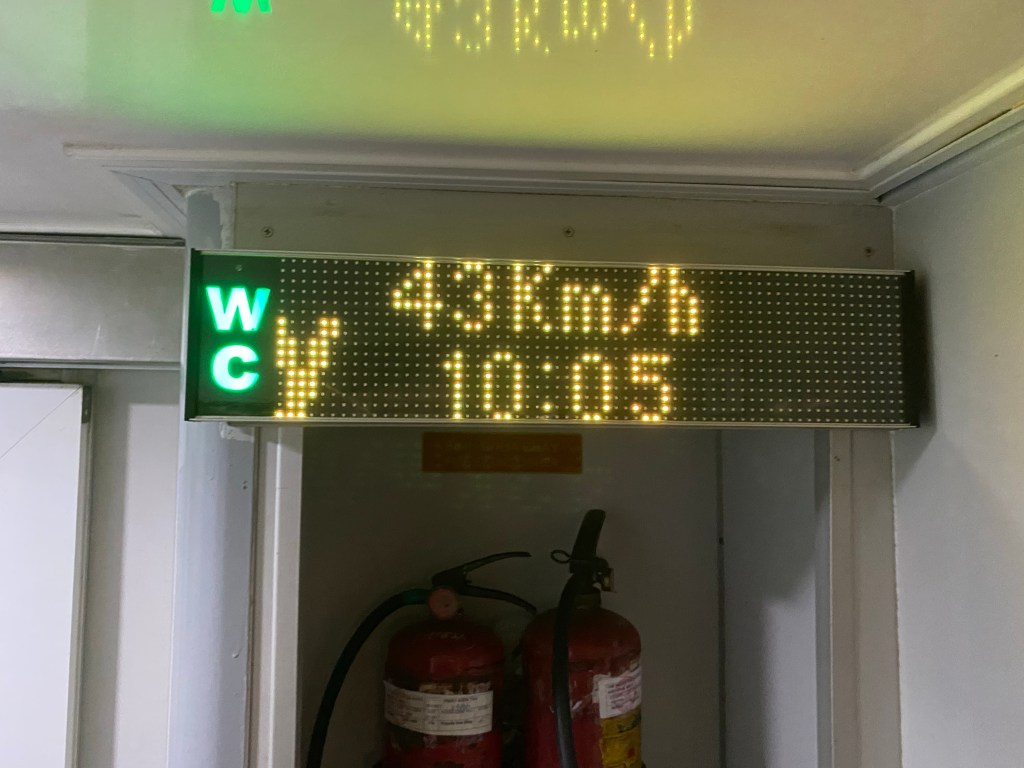
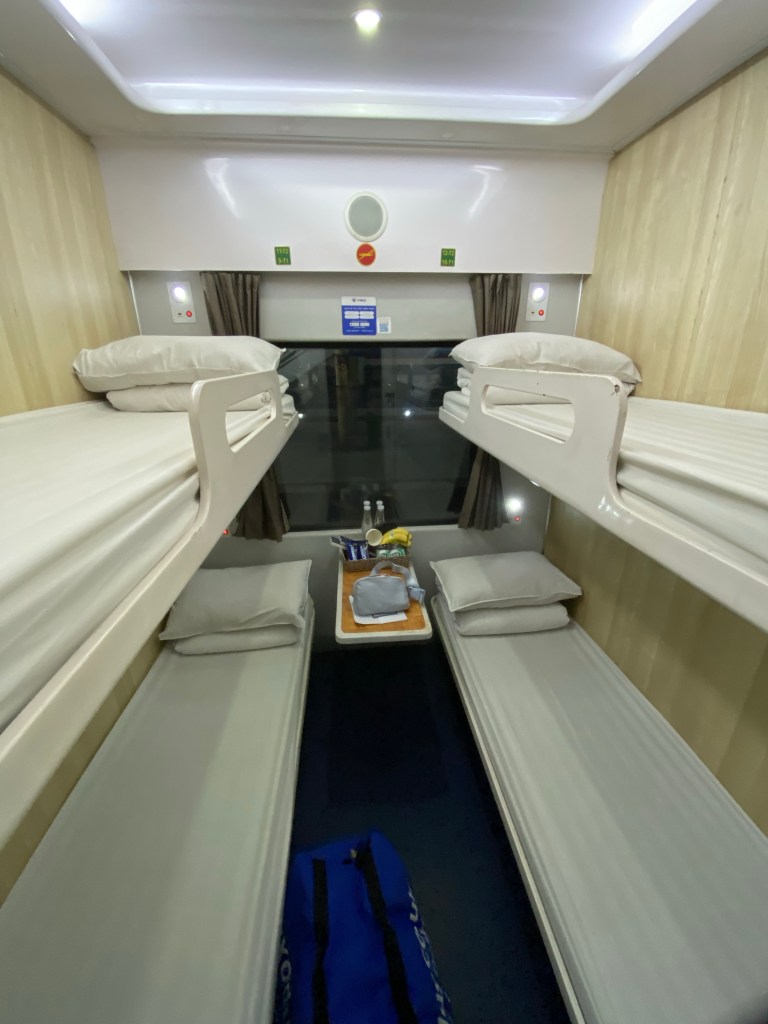
The next disappointment was the train itself and the compartments: electronic displays had replaced the friendly and always helpful multilingual conductor.
Plastic and steel fittings were now the norm instead of marble and (what looked like) mahogany
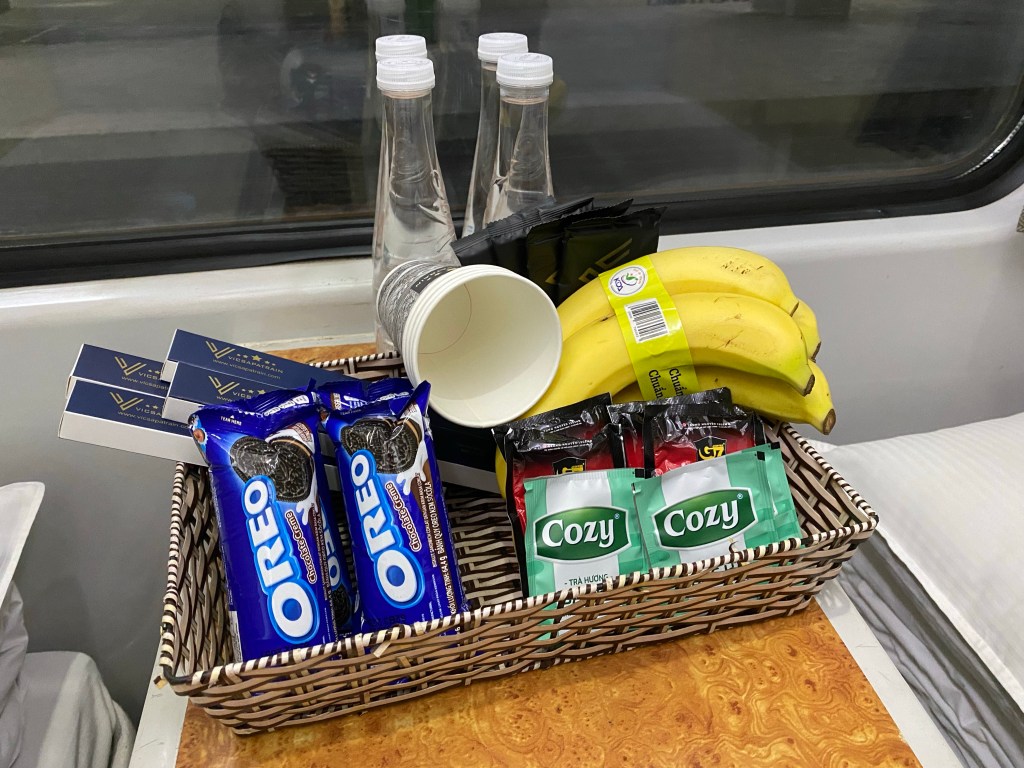
and instead of an elegant restaurant service, bananas and some plastic wrapped biscuits had to suffice as sustenance for the nocturnal journey.
And while the train started to squeeze itself through the labyrinth of buildings in the center of Hanoi, with not as much as a meter to spare on either side (which in itself has now developed into a tourist attraction),
I started to wonder if the old world flair had all but gone from this railway line.
Time to take a walk I thought…….
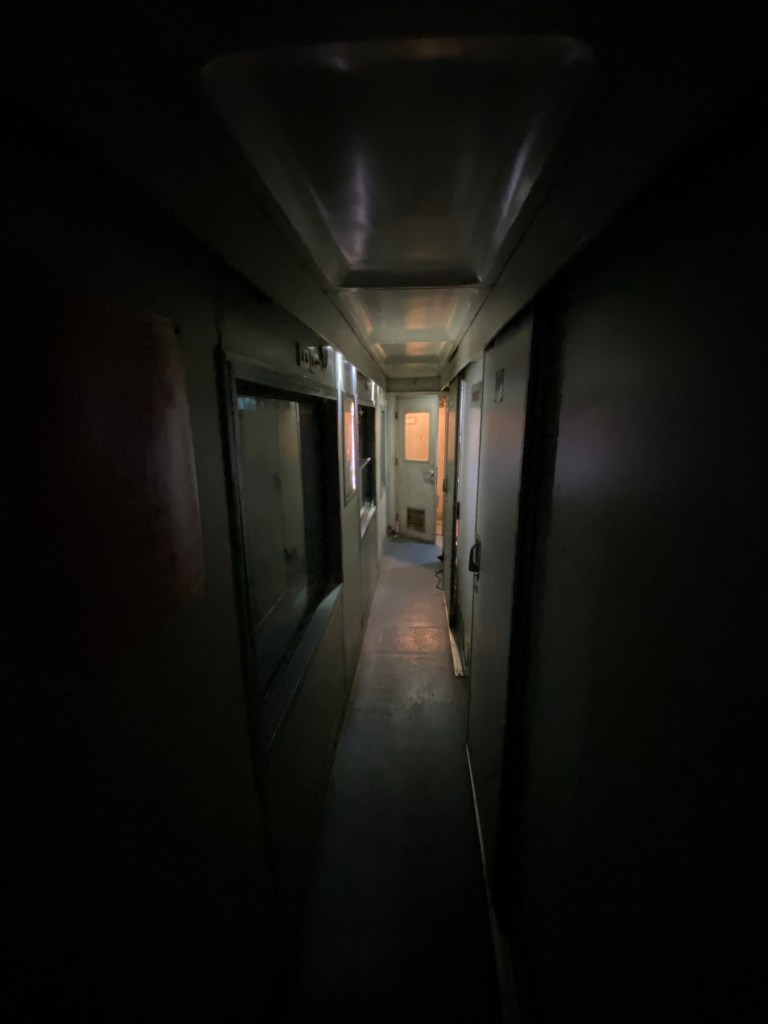
While the train was rattling – rather noisily – along with a lot of sideway shifting because of the narrow gauge, I delved into the bowels of this slow moving reptile.
Turning left to the remaining carriages, the standard deteriorated rapidly, with both the condition of the on board installations as well as the standard of hygiene fading rapidly.
The equally poorly maintained lighting was progressively appreciated…..
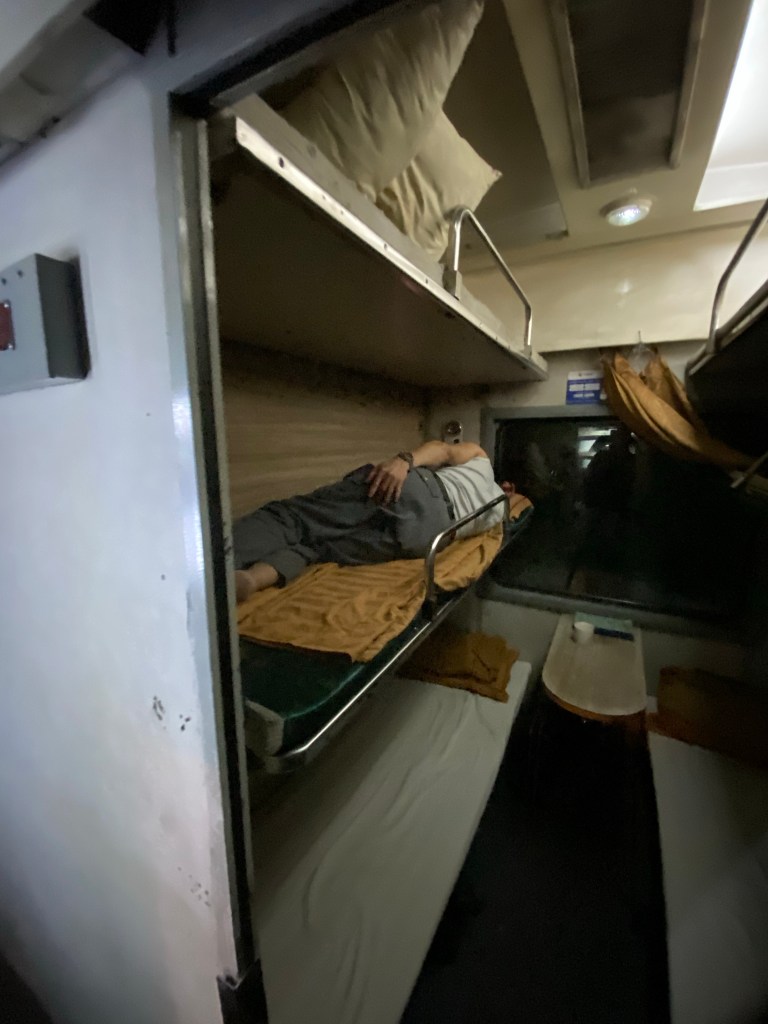
In comparison to this, our compartment wasn’t actually so bad, I thought, and once I had reached the final carriage, I turned back.
Time to explore the other end …….
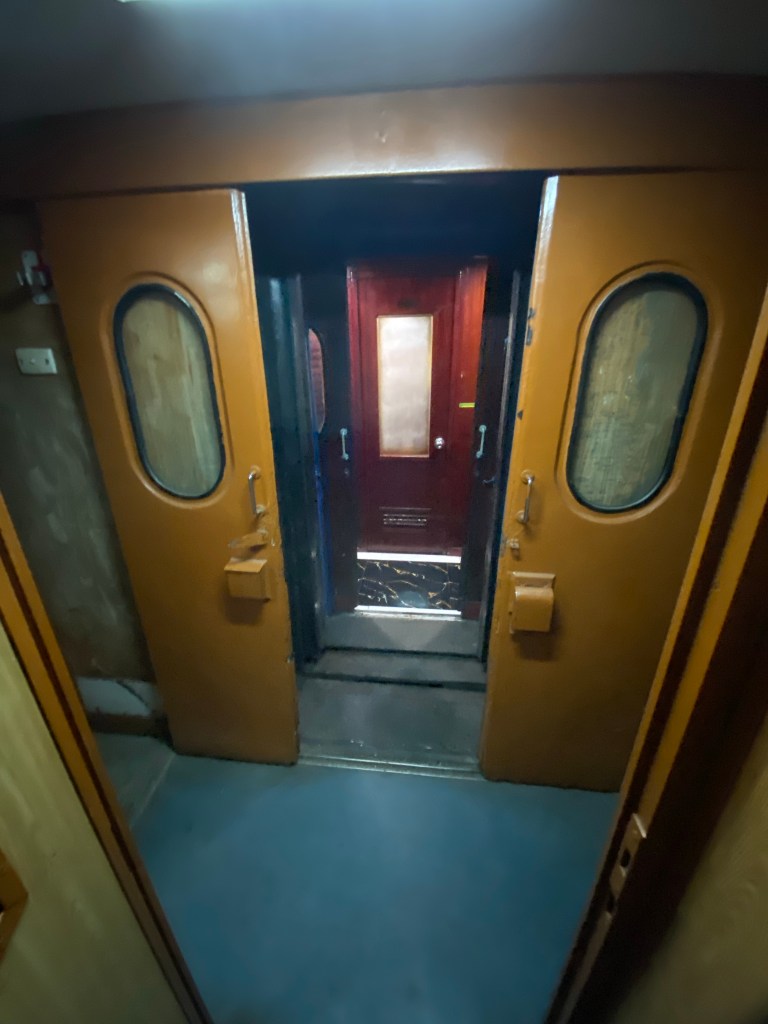
Risking my life by jumping over the threshold between the moving carriages, I stepped back well over a hundred years :
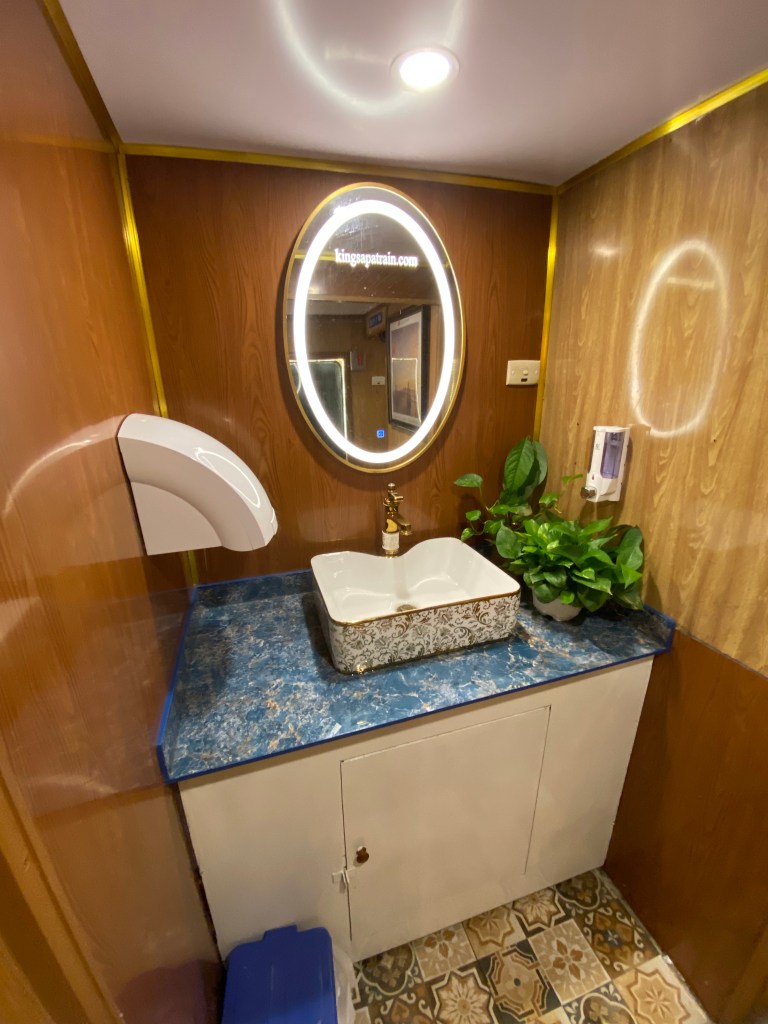
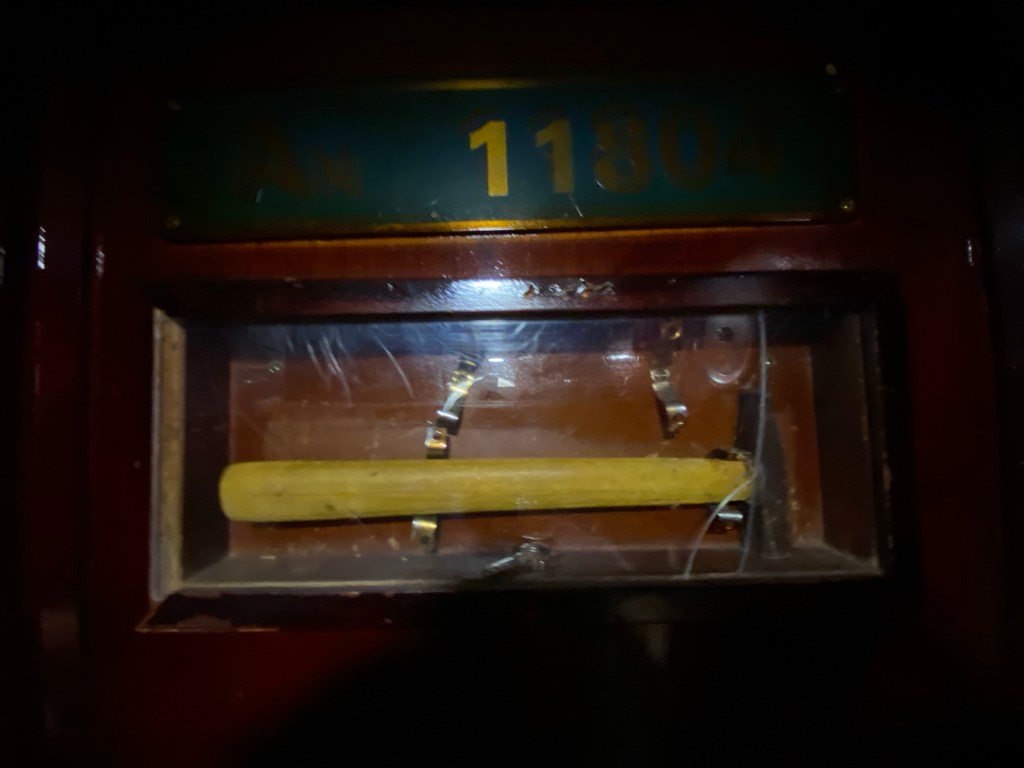
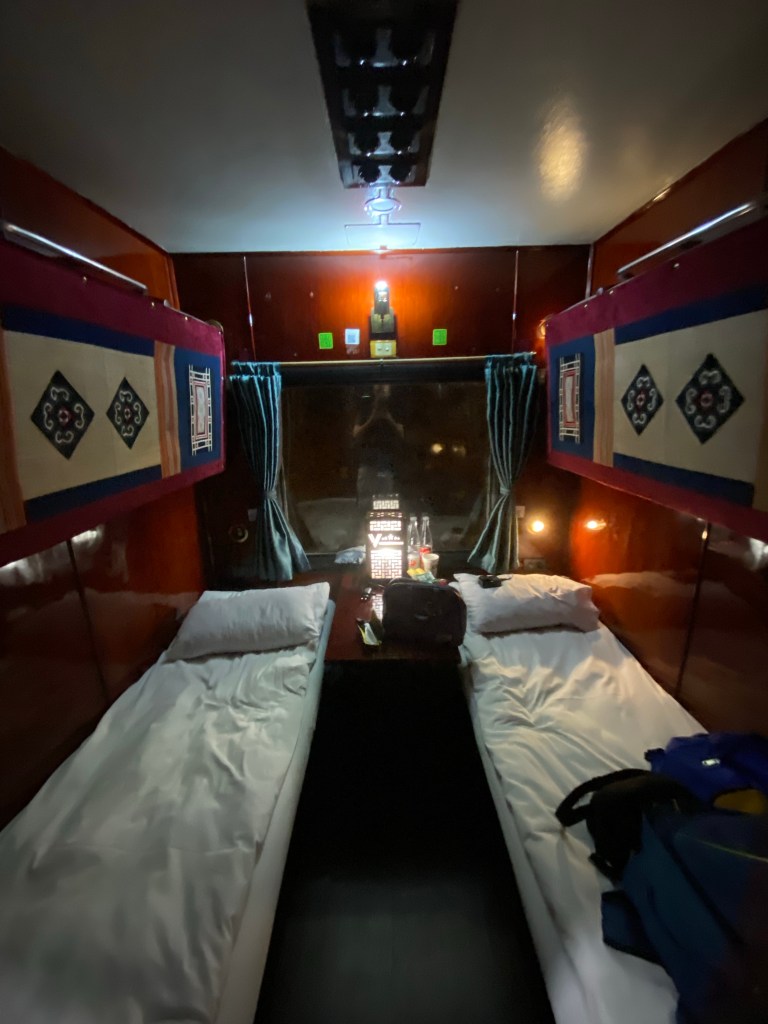
Here it was – the mahogany lined wall panelling, the well attended restrooms and the individually crafted compartment doors.
Even the emergency equipment gave a historic impression…..
The compartments were prepared for four or even for two travellers and there appeared to be a good mix of both Vietnamese as well as foreign passengers.
It struck me that this train was a bit like Vietnam in the 21st century – a complex mixture of old and new, embracing some aspects of its colonial past, but at the same time moving forward, no always in an expected or even appealing way, but at least with a bright future ahead.
If you want to experience both, you need to move fast and certainly more than at 40 km/h…….
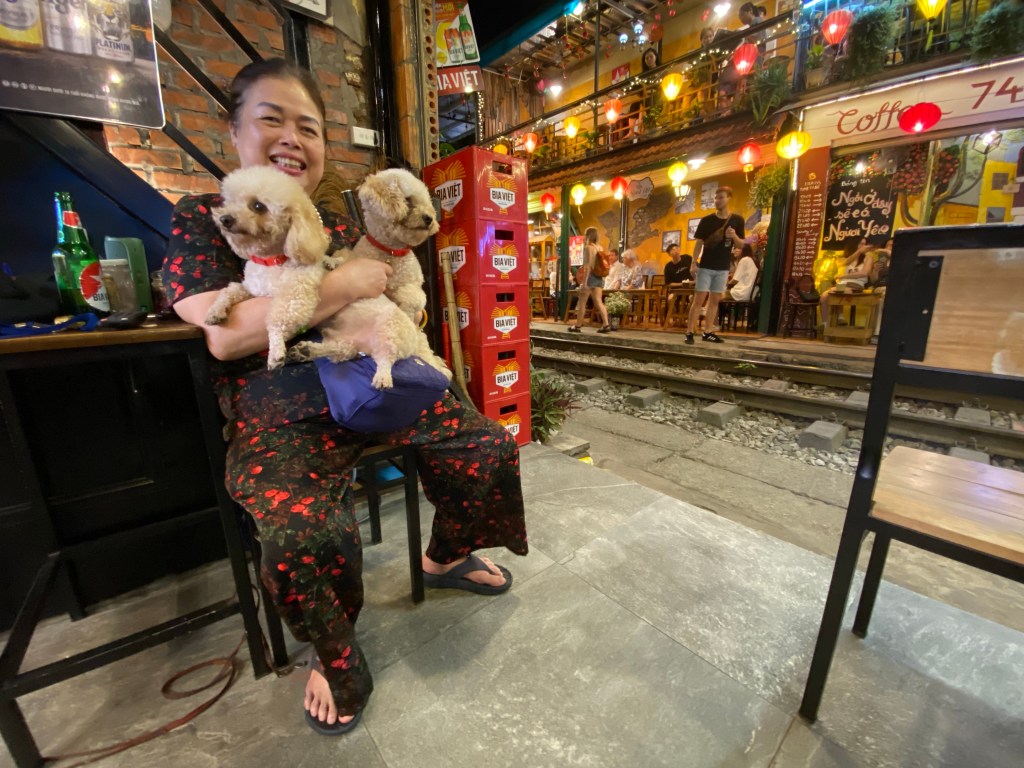
It is in the small restaurant “74”, right next to one of the main railway lines out of Vietnam’s second largest city, where I meet “Tó” , one of the four poodles of Mrs Nguyen.
These much loved dogs live a typical canine urban life in Hanoi. Confined to a shop, a small restaurant or to a flat, most dogs are adjusting remarkably well to their owner’s life style and to the hazards around them.
A lot of these – usually small – dogs live right next to busy roads or – as in the case of the “74” – just a couple of meters away from a railway line.
Dog ownership, considered by communist governments a bourgeois past time and frequently discouraged as a waste of precious food resources, has in many countries increased in line with an improved standard of living. Over time, the human- animal bond has proven to be more powerful than any political system…..
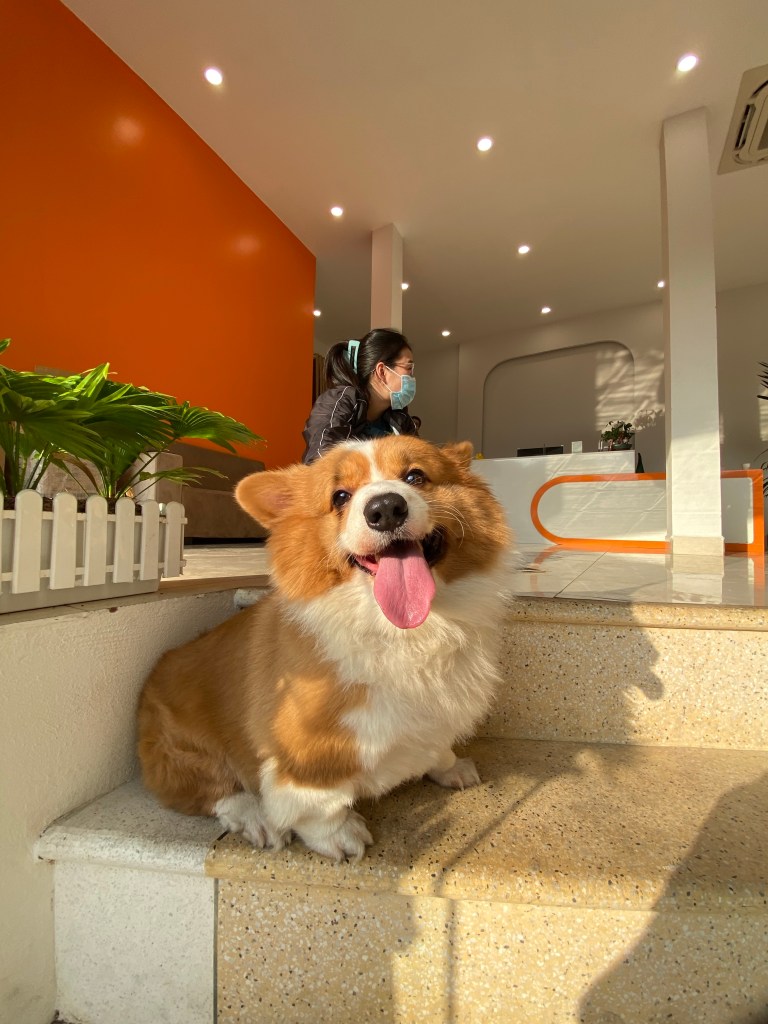
On my walks through the center of Hanoi, I mostly see small poodles, Chihuahuas and a surprisingly large number of Corgies. Interestingly no pugs or French bulldogs and thankfully no larger breeds at all.
At least in the centre of this huge city, there doesn’t appear to be any stray dogs and despite their very confined existence, most of these small canine companions seem to enjoy a reasonably good life, in any case compared to their cousins on the countryside.
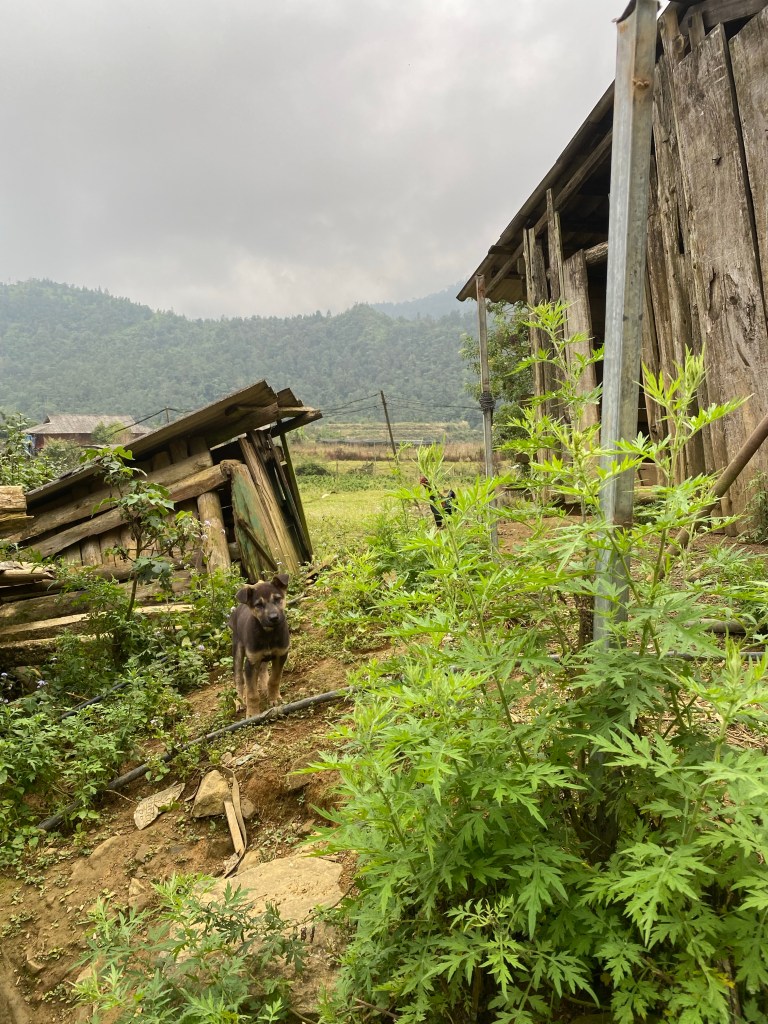
Having to scrape by, mostly on left overs, competing often with the life stock of the same household and with little or no hope for any veterinary care. After all, this is a country where the dog as a potential food source has not completely disappeared from the menue….
Along with an increased interest in pet ownership, mostly in the urban centers, has come not only a demand for better veterinary care, but driven by popular television programmes and by social media, for veterinary care of an international standard.
A brief online search for veterinary services in the center of Hanoi, results in a plethora of practices and clinics, with often colourful names and all with raving Google reviews, albeit usually by reviewers with not more than a total of three or less reviews to their name.
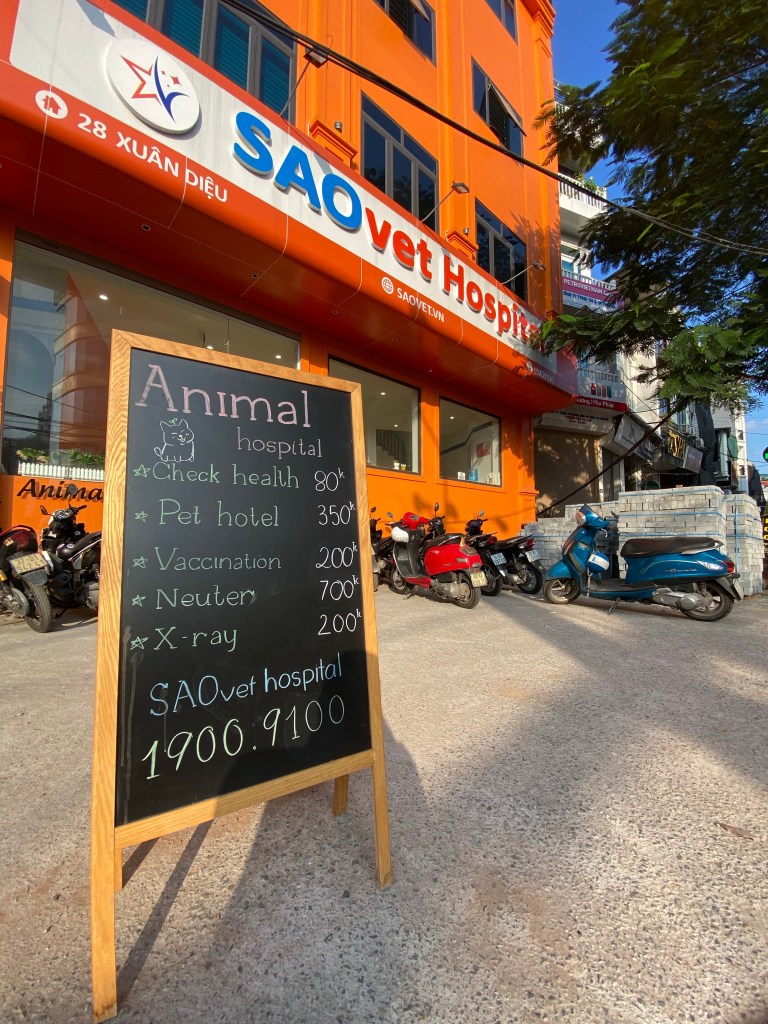
Openly displayed price lists – reminding me a bit of a black board displaying the daily specials in a restaurant… – give an indication not only of the competitiveness of the market, but also of the range of services typically provided.
Health checks for less than £ 3/ 4$ and vaccinations or X-Rays for less than £ 7/ 9 $, look very competitive and so does the neutering of a (female ?!) dog for less than £25/ 30$.
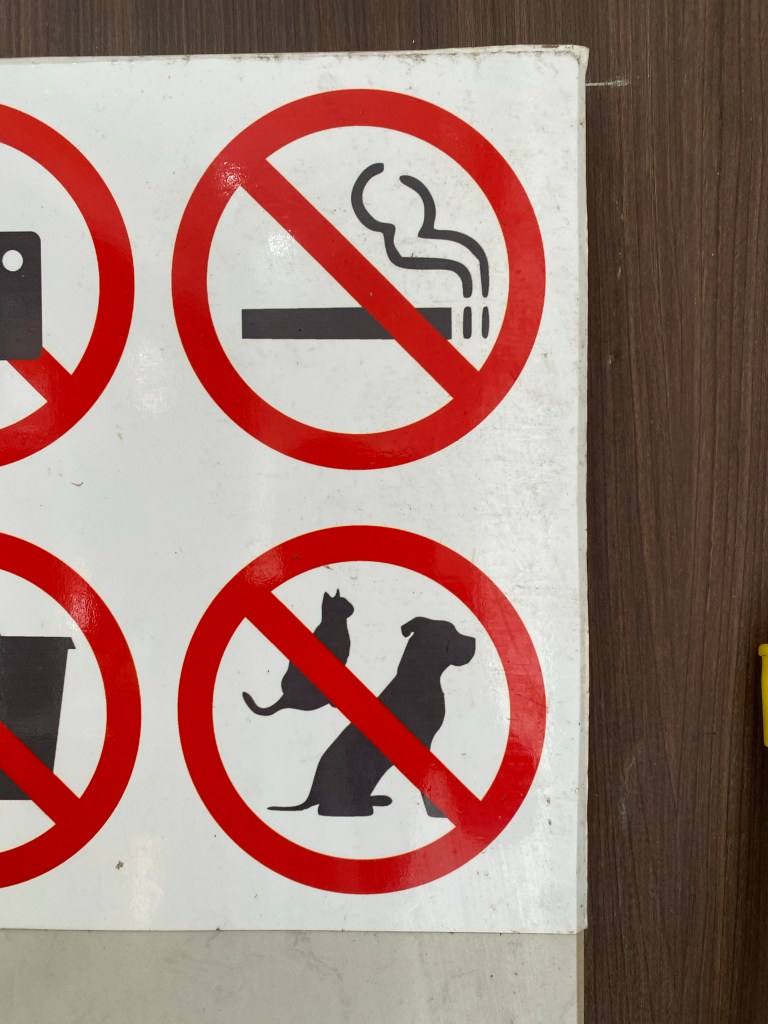
At the moment the life of an urban dog in Hanoi remains pretty much confined to the dwelling of their owner and to the very few and always busy local parks. Taking a dog (or a cat !) inside a shop or a restaurant is generally not allowed.
But even in this respect – often driven by foreign influence – attitudes might change over time.
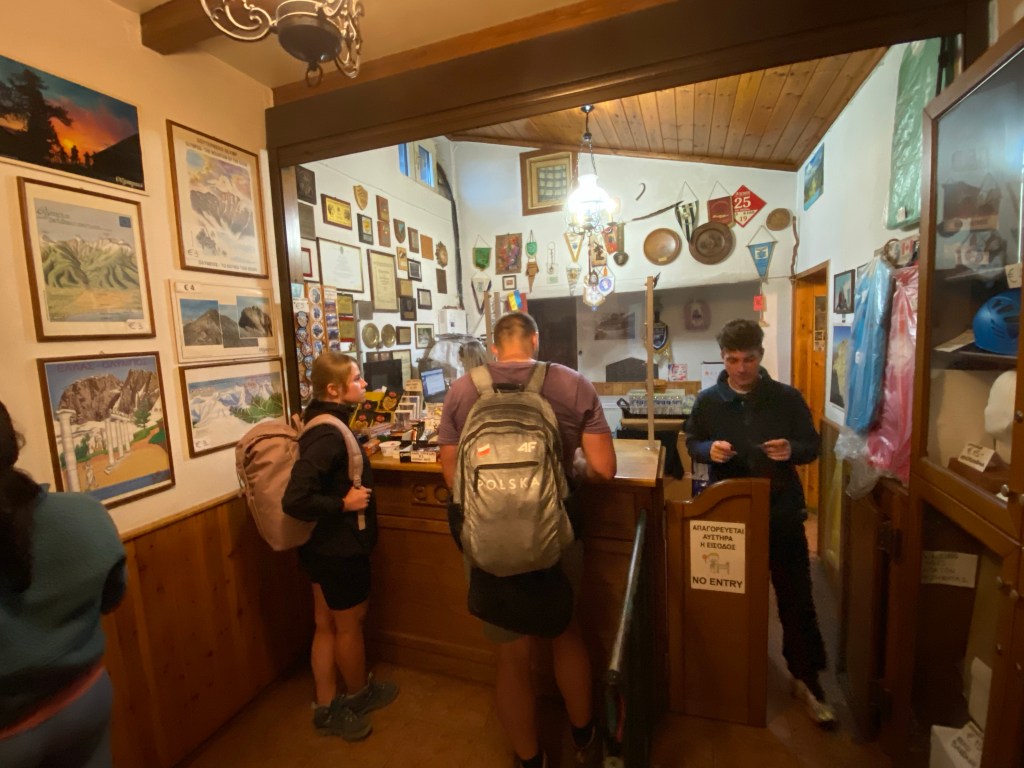
Light rain was greeting me in the morning, as I stepped out of Spilios Agapitos, the central mountain refuge of EOOS, the Greek Federation of Mountaineering Club.
This was not a great day to summit the highest peak in Greece, but as the recent torrential rain had destroyed the water supply to the hut, leaving it without running water and – worse – any sanitation, this was also not a good place to stay….
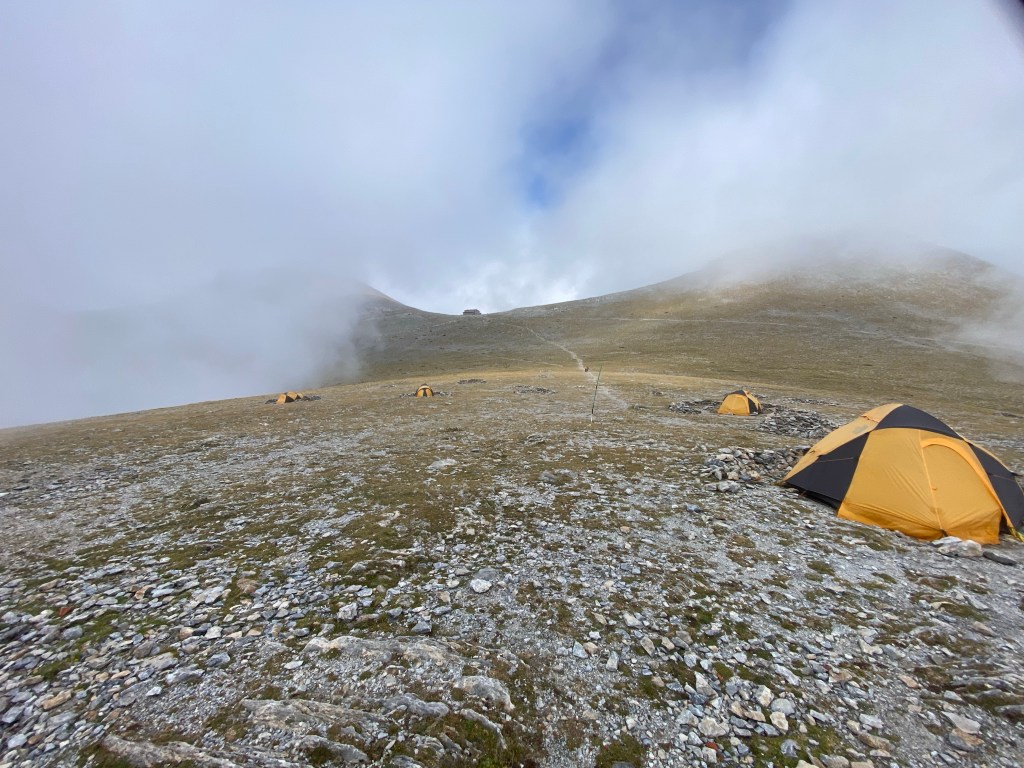
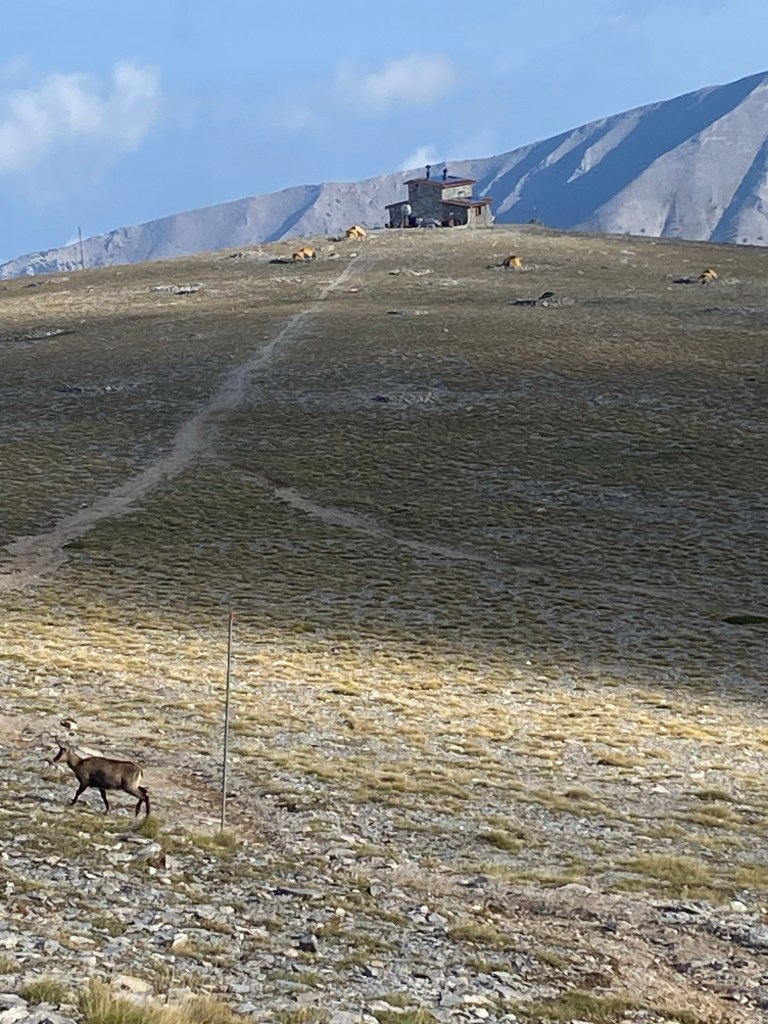
Thankfully Giosos Apostolidis, the highest refuge of the massif, based on Muses’ Plateau, had a spare bed, so that I decided to spend an extra day in the mountains and now there were just 600 altitude meters to cover to reach my next stop. This was a nice change to the nearly 2000m I had scaled the previous day, when starting this trip in the small village of Litochoro, close to the Aegean Sea.
It was the beginning of October and before attending another Eastern European Regional Veterinary Conference in Thessaloniki, I had a bit of time to kill. So what better than hiking to the top of another of Europe’s epic mountains ?
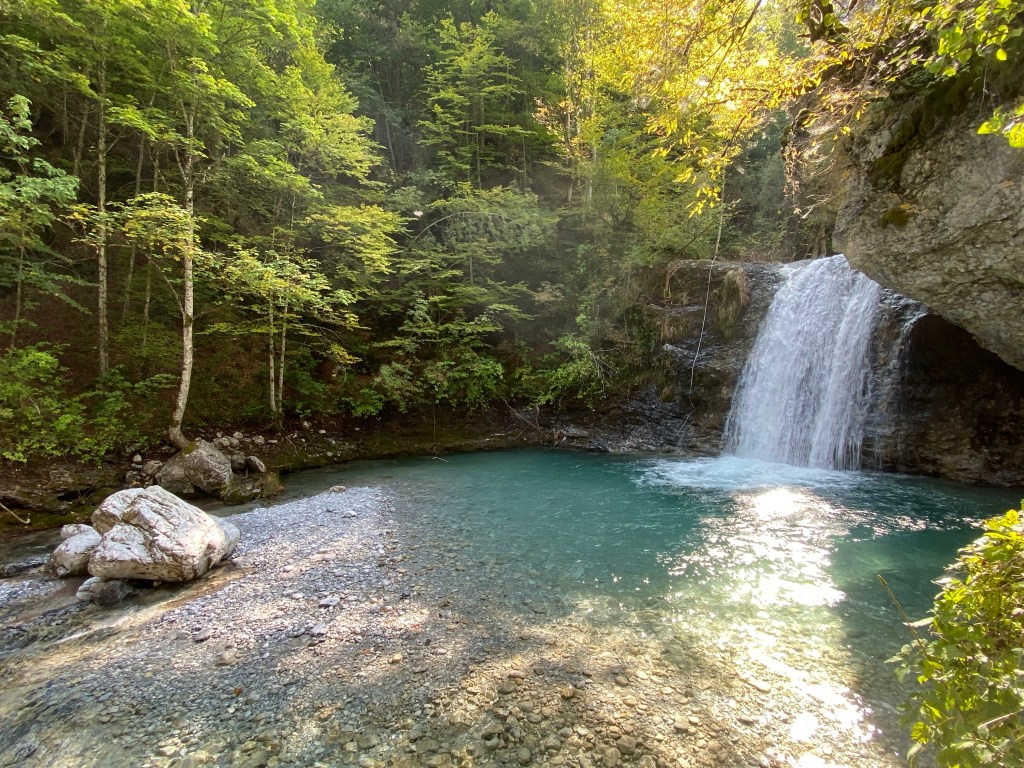
The hike the previous day went through a deep gorge, most of the time in a lush forest, along a river with a lot of water falls, pools and even a natural spring underneath a rock ledge.
This for many years had been the home of a hermite and it eventually proofed to be an ideal location to build a small monastery nearby.
The walk to the refuge had taken longer than expected and I arrived at Spilios Agapitos just before sunset.
The hike from there the next day to Giosos Apostolidis was, albeit much shorter, fairly steep and because of the rain the ground was slippery.
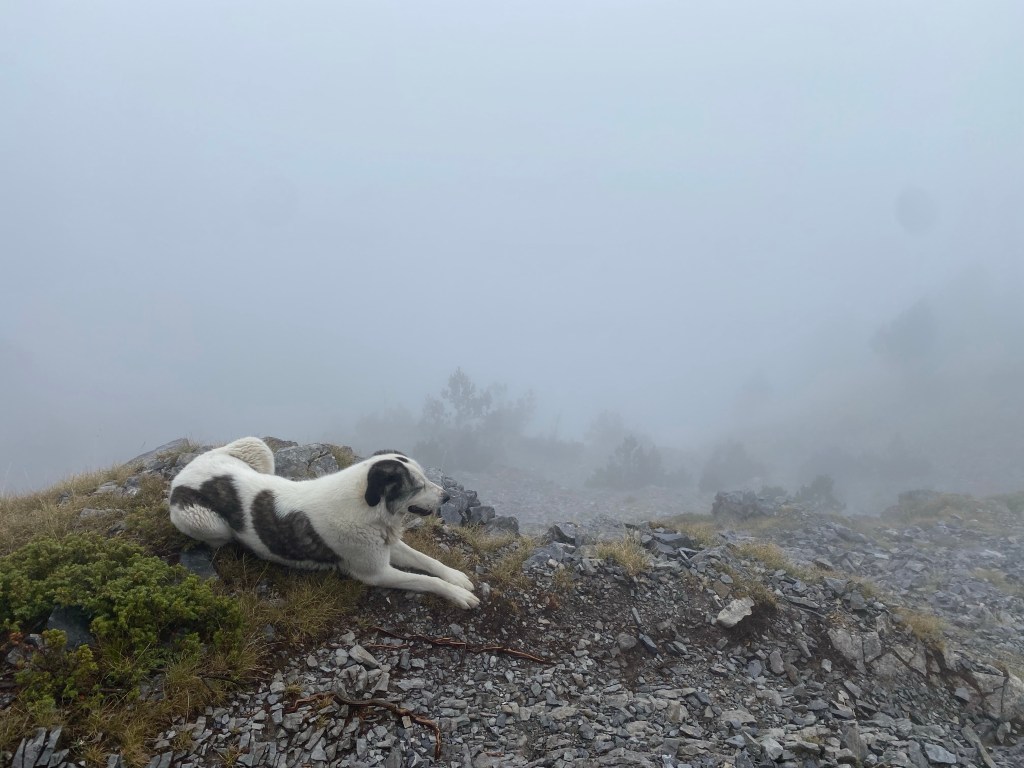
In the middle of the trail, out of the mist, appeared suddenly a huge dog. These dogs are normally used by the local shepherds to guard their flock against wolfs and even bears and it is advisable to give them a wide berth .
Thankfully some locals turned up a moment later and I complemented them on their (thankfully) gentle giant. As it turned out, it wasn’t their dog either ….. but one of a pair that were seemingly living on these trails during the summer months. Not harming anyone and not chasing any wildlife, they were living off handouts from hikers and of left overs of the mountain huts. I met the other dog near the summit the next day.
Making this detour and spending an extra day on the mountain had been a good idea, as the weather eventually improved and both in the evening as well as during the whole of the next day, there was just a blue sky without any clouds.
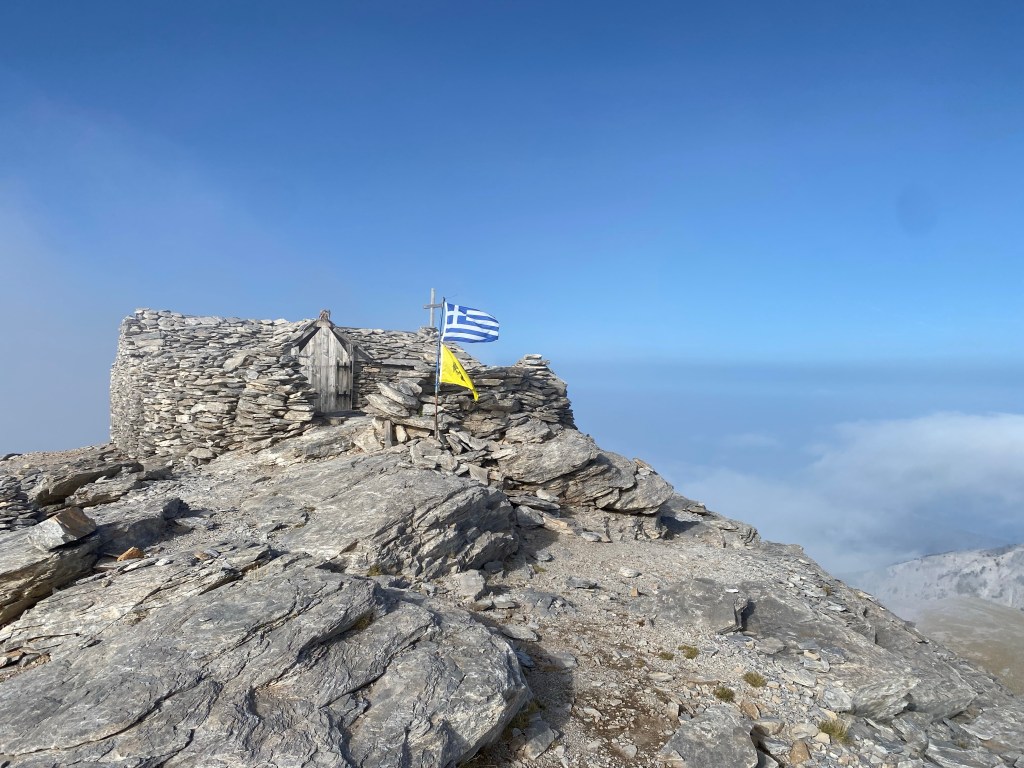
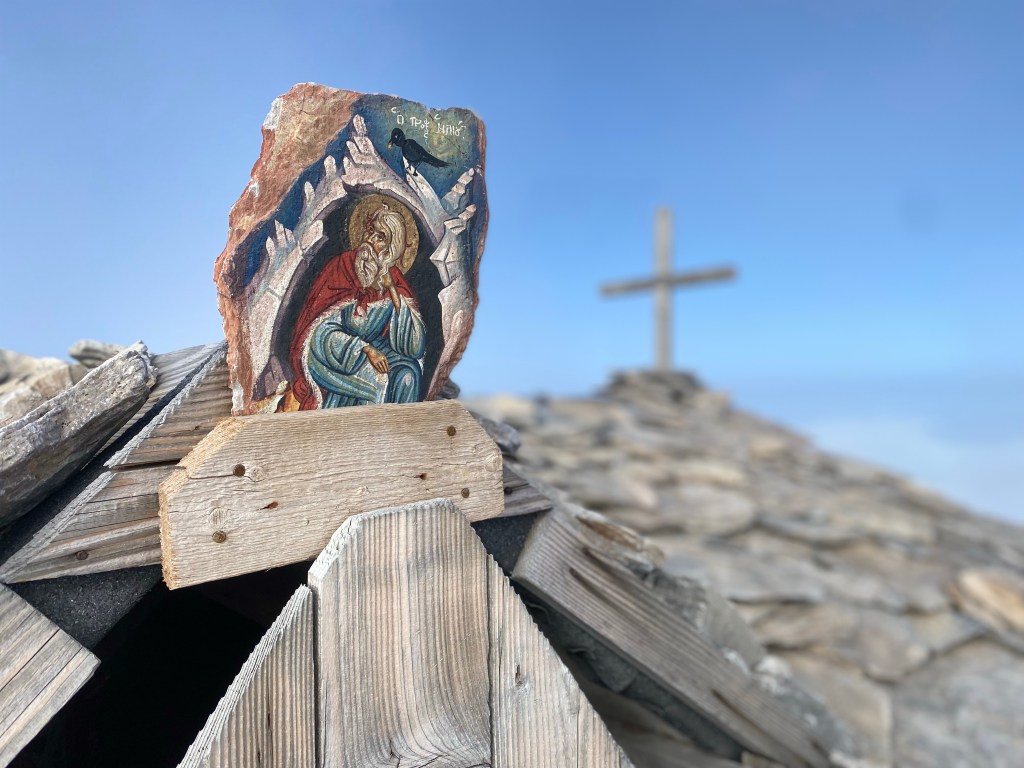
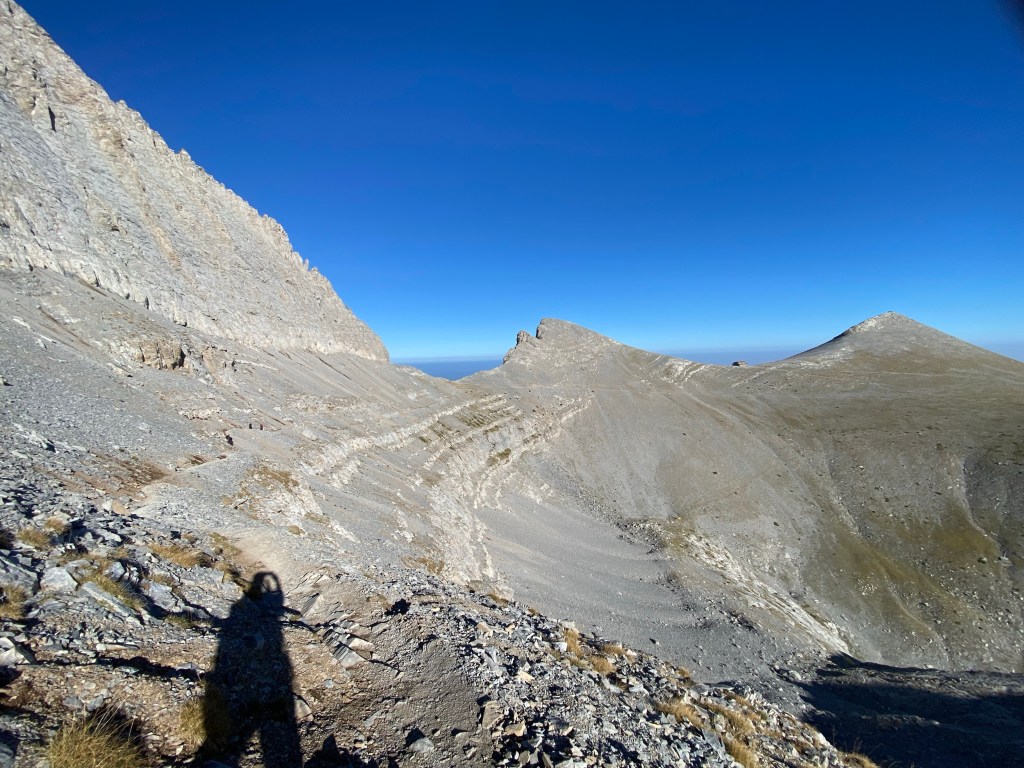
This provided me with a lot of great photo opportunities of the summit from the small chapel of Profitis Ilias
and I realised, that on my ascent, I had walked right through a whole herd of mountain goats without spotting a single one of them in the fog…..
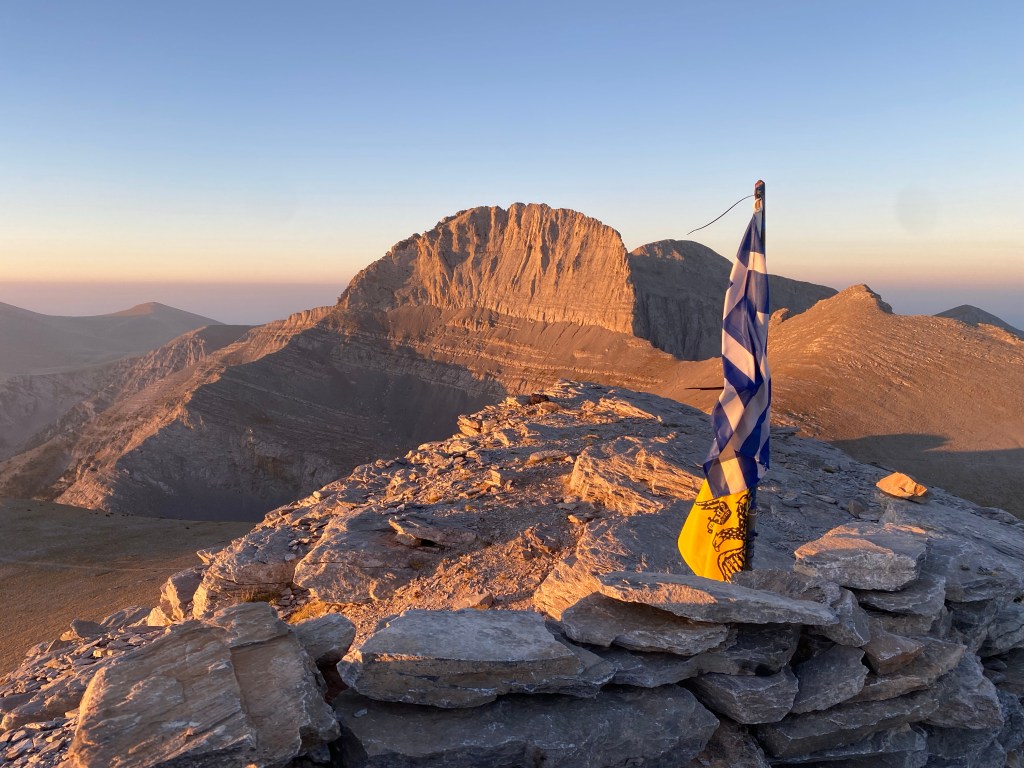
With weather like this, it meant an early start the next day to catch the sunrise over the Aegean Sea and to see the light reflecting from Greece’s highest mountain.
Followed by a short breakfast with an obligatory Greek coffee, I then set off on a spectacular traverse just below the summit.
The path eventually made a sharp turn and ascended steeply North to a high alpine plateau and to Scala, one of the nearly 50 sub summits of Olympus.
What was left, was a scamble for another half an hour and eventually I was standing on Mytikas, with 2918 m above sea level the highest peak in Greece.
Arising from out of nowhere and standing on its own with a diameter of just 26 kilometers, being just 18 kilometers away from the coast, catching the first sunlight in the morning and providing a unique navigation point to a nation of seafarers through the millenia, it is no surprise that this place was believed to be the home of the Gods.
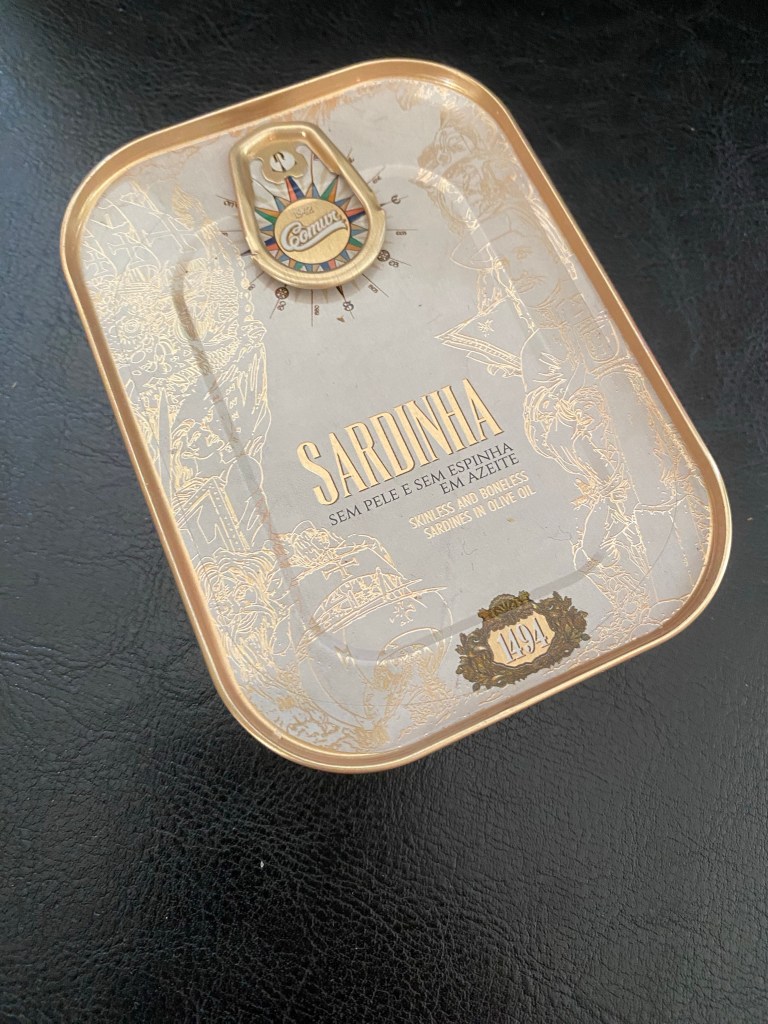
In this post I wanted to write about the castle of Óbidos, but instead I am writing about a tin of sardines….
When driving to this famous medial castle, I had no intention to buy not one, but in fact three tins of sardines. I don’t particularly like sardines and I certainly had never planned to spending 48 Euros on them.
And yet, here I am standing with my three tins of sardines and I am happy……
How was this possible?….
It all started with an obligatory visit of Óbidos – another “must see” item on Gonçalo’s list.
Óbidos is a beautiful maintained medieval castle, with a whole town with a lot of stunning mediterranian gardens within its walls, with Chinese Hibiscus and Beougainvillia in spectacular bloom.
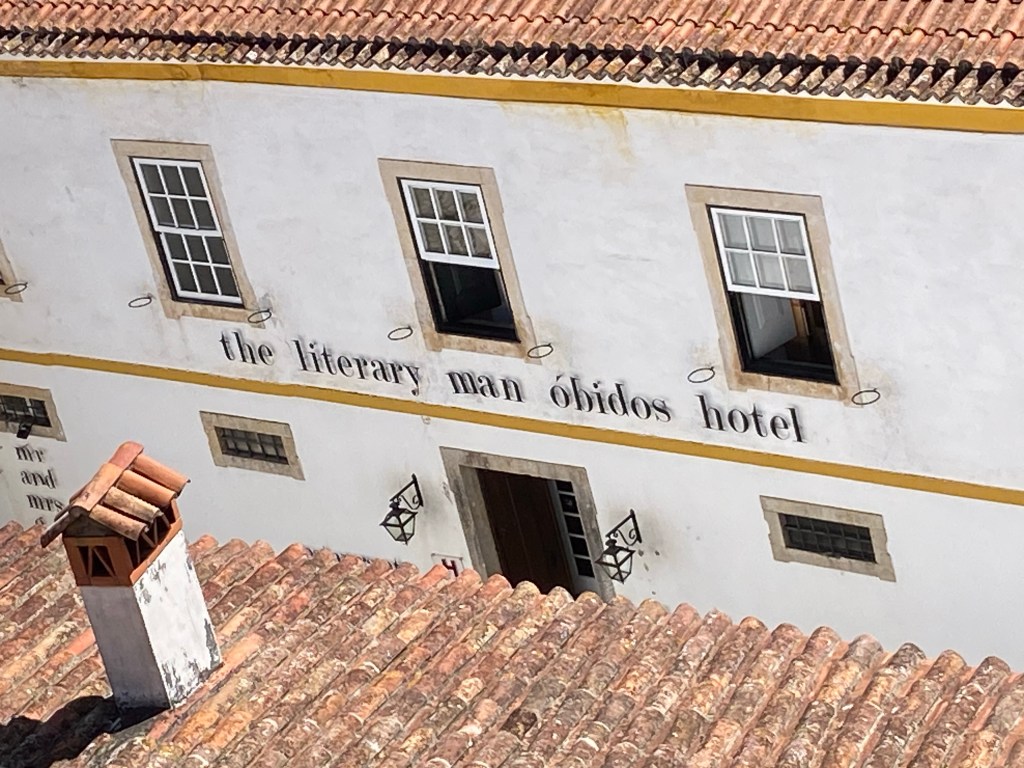
It also is a pilgimage site for book lovers, famous authors and their readers from all over the world.
Ignoring a number of health and safety warnings and relying entirely on the firm footing of my hiking boots, I survived the nearly 2 km long walk along the unsecured parapet of the castle, featuring sheer drops of 12m and more. However, Gonçalo had been right – the breathtaking views were worth it.
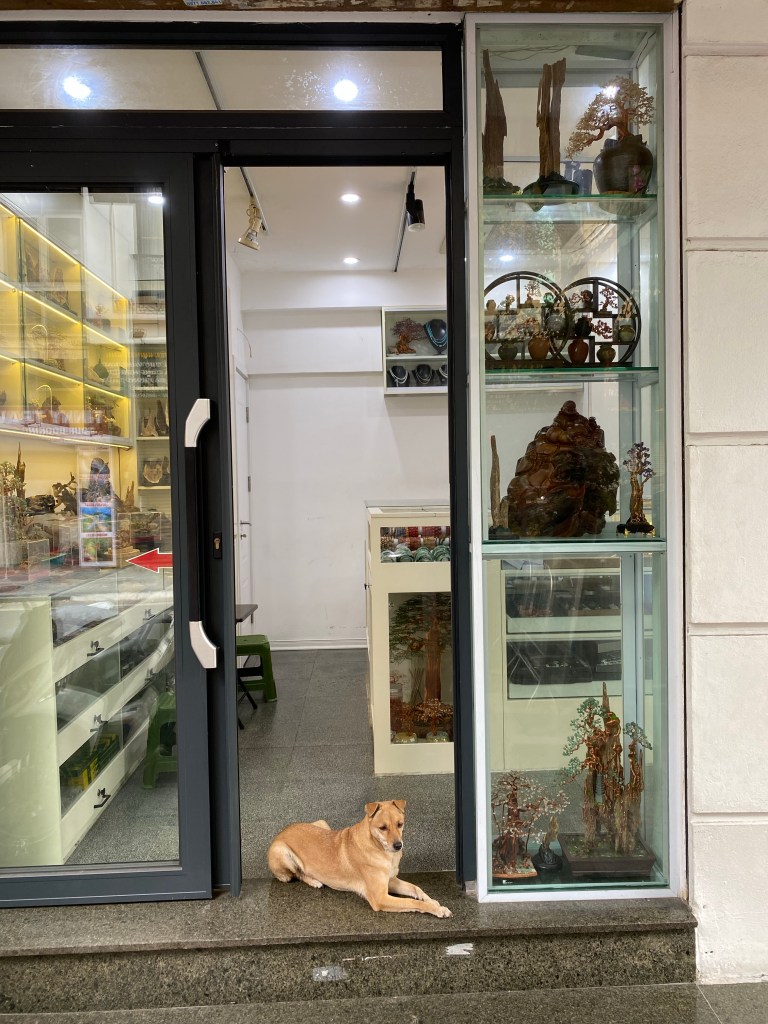
Eventually I ended up on the main street of this world heritage sites, bracing myself for the obilgatory souvenir shops on the way back to my car, when a cat at the entrance of one of the shops caught my sight.
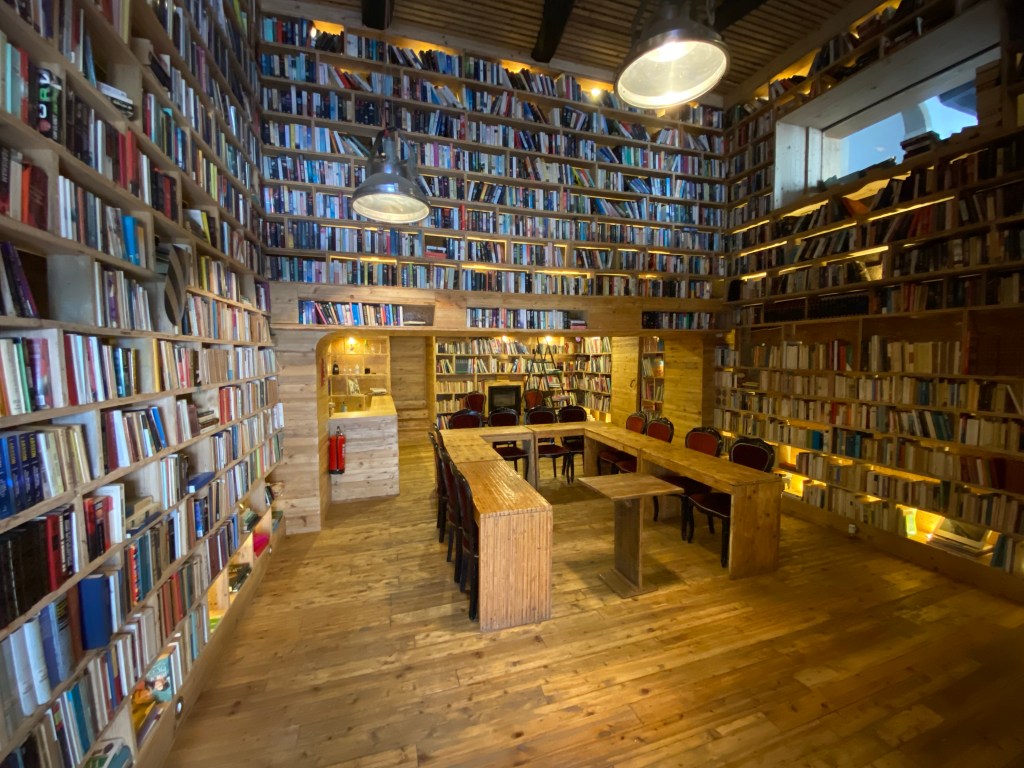
When stepping closer, I noticed that I was standing at the entrance of a beautiful old library, with professionally crafted wrought iron banisters and with rows and rows of historic leather bound volumes stacked up to the ceiling.
A young shop attendant approached me and offered to show me around. It was then, when I became aware of my fundamental misconception: I wasn’t standing in a library – I was standing in a fish shop! To be precise – in a shop that was selling nearly exclusively tins of sardines !….
The thoroughness of the guided tour that then followed, was on par just with the one I had enjoyed some years ago, when I visited a legal cannabis outlet in down town Toronto – but there, despite all efforts made, I left empty handed…..
“Normal” sardines were nicely lined up by the individual year displayed on the lid, starting from 1916 and conmemorating the birth of a famous person on the colourful tins. Then there were special editions, dedicated to different places in Portugal. Each of these with a small painting of a local event or building decorating the tin. Other sorts of sea food, like smoked cod, octopus, smoked mussels or eel in Escabeche – sauce were offered in sardine tins as well, and finally … small gold bars, filled with 140 g of the best sardine filets, sprinkled with small flakes of edible gold – at a price of just below the real thing…. – were displayed in the center of this library of sardines.
Unbeknownst to me, I had just stepped into the world of Comur, a staunchly Portuguese company, that is selling their sardines not only as a highly valued commodity, but even as collector’s items. Who says that only red wine, whiskey or coffee in aluminium capsules, but not the humble sardine, have a right to monopolise this concept ?
This place was just so far removed from Steinbeck’s portrayal of life in Cannery Lane, as a supermarket pizza might be from dinner at a Michelin star restaurant.
As it turned out, Comur has over a douzen other outlets all over mainland Portugal, Madeira and the Azores, which are all individually themed and which surely are all worth a visit.
I don’t know what it was in the end – the lure of the cat at the entrance, the friendly shop attendant, my utter surprise or my appreciation of the marketing concept, or just all of it together: three colourful tins ended up in my bag and I frankly didn’t care how they were going to taste…..
Comur – as I found out after my visit – is just one of fifteen different brands of “O Valor do Tempo” – The Value of Time company , which is limiting its clever marketing ideas not only to tins of sardines, as I found out when I entered the shop next door that was selling freshly made fish cakes.
Well…..you decide, if you might not be tempted to buy a fishcake and a glass of cava for 20 Euros in this place……



































 The Blue Vet Diary