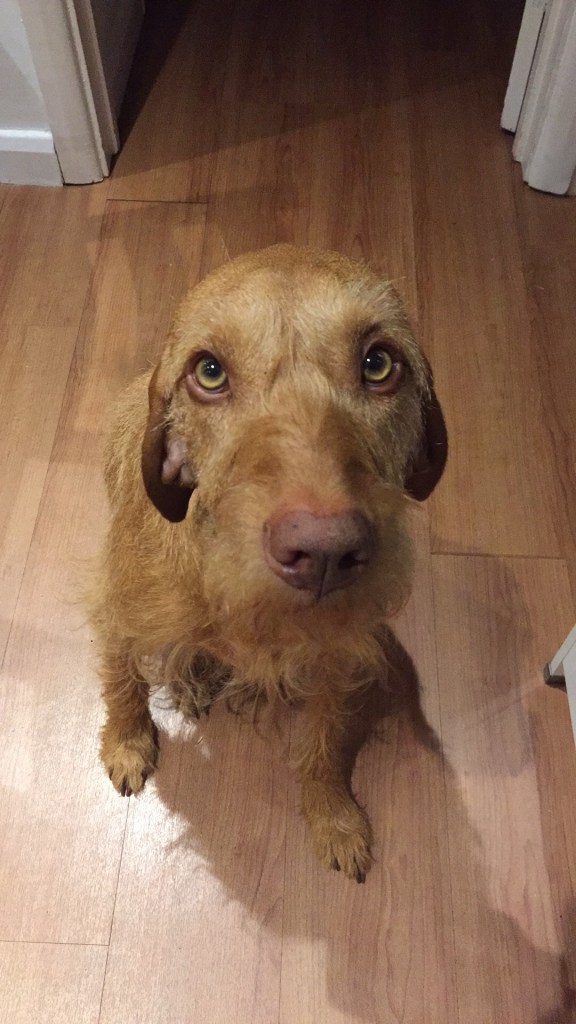
I had noticed it for a couple of days, but had tried to ignore it.
When passing her bed, there was a sour odour in the part of the entrance hall, where she was sleeping. That her food was left untouched wasn’t anything unusual – she had always been a reluctant eater, but now there was also this distinct smell of gastric acid and now the evidence of some dried phlegm on her bedding….
Time to take some action….
Without my own clinic now, I had to take Mia – our Hungarian Vizsla and a frequent travel companion on my journeys – to the local veterinary practices like any other pet owner in the UK and while I was allowed to stay involved with her blood tests, with the anaesthesia and a gastroscopy, which thankfully didn’t confirm my worst fears, I was still left with a bill that was just short of £ 3000.
Luckily Mia was and is still insured and while the insurer paid a fair part of the bill, I became concerned about what will happen once she gets older and is no longer insurable?….

As a young vet, there had been many reasons for me to move to England: the element of an adventure to start with, but then also the opportunity to work with international groups of colleagues, the better teamwork and the unrivalled dedication for the care of pets by most pet owners as well as by the veterinary professionals in this country.
What had been planned as a stay for a year or two had lasted well over thirty years and it is still ongoing.
Something that had come as an unexpected plus was the possibility of caring for a fair amount of insured pets.
While pet insurance had been known in my native Germany at that time as well, the few policies on the market offered only very expensive products that provided very limited cover. Insurance fraud committed by pet owners and frequently supported by members of the profession also inhibited the establishment of a diverse and widely supported industry at that time.
In the UK this had been different, mostly due to the efforts of Patsy Bloom and David Simpson, who as far back as in 1976 established PetPlan – for many years not only the trail blazer, but the market leader and the gold standard for pet insurance in Europe.
Both the uptake as well as the honest use of this kind of insurance worked here so much better and the economic success saw in a very short time the emergence of a very competitive market with a considerable number of providers who were able to offer good policies for reasonable fees.
It clearly was a game changer – both for the standard of care that could be provided to British dogs and cats, as well as for the complexity of work veterinary professionals could now offer and – of course – charge for.
With a considerable number of my patients being covered by health insurance, I could focus far more on the case itself and on tests and treatment a patient needed and I no longer had to justify to every client why an investigation was worth the fee we were charging. This took a lot of stress out of an already stressful job….
Many of my continental European colleagues envied me to work in such an environment.
As a result of decent insurance cover being available at affordable prices, inevitably more advanced treatment could not only be offered, but was often expected by pet owners. The emergence of a number of popular vet programmes, often featuring the work performed at referral hospitals, added to this. As a result of this vet bills increased considerably and so did the price of the policies.
Seeing how high bills could now become, even I as a vet with my own clinic started to insure my own pets and as news got around of some extreme vet bills, this further made it clear to the pet owning public how vital pet insurance was, unless you wanted to face financial ruin.
The situation wasn’t much different in the Nordic countries and I recall a number of appointments I had with continental pet owners who had taken their dogs on a Scandinavian holiday, but who saw their travel funds depleted once their canine companion required veterinary care. There vet bills could be a multiple of that what dog owners were used to on the other side of the Baltic Sea.
In most Nordic countries it is now unthinkable of owning a dog or a cat without health insurance – it’s the same as driving a car without insurance. But what happens if even that isn’t good enough? What happens when your pet is healthy, but becomes too old to be insured or what can you do if the treatment cost exceed the limits of your policy ?
I am still haunted by the case of a three-year old Jämthund, the dog of a forest worker with a very basic income, which I saw some years ago in Sweden.
The dog had got into a fight with a moose and had sustained a fractured jaw, a couple of cracked ribs and a punctured lung. While this case had its dramatic elements, the dog was pretty stabile and these injuries could certainly be fixed.
The owner was insured, but the cover was limited to 6000 Euro and the bill was estimated to be in the region of 8000 Euro for the necessary operations and the expected hospital care.
While the owner, an honest, hard working man, explained that he just didn’t have the means to cover the difference, the clinic management remained firm on the price they would have to charge. As a result, this otherwise athletic and healthy dog was put to sleep…..
Seemingly not an uncommon occurrence, also going by some of the cases presented at veterinary conferences, where following high end state of the art veterinary care patients eventually have to be put to sleep or were lost to follow up tests, because the owners finally had run out of funds.
What might be the solution?
While the advancements of modern veterinary medicine is coming at a price, I am getting progressively concerned that we might be loosing sight of the solid middle ground.
Too often is there only the option between very basic and often inferior care or the high end solution with eye watering final bills. Solid but yet not specialist care needs to remain affordable and accessible, without veterinarians running the risk of being liable for malpractice if the state of the art route had not been taken. As in most cases, good communication with the pet owner has to be the key.
When it comes to the care of elderly and no longer insurable pets, I think that both sides – pet owners and members of the profession – need to limit their expectations and at least find an acceptable solution to better the (remaining) life of the patient.
Where did this leave Mia ?….

Thankfully she recovered remarkably well from an inflamed oesophagus and a secondary aspiration pneumonia and while she remains insured – albeit with a limited cover – I have started to put money aside to be prepared for the next unpleasant surprise. I keep her as fit and well protected as possible, but I am starting to worry that I will no longer be able to take her with me travelling to some countries once her insurance cover finally ceases to exist.
Sadly not every pet owner will have the discipline or the means to do the same with their pet….


 The Blue Vet Diary
It is called “economic euthanasia” over here, and is a real problem. One’s best bet seems to be CareCredit, basically a health care credit card that is good for both veterinary and human medicine, if you can make the payments on time, and there is a time limit. The bigger the bill, the harder that gets. I’ve looked through the literature on the table at the clinic at various plans. Generally an age limit, no multiple animal discounts, no pre-existing conditions allowed, and definitely won’t cover cancer treatment, one of the most expensive things to contemplate paying for if faced with it, and I have been. For those who live in rural areas and take on strays and have multiple animals or try to help a feral animal, vet care can be prohibitive. Pet insurance has also driven up the basic costs of veterinary care.
There is no “Obama Care” here for animals. Even with Medicare for those people 65 years of age and older, Americans pay the Medicare premium out of their Social Security income and often find themselves having to pay for extra insurance through Medigap or Medicare Advantage plans to get adequate coverage. And, one has to pay out of pocket for what none of the above will cover. Couple that with the current effort afoot to get rid of Social Security and Medicare, and you have a very bad situation. The Powers that Be are not enlightened Europeans.
Oregon has a Physician Assisted Suicide law for human terminal illnesses. Lots of regulation and restrictions around it, but helps those humans who do not wish to suffer the pain and expense of a terminal illness. It is called the “Death with Dignity Act”.
https://www.oregon.gov/oha/PH/PROVIDERPARTNERRESOURCES/EVALUATIONRESEARCH/DEATHWITHDIGNITYACT/Pages/index.aspx
I am sorry for the diatribe, Wolfgang, but you have hit a real nerve with this topic.
LikeLike
Dear Lavinia,
This diary entry had been on the back burner for a long time …. actually since you suggested it as a potential subject for a chapter.
Thank you for suggesting it !
Regards
The Blue Vet
LikeLiked by 1 person
Thank you for including it.
LikeLike