I couldn’t have been more than eight or nine years old, when at our local church, which was a converted farmhouse with a thatched roof in the North of Germany, the villagers had been invited to an unusual spectacle:
a member of the parish had travelled to Brazil and had come back with a Super 8 footage of this journey. The flickering film included images of Brasilia, the then still very new capital of this so distant and exotic country.
The images I saw, could have featured in an episode of Star Track, so outlandish appeared the architecture of the buildings of this city in the tropics to me. In the world I grew up in, most houses had a pitched roof and were made out of red bricks or were, if they had survived the war, even timber framed. And yes, since the nearby naval port of Kiel had been mostly flattened by British and American bombing raids, most of the post-war office and retail buildings had come directly out of the textbook of the Bauhaus, as the objective had been to build fast, efficient, and ideally at low cost.
However, the buildings in Brasilia were just on a different level. Here functional architecture had been combined with impossibly light, organic structures that were supporting the over hanging roofs. Waterfalls were coming from somewhere inside the buildings and were feeding into moats filled with colourful fish and a large square leading up to these buildings was decorated with equally beautiful, abstract sculptures.
What grew inside me on that day, was the desire to – at some point in the future – visit this place and to see these unbelievable buildings with my own eyes…..
What I didn’t know at the time, was that most of these buildings came from the drawing board of one and the same man, who is widely considered the most outstanding architect of the 20th century: Oscar Niemeyer.
Niemeyer, despite his Germanic surname, was a Brazilian native, a lifelong communist and strongly influenced by the work of Le Corbusier. Without doubt, Dessau and the Bauhaus movement must have played its role in Niemeyer’s development, but at some point he had started to go his own way, and he despised famous peers like Walter Gropius for their all too commercial approach to architecture and for their inability to take into consideration the geographical aspects of their projects.
For Niemeyer, Bauhaus was just too far removed from organic lines.
When Juscelino Kubitschek became president of Brazil in 1956, he started immediately to implement the by then already long-established idea, to move Brazil’s capital away from the coast and into the center of the country.
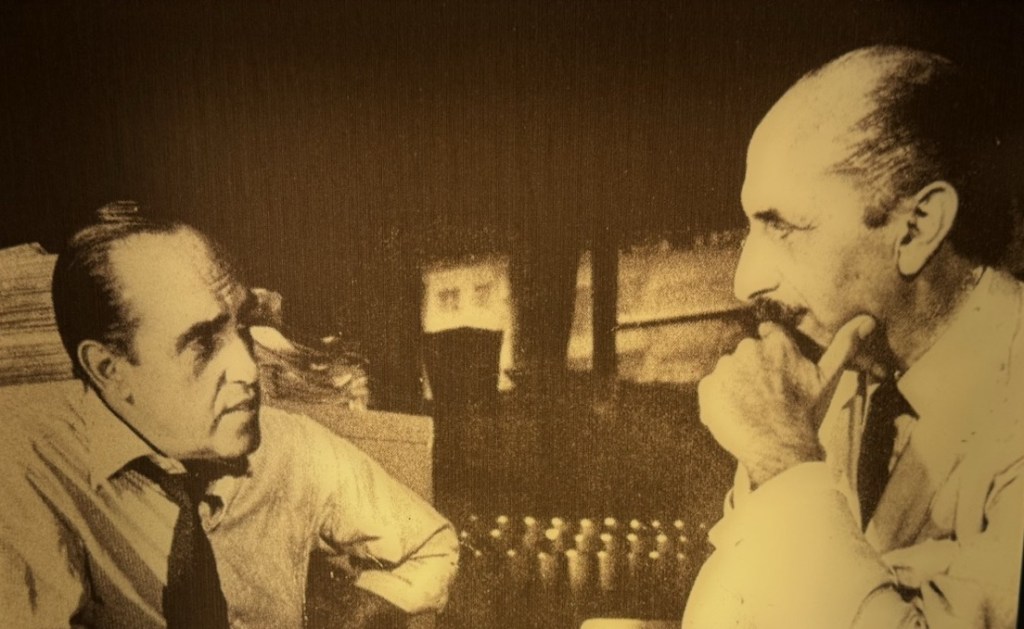
The ground breaking urban plan for this project, submitted by Lúcio Costa, had the shape of a plane, a bird in flight or a bow and arrow, that were hugging the western shore of a lake on the central highland. Part of Costa’s team was Oscar Niemeyer, who had received a lot of praise for – among others – his involvement in the designs of the building of the Brazilian Ministry of Education and Health in Rio de Janeiro and of the building of the United Nations Headquarters in New York. For Brasilia, Niemeyer was tasked with the designs of all the major government buildings.
My first encounter with Niemeyer’s work was not in Brazil’s capital, but just outside of Rio, when I visited the Museum of Modern Art in Niterói. While this is a later work of Niemeyer, it didn’t disappoint with its originality.
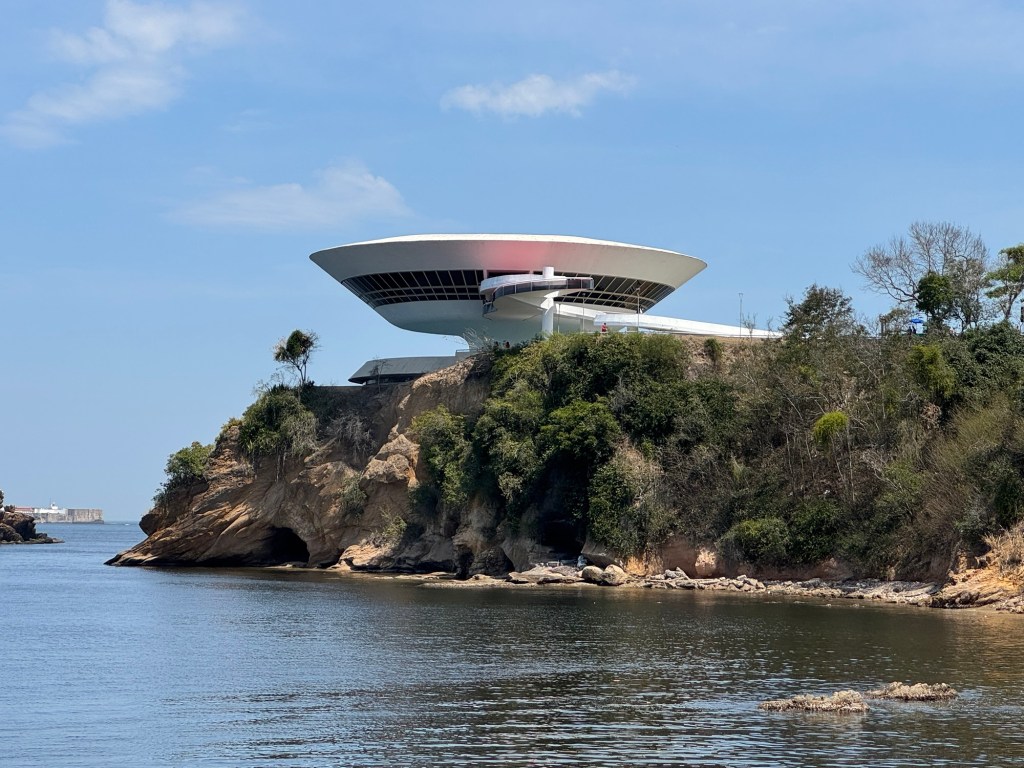
Resembling something like a flying saucer with a long, trailing, red and white scarf, perched on a rocky outcrop overlooking Guanabara Bay and beyond that, Rio de Janeiro and Sugarloaf mountain, this building is more than just a museum, it is a design statement.

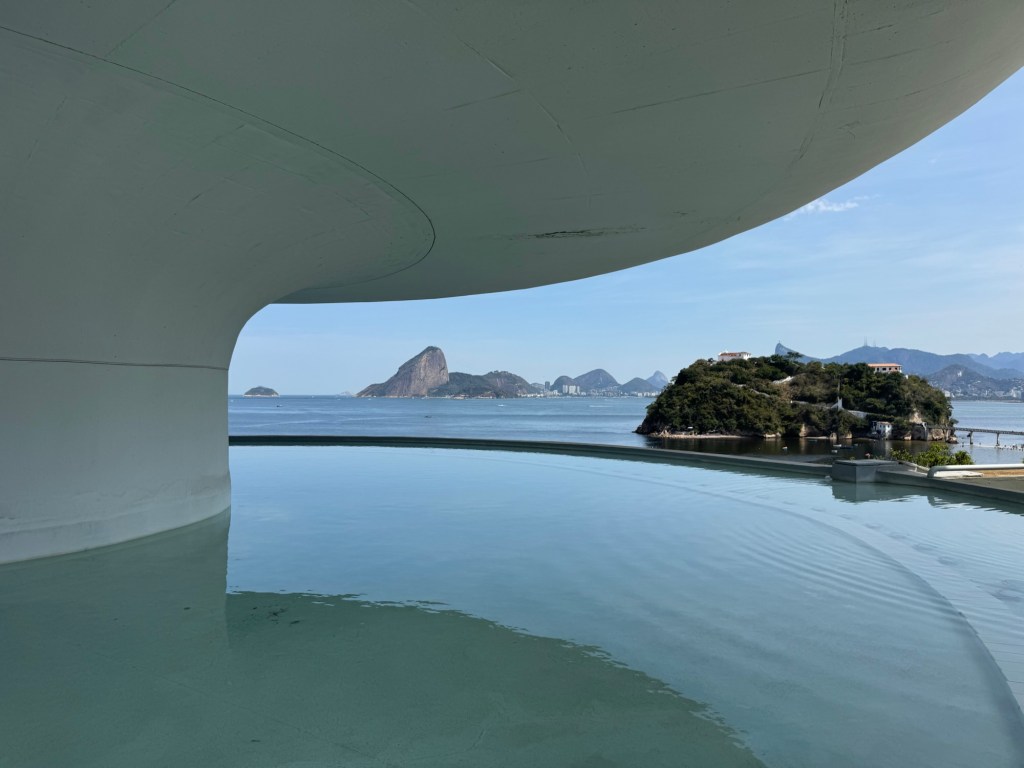
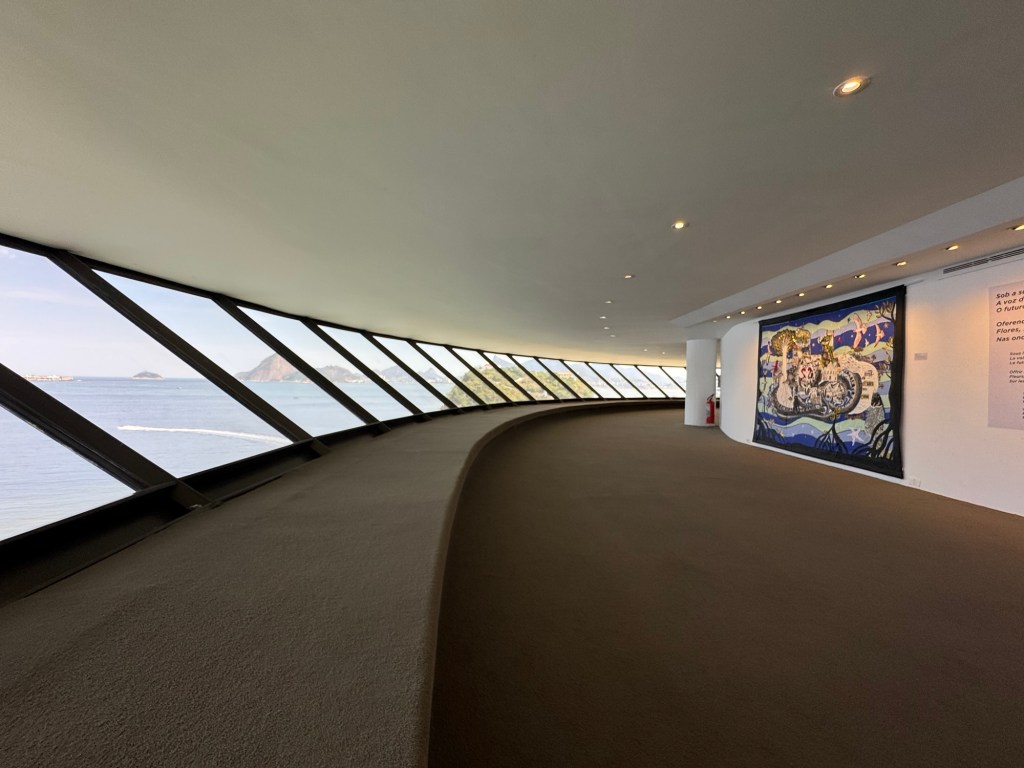
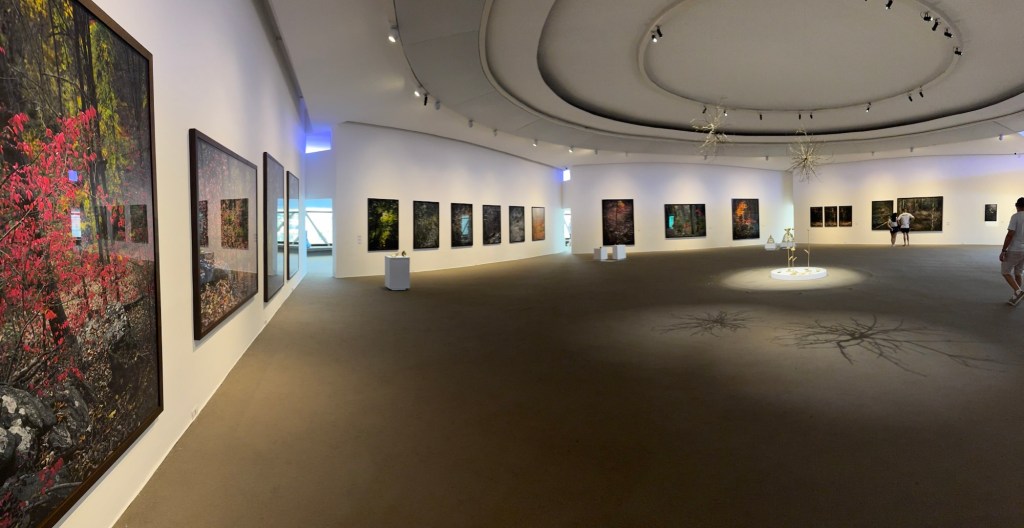
The windows on the first floor offer a 360-degree view, while the exhibition space, mostly sheltered from the daylight, is kept in the center of the construction. Standing on a single, slim column in a pool of water, which reflects the sunlight on to the underside of the building, the whole structure appears to float in mid air.
In addition, the museum features an upmarket restaurant in its basement, where the eyes of the guests are kept just above the ground level, so that every little detail and every small reptile or bird on the lawn outside the windows can be viewed, combined with the city on the other side of the bay.

A few days later I arrived in Brasilia, and as it was already night by then, the only Niemeyer structure located near my hotel was the TV tower, which, illuminated in lavender indigo, appeared to levitate in mid-air, as the lights on the supporting columns had intentionally been turned off. Sadly, I had to leave it by this first impression, as a nocturnal stroll along the mostly deserted streets towards the government buildings had come with a serious health warning…
Getting up early the following day, a short taxi ride delivered me to the entrance of the Metropolitan Cathedral and by this to the starting point of this so long scheduled visit.

A circular structure of colourful glass and white reinforced concrete, this building looked nothing like a church, but more like a glass bowl for sweets one might have found on a nineteen sixties urban dinner table. Even the bell tower had been kept quite a distance away from the building and faintly resembled an oversized fork or a candle holder.

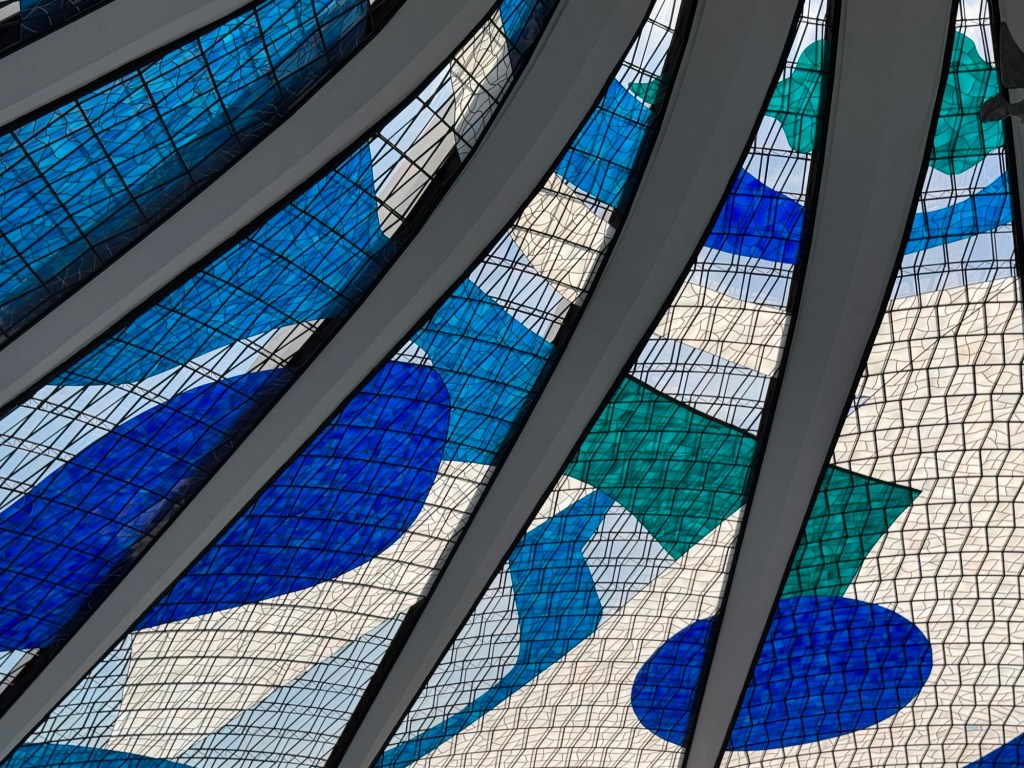
The inside of the cathedral was bright, with the glass of the roof kept in white and in different shades of blue and green. Suspended from the ceiling were a couple of angels.

The only feature that could have reminded an unprepared visitor of a traditional clerical building, was an abandoned wooden cross placed a bit out of sight against the wall. There was nothing here that produced the sometimes dreary, depressing, self flagellating, dark and guilt-ridden atmosphere of a traditional church. No crucifixion, no martyrdom of saints and no graphic portrayal of the final judgement.
Well, I thought, that is what you get, when you ask a communist to design a church….
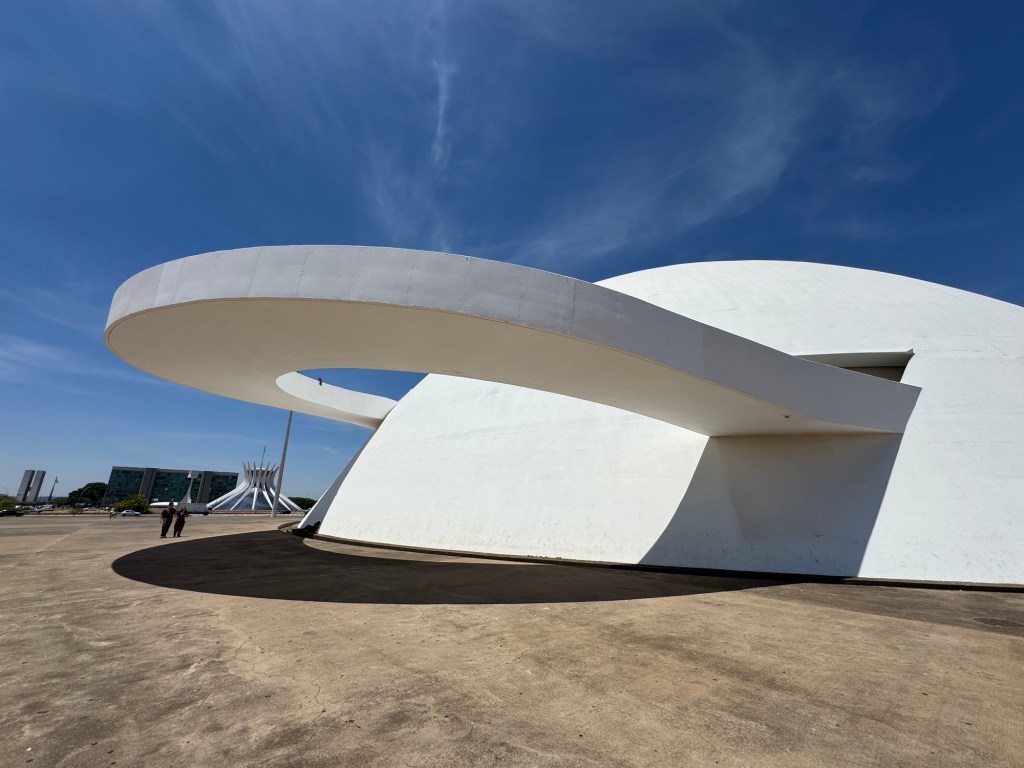
Next to the cathedral, slightly uphill, were the National Museum and the National Library.

The first one, again a domed structure, reminded me of an Igloo with a near impossibly suspended gangway circling a fair part of the museum. Without doubt this feature must have given the structural engineers a few sleepless nights.
The nearby library looked far more like a plain office building, if there wouldn’t have been the delicate rounded supporting arches at the first-floor level, that made all the difference and that aligned this building with some of the central government buildings further down the road.

Walking now along the “monumental axis”, the central highway towards the main state buildings, one had to pass a double row of plain and functional office buildings that housed most of the individual government departments.


At the end of these columns of administrative buildings, followed the more upmarket Palacio Itamaraty, which housed the Department of Foreign Affairs and on the contralateral side of the axis, the Department of Justice. Both of these buildings were surrounded by water and were accessorised with abstract sculptures. The Palacio da Justiça featured the above mentioned waterfalls. A white circular sculpture in-front of the Foreign Office, was by Bruno Giorgi, symbolising the five continents.

These buildings were the entrance to the center of Costa’s urban plan, to the head of the arrow, to the cockpit of the plane – the Square of the Three Powers, the Praça dos Três Poderes, featuring most of the buildings that had impressed me so much, many years ago.

While dominated by the tall twin towers of the National Congress building on the west side of the square, which was facing on the other side of the square a giant flag pole (which was added later, under Niemeyer’s protest….) and a much smaller, more delicate building, that symbolised a dove and remembered a list of National heroes in a book of steel,
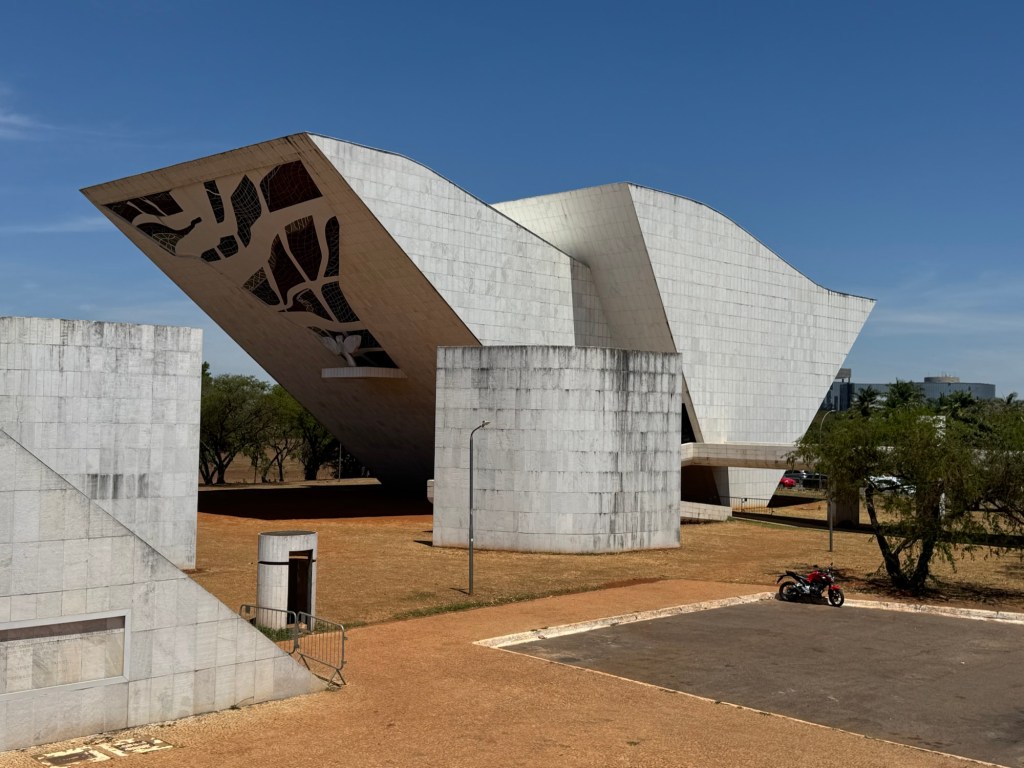
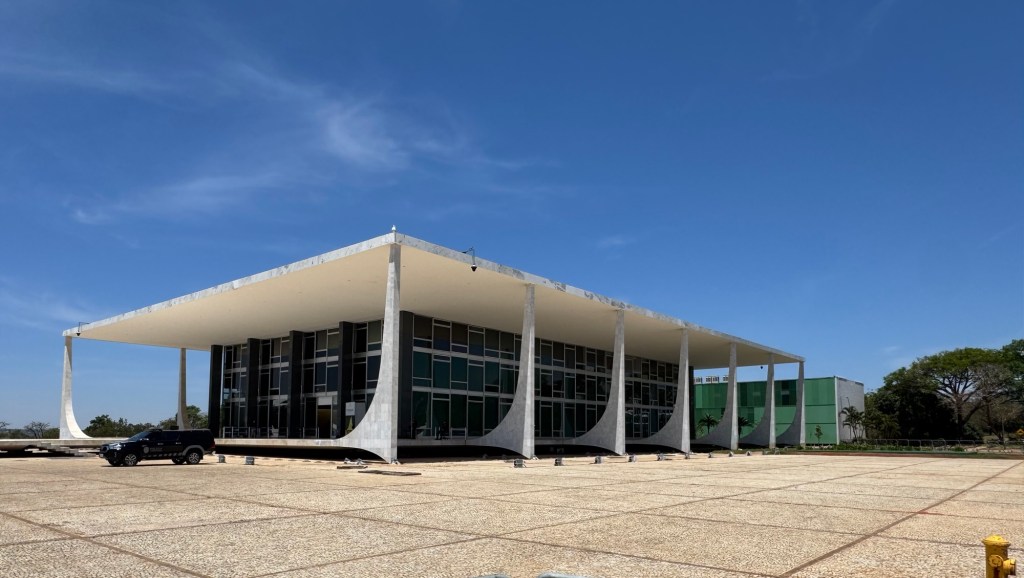
the real architectural stars were without doubt the Federal Court building on the southern side
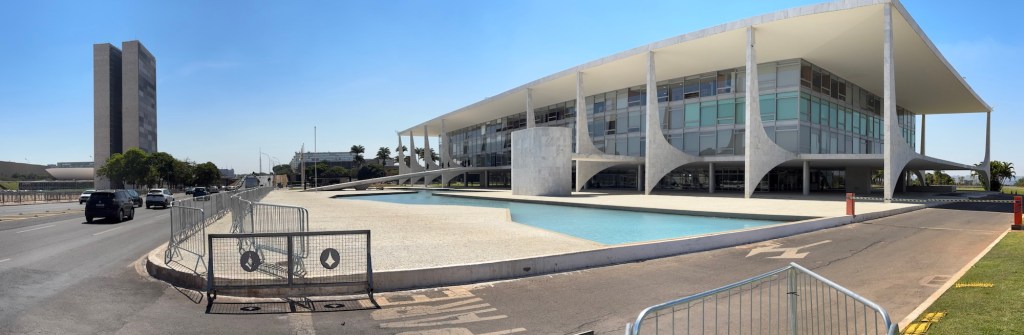
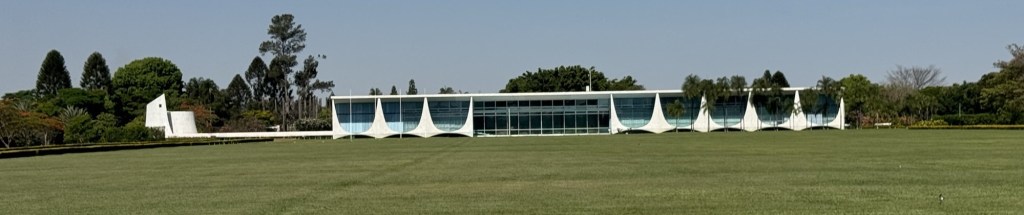
and the stunning Palacio do Planalto, which housed the Presidential Offices, on the northern side.

This building in particular, with its huge marble ramp and the large overhanging roof, supported by gently curved and yet very pointed columns, was quite rightly considered one of Niemeyer’s master pieces.

The distance between all these buildings was covering the best part of two kilometres, and with the mid-day heat now transforming the square into a frying pan, there was some much needed shelter provided in a small café on the eastern side of the square.

This stylish place – of course also designed by Niemeyer – was a partially subterraneous structure, which kept once again the eyes of the guests, once seated, at a level with the surface of the square, a detail that was later repeated in Niterói.
While recovering with a cold drink, it became clear to me that all the other famous buildings had to be explored with the help of a taxi. The equally stunning Palacio da Alvorado, the presidential residence, which features similar columns as the Palacio do Planalto, the pyramid-shaped National Theatre building, the National Football Stadium with its exoskeleton of seemingly a thousand columns, the dome shaped giant food hall next to it or finally, at the tail end of the Axis, the JK Memorial and the Memorial dos Povos Indigenas – all of them outstanding architectural statements and each of these buildings worthy of a chapter of their own.

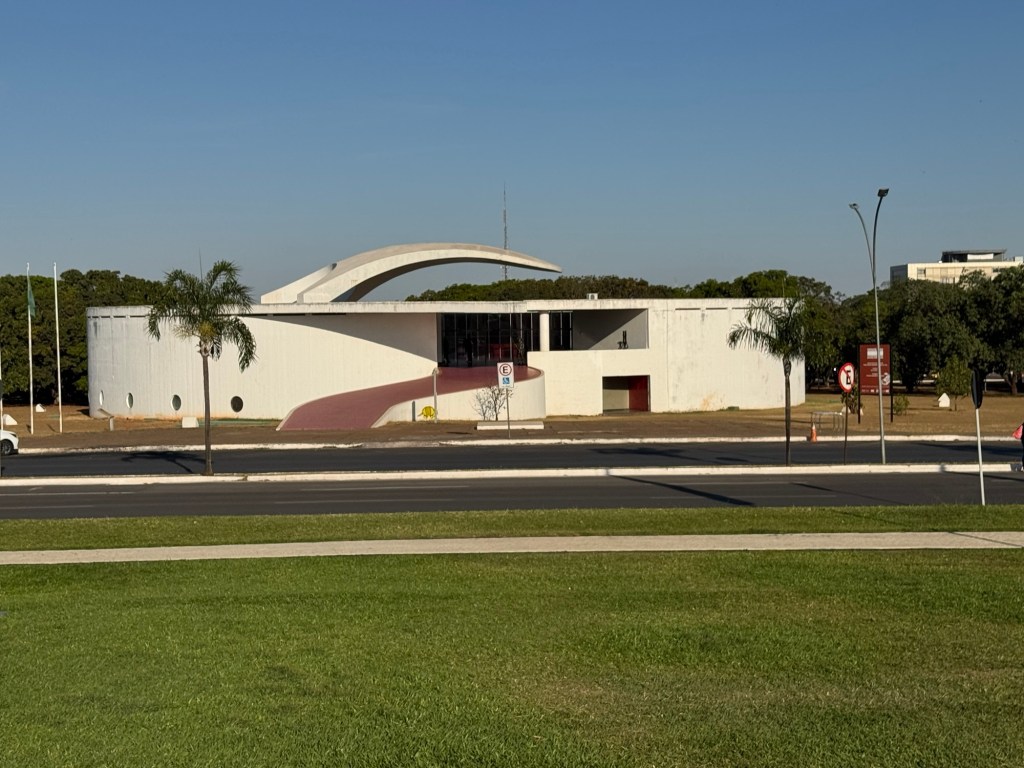

At the end of the day, I was exhausted, but unexpectedly well hydrated because of the half litres of freshly squeezed strawberry juice, which cost the equivalent of 50 pence (I think I enjoyed three of them…) at the restaurant inside the JK Memorial.
Walking up the hill from the Congress building towards the Department of Justice, I noticed a man with a large cowboy hat, who had befriended a small white heron.

For some reason, this looked out of place….
Here was an interaction between an animal and a human being that hadn’t been planned, that wasn’t part of the design, that distracted from the grandeur of all the monumental, once groundbreaking structures and from the system of highways around us.
And with this, the giant floor of places like Brasilia became apparent.
Cities that have not grown, but that have been conceived in an urban planning office, based on plans that then had been dictated by an autocratic ruler or – as in this case – that had been agreed on by a committee of a few men (and often no women…) and that finally were build as a giant national project, usually fail to make the people happy, who have to live in them.
While Dubai might have an appealing warm climate and might be a great place for shopping, while Milton Keynes might offer great work opportunities and affordable housing and while Songdo might offer a Free Economic Sone, Satellite Campuses of renowned foreign universities and an excellent road infrastructure, no one is drawn to these places because of their beauty, of their appeal as a place just to live there. No one, unless forced by financial or by other constraints, would seriously choose to retire in these places.
There is a good reason why cities like Barcelona, like Istanbul or London are continuing to grow, despite the poor infrastructure, the strained health services and the social economic problems they might have. It is because they have a soul, they have a history, because they have a personality that has grown over hundreds if not thousands of years and that have stood the test of time.
Brasilia, with its astonishing, monumental buildings, which quite rightly deserves its World Heritage site status, is like a carefully arranged dish without taste, like a Burgundy wine with a deep red hue, yet without flavour, body and finish. It is like a beautiful person, but without wit, charm or character, completely devoid of personality.
There was a good reason why Niemeyer, while enjoying the time during the construction of all of these buildings in Brasilia, eventually decided to spend the final days of his long life in a flat on the Copacabana in Rio de Janeiro.
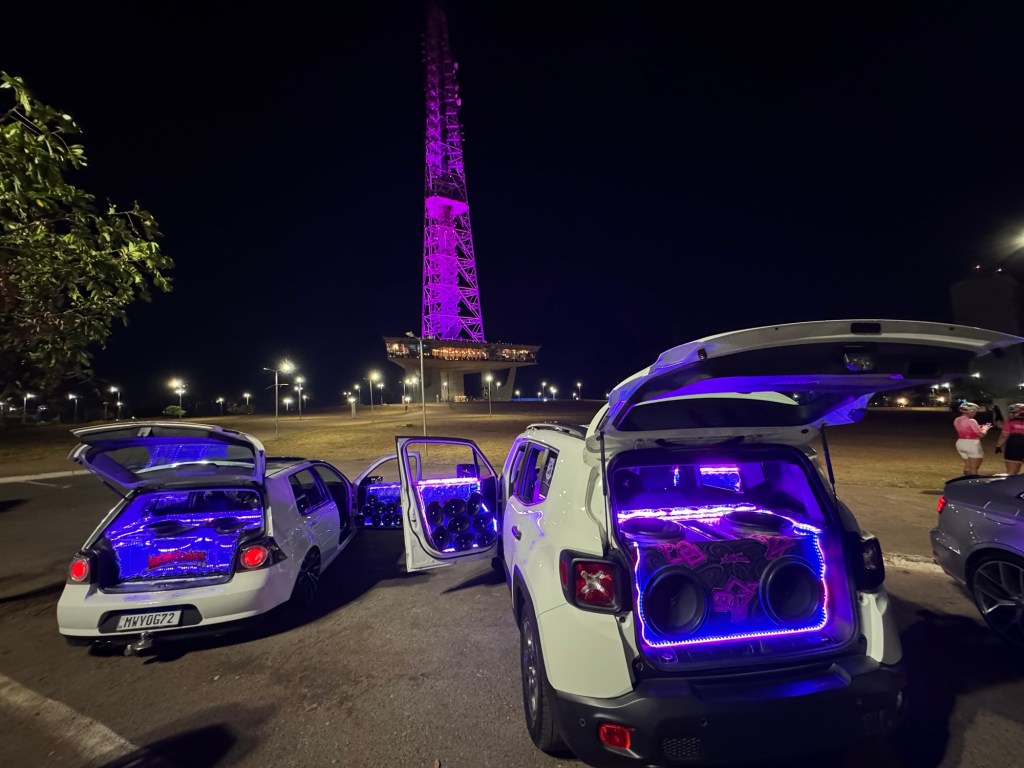
Strolling back from dinner at the restaurant at the base of the TV tower, I walked straight into a gathering of tuned cars.

All lowriders on steroids, that had a ground clearance of not more than 10 centimeters, their bodies polished to a lustrous shine and the interior of all of them packed with obscene numbers of loudspeakers and LEDs, which probably required a second alternator to provide them with the necessary power.

While the TV tower made a perfect backdrop for this rally, I considered it to be a very fitting end to my stay: Brasilia, I found, is probably more a city for cars than for people and it is unlikely that I will make again a detour for a visit.

 The Blue Vet Diary
I recall my amazement at the
LikeLike
whole business of the Brazilians just moving their capital out to the wilderness and putting up all those futuristic buildings to house the various government functions. As a child at the time, the whole idea of it just didn’t register as possible! I believe the plan to encourage settlement of the interior eventually sort of worked.
Doug Thomas
LikeLike