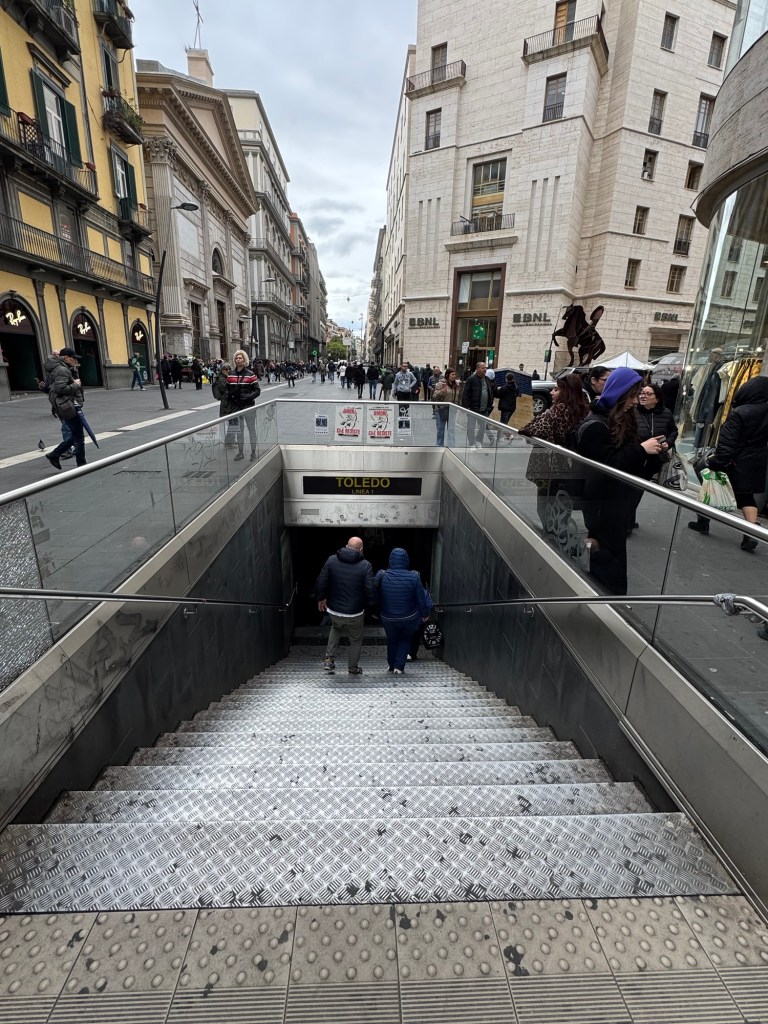
Ignoring the large array of souvenir and fashion shops, the street vendors and Italian food outlets along Via Toledo, Naples’ main shopping street, that separates the narrow lanes of Quartieri Spagnoli, from the banks and public buildings of San Giuseppe, I am descending into the local underground station to purchase a train ticket without any intention of using this form of public transport.
For the very reasonable price of 1 Euro and 50 cents, I have in fact entered one of Europe’s most unusual art installations.
The general idea, that underground stations could be more than just a functional assembly of escalators, platforms and tunnels, designed to ferry people to different parts of a city, is not new.
Whoever had the opportunity to visit the underground stations in Moscow or St Petersburg, and witnessed their grandeur, the opulence of decoration, the quality of the material used and the generous application of space and light, could understand what a great opportunity metro stations provide to convey a message or to interact with the millions of travellers who are passing through them on a daily basis.
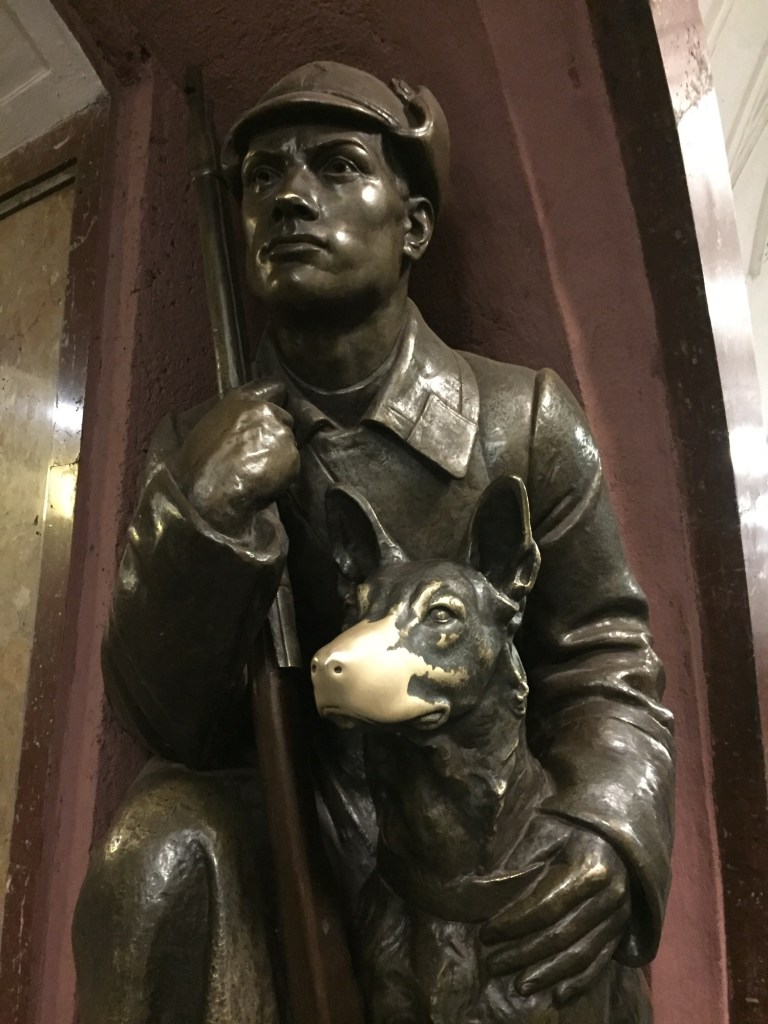
In stalinist Russia the intention was, to provide the working class with the illusion of their own palaces, to distract from the miserable existence they had anywhere else for the rest of the day.
The London Underground – with a few exceptions – compares as more functional, but at times claustrophobic. Here commerce and advertisement, predominantly promoting local entertainment or the benefits of various food supplements, appears to be the dominating theme.
At Toledo station, where advertisement is kept to a bare minimum, commuters are confronted with a playful and at times ingenious mixture of art and design, that in the opinion of some commentators have made it Europe’s most beautiful underground station.
Designed by Spanish architect Oscar Tusquets and featuring murals and installations of various artists, the station was opened in 2012, as the center piece of the Art Station Project. A visit can best be summed up as an audiovisual combination of a psychedelic ride and a deep sea dive, with the difference that you do not have to take any drugs and you will not get wet….
My descend from the Via Toledo exit, made possible by the purchase of a single journey ticket, has started gentle and unspectacular enough with just the remnants of an ancient fire place reaching out of the wall on the right side of the entrance and a mosaic, with references to the history of Naples, to the left, as the only decoration at this level.
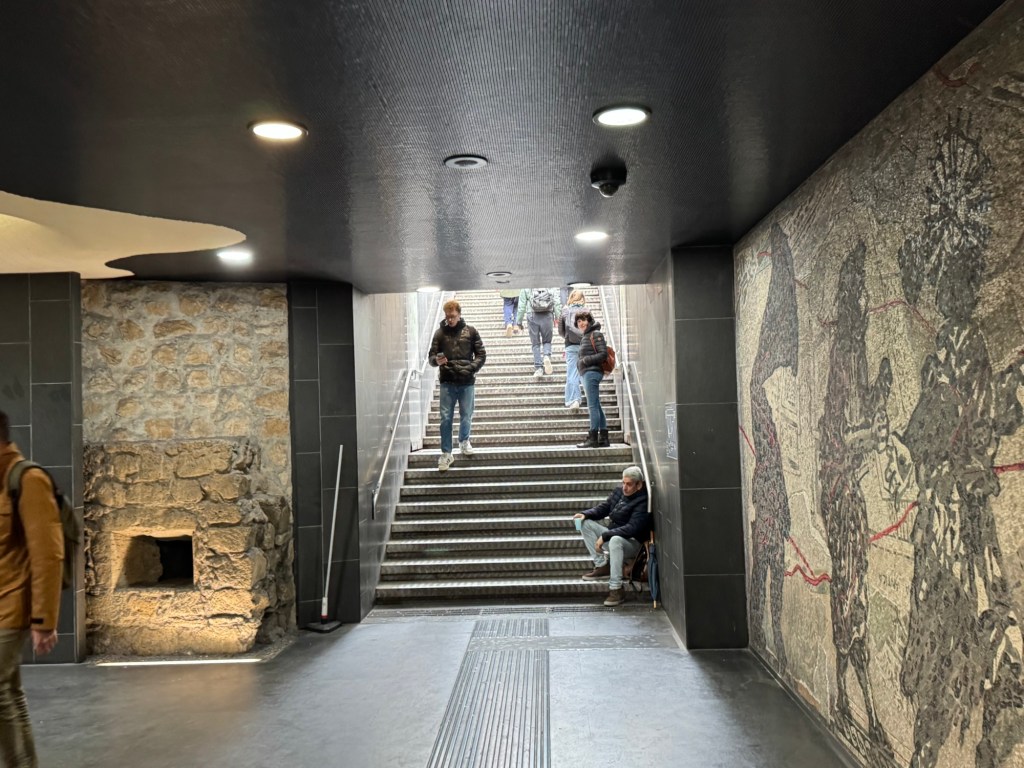
A short flight of stairs brings me past the gates and on this level, the walls are now kept in yellow and ochre, referring to the Neapolitan sun and soil, that is covering the fields and the hills around the city.
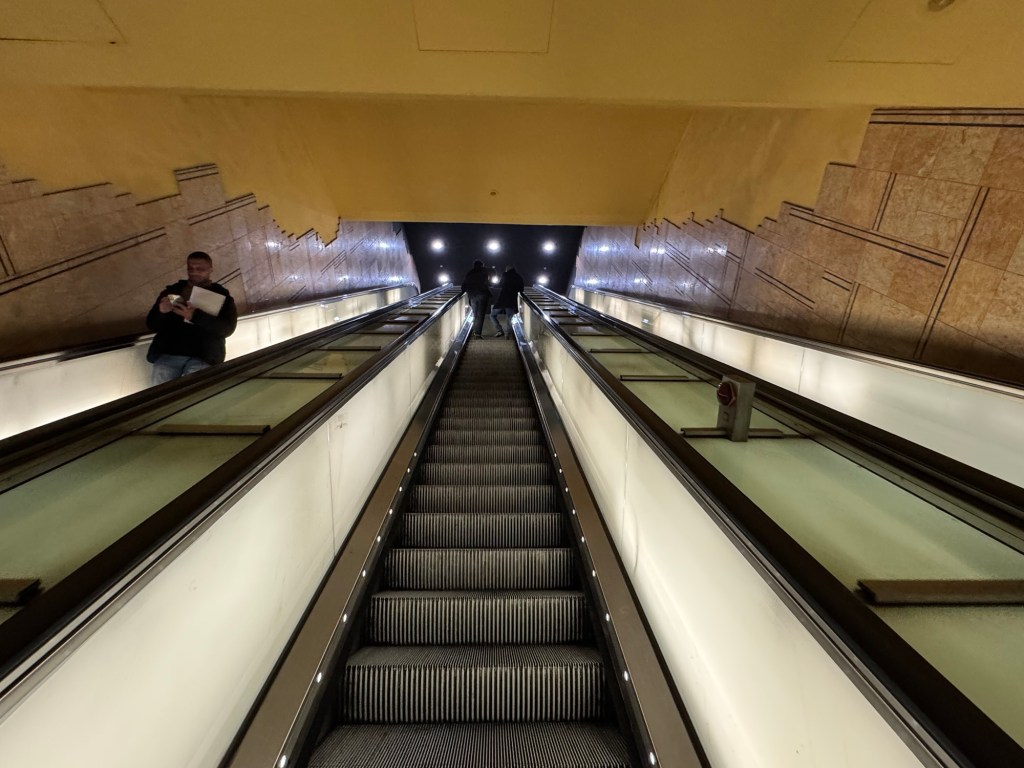
Getting on to the next escalator, the scheme changes again, from the rather plane yellow, to an irregular pattern of small, glazed white and blue tiles, that reflect any source of light, depending on the direction and the colour of the source.
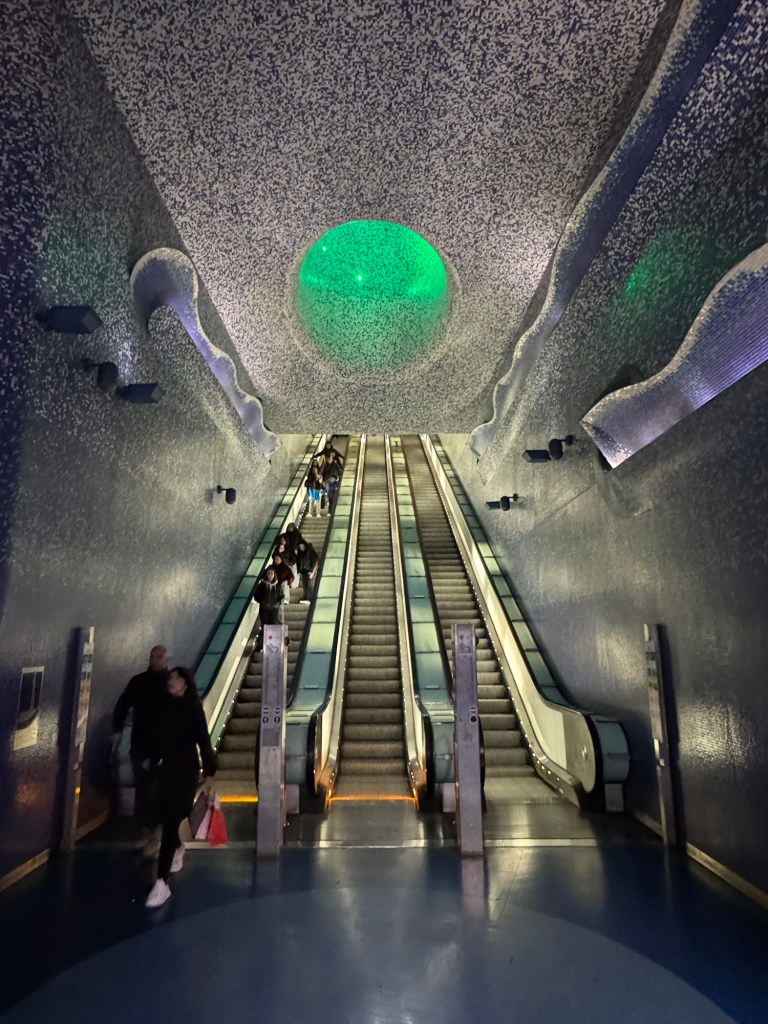
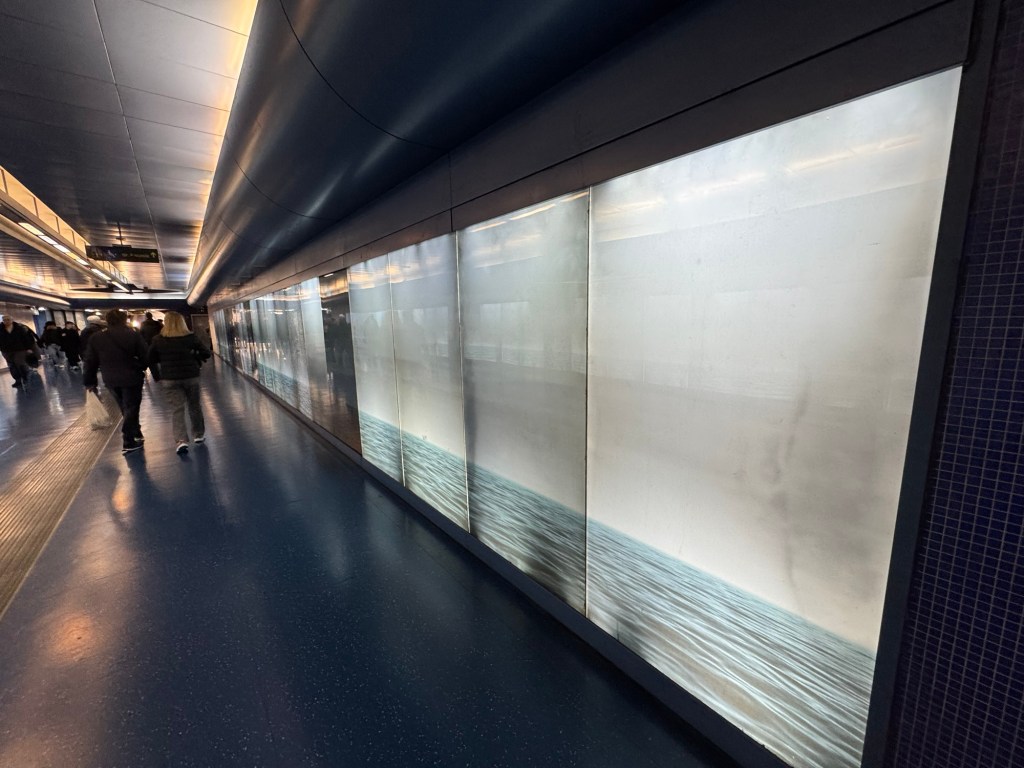
This is used to great effect in the “Crater de Luz”, a large cone penetrating through nearly all the levels of the metro station, where a ray of daylight is blending with that emitted by green and blue LED lights inside the opening. This unusual, yet instantly eye-catching feature is indisputably the highlight of the metro station, creating constantly changing light effects at the bottom of the escalator, from where, divided by a tunnel, the platforms, kept in deep blue, can be reached. The tunnel itself has screens on both sides, reproducing the surface and the sound of the Mediterranean Sea.
Most visitors seem to be so in awe at this point, taken by the hallucinogenic effect of the Crater of Light and the tunnel, that lets you walk across the Sea, that they fail to venture even deeper into the structure, where a long corridor, crossing underneath the Spanish Quarter, with the photographs of two thousand different people along the wall on one side, is displaying the diversity of the citizens of Naples.
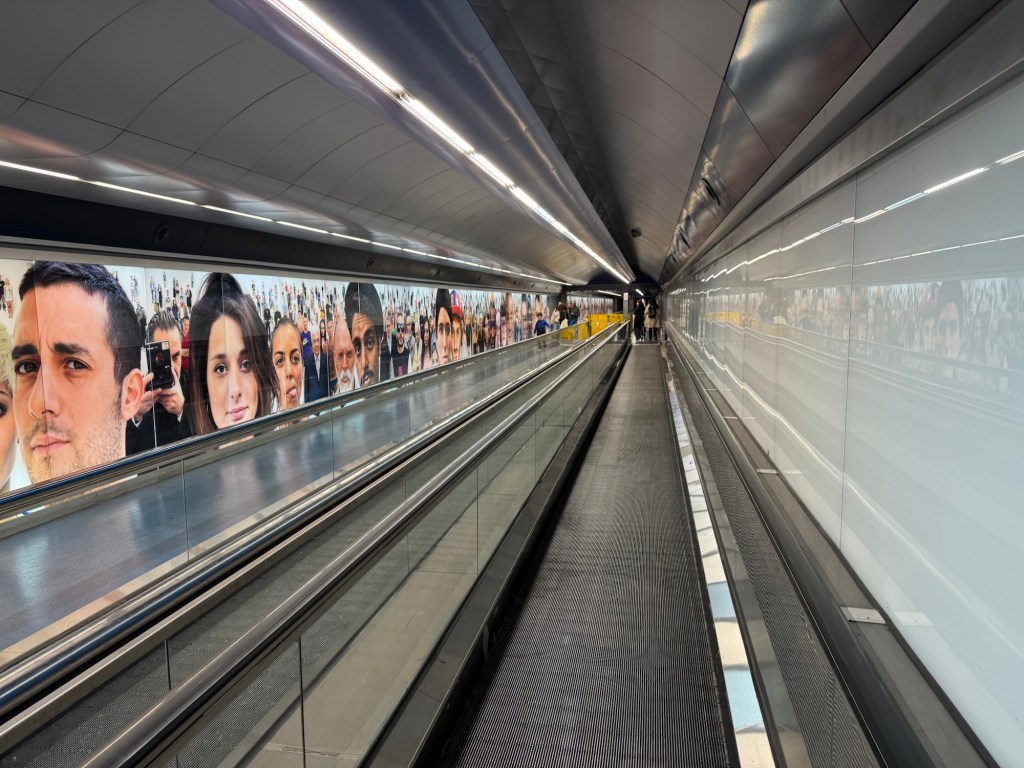
The corridor, now virtually devoid of travellers, is leading to a second exit at the Piazza Montecalvario, right in the center of Quartieri Spagnoli.
To get to the street level, I am again following several flights of escalators, this time in the reverse order of the colour scheme.
On each level, a different art installation is waiting for me.
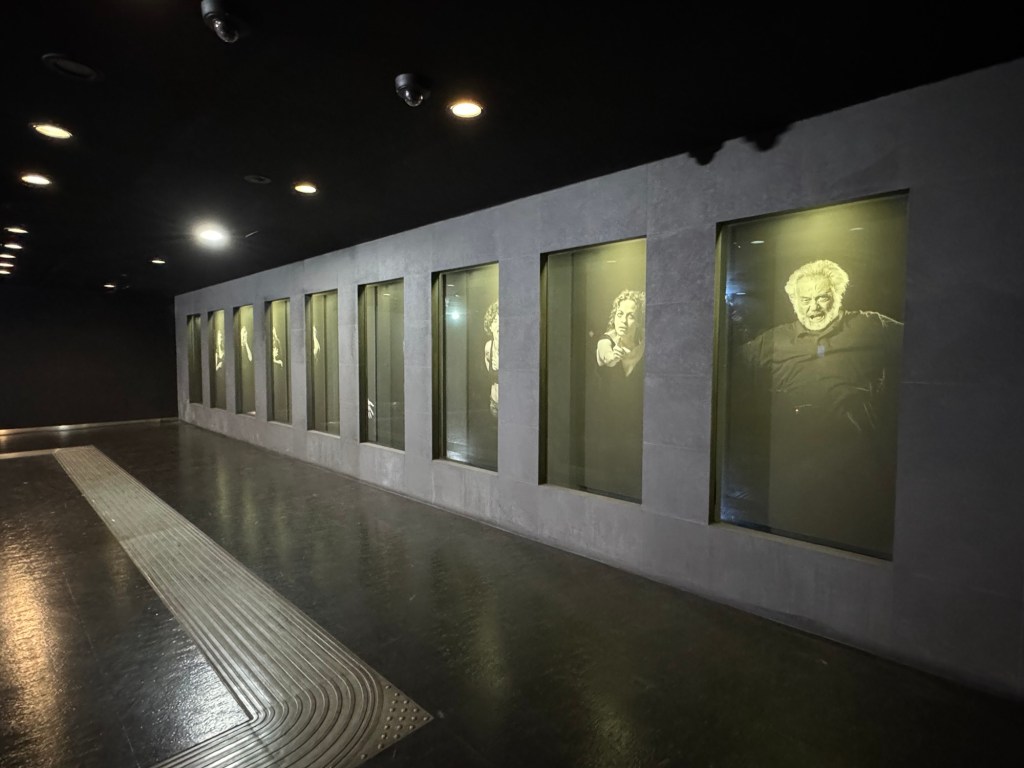
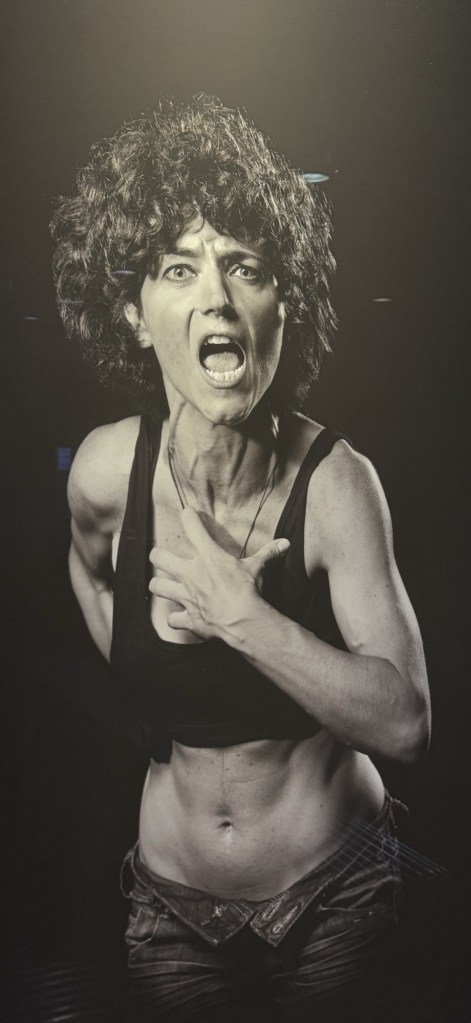
At the ground level, life sized, black and white photographs of people in rage and despair make for a very engaging wall decoration. I am expecting that any minute, these characters might jump out of their pictures and shout at me.
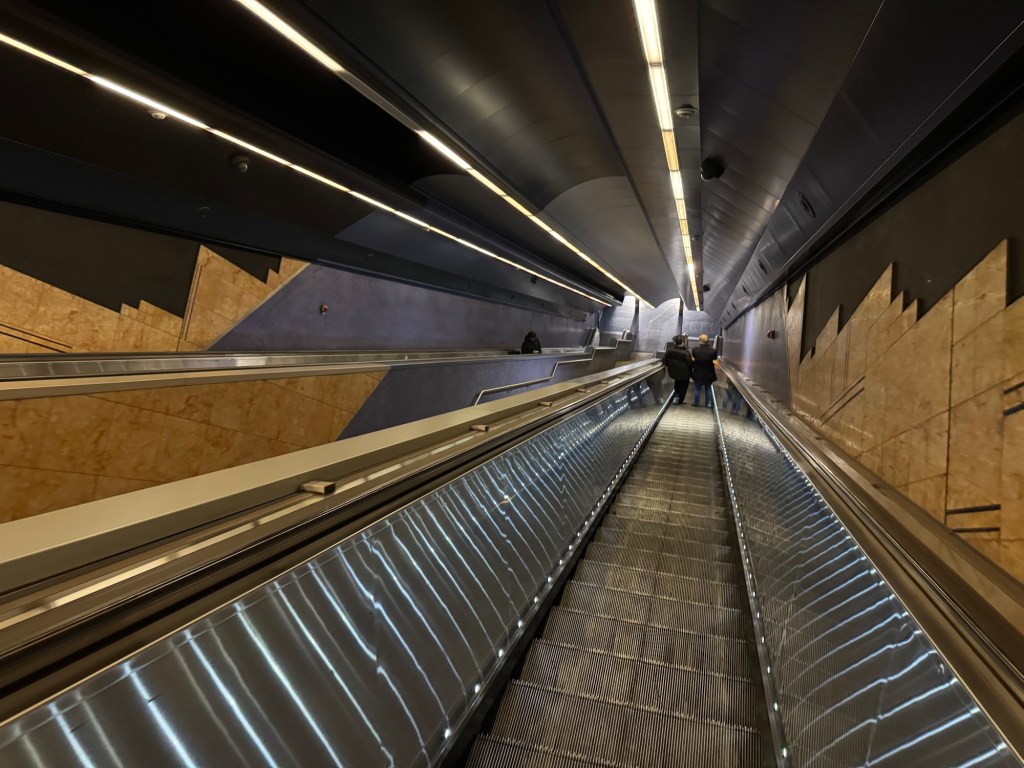
I am moving on to the next escalator, where the walls feature again the ochre colour of the local tuff, but now there is a starless night sky.
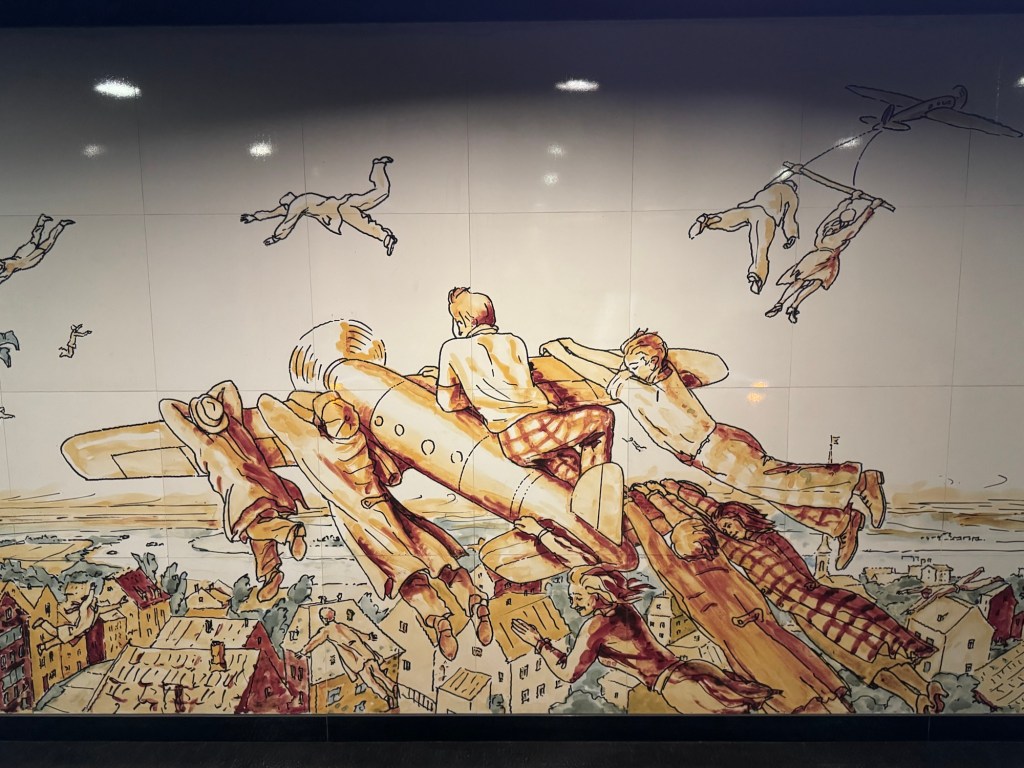
Next, I am standing in-front of a large mural, that shows a naïve display of the city where the citizens are flying through the air, aided by simple contraptions that are pulled by birds, by hanging on to the wings of planes or floating completely unsupported, as if taken out of a Selma Lagerlöf narrative.
Eventually, another escalator delivers me to the barriers at the street level of the piazza.
This final level is decorated by a partially shredded, yellow band of traditional dancers, that have formed a long, undulating line through a rugged landscape.
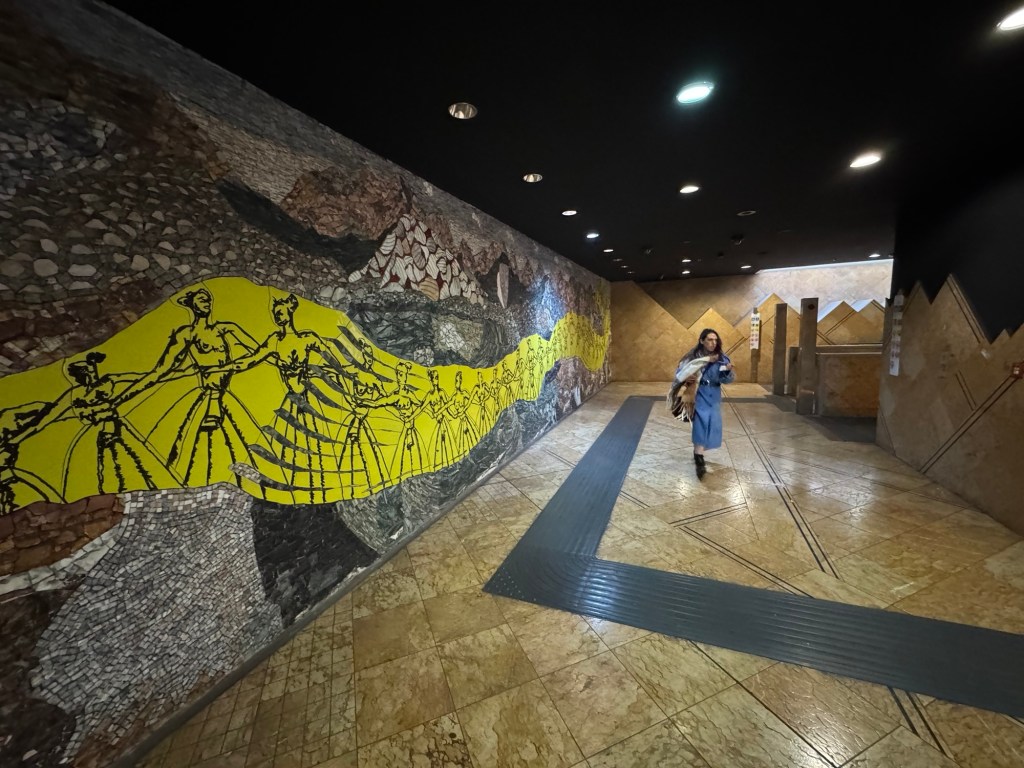
At the end of this unexpected underground excursion, I am finding myself outside of the station, in the middle of a small and peaceful piazza, agreeing with myself that this was probably the cheapest and best invested underground ticket I had ever bought for a train ride I never took.


wow, been to naples but didnt see any of this.
LikeLike
You must visit the next time – the best things in life are often not advertised….
LikeLike