
It was at the end of another locum placement high in the Swiss mountains, when Joana, one of the nurses, entered the consulting room. There would be the euthanasia of an old Husky and the owners were asking, if I would mind coming to their farm to put their dog to sleep….
“Of course, I wouldn’t – in fact, I would prefer to do it that way.” was my reply.
Whenever I have had the choice, I had euthanised my own pets at home and I had always offered this option to my own clients.
Euthanasias are a complex subject and an area where the human medical and the veterinary points of view are least aligned.
The right to euthanise a patient is both a privilege as well as a mental and an ethical burden. Always controversial, always a subject of debate. Always just a last resort, at the end of prolonged suffering or of a fast-deteriorating quality of life. But over the last few years, in veterinary patients, also more frequently the only remaining option, when the owner’s financial or personal circumstances no longer allow the continuation of treatment.
Thankfully, this was not the case here. Nook was old and with winter on its way, they felt that his time had come. He had received regular medication over the summer months, but now he had started to deteriorate.
So the euthanasia was scheduled for Friday afternoon, as my last appointment.

Unsurprisingly, as with all acts of clinical practice, there can be good and bad euthanasias and there has been good and not so good training to prepare for this procedure.
Likewise, some veterinarians are very good at it, while others are struggling. Not because they have done anything wrong from a technical perspective, but because they might have failed to show the right level of empathy a pet owner had expected.
When I studied in Hanover, in a class of 230 students, my training for this procedure covered just the technical aspects – the choice of drugs used, the routes available to administer the medication and the means to confirm, that a patient indeed had passed away. In addition to this, following the deep sedation of the patient, instead of a barbiturate, a drug was used, that caused a blood clot in the heart and the main blood vessels, similar to a massive stroke, to end the life of the patient.
Not an ideal solution….
How different then was the guidance I received a couple of years later, when I did a clinical internship at the vet school in Oslo, where we were just a group of six aspiring veterinarians. The session started with a cup of coffee and a sit down around a table in the social room of the small animal clinic. While technical aspects formed part of the session, the focus here was far more on the ethical aspects of taking an animal’s life, on the mental state of the owners and finally on our own mental health.
I will be eternally grateful for this session…
And yet, despite of all the preparations and the clinical training, I have had bad euthanasias and some that with hindsight could at least have gone better.
Most of these – thankfully – happened in the earlier years of my professional life and they were invariably due to poor communication or preparation on my part.
Problems arose when I had agreed to put an animal to sleep, while not all family members (often the children) that were present were completely comfortable with this decision, when I was about to start the procedure and realised that a vital piece of equipment was missing or not ready, causing an unnecessary delay for the animal and its owner or when I had failed to inform the owners in advance about what to expect when an animal is put to sleep.
With horror and shame, I am recalling some euthanasias, which we had to perform at the beginning of the pandemic, when we could not allow owners to stay with their beloved pets in their final moments, as this appeared to be the only way to assure client and staff safety. This carried on, until I realised that one of the branch surgeries I was working at, had a large, fenced in garden with a wooden bench, where the owners could take their dogs for a final walk and where they could sit down with their pets while they were falling asleep.
Eventually some of my most memorable and peaceful euthanasias were the result of this compromise.

And then there were other ones, that went so well, that they have stayed in my memory, even decades later.
Some years ago, one of my patients was a small terrier, owned by a very wealthy old lady. She usually arrived in a Mercedes convertible and always wore leather gloves when driving her car. Her dog was her only companion and he absolutely hated me. Invariably, he started snarling as soon as he entered the practice.
I tried to be as gentle as possible with him, and I limited any handling to the absolute minimum, but it did not make any difference. Eventually, when he came for one of his regular check-ups, he was much calmer and easier to examine. I took this as a bad sign. A check of his weight and a blood test confirmed that he was gravely ill.
When the time came to put him to sleep, I went to the lady’s house. By then he was very weak and was lying in his bed. I only had to give him a very low dosed sedative, and he did not even raise his head. The owner and I sat with him until he had fallen asleep while the Adagio of Rodrigo’s Concierto de Aranjuez played in the background, a piece the owner had selected specifically for the occasion. While I don’t know, if it made a huge difference to the little dog, the interplay of the Spanish guitar, the English horn and the string section in this piece of music was so fitting that the whole scene will stay with me forever.
Eventually, Friday afternoon arrived and Joana and I drove out to the sledge dog kennel.
I had worked many times before with Huskies and when these dogs were kept and used as intended, I have always found them very predictable and have never had a problem with them as veterinary patients.
A few years ago, I was sitting with a dozen Huskies in the large kitchen of a colleague in the wilderness near the Swedish Norwegian border, while having a cup of coffee and talking about veterinary life…. Each of these dogs could easily have torn me to shreds and yet, once losing interest in their visitor, they had all fallen asleep.
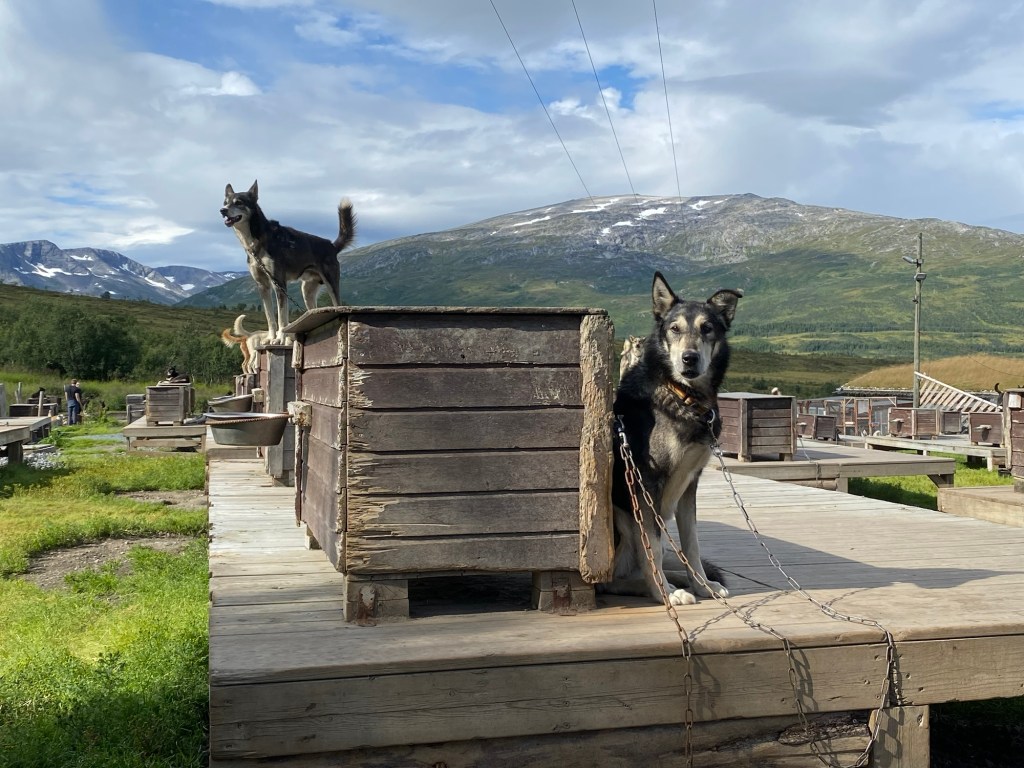
The life of these dogs is hard. They must endure brutal temperatures in the winter, are ill equipped for the heat of the summer and they have to run long distances, pulling often heavy weights.
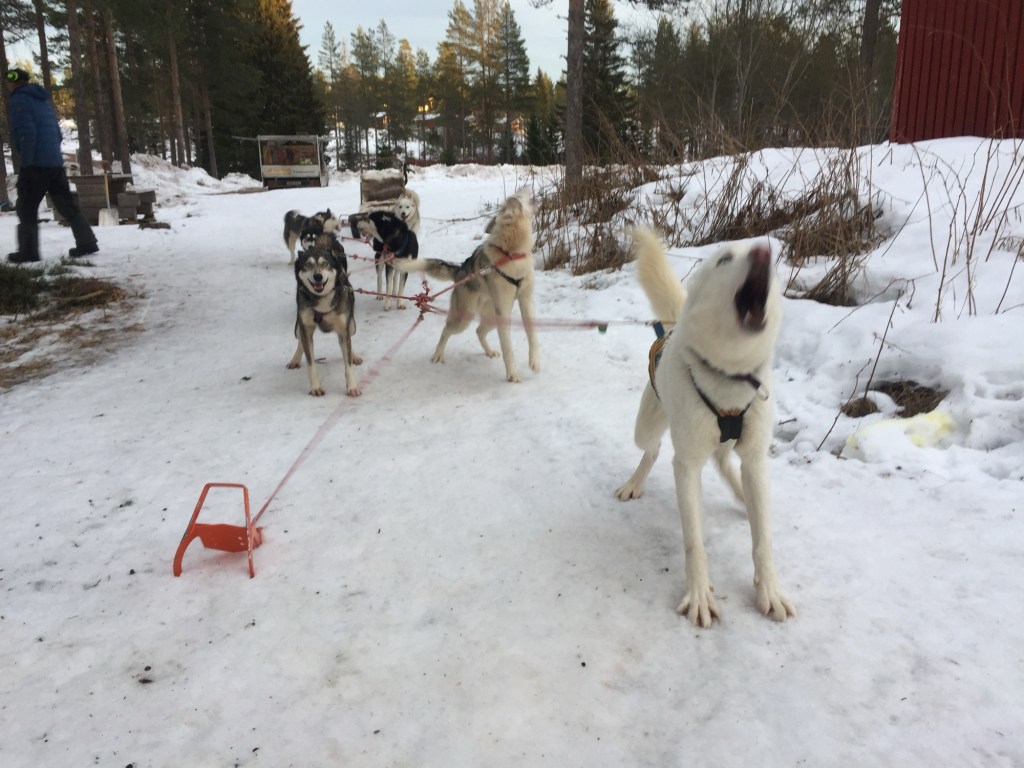
What keeps them going and mentally stable, is the social interaction with the pack, the competition with their peers and the attention and guidance they get from their musher. If all this is missing, the Husky can become a very difficult dog to handle. This is, what unfortunately happens to many urban Huskies that were obtained mainly for the colour of their eyes or their wolf-like appearance.
Not so at the farm.
When we rolled on to the yard, we saw the whole family, parents, children and a pack of probably 40 sledge dogs of all ages waiting for us.
The Huskies were kept in social groups in their open pens, where they remained, until they were allowed to come out by their owner. All were well socialised and the children walk among the dogs freely.
After satisfying the interest of a few puppies that were not yet used to the kennel rules, we started to prepare ourselves. A large blue tarpaulin was laid out on the ground near the house and Nook was called to join us.
Slowly, very stiff but with a wagging tail he came out of his pen, greeted us, and inspected our bags. He was thinner than most of the other dogs and he clearly was no longer as well muscled as the younger Huskies. The owner told us, that he had never been a leading character, but that he was – even in old age – well respected in the pack and that he had always been a very good sledge dog.
When Nook and everyone around him had settled on the tarpaulin, I gave him his sedation. I had chosen the thinnest possible needle, and he did not even seem to notice. We then continued talking. The owners told me about the challenges of running a sledge dog business in the Alps, while I reflected on some of my experiences with these dogs and with their owners in the north of Scandinavia, including my first single- handed caesarian section on a Siberian Husky, who’s owner had traveled over 200 kms through the tundra to get help from me – a 4th Year veterinary student with just a temporary license…..
Not only the dog, but also all the puppies were fine in the end.
Eventually, Nook had gone to sleep, so that I could place an i/v catheter and give him the final injections. He passed away peacefully in the middle of the yard.
We then placed him into a crate, and the owner started to call one group of dogs after another to come forward to inspect him for the last time. For the owners this was important and I observed it in utter fascination.
Most of the adult Huskies walked up to him, sniffed for a brief moment and then lost interest, others backed away from the body with signs of uncertainty and possibly some confusion and fear. The puppies and the juveniles jumped around the cadaver of the old dog expecting some sort of game. None of the older male dogs tried to mark on or near the cadaver and none of the Huskies howled.
When the procession had ended, we collected our equipment and before leaving, I said to the owner:
“This was probably the least stressful way for him to go. He was among his family, and he didn’t know what was due to happen to him when he walked up to us.”
“Oh, he very well knew….” was the knowing reply of the musher.
Of course he did I thought….



Beautiful ❤️
Thank you for being with me in my dogs last moments in your own time. Never forgotten xx
LikeLike