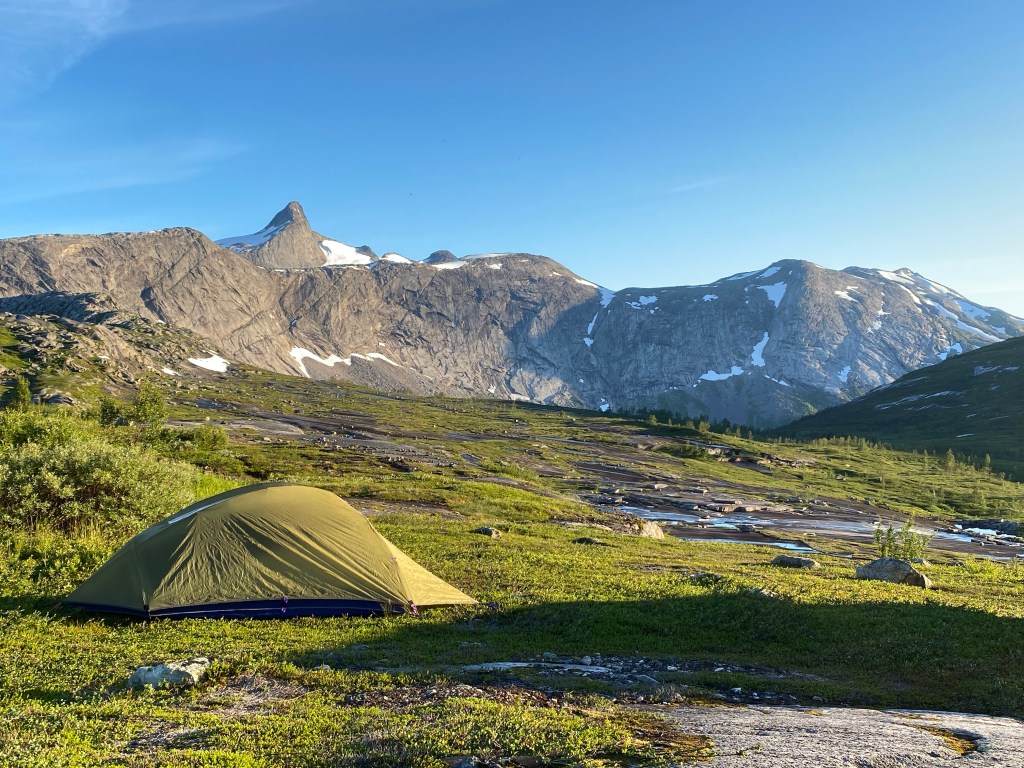
My intermezzo with the friendly team in Aberdeen was ( as planned) just a short one, but it provided me with the opportunity to fit in a few days of hiking in one of Britain’s finest mountain ranges – the Cairngorms.
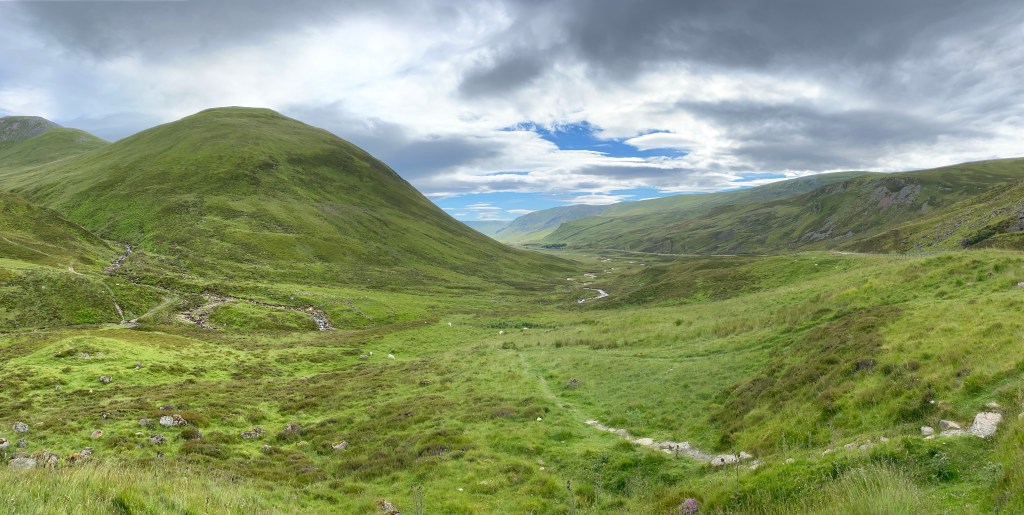
Not even an hour’s drive away and I was surrounded by rolling green hills, by streams and waterfalls and the ever present sounds of herring gulls was replaced by that of oystercatchers, curlews and terns.
My companion on the trip to the mountains was my colleague Sean Wensley – or better the audio book version of his impressive literary debut “Through a Vet’s Eyes” where he is juxtapositioning the keeping of domestic animals in the 21st century with his own ornithological observations. A not surprising, but still very sobering account with a lot of graphic detail. As brilliantly written and as important as this book is, I have to admit that is one of these volumes that I can only get through in the form of individual chapters with a fair amount of breaks inbetween.
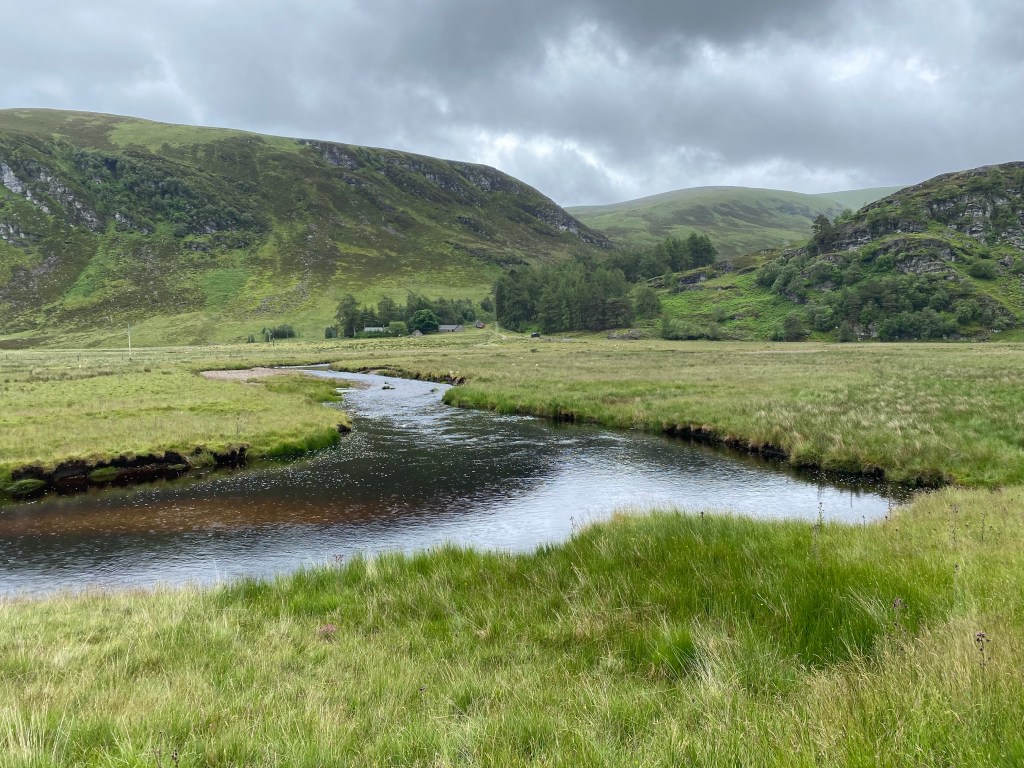
….and these you get enough of by just following the river Dee west.
Similar to the countyside in Wales, I consider the Cairngorms – compared to their much larger Scandinavian and Alpine cousins – as very forgiving mountains, allowing for shortcuts if you have veered off the track without running too much of a risk of falling off a sheer mountain side …..
Of course you have to be prepared for midges and a fair amount of rain , but after all, this is Northern Europe.
On my way towards Glasgow I had to treat myself not only to a visit of probably Her Majesty’s favourite residence,
but also to the great British institution called “Cream Tea” , admittedly without the company of the land lady……
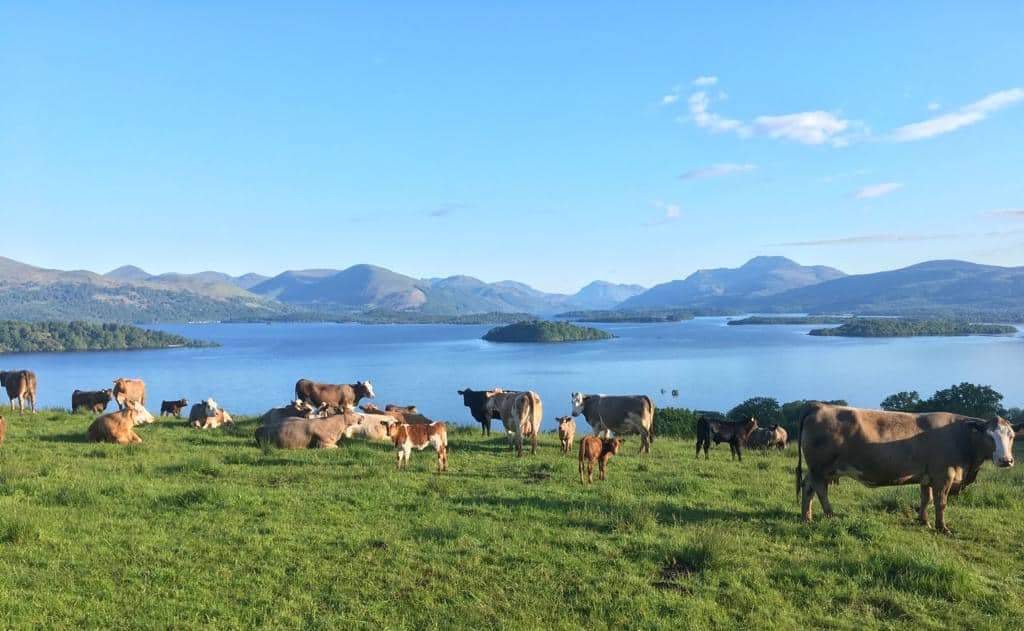
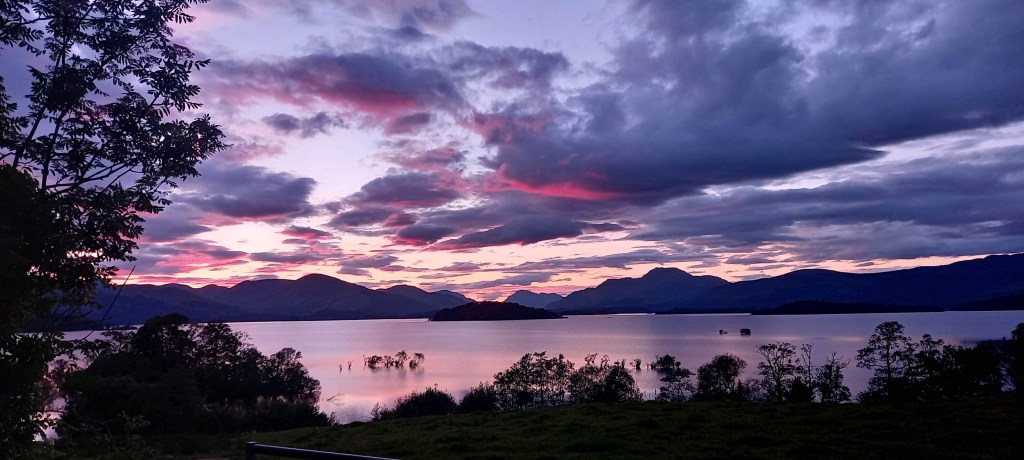
To finish this first veterinary adventure in style, I paid a visit to the beef farm of my famous Scottish colleague Freda Scott-Park and her husband David in a unreal setting at the shores of Loch Lomond.
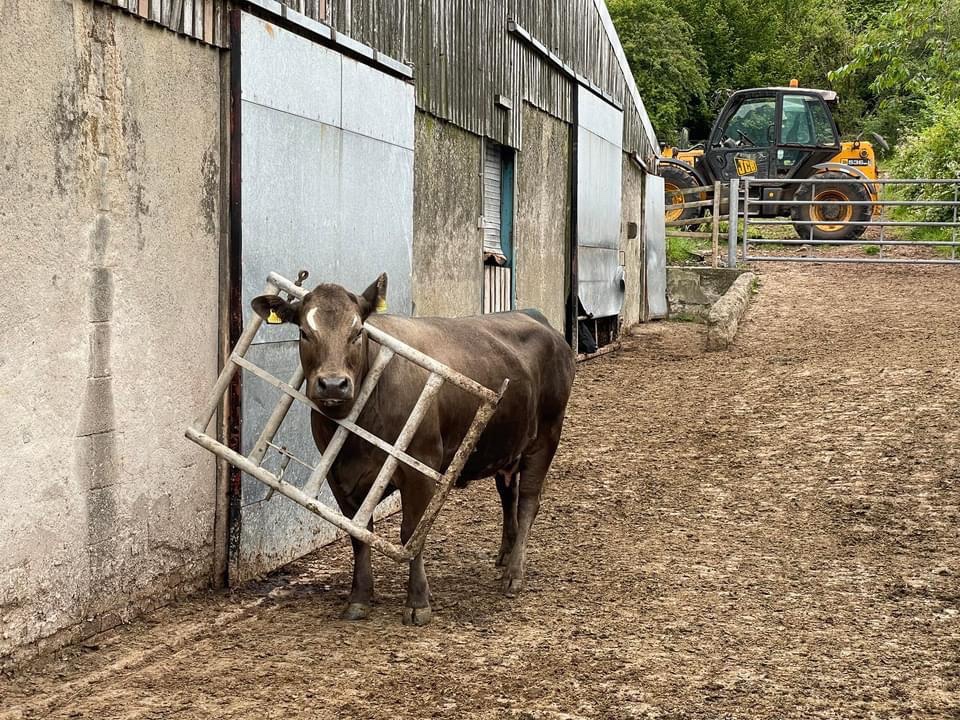
When driving onto the farm yard, I was presented with a case that made me once again appreciate the decision I made many years ago to stick to treating just companion animals ……
800+ kg of distressed bovine muscles combined with 30 kg of solid steal gate can ruin your health or even finish your life in a matter of seconds if you are taking the wrong decision with such a patient. I was grateful that a far more skilled colleague from Glasgow Vet School resolved this problem with the help of a decent sedation.
Photo by Nisha George
This left us with enough time for an unforgetable dinner on an island of the lake as a lasting memory of Scotland .
From the “Stone City” to the “Granite City” and from timber to oil – it was time again to pack my bag and to try out a new place (actually the first of a few new places I have planned this year….).
To make a start I contacted my agent and suggest to give Scotland a go, especially as I had virtually never been there despite living on these Isles for nearly three decades….
Sure enough, there was an opening in the far North East, in Bridge of Don in Aberdeenshire. This was perfect for me as the Cairngorms are in easy reach from there and I was looking forward to explore the famous coastline up there.
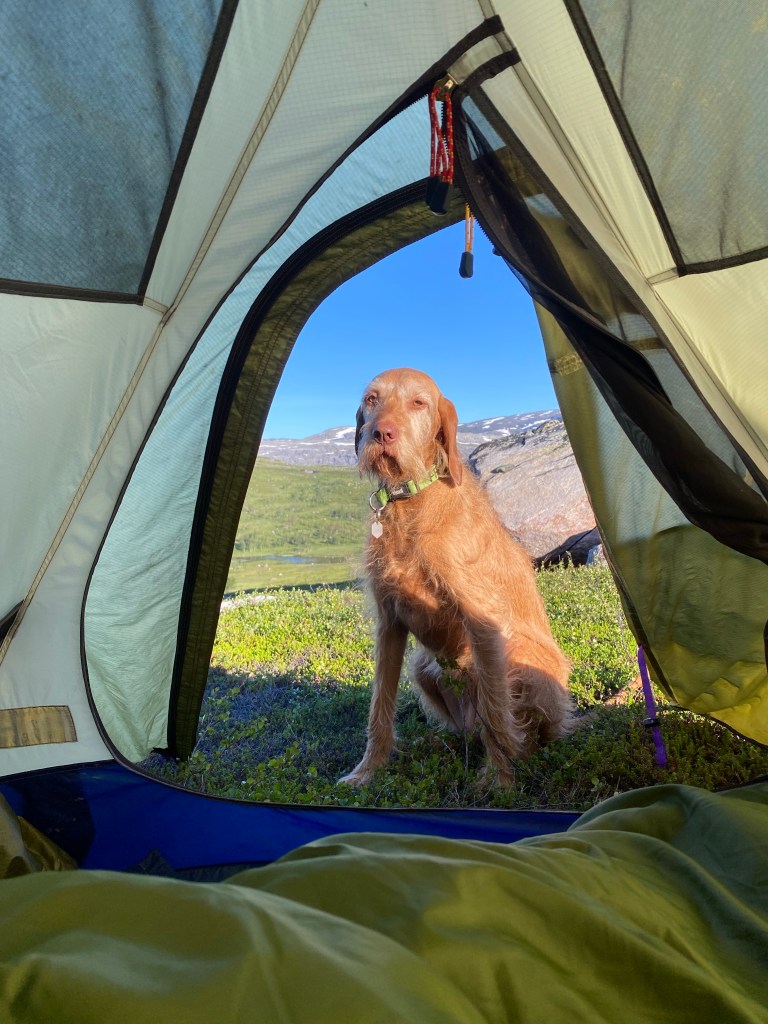
A couple of weeks later the car was packed and together with a somewhat reluctant Vizsla I crossed into the “very best of Scotland”….
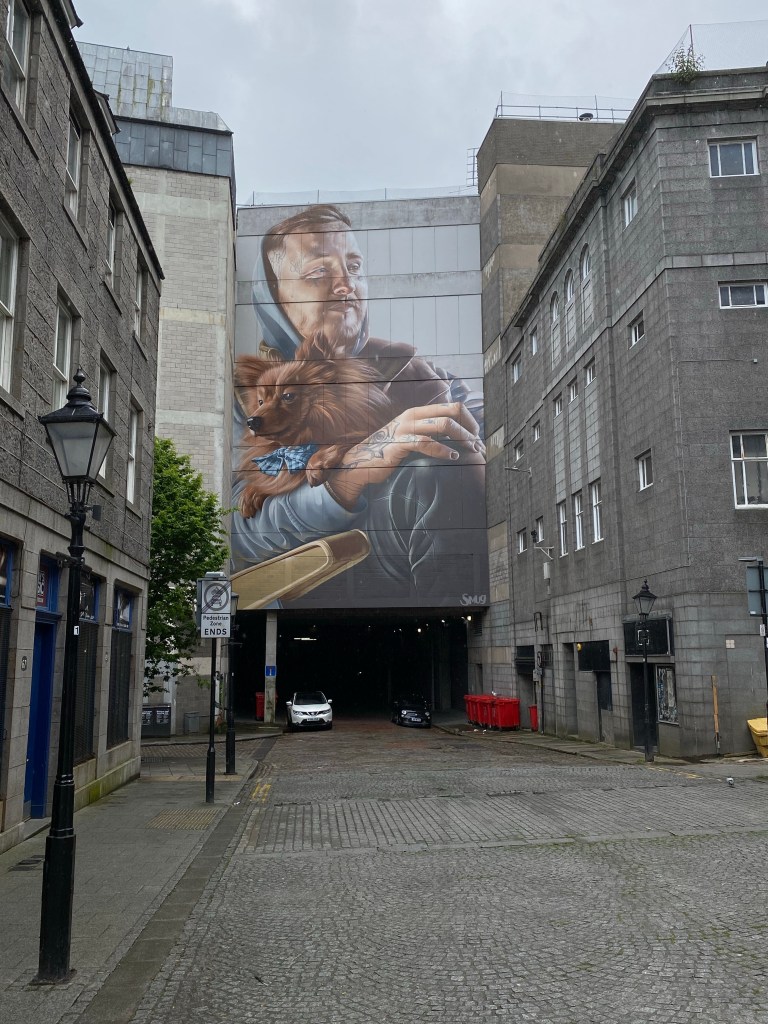
Aberdeen didn’t strike me as the most inviting place at first, but there was no doubt that the people of this habour city loved their pets as much as anywhere else on the island.
Unlike in Sundsvalls the city’s forefathers didn’t need a number of catastrophic fires to find out that stone and in this case granite was a pretty durable (and less ignitable ….) sort of building material and it is estimated that more than half of all buildings were constructed with granite from the city’s own Rubislaw Quarry, leaving Europe’s biggest man-made hole with a depth of 142 m and a diameter of only 120 m. The quarry is now closed and filled with water.
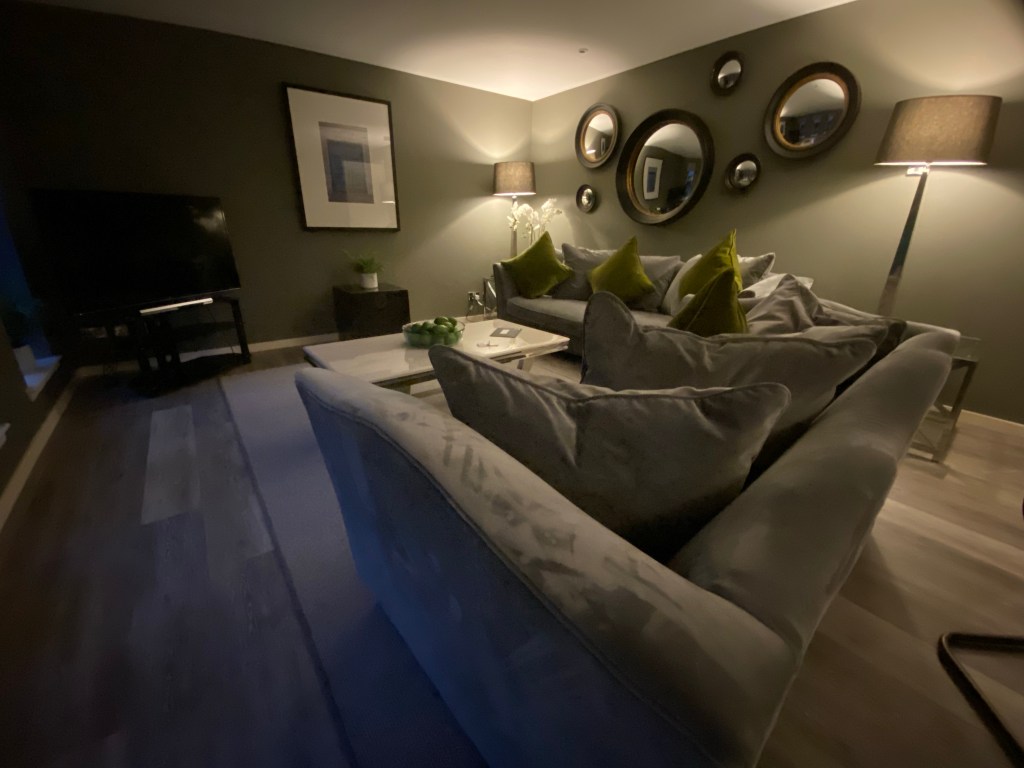
My accommodation in one of these solid buildings was excellent
although it failed to impress my four-legged companion ……
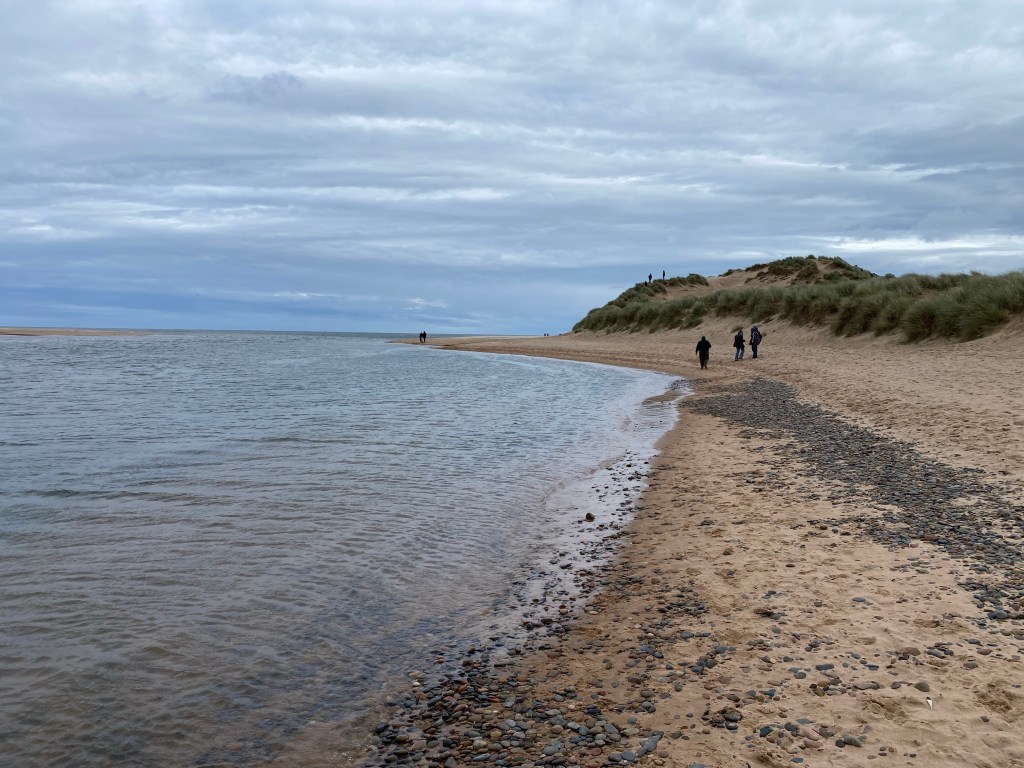
Something that was more to the delight of a canine heart was the 20 km long, virtually endless beach in the North of the city,
inviting to extensive evening runs.
On the next day there was a warm welcome by the local veterinary team
and I was pleasantly surprised that I not only managed to understand the local dialect pretty well, but that the clinic used the same management software on their computers as we did in Virginia Water. Although I hadn’t worked with this system for over a year now, it didn’t take me long to pick up where I left.
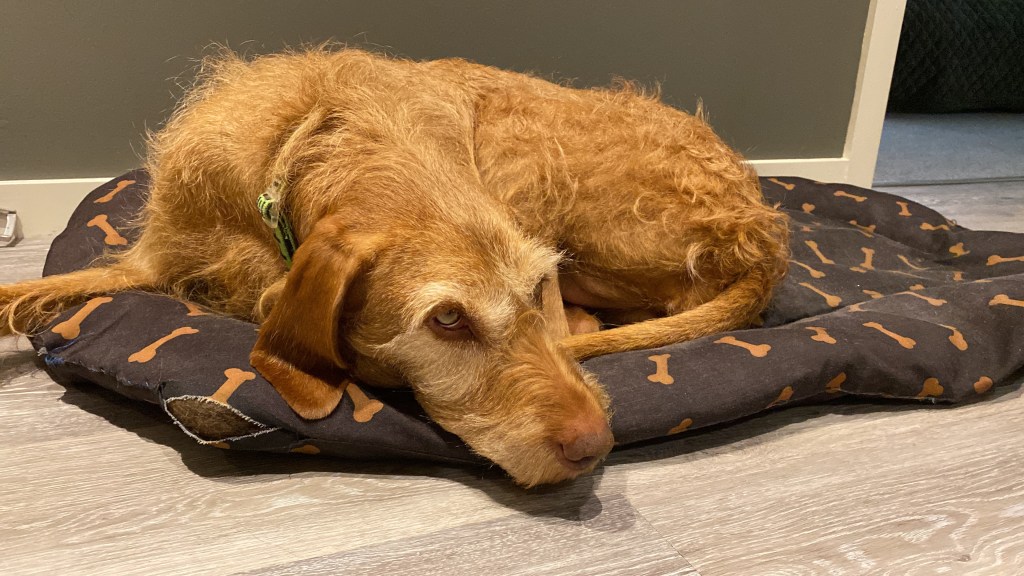
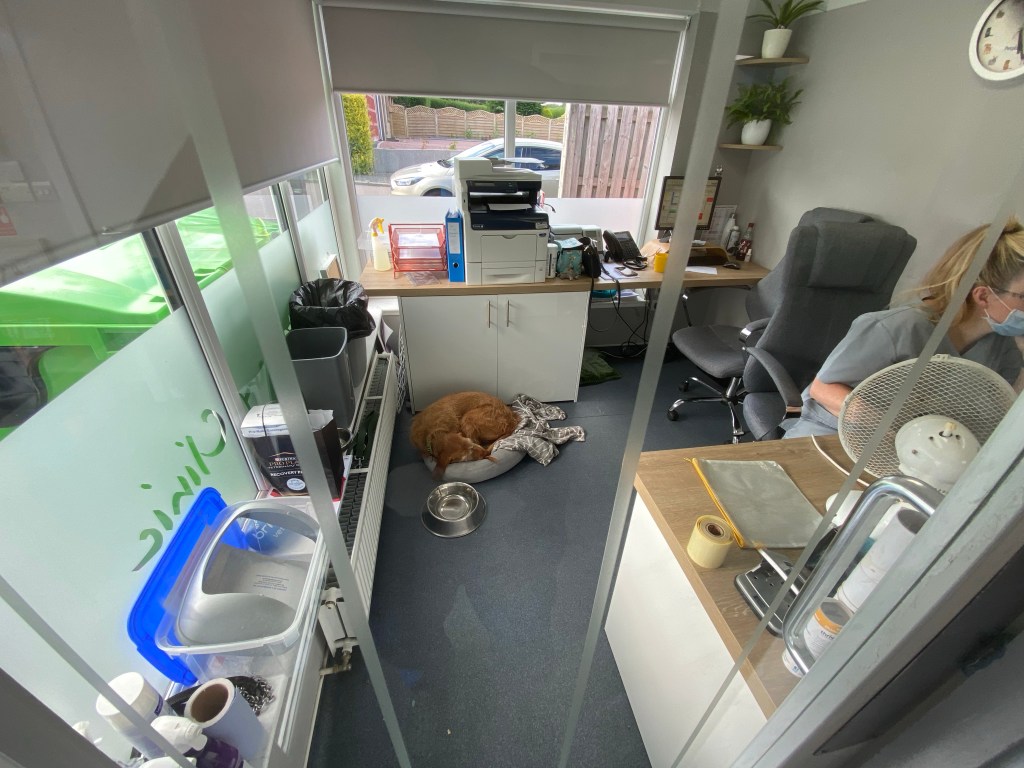
Also Mia seemed to be a happy bunny, settling in as an additional member of the reception team, despite that fact that her bed here was designed for a currently holidaying Miniature Schnauzer…..
The clients were once again wonderful and it helped a lot to be supported by a very professional nursing team – there were many happy memories of my own team in Surrey…..
However, every clinic and every location has its very own characteristics and being in a city that is generating most of its income from North Sea oil and gas, notices like this were not uncommon in patients’ files:
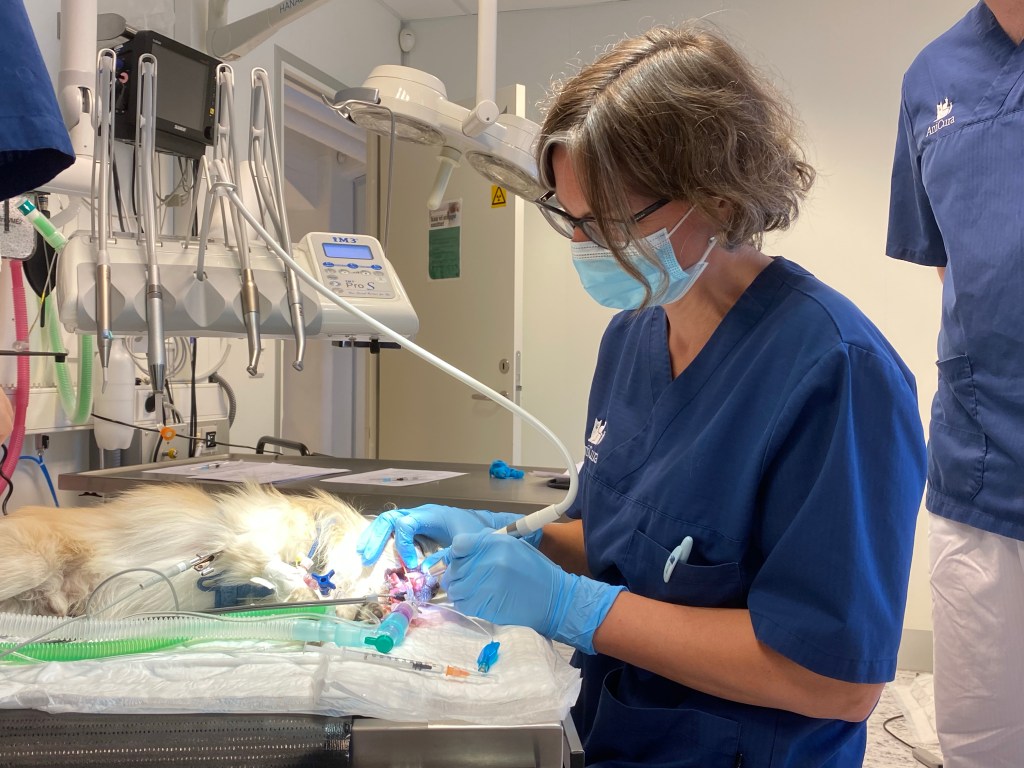
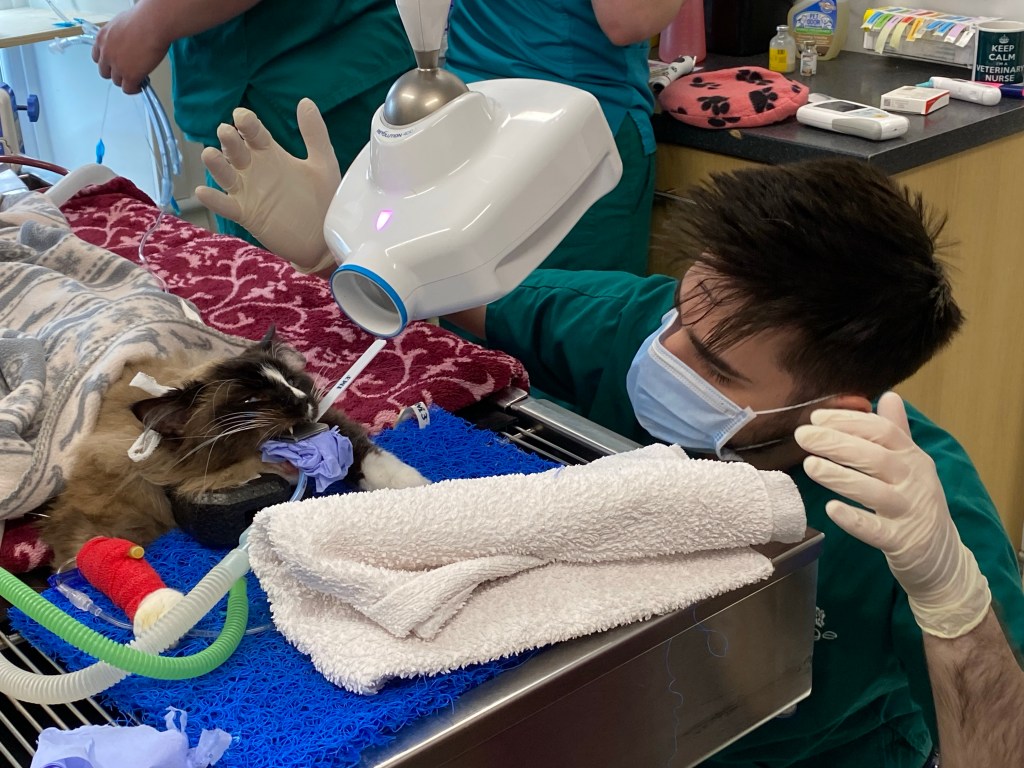
My work in Aberdeen was a nice mix of consultations and of operations which included some dental work.
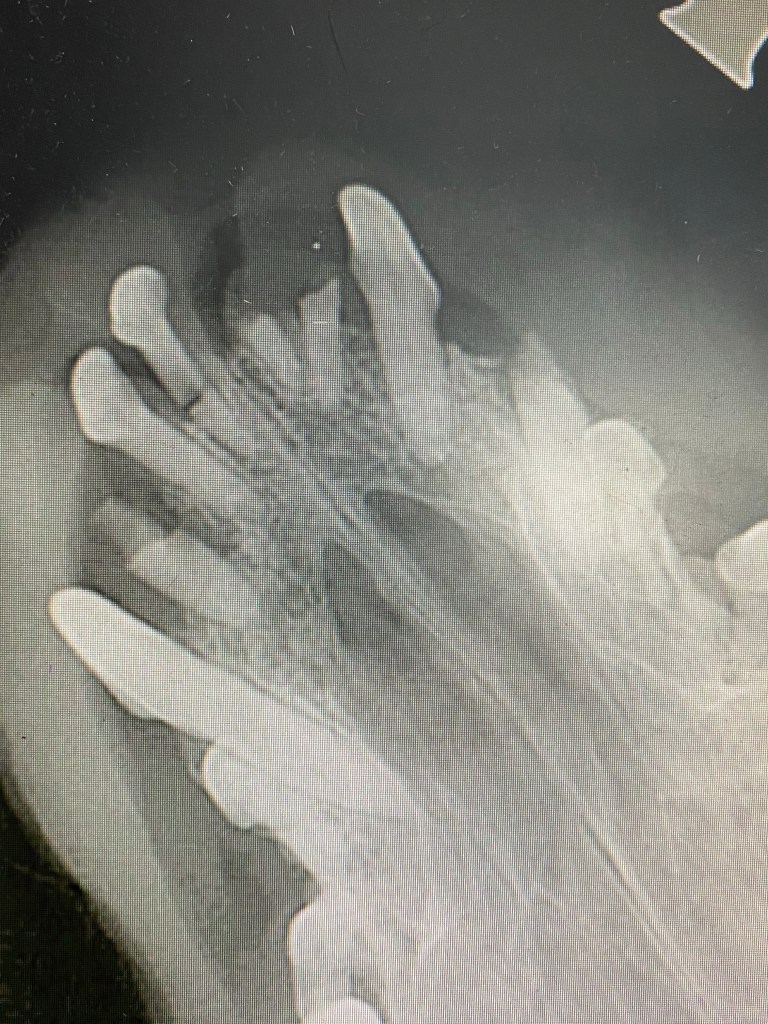
I was grateful that the clinic featured a state of the art dental radiography system for this and that the team went to great length to provide high quality images.
The importance of this was highlighted when a small dog with some missing teeth and a completely unrelated problem turned out to have a number of retained (and probably very painful) roots and fractured teeth, even if this subsequently impacted severely on the duration of my lunch break that day….
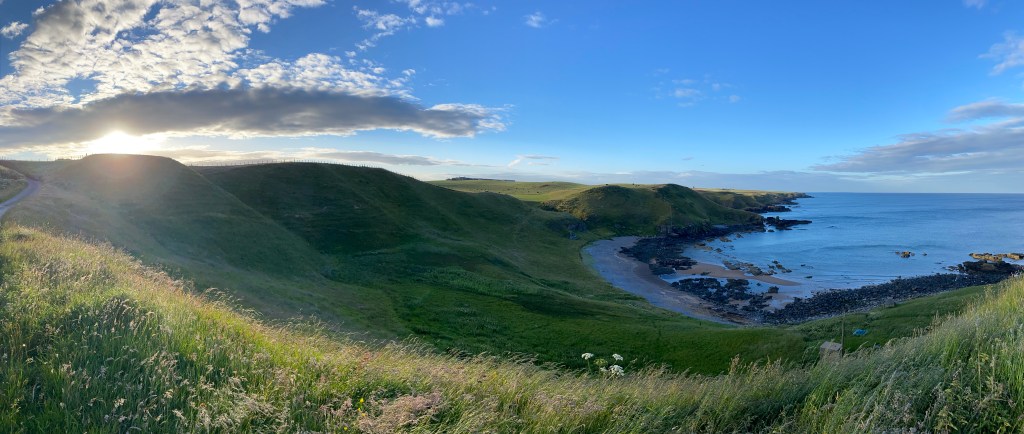
Aberdeenshire might not be the sunniest place of the UK, but the long days in the summer left me with plenty of time to explore the nearby coast after work and within only a few minutes of driving a day could be finished with some dramatic scenery.
As enjoyable as my time was in the city of granite and oil, this time my stay was only a short one and at the end of the week the nearby mountains were calling……
It pays getting up early in the morning to explore one of Europe’s most magical cities. Even more so if it is a bright Sunday morning and your means of transport are your somewhat worn but trusted running shoes….
Setting off at the impressive fortifications of Vysehrad at the South of Prague, the road is decending gently to the East shore of the Vltava river. A slight downhill slope – I think – always makes a great start to a scenic run, as it gives the body an opportunity to wake up and to adjust to the running routine, especially in the morning.
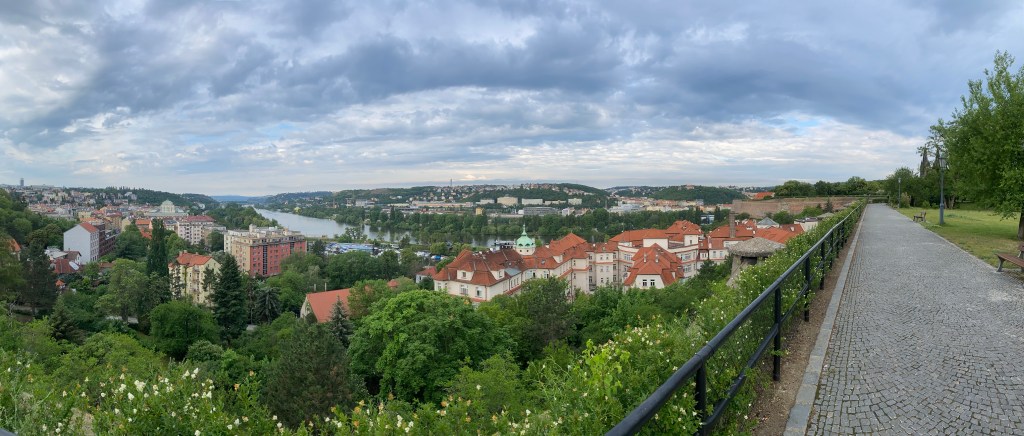
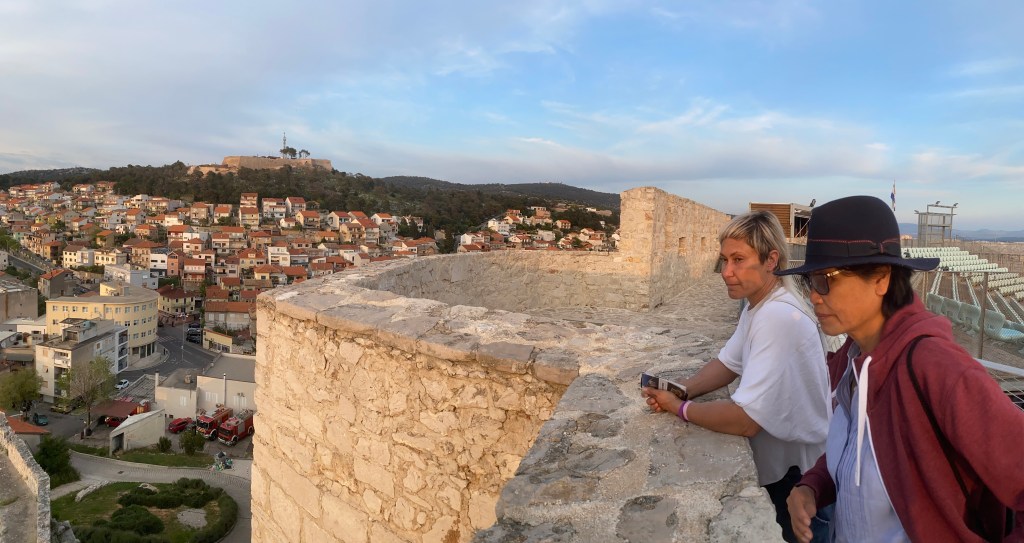
Vysegrad gives a commanding view over both the river and the surrounding hills
and in the cemetery of the Basilica of St.Peter and St.Paul rest the remains of great Czech composers like Dvorak and Smetana. The latter immortalised the river below with his famous symphonic poem “Vltava” (The Moldau).
The river continues to be busy with nummerous restaurant boats taking visitors from all over the world up and down the stream, enjoying classical music and Bohemian culinary delights while passing underneath its famous bridges.
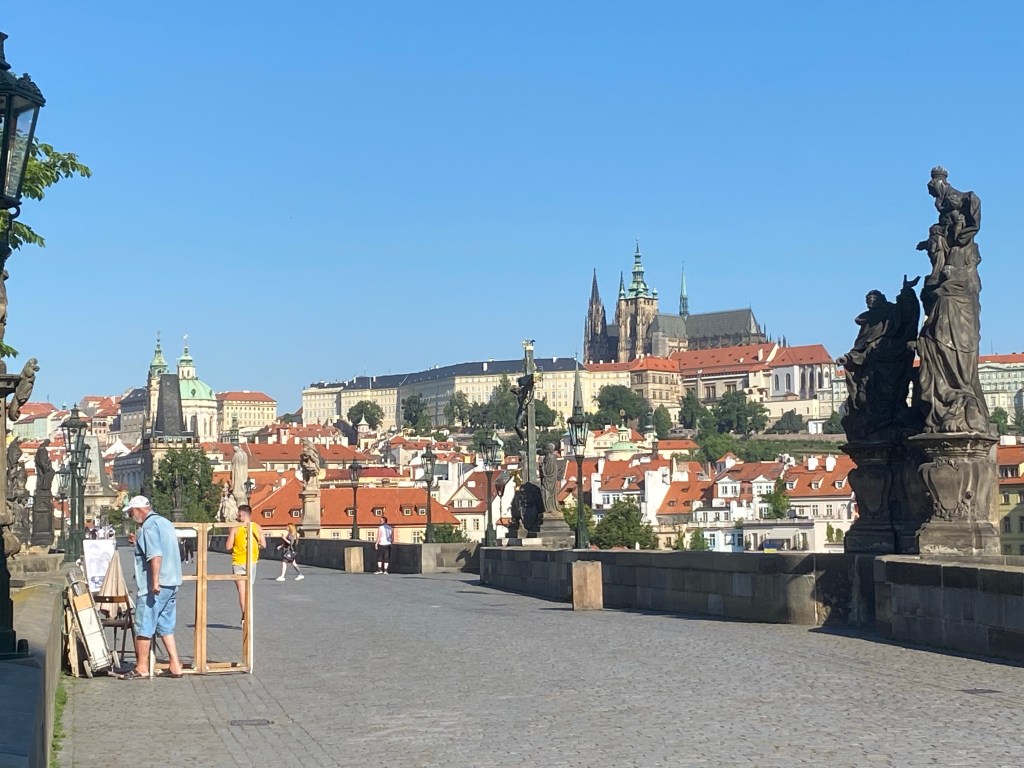
None more so than the Charles Bridge with its impressive towers and its alley of 30 statutes. Until 1841 it was the only crossing between the Prague Castle and the Old Town and one of the most important bridges connecting Eastern and Western Europe.
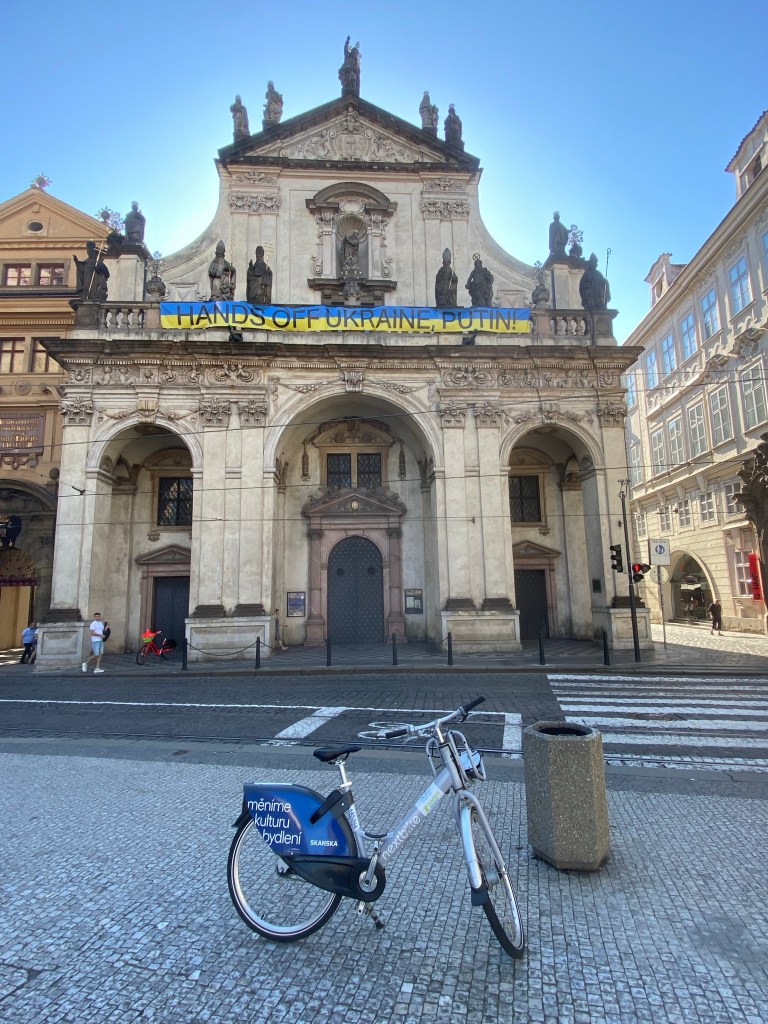
With the bridge continuing to be arguably the center of tourism in Prague, it is also a great platform for political statements – something that can be seen in many places in the city at the moment….
Continuing my run along the Eastern shore of the Vltava, I am coming across an instalation that is absolutely no-Czech, however such is the draw of this city that music of all composers and works of artist from all over the world appear to have made it their second home.
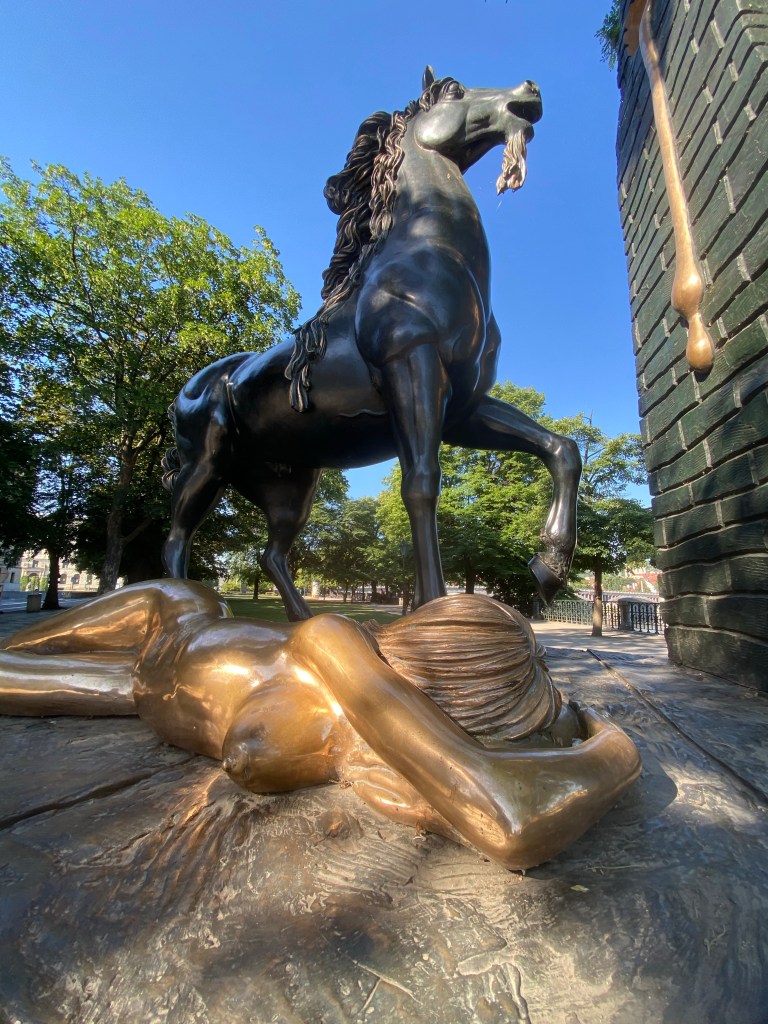
Leaving Salvador Dali’s unicorn (admittedly with not much of a horn left…) and the sleeping beauty at its feet behind me, the river is now starting to turn towards the East and at the Stefanikov bridge I decide to leave the Vltava to return to the starting point of my run through the still sleepy Old Town.
The Art Noveau fassade of the Czech National Bank
standing in direct juxtaposition to the 15th century Powder Tower , not only offers another photo opportunity, but it is also a symbol how different architectual styles and periods are coexisting peacefully here in a unique composition.
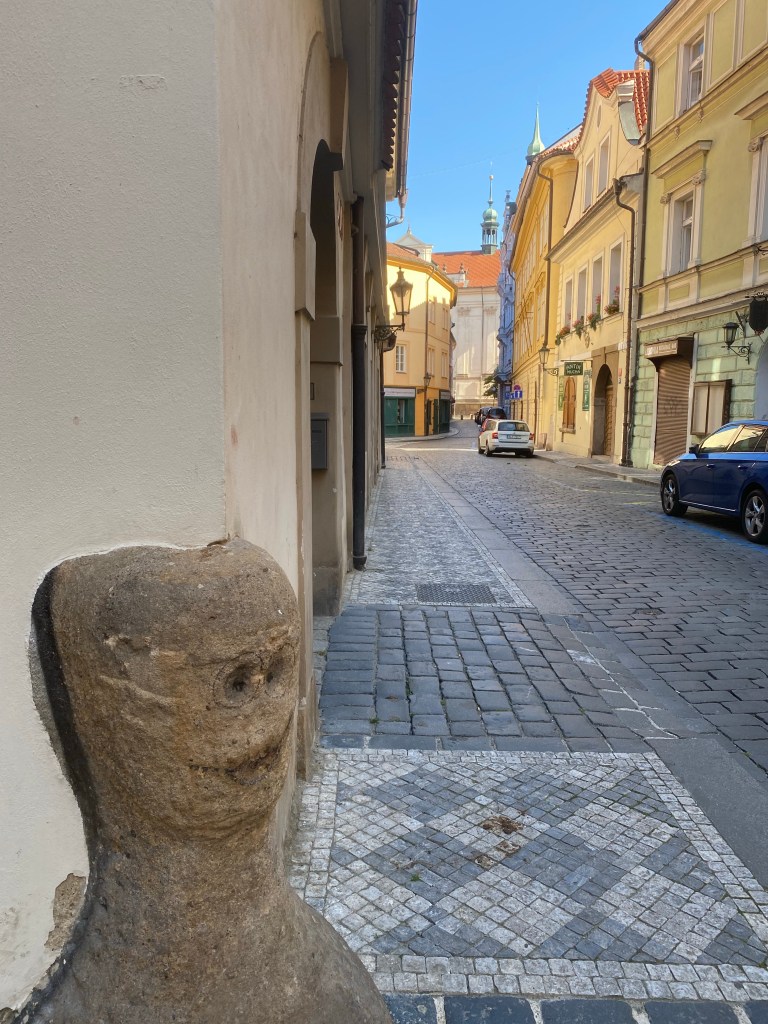
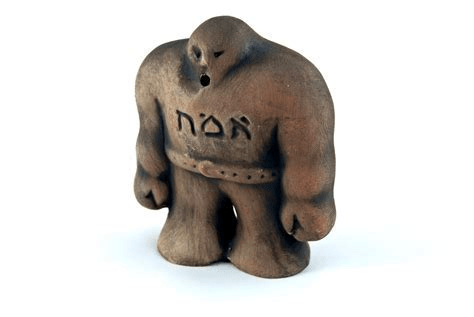
No question that I am not far from the old Jewish Quarter when I am passing another Golem….
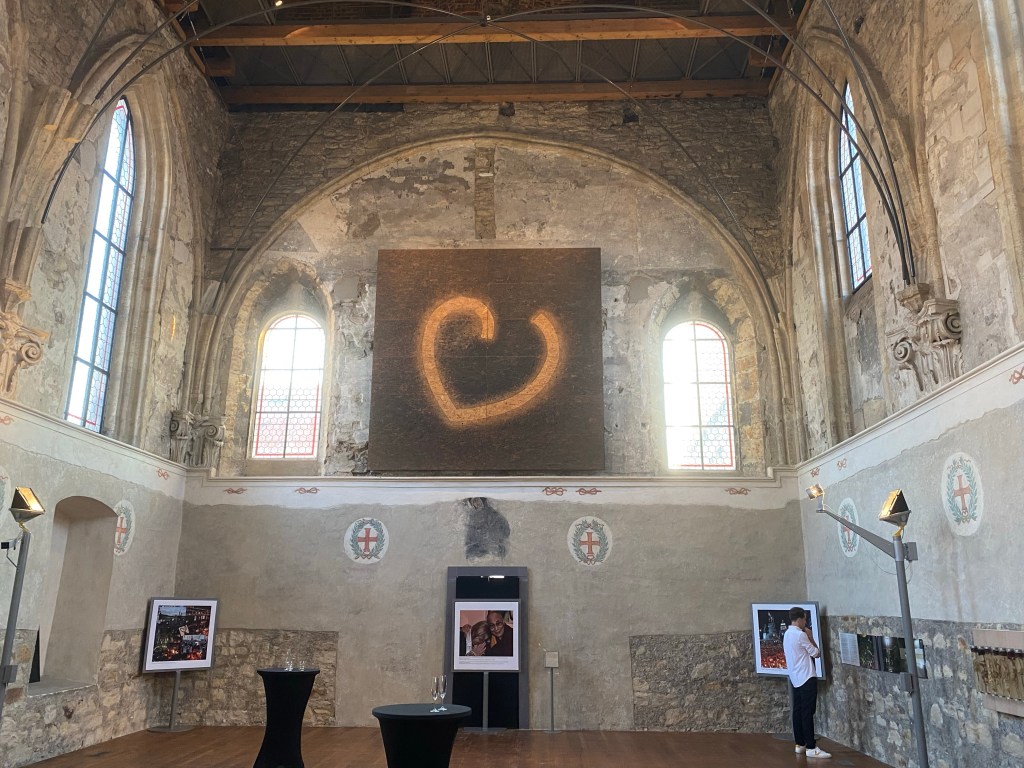
and a few moments later I am running past “ Prague Crossroads” , a Church now converted into an art centre
where Czechia’s famous Poet-President Vaclav Havel is fondly remembered.
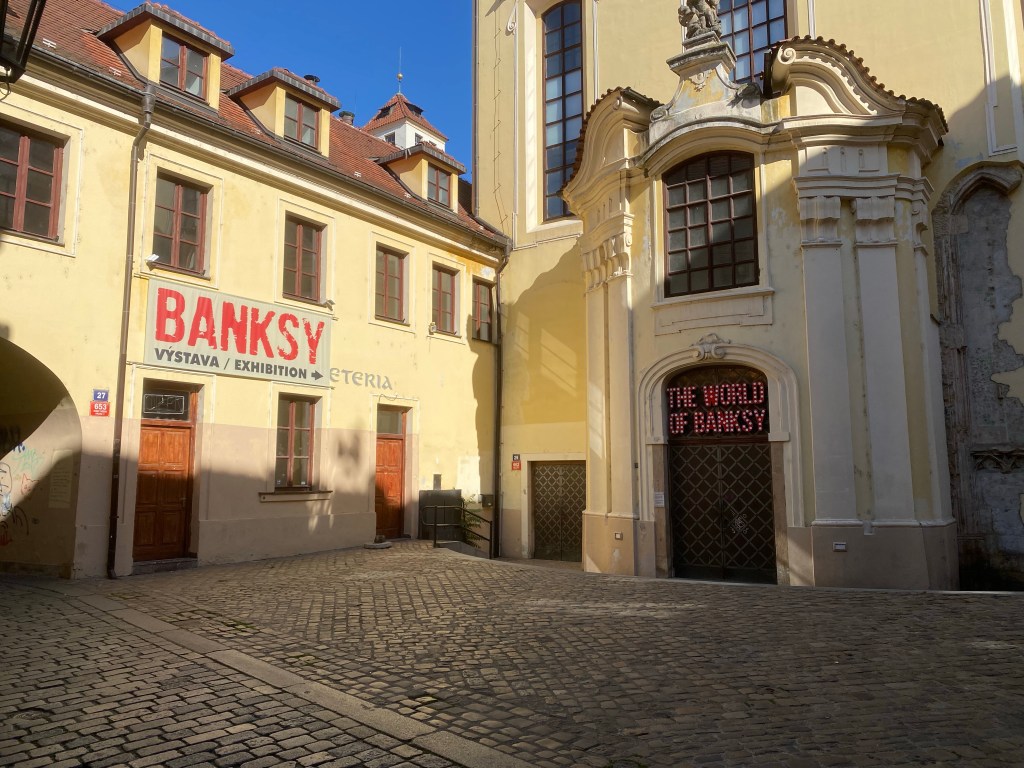
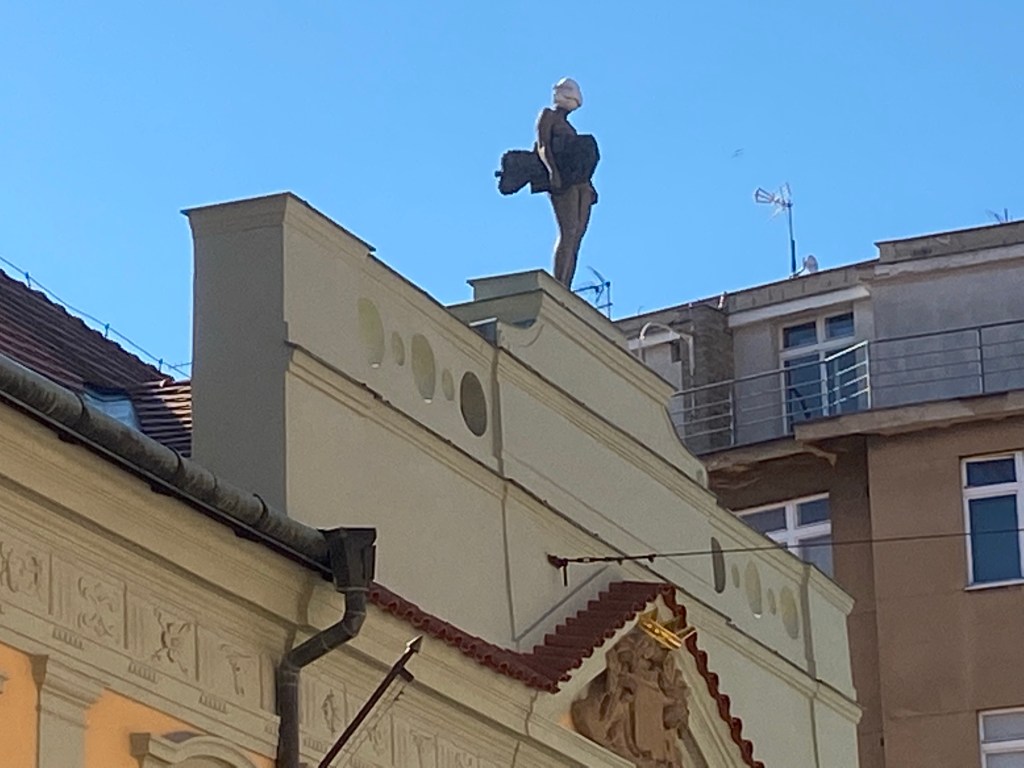
Before hitting the 10 km mark , I am coming across the evidence of another “Art Tourist” more frequently seen on these shores
and I can’t supress the feeling that Antony Gormley must have brought his influence to bear here as well……
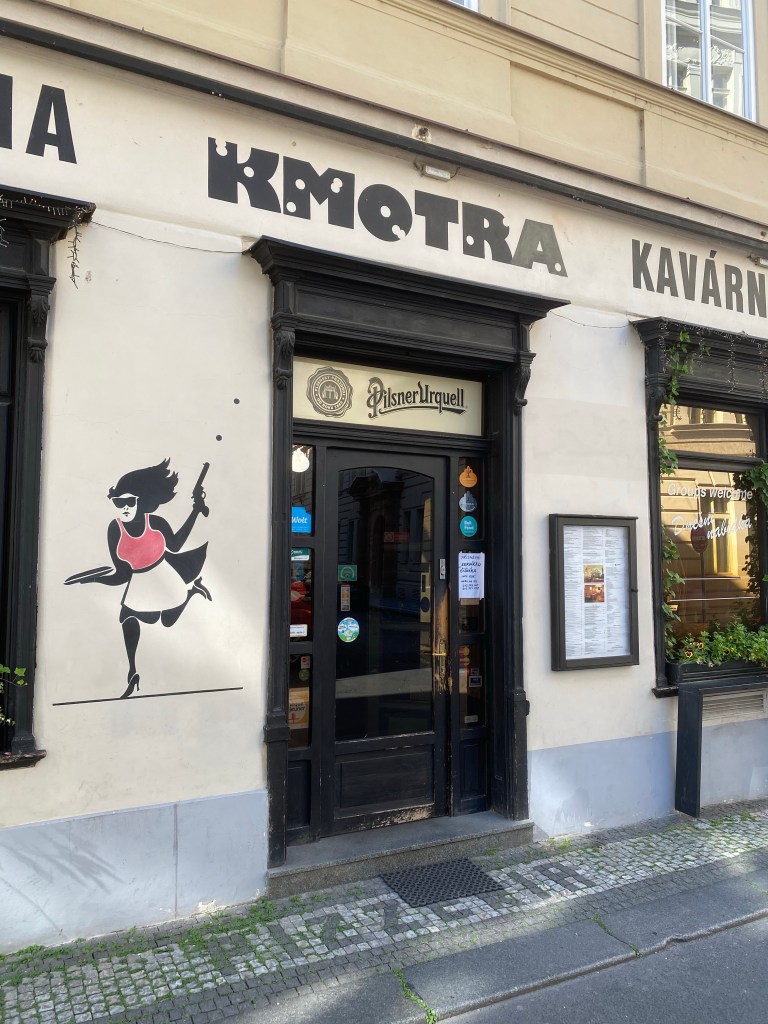
With a sharpe shooting “Godmother” in hot pursuit…
I am then paying the price for the altitude loss at the beginning of my morning outing, when a sheer endless number of steps right at the end of my run force lactic acid into my thighs and make me crave for a shower and a well deserved breakfast.
What would make for a convincing title for a cold war thriller by the likes of John le Carré, had a far less sinister but still quite entertaining back ground:
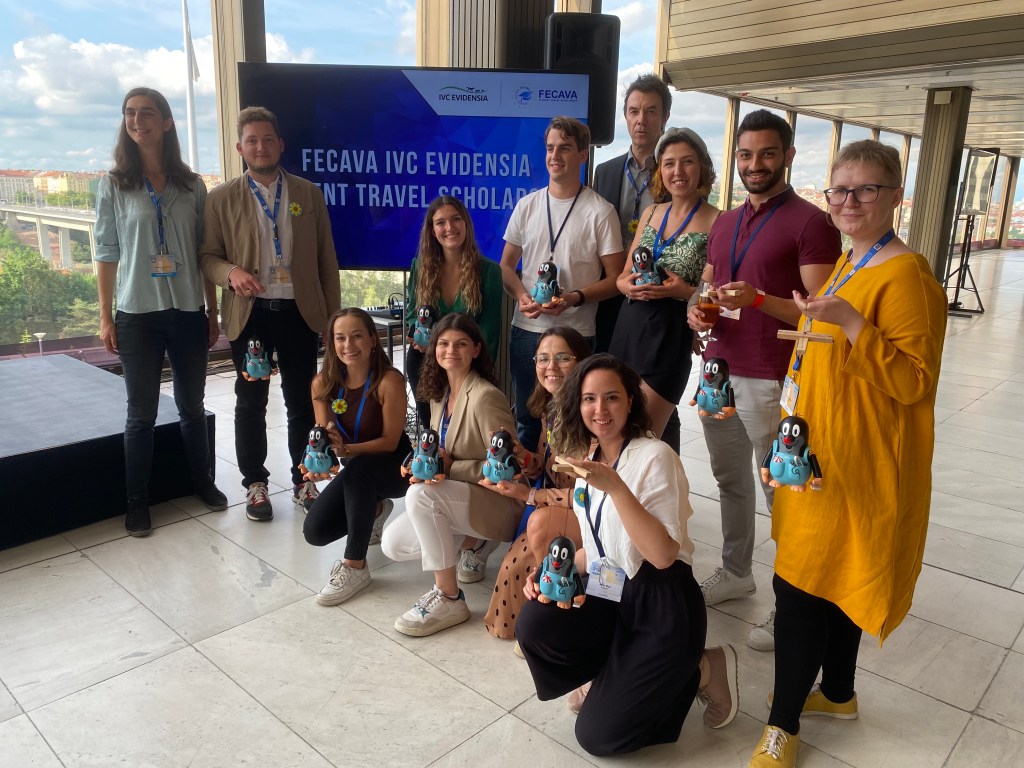
With the help of a corporate sponsor, we had managed to invite a group of ten veterinary students from different European countries to Prague to enjoy together with us our 27th FECAVA EuroCongress, which after a year’s delay was now finally happening as a physical event.
With the welcoming of the students being part of the opening ceremony, I suddenly found myself confronted with the task to transform it from a mere agenda item to a truly memorable event for both the students and for us the organisers. (For some unexplainable reason these challenges always seem to land on my doorstep…..)
To solve this problem, I had a couple of hours time and I had to find a solution that was not stretching the already very tight conference budget much further. A non-controversial, positive and eye-catching souvenir from Prague or from Czechia was asked for, which the students could take home and enjoy even after the event.
Rated as typical Czech souvenirs I found :
Czech beer – Certainly world famous, but not everyone is a beer drinker and with a group of thirsty students unlikely to even survive for the duration of the conference…..
Glas ware – Yes nice…..but lacking the fun part and probably unlikely to make it in one piece back home (before then being passed on to a grateful granny….)
A Golem – This mystical creature, conjured out of clay of the Vltava River in the late 16th Century to protect Prague’s Jewish community is certainly a very typical souvenir for the Czech capital, but possibly a bit too gloomy and lacking the positive take home message required.
….and so entered Krtek !…..
“…and who the hell is “Krtek” ?”, some of you might ask, while all the others might have to dig deep into their own childhood memories…..
Krtek, or the “Little Mole”, is a very benign cartoon character created in 1956 by the Czech Animator Zdenek Miler. This always busy, always curious and adventurous and never really talking little creature was arguably the star of the incredible successful Czech children TV productions, that with other protagonists like Pan Tau or Spejbl and Hurvinek managed – despite the harsh political realities in the 1950-1980th – to cross the Iron Curtain to entertain and to educate children (and their parents) in a non-confrontational way all over the world. (Not sure if the same can be said of today’s popular cartoon characters like ‘the Simpsons”…..).
With other words: Krtek was the perfect present for our guests.
Investing 20 CZK (= £ 0.69 (!)) in a Metro ticket, I found myself a few minutes later in the center of the old town, scanning the countless souvenir shops for “my perfect mole”.
Eventually, I spotted one – sizable and in form of a puppet – in a tiny shop not far from the world famous Charles Bridge. The shopkeeper, a lively Bulgarian lady, was happy to sell me the puppet at a good price, until I mentioned that I would need nine more ……….
My opposite hesitated, then replied to me with just so slightly dilated pupilles……
“Oh my God !….. nine more ?!” – “Yes!”
“By when ?” – “Now.”
“Oh my God !….not possible……wait……yes, it will be possible !……”
What then followed is hard to describe…….
First of all, three more moles were mustered from storage at the rear of the shop. Next the whole shop was closed and I was taken on a walking tour of each individual souvenir shop in the neighborhood to source more of the same subterranean toys, with a final yield of ………zero!
However, by now I was so impressed by the sheer determination of this lady to help me in my task, that we agreed that I would take with me the four moles that were already available now and that she would organise six more for me by noon the following day.
Pretty pleased with my decision and laden with my initial purchases, I returned in time for my next meetings to the conference center, when I ran into my Ukrainian colleague Vlad Ushakov with his wife and their young son….This automatically reduced my tally again from four to three moles…..
The next day came and skipping my lunch break, I found myself again in the Metro heading North towards the old town.
Already waiting for me – as promised – were another six boxes with the desired content. However, imagine the face of the shop keeper when I cautiously indicated that I was still one mole short…….
Well, what followed was a repeat of the guided tour through the neighborhood, but thankfully this time with far more luck, as the news seemingly had got around that mole puppets were suddenly in high demand and some of the other shop keepers had immediately stocked up with them …….
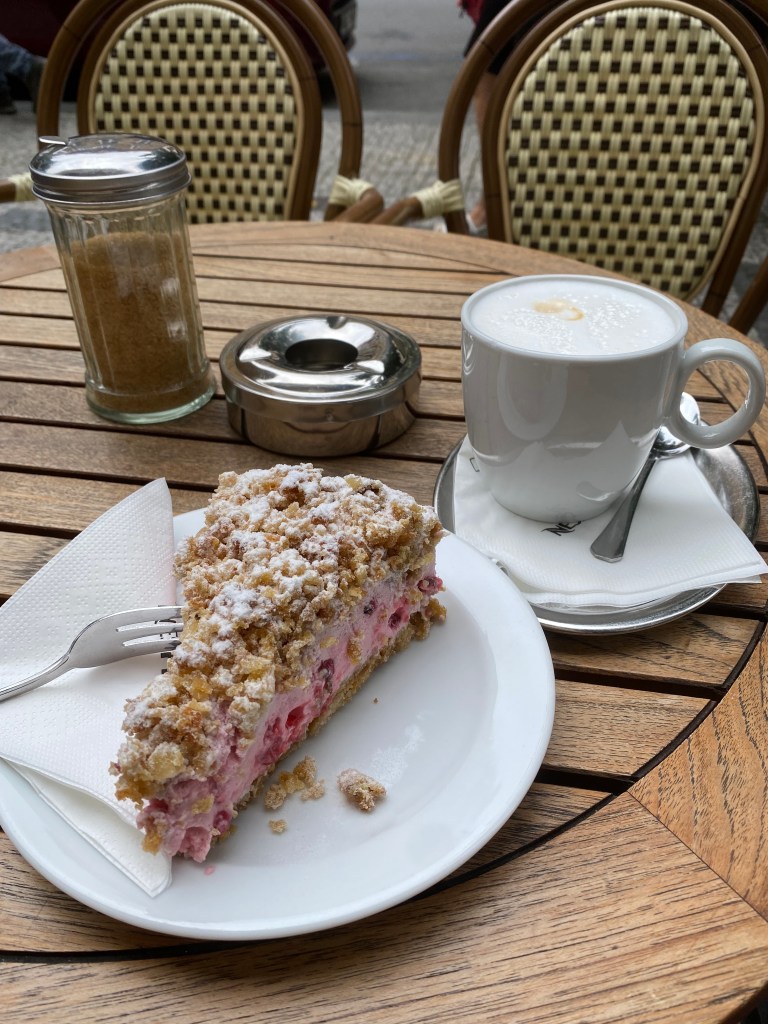
Finally with another seven moles in bags and fortified by an emergency coffee break in one of Prague’s beautiful outdoor cafes
I left for the presentation with a couple of hours to spare….
As it turned out not only a single mole is pretty photogenic,
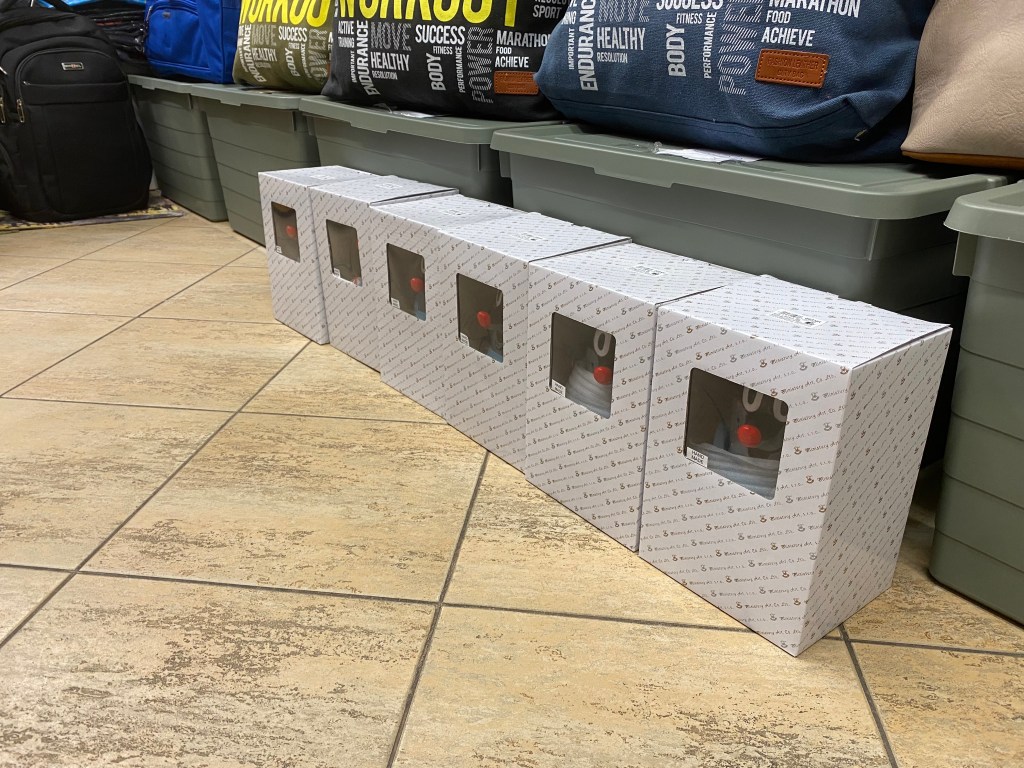
but a whole row of ten is quite a sight
and they eventually made for a great start for our forthcoming colleagues at their first international conference – with hopefully many more for them to come in the future.
Lets hope that the virtues of the “Little Mole” – digging deep, working hard, being curious to see new things and to learn new techniques, but also to take some risks will guide them through their forthcoming profession lives.
The next stop on my itinerary was a return to Slovenia and to be more precise to the beautiful capital of Ljubljana.
EERVC, the Eastern European Regional Veterinary Conference is the brain child of my Serbian colleague Denis Novak. After having enjoyed part of his training in England and now running the most renowned veterinary clinic in Belgrade, Denis pretty much single handedly redefined continuing education especially for young veterinarians in large parts of Eastern Europe.
Traditionally post graduate education had been a remit of the universities, but that limited the access to new trends in small animal medicine as these institutions often remain very focused on farming animals.
EERVC took a very different approach – starting as a cooperation between the British Small Animal Veterinary Association (BSAVA) and leading veterinarians especially from the Balkan countries, the conference is delivery cutting edge knowledge and speakers, but this at a fraction of the cost of similar events in Northern Europe, because of the much cheaper venues and general cost of living.
For years, at least until COVID, regardless if it took place in Bukarest, in Zagreb or in Thessaloniki (see my blog post in 2019) , EERVC had been a solid entry in my diary.
Even more so this time, as I had the honor of chairing the neurology presentations of Elsa Beltran, one of Europe’s best veterinary lecturers and a magnet for veterinarians and for veterinary students where ever she goes.
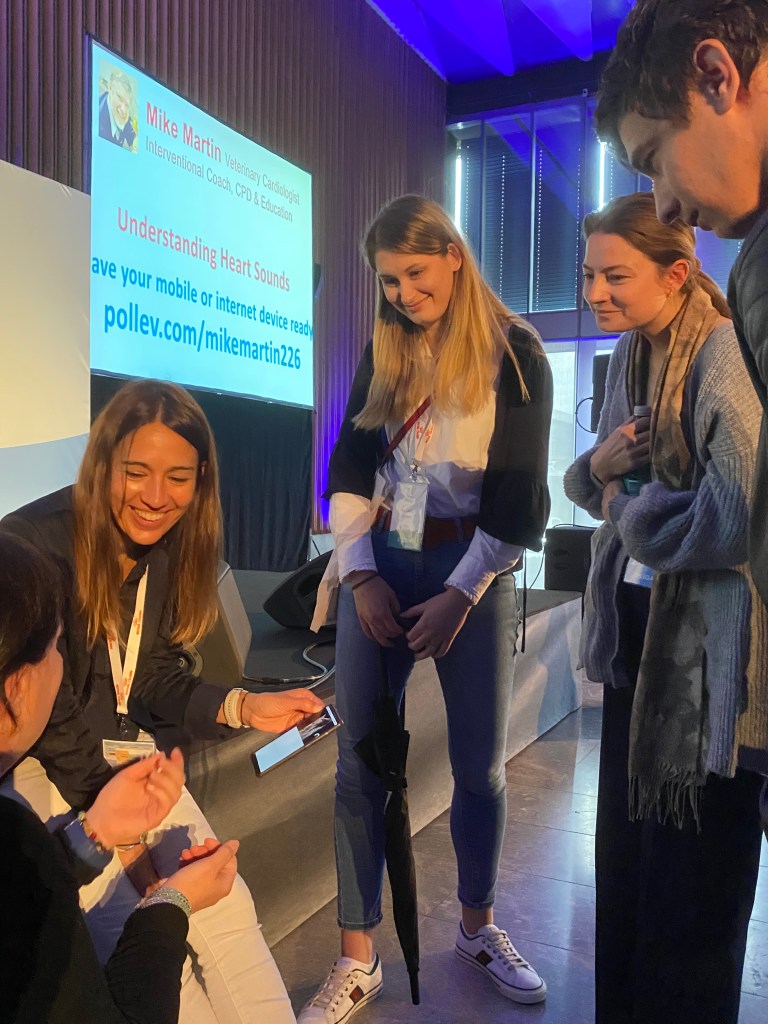
This has to no small degree to do with the fact that Elsa is able to make a very complex area of medicine look so simple and logical. She is achieving this with interactive illustrations which are taking her hours to put together and which are then devoured by her listeners within seconds (and unfortunately due to the sheer amount of information to a large degree again forgotten….). Still – what a pleasure enjoying CPD delivered like this…
The conference was – after 2 years of COVID restrictions – also the first truly international event for me and for most of us one of the first opportunity to meet again with a lot of colleagues from other countries and to enjoy together the – by now obligatory – Saturday evening party with Perpetuum Mobile from Belgrade.
Next year EERVC will be in Greece again – my place is already reserved.
The car was swerving slightly as we were speeding around a corner just before the worn suspension was hitting another pothole…..
I leaned back into one of the rear seats having long ago resigned myself to fate and to the driving skills of Lea Kreszinger, my friend and colleague from Zagreb. With us in the car was Siraya Chunekamrai from Thailand, the current President of the World Small Animal Veterinary Association who was busy touring Europe.
Over the last few days we had visited Split on the Dalmatian Coast and got lost in the forests of the Plitvice National Park on a whistle stop tour of Croatia.
I considered myself very lucky not only for leaving the driving to Lea, but also for the opportunity to spend a few days together with these two remarkable colleagues who I hadn’t seen for over 2 years, other than as interviewees at FECAVA VetChat.
Our destination today was the vet school of Zagreb where Lea had arranged a tour of the clinical departments and our journey was just interrupted by a brief visit at the Macola road side restaurant
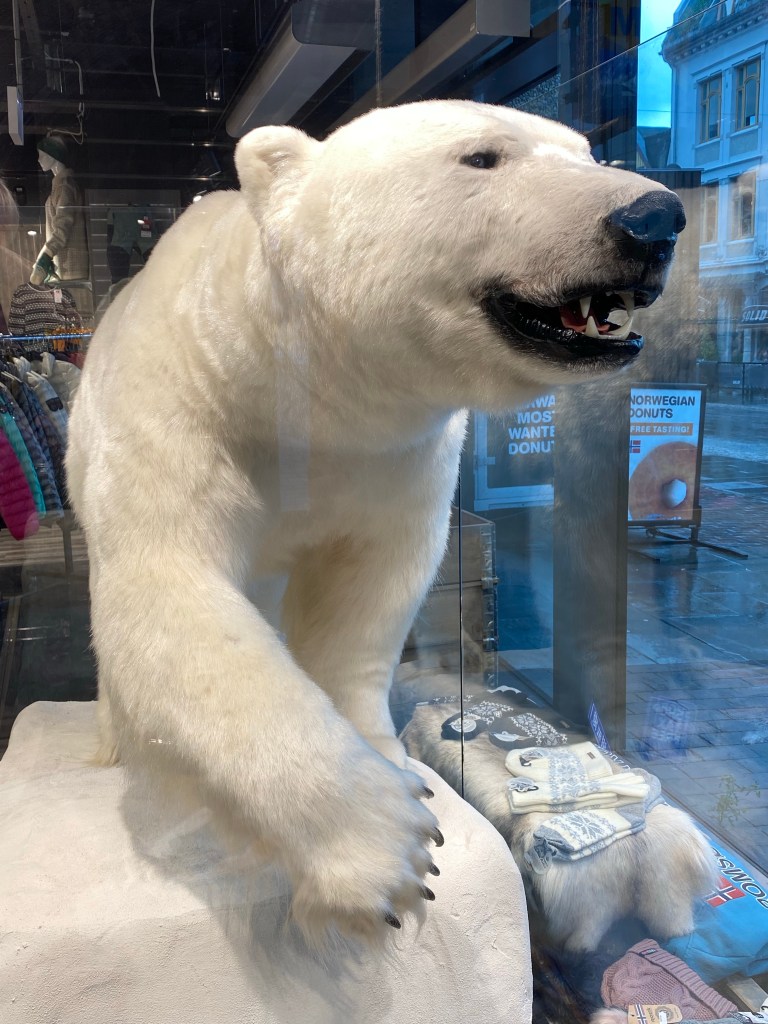
which is famous in Croatia not only for good local food and its somewhat eccentric owner, but also for the largest collection of stuffed local bears which would easily rival that of the National History Museum (but don’t worry – there are still a lot of them remaining in the mountains of the former Yugoslavia….).
Still with time to spare we arrive at the faculty where we were greeted by the senior lecturers of the internal medicine department.
What followed was a detailed tour of the surgical, the reproductive and the internal medicine clinics of the university.
Dividing the case load like this is dating back to the teaching of veterinary medicine during the Habsburg Empire and the system can also be found at the vet schools of Munich and Vienna. While being suitable for the treatment of Human patients, this system in a veterinary context is requiring a more complex housing of patients (all species under one roof) and a fair amount of running for the emergency vets who have to attend to patients of the same species but in different buildings.
The alternative to this are species specific clinics – something I am more familiar with from my own Alma Mater in Hanover and from the British vet schools.
The facilities we were shown were spacious and although housed in some older (in fact listed) buildings, they were surprisingly modern, organised and they provided a great environment for both students and clinical staff to attend to their patients.
Like many other vet schools these days, Zagreb too is trying to improve their funding by providing a English spoken course for paying students from abroad. Considering the location of Croatia in Europe and having enjoyed the restaurants and the nightlife of Zagreb myself in the past, I could think of a few worse places to study veterinary medicine….
As always with visits like this I came across a pretty clever idea with a practical application for day to day companion animal practice – an inventive soul had constructed an ultrasound table out of a steel frame and a mesh of car safety belts to allow cardiac ultrasonography.
The norm is a plank of wood or thick plastic with a cut out triangle with the inherent problem that very small patients might fall through it…..
This alternative design struck me as rather ingenious and I might consider now raiding the local scrap yard for old safety belts.
Our visit concluded with an inspiring exchange of ideas over coffee and chocolates before the road was taking us to another veterinary institution…..
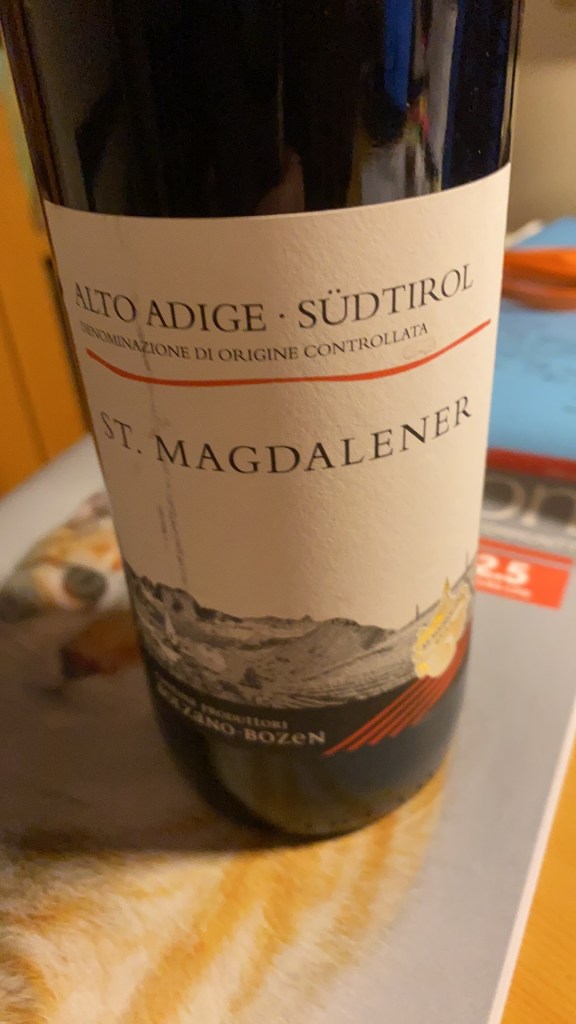
It is Saturday , the 9th of April and with a glass of red wine I am settling on the sofa in my living room in Surrey, pretty drained but also happy and satisfied with an exciting day.
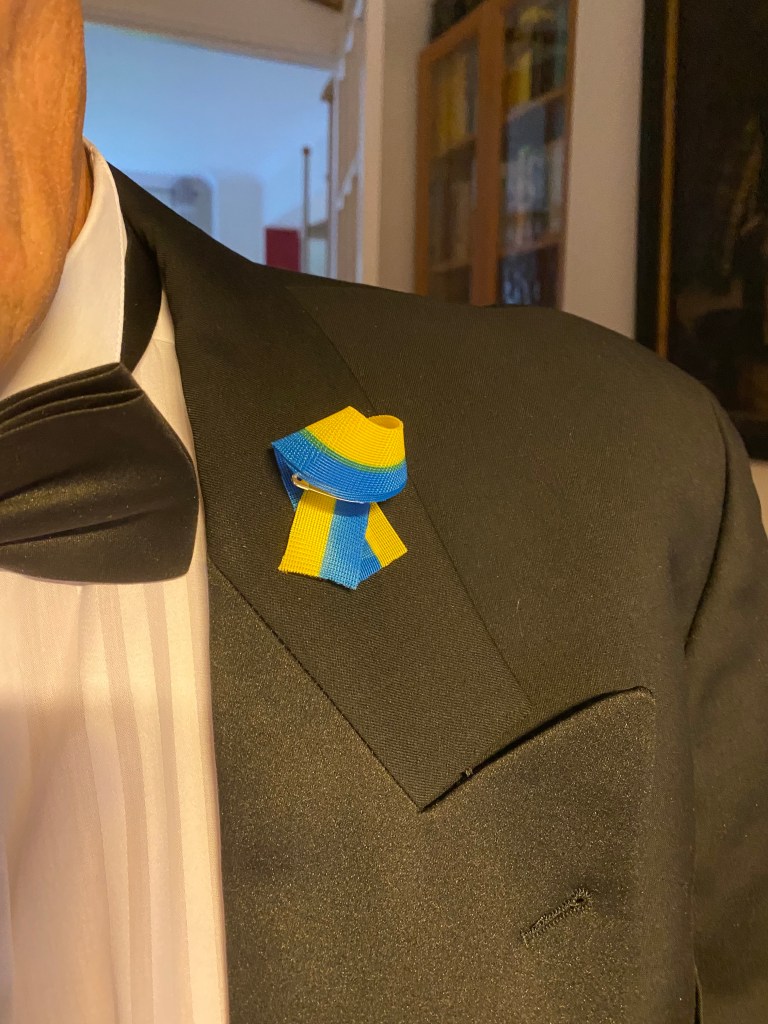
With the help of many friends and of some incredible characters we managed within 5 weeks to register nearly 4000 colleagues for an online CPD event and we raised over £ 33000 while learning a lot and having a lot of fun at the same time…..
So how did this all come about?…..
As already mentioned in one of my previous blogs I had been (and I still am) pretty upset about the war in Ukraine and the return to a new Cold War reality.
When – after my return from the North – I made a short detour to Belgium, I had a drink with some of Europe’s finest speakers in veterinary dentistry and we started to circulate the idea of running an online “Life-Aid” style event to raise funds for the relief effort for both the people and the animals from Ukraine. My colleagues – Ana Nemec from Slovenia and Jerzy Gawor from Krakow in Poland – immediately offered their support, providing that I would set it up……..
With some hesitation I agreed to look into this, but it clearly was one of those moments where you ask yourself : “Oh my God, what have I done?!……”, because I realised that it wasn’t such an impossible task, but that I had just committed myself to several sleepless nights and a lot of work. The rest of the evening including one of the first parties since the start of the COVID pandemic, in the historic mining company head quarters in Genk was lost on me as I had to think…..
Thanks to my somewhat restless existence at the moment, I had all the necessary contacts, but now it had to call in a lot of favours.
For the biggest favour of all, I needed the help of one man and on his support hinged the decision to go ahead or to drop the whole idea at once:
Off I sent a message to Anthony Chadwick, better known as “The WebinarVet”.
In 2020, when the pandemic started, Anthony, just a “normal” vet like me, had – almost single handedly – introduced the whole veterinary profession in the UK to webinars and to online meetings and he kept many of us both sane and entertained during this difficult time.
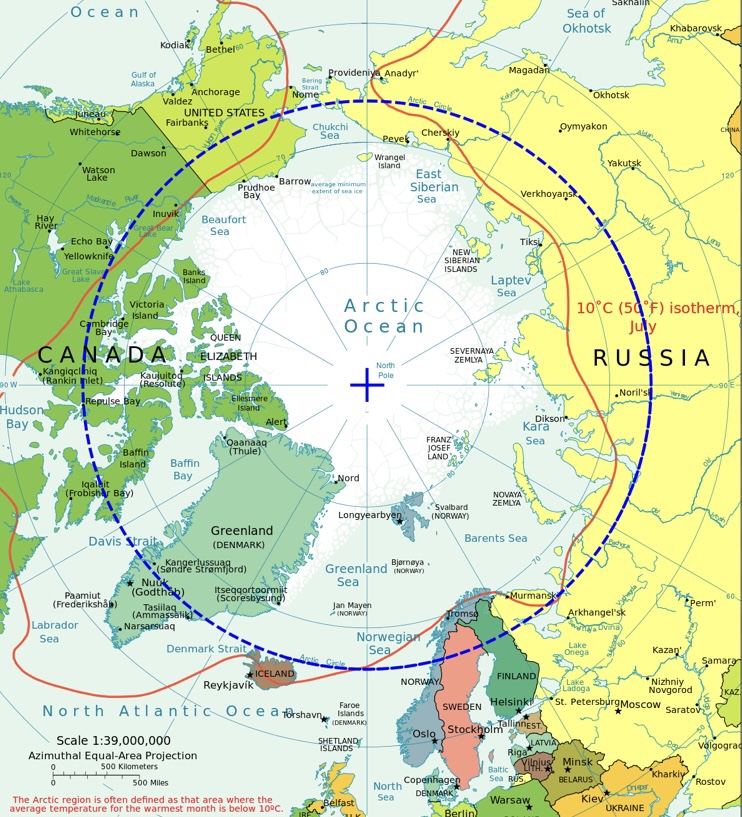
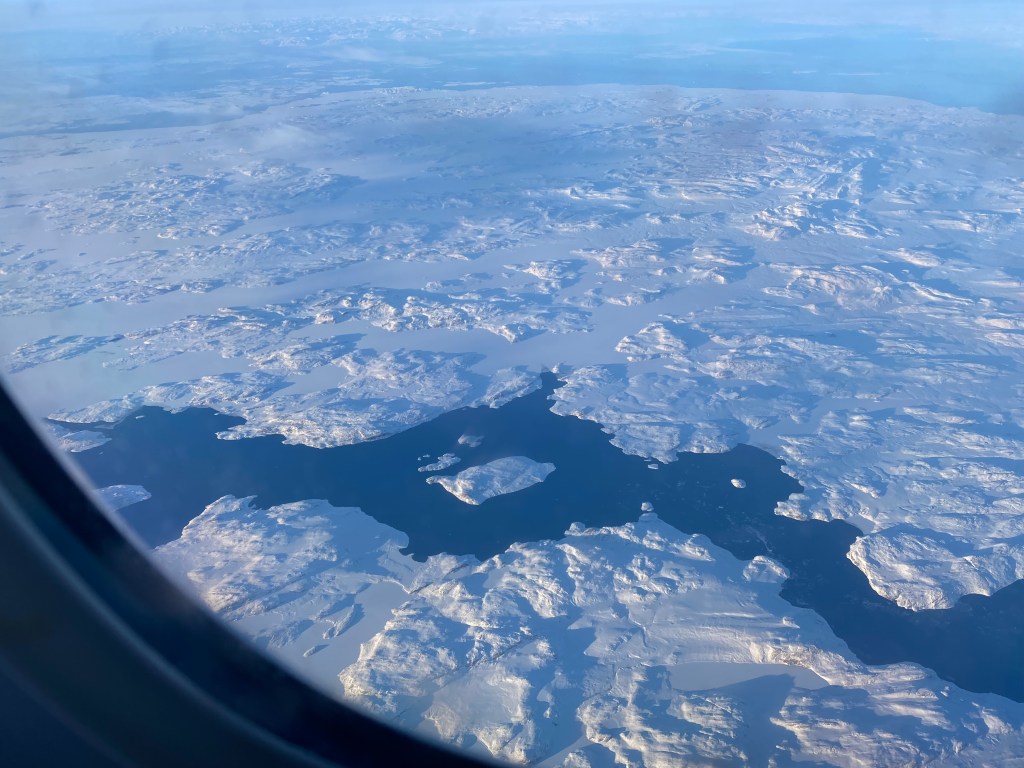
Thankfully Anthony came back to me right away and we fixed an online meeting a few days later. That gave me the necessary time to put “meat to the bones” of my idea and while heading State-side, flying over the Southern tip of Greenland and seeing landscapes I will never be able to set foot on,
I worked on my pitch:
21 world class speakers, not more than two on a clinical subject area, from as many countries as possible, all just for 20 minutes plus 5 minutes for questions and answers, plus a team of moderators who were all great communicators and who were already known as veterinary influencers.
Fundraising through an established platform which channeled all funds directly to the chosen charities and which updated us in real time on the amounts raised. Once the idea had some traction, possibly also the involvement of the veterinary industry to raise more funds. Only Online advertisement but through all channels available to FECAVA, the Webinar Vet and the contact lists of everyone involved with the event.
At the end of the flight three pages of tightly written notes and names were lying in front of me and I had a plan that could work…..
Thankfully that view was shared by Anthony the next day and within a matter of hours I had the whole Webinar Vet organising team plus the help of my colleague Andreja and her marketing team in Ljubljana at my disposal and – with an 8 hour time difference – e-mails and text messages started flying through the internet.
My task now was to set up the scientific programme and to recruit all the speakers and the moderators for the event.
Kersti Seksel, a well known Estonian veterinary behaviorist agreed to join the event from her home in Australia. Heads of university clinics and of surgical departments in Hanover, Vienna and from my neighborhood in Surrey joined the effort. Ana managed to get in touch with some of her colleagues from UC Davis who also agreed to lend a hand, but with the caveat to insist on an early morning slot (in California) to be able to go surfing right after the presentation.
Once the news had got out, offers to help came flying in and at the same time we started with the fund raising.
As fellow moderators I was extremely lucky to get the support of my friend and colleague Julian Hoad and his partner in crime Mike Bramble, who are running a very successful You Tube channel and podcast series called “Veterinary Ramblings”.
Joining the effort as well were Cat Henstridge, better known as “Cat the Vet” from Yorkshire and from Ireland Pete Wedderburn, known as “Pete the Vet” in numerous TV and online appearances.
Whenever I opened my inbox over the following few weeks as we were progressing towards the event, there were new messages of support and encouragement and with the tireless help of the Webinar Vet team (ignoring graciously several set and passed deadlines, mostly due to my restless lifestyle….), the whole event started to take shape and several days before the conference, we already passed the ambitious fund raising target of £ 20000.
Then – finally – came the 9th April and following some final technical instructions from the team, I could start this crazy event that took its first step not even 5 weeks earlier over a glass of wine in Belgium….
When entering Ripon Veterinary Hospital in California’s Central Valley, one is immediately struck by the hustle and bustle of a well oiled, all female veterinary machine with Dr.Debra Daniel’s – the principle – with over 40 years of clinical experience, calm and confidently in the center of the storm…..
Today the focus is on neutering cats for one of the local animal shelters.
Several cat traps had been placed in local gardens over night and a decent number of stray cats had been caught. If there is evidence that they already had been neutered (eg a clipped off ear tip), they are only checked over and released again.
The others are with great efficiency been sedated by the team of technicians and after they have been treated against parasites, they are prepared for surgery. Here as well, the middle approach is favored over the flank technique. New to me – once castrated or spayed – a small incision is made just 1 cm or so next to the operation site and a small amount of green tattoo ink is applied to the wound, to identify the cat as being castrated in the future.
Unlike in the UK – and much to the envy of Dr.Debra – microchipping isn’t compulsory in this part of the world, neither for dogs nor for cats.
Comparing typical prices for veterinary procedures, I learn that a course of initial vaccination, neutering and parasite treatment can easily cost an American cat owner $500 – considerably more than in most clinics in the UK.
Despite these prices the number of insured pets remains fairly low though – something which unfortunately is making it not uncommon that treatment can not be given because of the cost involved.
A huge change for me – after working so long in Sweden – is to see once again a well stocked veterinary pharmacy, enabling the team to send patients home with all the medication they need at the end of the consultation or operation, rather than relying on the limited amount of veterinary drugs at the local pharmacy. It certainly is making life much easier…
However – this in turn means that antimicrobials remain far more readily available and are also used more frequently. So are there some raised eyebrows when I report that following my experiences in the North, I no longer use antibiotics for the treatments of cat bite abscesses. I wonder if Debbie and her team will follow my recommendation to give it a try as well……
A piece of equipment I am not familiar with is an automated testing device for the detection of parasite eggs in faecal samples. With the Mediterranean climate in the Central Valley, both endo and ectoparasites have a pretty comfortable life, but rather than relying on the environmentally probably questionable regular worming, pet owners are encouraged to have their pets’ droppings frequently checked. This still requires a standard flotation test, but the machine will then take care of the rest.
Here too the pandemic had impacted on the team with kerbside consultations and the emergence of the COVID puppy phenomenon, but slowly at least the consultations were getting back to normal.
In the waiting room I come across a number of Govinder Nazran prints.
I had some other works of this Yorkshire based artist in my own clinic in Virginia Water and considered myself in fact lucky that I got one signed when I met him in Birmingham not long before his accidental death in 2008.
Having traveled so far, I am not only struck how easy and straight forward it is to communicate with the whole team, but also how similar the daily work load is and memories come up to the happy times with my own team in Surrey….
7 o’clock in the morning, the sun hasn’t even risen and while a fresh breeze from the Pacific Ozean is sweeping the low lying fog from the fields around me, I am cruising down Highway 1 from San Simeon towards Big Sur with 2 cylinders of Milwaukee steel hammering away like a steady heartbeat underneath the seat of my Harley Davidson……is this for real?…….
It all started 3 weeks earlier while I was still working in Sweden……
When an unexpected change of shifts on a Monday morning meant that I had a whole day off, I made use of the spare time by exploring more of Sundsvall. While driving down the road pass the local aluminium smelter, I came across a Harley Davidson store and an idea started to take shape.
A couple of days earlier I had found out that the next stop on the Blue Vet’s travel itinerary would be Northern California and with that came the opportunity not only to drive along the epic Pacific Highway 1, but to do so in style on probably the most iconic brand of American motorbikes.
A small draw back though was, that I don’t own a bike, that I had never ridden a Harley Davidson and that the last time I sat on a motorbike was more than 10 years ago when in a similar act of mild madness I rented an enduro bike to drive for a day along the Panamericana in Peru (and lived to tell the tale…..just…..).
Following a brief stop in Munich and in Belgium, I was on a plane again and the only equipment I had for this undertaking were a pair of leather gloves (not the proper motorcycle ones….), my trusted hiking boots (they had to be good enough for this job as well….) and my mobile phone.
The latter was rather important because it turned out that renting a motorbike from a private owner is in fact not too difficult by using dedicated websites like “Riders Share” or “Twisted Road”. A few identity checks and proof of a valid motorbike license later, you can choose between a humble Vespa and a 1800 cc Honda Goldwing (or even larger bikes…..).
Utilizing the wonders of the internet, I not only succeeded in securing the set of wheels I was looking for in the South of San Jose, I also struck lucky at a local Goodwill store with an absolutely brilliant Bomber jacket and a solid pair of trousers for a grant total of $16 (not including the bike….) !
As Lewis – the owner of the bike – was kind enough to throw into the bargain his helmet for the ride, I was now all set for the next adventure!
The following day, having signed my will and taken out all sorts of insurance cover I was standing in front of a Harley Davidson Sportster Iron 883.
A few You Tube videos had informed me that this was a fairly basic and easy rideable member of the HD family, with more than 60 years of model history and with the unmistakable deep thudding engine sound. The downsides of this beast – as I soon found out – were the small tank, the poor suspension, the limited race-ability and the very spartan seat.
As one of the many gas station owners I later met told me : ” Riding a Harley is not so much about the ride but about the attitude!….”
Enhancing these shortcomings (and not mentioned in the You Tube clips….) was the terrible road surface of the American Freeways which made me seriously question my sanity on the journey down South pass Santa Cruz to Monterey. While feeling every bump in the road, I had to hang on to the handlebars for dear life while not exceeding much more than 50 miles an hour.
A well deserved coffee break in the sunshine of peaceful and laid back Carmel restored me to some extend and now the whole trip seemed to change at an instant: as Highway 1 turned from double to single lanes and the road became more twisted, the whole traffic slowed down and miraculously even the surface became much more even and well maintained.
This truly was what I had come for and while one dramatic piece of coastline followed the next, the movement and the sound of the bike came into their own and at last I started to enjoy the ride.
Leaving the well maintained properties of Carmel Highlands behind me, I soon crossed iconic Rocky Creek Bridge
and headed along an empty road towards the lush forest of the Pfeiffer Big Sur State Park. Here I was smart enough to refill the tank, as the coast became now even more deserted and dramatic with only a few houses at Lucia and at the Whale Watching Point at Gorda.
Finally – putting the acceleration and the breaks of the bike to good use – I scaled Ragged Point and finally cruised down the long straight road, stopping just briefly to see for the first time in my life an elephant seal,
before arriving in San Simeon for a warm shower and a hot meal after 190 at times draining, but all together thoroughly enjoyable miles.
The next day was then far more manageable with a very relaxed ride, with bright sunshine and a blue sky to “The Rock” and to the tranquil setting of Morro Bay.
By now the Sportster and I had started to understand each other and while having decided to leave Santa Barbara and the deeper South for another day, the journey back North along smaller country lanes pass the never-ending fields of Salinas, the Sea Otter Colony at Moss Landing and finally the crossing of Hecker Pass with it’s vineyards South of San Jose finished a great American road trip, which had started at a motorbike dealership on the shores of the Baltic Sea.
As the snow was slowly receding even in Northern Sweden, I had to accept that even the best times in life will come to an end at some point and once again I found myself on the platform at the railway station in Sundsvall waiting for the train to Stockholm…..
A couple of days later I found myself at the former head quarters of a coal mining company in Genk, Belgium for my first veterinary conference in pretty exactly 2 years.
Swapping the operating theatre with the board room after such a long time, my colleagues and I soon realized though that our work hadn’t become easier – the social restrictions caused by the pandemic had been replaced completely by a conflict we all had thought no longer be possible in Europe in the 21st century.
These are sad days for an international organisation which has always worked towards the peaceful communication among veterinary professionals, but unfortunately with members from both waring parties.
It was somewhat a relief to be able to finally hand over the presidential gavel to my friend Denis Novak (something I had forgotten to do a couple years ago) and looking back, I considered myself very lucky having enjoyed leading our FECAVA “Family” in happier days, with memorable congresses both in Tallinn and in St.Petersburg.
But at least for now we once again enjoyed meeting again with our colleagues in person and later that day a conversation I had over a glass of wine is likely to open another chapter in the journal of the “Blue Vet” in the not so distant future…..
Before that though, I will need a change of scenery…..